Introduction
Picture a typical Monday morning at a growing Indian business. The sales team is chasing last week's numbers across three different spreadsheets. The accounts team is manually uploading invoices to the GST portal — and two just got rejected. The warehouse manager is on WhatsApp trying to confirm stock levels with a colleague in another branch. And somewhere in that chain, a follow-up with a high-value client fell through the cracks last Thursday.
This isn't an edge case. According to a 2026 survey by the Research and Information System for Developing Countries (RIS) covering 2,882 Indian MSMEs, only 12% use ERP systems, 13% use CRM tools, and 11% use supply chain management software. Nearly half of all surveyed MSMEs were still fully offline.
Cloud-based platforms have changed that calculus. Enterprise-grade capabilities are now accessible to growing businesses without the SAP-level complexity or the budgets that once came with it.
This guide covers what digital solutions are, why they matter for Indian MSMEs, which types to prioritize, and a practical five-step implementation roadmap.
TL;DR: Key Takeaways
- Digital solutions replace manual, fragmented processes with connected, automated workflows
- Top benefits: operational efficiency, real-time visibility, faster billing, and scalability
- Core types: ERP platforms, CRM tools, financial and compliance software, and HR tools
- Implementation: audit first, prioritise by pain point, then deploy in phases
- For Indian MSMEs: a unified platform covering multiple functions delivers faster ROI than stitching together standalone tools
What Are Digital Solutions for Business?
Digital solutions are software tools and platforms that enable businesses to automate operations, manage data, connect departments, and serve customers more efficiently. They replace manual processes — spreadsheets, paper approvals, phone-based coordination — with structured digital workflows.
Digital solutions are distinct from "digital transformation," which is a broader strategic objective. Digital solutions are the specific tools that make transformation possible — transformation is the goal; these are the means to get there.
The Spectrum: Point Tools vs. Integrated Platforms
Digital solutions exist on a wide spectrum:
- Point tools — single-function apps (a standalone invoicing tool, a separate HR system)
- Integrated platforms — unified systems covering finance, inventory, HR, billing, and CRM under one roof
Most growing businesses start with point tools because they're quick to deploy and solve an immediate problem. The issue surfaces later: when your accounting software doesn't talk to your inventory system, someone manually reconciles them. Add a third tool, then a fourth, and that reconciliation becomes a part-time job — a real cost that rarely appears on any budget line. This is why integration, not just digitisation, is the actual goal.
Key Benefits of Digital Solutions for Growing Businesses
Operational Efficiency and Cost Reduction
Manual processes aren't just slow — they're expensive. Every data entry task, paper approval, and phone-based follow-up adds cost without adding value.
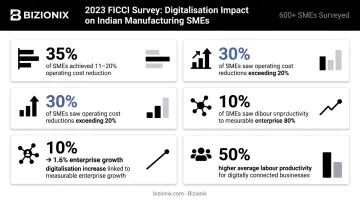
A 2023 FICCI survey of 600+ manufacturing SMEs put numbers to this:
- 35% of respondents reported 11%–20% annual operating cost reduction from digitalisation
- 30% reported reductions exceeding 20%
- A 10% increase in digitalisation levels linked to a 1.6% increase in enterprise growth
- Nearly 50% higher average labour productivity when businesses moved from fully offline to basic digital connectivity
For Indian MSMEs specifically, the operational drag is well documented: scattered Excel files, no version control, manual error risk, and zero real-time insights. When those processes are replaced with automated workflows, the efficiency gains compound quickly.
Real-Time Visibility and Better Decision-Making
When sales, inventory, finance, and HR data flow into one system, business owners stop managing by memory and start managing by data. Real-time dashboards replace month-end surprises with decisions grounded in current data.
Bizionix, for example, is built around this principle — live dashboards and instant reporting mean leadership knows what's happening now, not three weeks after the fact. That's particularly valuable for multi-location operations where no single manager has eyes on everything simultaneously.
Faster Billing Cycles and Cash Flow Improvement
Delayed payments are a structurally serious problem for Indian MSMEs. Research by GAME and Dun & Bradstreet estimated ₹10.7 lakh crore is locked annually as delayed payments to MSME suppliers — with 80% of that burden falling on micro and small enterprises. Median debtor days beyond the statutory 45-day period reached 195 days for micro enterprises.
Digital invoicing tools directly address this. Automated invoice generation with pre-validation checks eliminates the rejection errors that delay payment cycles. Bizionix's direct API integration with the GST e-Invoice system generates IRN and QR codes in seconds — removing the manual upload steps that cause delays and rejections.
Scalability Without Proportional Cost Increases
Cloud-based platforms scale with the business. Adding a new user, branch, or product line doesn't require infrastructure upgrades or expensive IT projects. Bizionix's multi-company management feature, for instance, allows a holding company or franchise network to add new entities under the same login without fragmenting data or duplicating systems.
For businesses planning to grow, the architecture decision made early determines how painful that growth becomes. Starting on a scalable platform eliminates the data migration, retraining, and downtime costs that come with switching mid-stride.
Competitive Relevance and Customer Experience
Customers and B2B partners increasingly expect faster responses, accurate documentation, and error-free invoices. Businesses running on manual processes can't match the turnaround speed of digitally enabled competitors — and the gap widens with every quarter they delay.
Types of Digital Solutions Every Growing Business Needs
ERP and Business Management Platforms
ERP (Enterprise Resource Planning) systems integrate core business functions — inventory, procurement, finance, billing, HR — under one platform. Instead of five separate tools that don't communicate, an ERP gives every department a shared view of the same data.
That value hasn't translated to widespread adoption yet — ERP penetration among Indian MSMEs sits at just 12%, according to the RIS survey. The barrier isn't need; it's perception: many MSMEs assume ERP means expensive, complex, and built for large enterprises.
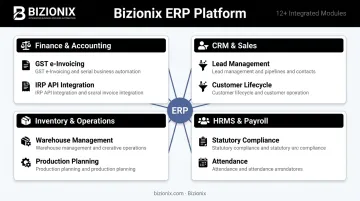
Cloud-based ERPs have changed that equation. Bizionix is built specifically for Indian MSMEs and covers 12+ core modules on a single platform:
- Finance & Accounting and GST-ready e-invoicing with direct IRP API integration
- CRM, Sales, and complete customer lifecycle management
- Inventory, Warehouse Management, and Production Planning
- HRMS & Payroll with statutory compliance
Enterprise-grade capability, without the implementation complexity of legacy systems.
CRM and Sales Management Tools
CRM tools track leads, manage customer interactions, monitor the sales pipeline, and automate follow-ups. For businesses with large customer bases or field sales teams, CRM provides visibility into the sales cycle that manual tracking can't deliver.
Without CRM, follow-ups fall through the cracks, pipeline data lives in a salesperson's head, and there's no real accountability for revenue outcomes. Bizionix's CRM module covers lead management, quotations, sales orders, follow-ups, and complete customer lifecycle tracking — all connected to sales invoicing and accounts.
Financial Management and Compliance Software
For Indian businesses, GST compliance is non-negotiable. Since 1 August 2023, the e-invoicing threshold dropped to ₹5 crore annual aggregate turnover (GST Council Notification No. 10/2023).
Businesses above that threshold must report invoices to the IRP and obtain an IRN. From April 2025, invoices older than 30 days can no longer be reported for businesses with AATO of ₹10 crore and above.
Standalone accounting tools handle invoicing and bank reconciliation, but when finance sits separately from operations, double data entry and reconciliation errors are inevitable. An integrated financial module within an ERP eliminates that gap. Bizionix's finance module auto-populates GSTR-1 from sales data and updates payables and receivables in real time — no manual bridging between systems.
Communication, Collaboration, and HR Tools
As businesses grow, managing payroll, attendance, leave, and performance manually becomes unsustainable. HR tools bring structure to these processes and reduce the administrative burden on leadership.
HR tools running in isolation from finance create the same silo problem as disconnected accounting. When payroll sits in a separate system from the general ledger, salary postings require manual reconciliation every cycle. Bizionix's HRMS — covering attendance, leave management, salary processing, and statutory compliance — is integrated into the same platform as finance, so payroll data feeds directly into the books.
How to Implement Digital Solutions: A Practical Guide for MSMEs
Step 1 — Audit and Map Current Processes
Before selecting any tool, document how work flows across departments. Where do manual handoffs create delays? Where does information get lost between teams? Which processes rely on WhatsApp or verbal confirmation?
This audit is the foundation for every implementation decision. Businesses that skip it tend to digitise their current processes — including the broken ones.
Step 2 — Prioritise by Pain Point and Business Impact
Not every inefficiency needs solving at once. Rank pain points by their financial or operational impact:
- Highest revenue leakage
- Slowest cycle times
- Highest error rates
- Biggest compliance risk
Start there. Early wins build confidence and justify further investment.
Step 3 — Choose the Right Platform for Your Scale
Evaluate point tools vs. integrated platforms based on how many functions you need to connect. For businesses managing billing, inventory, HR, and compliance simultaneously, a unified platform avoids integration overhead and data fragmentation.
Key criteria for Indian MSMEs:
- GST-readiness — automated e-invoicing, GSTR-1 auto-population, IRP integration
- Cloud accessibility — 24/7 access without infrastructure investment
- Multi-entity support — if you manage multiple branches or legal entities
- Vendor support quality — implementation help, not just software
Bizionix addresses this directly: a single platform covering billing, inventory, HR, GST compliance, and more, built specifically for Indian MSMEs without SAP-level complexity or cost.
Step 4 — Plan for Change Management and Team Adoption
Technology doesn't drive results on its own — adoption does. This is where most implementations fall short.
Gartner predicts that by 2027, more than 70% of ERP initiatives will fail to fully meet their original business case goals. Prosci attributes roughly 1 in 5 of those shortfalls to adoption failures, not software failures. Closer to home, FICCI found that 40% of surveyed Indian SMEs cited lack of skilled resources as a key barrier to technology integration.
Phased rollout vs. big-bang deployment:
- Roll out one or two modules at a time: lower disruption, easier course correction (phased approach)
- Deploy everything simultaneously: faster overall, but higher risk when adoption lags (big-bang approach)
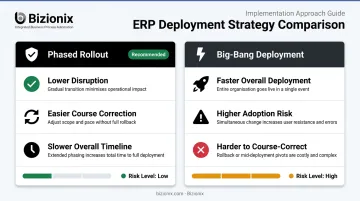
For most MSMEs, phased rollout is the better starting point. Begin with billing and accounts, where ROI is immediate, then expand to inventory and HR.
Adoption tips:
- Communicate the "why" before the "how"
- Assign module champions within each department
- Set a clear go-live date with structured training beforehand
Step 5 — Measure Outcomes and Iterate
Define KPIs before go-live, then review them at 30, 60, and 90 days:
| KPI | What It Measures |
|---|---|
| Invoice processing time | Speed of billing cycle |
| Order cycle time | Fulfilment efficiency |
| Error rates | Data accuracy improvement |
| Collection days (DSO) | Receivables velocity |
| Reconciliation hours | Finance team efficiency |
Use these reviews to identify what's working, what needs adjustment, and where to focus the next phase of digitisation.
Common Mistakes Businesses Make When Going Digital
Most digital transitions don't fail because of bad technology. They fail because of avoidable mistakes in how the transition is approached.
- Digitising a broken process instead of fixing it first. Automating a flawed workflow makes errors happen faster, not slower. Redesign the process, then apply technology to the improved version.
- Choosing too many point tools instead of one integrated platform. When finance, inventory, and HR each run on separate software, data reconciliation becomes a full-time job and real-time visibility disappears. Platforms like Bizionix replace 5–6 disconnected tools with a single system — reducing both cost and complexity.
- Underestimating training and change management. Even well-designed software fails without employee adoption. Rushed rollouts lead to workarounds, shadow systems, and staff reverting to Excel "just this once" — until the tool gets quietly abandoned.
Frequently Asked Questions
What are digital business solutions?
Digital business solutions are software tools and platforms that help organisations automate operations, manage data, connect departments, and serve customers more efficiently. They replace manual, paper-based, or fragmented processes with connected digital workflows that reduce errors and improve visibility.
What are the most important types of digital solutions for small and mid-sized businesses?
The key categories are ERP/business management platforms, CRM and sales tools, financial and accounting software, and HR/collaboration tools. For most Indian MSMEs, starting with an integrated platform covering multiple functions delivers the fastest ROI and avoids the ongoing cost of reconciling disconnected systems.
How long does it typically take to implement digital solutions?
Simple point tools can be operational in days. Integrated ERP platforms typically take 4–12 weeks depending on business complexity, data migration requirements, and team readiness. Phased rollouts reduce risk significantly compared to deploying everything simultaneously.
How do I calculate the ROI of digital solutions?
Compare measurable gains — reduced processing time, faster collections, lower error rates, and eliminated tool subscriptions — against total costs: licence fees, implementation, and training. Most businesses recover that investment within the first year through efficiency gains alone.
What are the biggest challenges when adopting new digital tools?
The most common challenges are employee resistance, inadequate training, poor system integration, and choosing tools that don't match actual workflows. A planned, phased rollout addresses all of these before they become costly problems.
Can a business start with one digital solution and expand later?
Yes, a phased approach is often the most practical path. The important caveat: choose a scalable, modular platform from the start. Expanding within one unified system is far easier and cheaper than migrating data across multiple disconnected tools later.