Introduction
Most growing Indian businesses run on a patchwork of tools: Tally for accounts, Excel sheets for inventory, a separate CRM for customer data, and manual processes for GST compliance. When you need a clear picture of cash flow, receivables, and stock levels simultaneously, you're chasing four different systems and hoping the numbers align.
This fragmentation isn't just inconvenient. It creates invoice errors, delayed filings, unbilled work, and decisions made on outdated information.
A business management system (BMS) solves this by consolidating all these functions into one coordinated platform. This guide is written for Indian MSMEs, operations managers, and growing businesses evaluating whether a unified system is right for them. You'll learn what a BMS actually is, the different types available, the concrete benefits, and how to implement one without disrupting your operations.
Key Takeaways
- A business management system centralises finance, inventory, CRM, HR, and compliance in one platform, eliminating data silos
- Fragmented tools create double entry, delayed reporting, and blind spots that quietly drain time and money
- Indian MSMEs specifically need GST compliance, e-invoicing, and multi-entity management built into any system they adopt
- Implementation succeeds or fails based on change management, not just software selection
- Bizionix is a cloud-based, GST-ready BMS built for Indian MSMEs, with plans starting at ₹999/year
What Is a Business Management System?
A business management system (BMS) is a structured set of tools, processes, and technologies that centralises operations across finance, inventory, sales, compliance, and HR — all within one coordinated platform.
The core purpose is to eliminate data silos, reduce manual processes, and give leadership real-time visibility across all business functions. Instead of waiting for end-of-month reports from different departments, decisions are based on current, accurate information.
BMS vs. ERP: Are They the Same?
The terms are used interchangeably, and for practical purposes, they describe the same concept. According to Oracle, an ERP (Enterprise Resource Planning) system integrates core business processes into a single platform — which is exactly what a BMS does. The distinction matters when evaluating vendors: a true BMS is an end-to-end system, not a collection of disconnected point solutions.
A separate accounting tool + a separate CRM + a spreadsheet for inventory is not a BMS. That's the fragmented model most MSMEs are trying to move away from.
What Problems Does a BMS Actually Solve?
In concrete operational terms, a BMS addresses:
- Double data entry: recording the same sale in the CRM, then again in accounting
- Delayed reporting: waiting until month-end for numbers that should be available daily
- Invoice errors: mismatches between sales orders and invoices caused by manual re-entry
- Payment follow-up gaps: no automated reminders, leaving receivables unpaid for weeks
- Accountability blind spots: no clear record of who approved what, or when
- Multi-branch fragmentation: no consolidated view of stock or revenue across locations
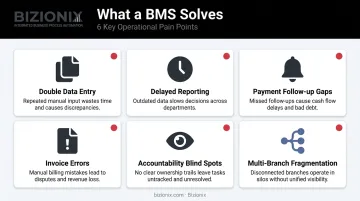
Each of these problems compounds the others. A missed payment reminder becomes a cash flow gap; a data entry error becomes a disputed invoice. A BMS closes these loops by connecting the underlying processes — so issues surface before they escalate.
Types of Business Management Systems
Not every system serves the same purpose. Understanding the landscape helps you identify what you currently have versus what you actually need.
Accounting and Financial Management Systems
These handle invoicing, expense tracking, accounts payable and receivable, tax compliance, and financial reporting. For Indian businesses, GST compliance and e-invoicing are non-negotiable requirements — a basic accounting tool may cover bookkeeping but fall short on regulatory obligations like IRN generation or GSTR auto-population. Evaluate your current tool against these specific requirements before assuming it's sufficient.
Customer Relationship Management (CRM) Systems
CRM systems manage customer interactions, track leads, support sales pipelines, and centralise customer data. The value multiplies when CRM data is connected to invoicing — so a won deal automatically flows into a sales order, not into a separate manual process.
Inventory and Supply Chain Management Systems
These track stock levels, manage purchase orders, monitor warehouse operations, and coordinate supply chain movement. For manufacturing, distribution, and retail businesses, poor inventory visibility leads directly to stock-outs or overstocking — both of which erode margins. Real-time, multi-location stock tracking is the baseline requirement here.
Human Resource and Payroll Management Systems
HR systems cover employee records, attendance, leave management, and payroll processing. For growing businesses transitioning beyond informal HR tracking, structured workforce management reduces compliance risk (PF, ESI) and eliminates the manual payroll calculation cycles that consume HR teams every month.
Integrated Business Management Systems (Unified BMS / ERP)
This is the most effective type for growing businesses. An integrated BMS combines accounting, CRM, inventory, HR, and compliance into a single unified platform with shared data. Every department operates from the same information — eliminating duplication, delays, and the version conflicts that plague businesses using multiple disconnected tools.
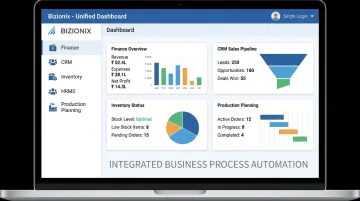
Bizionix is built on this integrated model, combining all core functions into one cloud-based platform designed specifically for Indian MSMEs:
- Finance & Accounting with GST compliance and automated e-invoicing
- Sales & CRM connected directly to invoicing and order workflows
- Inventory Control and Warehouse Management with real-time stock visibility
- HRMS & Payroll covering attendance, leave, PF, and ESI compliance
- Production Planning for manufacturing operations
Key Benefits of Implementing a Business Management System
Reduced Operational Costs
A unified BMS replaces multiple software subscriptions, cuts manual data entry hours, and prevents financial leakage from untracked expenses or unbilled work. Bizionix, for example, replaces 5–6 separate tools with one platform starting at ₹999 per year — a fraction of the cost of maintaining separate CRM, accounting, inventory, and HR tools with their own licensing and integration overhead.
Real-Time Decision-Making
When cash flow, pending orders, and inventory levels are visible simultaneously from one dashboard, decisions happen faster and with more confidence. The alternative is waiting for end-of-month consolidations from different teams using different systems, which means leadership is always working with outdated information.
Accountability and Audit Trails
A BMS creates a clear record of who updated what, when, and how it connects to other processes. For multi-branch or multi-entity operations, this is particularly valuable. Bizionix's role-based access controls and full activity logs per entity mean accountability is enforced structurally, not just through policy.
Automation of Repetitive Processes
A BMS handles the repetitive work that consumes staff time without adding analytical value. Core automations typically include:
- Invoicing and payment reminders
- Inventory reorder alerts
- GST compliance reporting and e-invoice generation
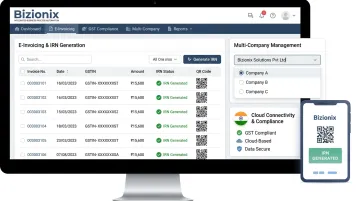
Bizionix's direct API integration with the GST e-Invoice system generates IRNs and QR codes instantly when an invoice is created. There's no manual JSON upload, no switching to the government portal. GSTR-1 is auto-populated from the same data, and the entire process takes seconds.
Scalability Without System Replacement
A well-implemented BMS grows with the business. Adding a new branch, a new GST entity, or a new user doesn't require a separate implementation — the system expands to accommodate it. Bizionix's multi-company management lets organisations add new entities through the same secure login, with independent books of accounts and centralised group-level visibility maintained automatically.
Together, these benefits compound over time: lower costs, faster decisions, and a system that doesn't need to be replaced every time the business grows.
Core Features to Look for in a Business Management System
Non-Negotiable Baseline Features
Any BMS worth evaluating should include:
- Unified data architecture — one source of truth across all departments, not separate databases that sync imperfectly
- Role-based access controls — granular permissions by user, department, location, and entity
- Real-time reporting and dashboards — live data, not scheduled batch reports
- Cloud-based accessibility — available from any device, any location, without VPN dependencies
India-Specific Requirements
For Indian businesses, these are not optional add-ons. They're core requirements:
- GST compliance — GSTR-1 auto-population, GST-ready invoice formats
- E-invoicing with IRN generation — mandatory for businesses with annual turnover exceeding ₹5 crore, per GSTN guidelines
- Multi-company management — separate GST registrations, ledgers, and compliance per entity
- Direct IRP integration — reduces manual steps and eliminates the risk of portal submission errors
Businesses that overlook these end up layering compliance tools on top of an otherwise functional BMS — recreating the fragmentation they were trying to eliminate.
Integration and Scalability
Compliance features matter, but a BMS also needs to grow with your business. The system should support:
- API integrations with third-party tools your teams already use
- Growing transaction volumes without slowing down
- New module activation without disrupting existing workflows
Ask vendors directly how they've handled clients who doubled their transaction volume or added three new locations within a year. The answer tells you more than any feature checklist.
How to Implement a Business Management System in Your Organisation
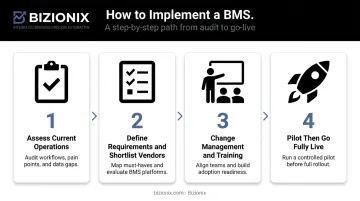
Step 1 — Assess Current Operations
Map your existing workflows. Document every function that's currently handled manually or across disconnected tools — invoicing, inventory updates, payroll, GST filings, customer follow-ups. The output of this step is a clear picture of your gaps and where fragmentation is costing you the most time or money.
Don't skip this. Businesses that jump straight to vendor selection often buy a system that solves the wrong problems.
Step 2 — Define Requirements and Shortlist Vendors
Translate your assessment into a functional requirements list. For Indian MSMEs, this typically includes GST compliance, multi-branch inventory, e-invoicing, and payroll. Shortlist vendors who specialise in your industry size and geography — a system built for a 5,000-person enterprise will be too complex and too expensive for an MSME context.
When evaluating demos, test against your actual business scenarios — not curated feature lists. Ask vendors to demonstrate:
- GST filing and e-invoicing workflows
- Multi-entity or multi-branch switching
- Inventory reconciliation in a live environment
Step 3 — Plan for Change Management and Training
Research consistently shows that ERP implementations fail primarily due to poor adoption — not software problems. Get team buy-in before go-live. Designate internal champions in each department who understand why the change is happening and can support their colleagues. Schedule structured training before the system goes live — not after problems emerge.
Step 4 — Run a Pilot, Then Go Fully Live
Run the new system in parallel with your existing processes for a defined period — typically 4–8 weeks for an MSME. During this phase, track data accuracy, user adoption rates, and any workflow gaps that surface. Resolve these before full cutover — not after. When the team is comfortable and the numbers are clean, complete the transition.
Why Indian MSMEs Need a Unified Business Management System
Indian MSMEs operate under a specific combination of pressures: GST compliance obligations, multi-location coordination, cash flow constraints, and rapid growth — often managed by lean teams who don't have time for manual reconciliation across disconnected tools.
According to India SME Forum research, while digital tool adoption among MSMEs is growing, effective integration remains a significant gap. Many businesses have adopted individual tools — accounting software here, a CRM there — but operate them in silos that recreate the manual coordination work they were supposed to eliminate.
The cost of this fragmentation is concrete:
- Delayed GST filings and reconciliation errors due to mismatched data across systems
- Invoice disputes caused by manual re-entry between CRM and accounting
- Inability to track receivables across branches without consolidating reports manually
- Duplicate data entry consuming hours of staff time weekly, adding up to real operational cost
For an MSME managing multiple GST entities, multiple locations, and compliance deadlines simultaneously, a unified BMS is a practical operational necessity — not a large-enterprise privilege.
Bizionix is built specifically for this context. It's a 100% cloud-based, GST-ready platform that unifies accounting, inventory, CRM, HR, production planning, and compliance in a single system for Indian MSMEs. Key capabilities include:
- Direct API integration with the GST e-Invoice system for instant IRN generation without portal uploads
- Multi-company management with independent books per entity under a single login
- No IT consultants or expensive infrastructure required — the NEO plan starts at ₹999 per year
Frequently Asked Questions
What are company management systems?
Company management systems are structured frameworks — software platforms or process methodologies — that organisations use to coordinate their operations, resources, and activities toward defined business goals. In practice, they range from integrated ERP platforms to standalone tools covering specific functions like HR or accounting.
What is BPM in simple words?
BPM (Business Process Management) is the practice of identifying, analysing, and improving the workflows a business relies on to operate. It's often supported by software that maps, automates, and monitors these processes. Unlike ERP, which centralises business data, BPM focuses on how work actually flows through the organisation.
What are the five types of MIS?
Management Information Systems are generally categorised into five types: Transaction Processing Systems (TPS), Decision Support Systems (DSS), Executive Information Systems (EIS), Knowledge Management Systems (KMS), and Office Automation Systems (OAS).
What are the 4 components of MIS?
The four core components of a Management Information System are: People (users who interact with the system), Processes (the workflows it supports), Data (the information it captures and stores), and Technology (the hardware and software that powers it).
What is the difference between ERP and a business management system?
ERP is a type of business management system — specifically one that integrates all core business functions into a single platform. BMS is the broader category; ERP is the integrated software implementation of that concept. The terms are used interchangeably in most practical business contexts.
How do I choose the right business management system for my business?
Start by mapping your operational gaps — duplicated data, manual handoffs, and limited visibility are the clearest signals. From there, evaluate systems on feature coverage, GST and e-invoicing compliance, scalability, and total cost of ownership. Brand recognition and feature volume rarely predict whether a system will actually fit your business.