This fragmentation is expensive. According to Gartner's data quality research, poor data quality costs organisations at least $12.9 million per year on average — a figure that reflects exactly what happens when disconnected systems force teams to reconcile, re-enter, and second-guess their own data.
An Integrated Business Management System (IBMS) solves this at the root. Instead of stitching together multiple tools, it connects every department — finance, inventory, HR, sales, procurement — through a single shared platform where data flows automatically and everyone works from the same source of truth.
This article covers what an IBMS actually is, its core modules, the key benefits, warning signs your business needs one, and a practical implementation roadmap.
Key Takeaways
- An IBMS is a unified software platform connecting all core business functions — finance, operations, HR, sales, inventory — through one shared database
- It replaces disconnected tools and eliminates manual re-entry, version conflicts, and reporting inconsistencies
- Delivers a single source of truth across departments — enabling faster decisions, lower operational costs, built-in compliance, and room to scale
- Clear warning signs include data mismatches across departments, WhatsApp-based approvals, and inability to answer basic questions like "What is our exact receivable today?"
- Implementation works best in phases — from auditing your current state and defining goals, through platform selection, phased rollout, and ongoing improvement
What Is an Integrated Business Management System?
An IBMS is a software platform that unifies all core business functions — finance, procurement, operations, HR, sales, and inventory — under a single shared database. Every department reads from and writes to the same data, which eliminates the version conflicts and duplication that come with separate systems.
Gartner defines ERP as "an integrated suite of business applications" that share a common process and data model covering broad operational end-to-end processes. An IBMS operates on exactly this principle, extended to include compliance, governance, and collaboration layers relevant to growing businesses.
How It Differs From Siloed Tools
When departments operate on separate systems, predictable problems emerge:
- Finance sees a different inventory count than operations
- Sales closes an order that procurement hasn't been notified about
- Leadership receives conflicting numbers at every review meeting
- Month-end close requires days of manual reconciliation
An IBMS eliminates these coordination failures. When a confirmed sales order is entered, it automatically updates inventory levels, triggers invoice generation, feeds into financial reports, and notifies procurement — without anyone re-entering the same data across multiple systems.
IBMS vs. ERP: What's the Difference?
The terms overlap significantly, but there are meaningful distinctions:
| ERP | IBMS | |
|---|---|---|
| Core focus | Finance, inventory, HR modules | All ERP functions plus compliance, governance, and collaboration |
| Compliance layer | Limited or add-on | Built-in (including GST for Indian businesses) |
| Typical complexity | High (legacy systems like SAP) | Configurable, scalable for MSMEs |
| Cost model | Enterprise licensing | Cloud-based, affordable tiers |
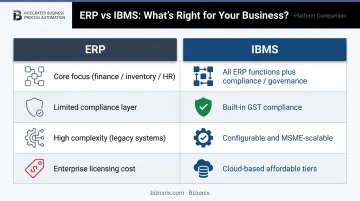
For Indian MSMEs, the practical difference comes down to implementation reality: a modern cloud-based IBMS delivers ERP-grade integration without the complexity or cost of legacy enterprise systems.
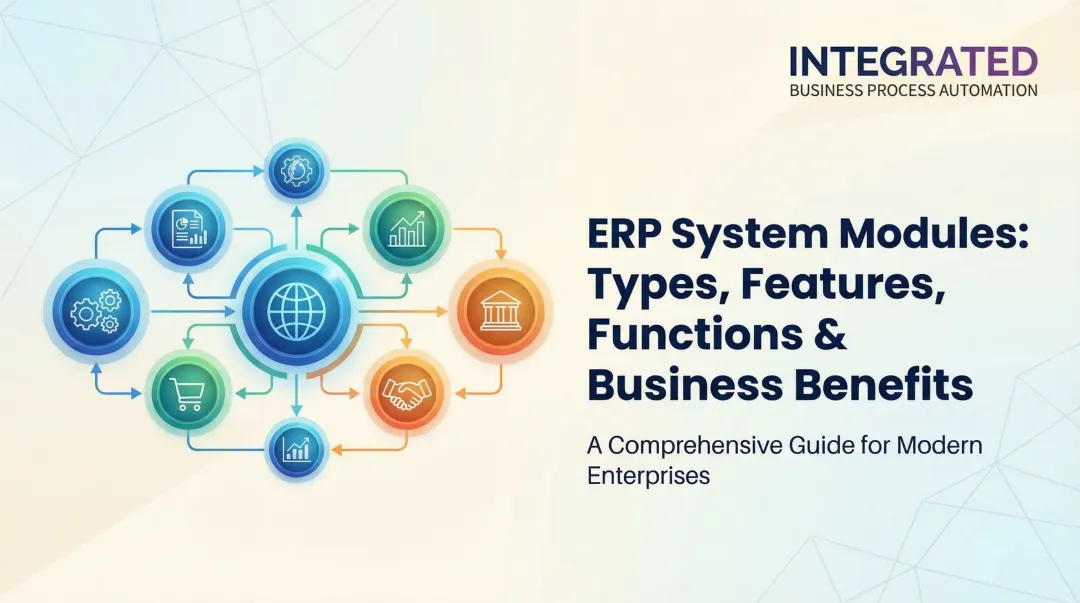
Core Modules of an Integrated Business Management System
Most IBMS platforms organise functionality into interconnected modules. The right combination depends on your business type, but the module structure below reflects what growing Indian MSMEs typically need.
The Operational Core
These three areas form the foundation most businesses deploy first:
- Finance & Accounting — GST-ready invoicing, accounts payable and receivable, ledger management, bank reconciliation, TDS tracking, and financial reporting
- Inventory & Procurement — Real-time stock tracking, purchase orders, goods receipt notes (GRN), vendor management, and consumption analytics
- Sales & CRM — Lead pipeline management, customer records, quotations, sales orders, and the complete customer lifecycle
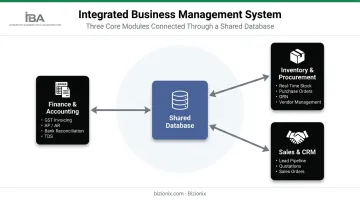
Platforms like Bizionix integrate all three into one architecture, so a confirmed sales order updates stock levels and auto-populates GSTR-1 without manual intervention between systems.
Operational Support Modules
Once headcount grows and operations spread across locations, manual coordination breaks down. These modules address that directly:
- HR & Payroll — Employee records, attendance tracking, leave management, salary processing, and statutory compliance
- Warehouse Management — Multi-location stock tracking and distribution workflows
- Document Workflows — Digital approval chains that replace email and WhatsApp-based approvals
- Reporting & Dashboards — Real-time KPIs and cross-departmental visibility for leadership
India-Specific Requirements
For Indian MSMEs, three capabilities separate an adequate platform from a genuinely useful one:
- GST compliance built into the core — automated invoicing, GSTR-1 auto-population, and return-filing support without needing a separate tool
- Direct IRN generation via API — under CBIC Notification No. 10/2023, businesses with aggregate turnover above ₹5 crore must generate e-invoices with valid IRNs. An IBMS with direct GST-NIC portal integration handles this instantly, eliminating manual uploads
- Multi-company management — business groups, holding structures, and CA firms managing client portfolios need a single login that spans multiple GST-registered entities without switching between separate systems
Key Benefits of an Integrated Business Management System
Single Source of Truth
When all departments share one database, data discrepancies stop being a weekly argument. Finance sees the same inventory count as operations. Leadership gets one consistent picture, not five different versions depending on who compiled the report.
IDC's 2024 Small Business ERP MarketScape found that nearly 40% of small businesses were actively migrating critical data from spreadsheets and document repositories into centralised ERP — confirming that fragmented data has become too costly to maintain.
Faster Decision-Making
Real-time dashboards replace the weekly or monthly reporting cycle. Instead of waiting for a team to compile data across spreadsheets, managers see sales performance, cash flow, and inventory levels right now. This matters when a key customer is consistently paying late, when a product line is overstocked, or when a branch is underperforming.
Reduced Operational Costs
Faster decisions also reveal where money is quietly leaking. Cost savings typically come from two directions:
- Consolidates accounting, HR, CRM, and inventory into one subscription instead of several
- Eliminates re-keying data between systems, fixing manual entry errors, and chasing approvals through informal channels — labour costs that rarely appear on any P&L
Improved Compliance and Audit Readiness
For Indian businesses, compliance isn't discretionary. GST filings, e-invoicing mandates, TDS tracking, and audit trail maintenance must be accurate and timely. An IBMS with built-in compliance controls — like Bizionix's direct API integration with the IRP for instant IRN generation and pre-validation before submission — means invoices meet GST requirements automatically and audit trails are always current without last-minute preparation.
Scalability Without Chaos
Businesses running siloed tools hit a wall when they try to grow. Adding a new branch, product line, or 20 employees requires rebuilding processes from scratch across every disconnected system.
An IBMS scales within the same architecture, so growth doesn't mean starting over. Specifically:
- New branches, users, and modules are added without rebuilding existing processes
- Approval workflows and compliance configurations carry forward automatically
- Bizionix's multi-company management lets holding groups run multiple subsidiaries from a single login — each with independent books — without splitting into separate systems
Organisational Transparency and Accountability
When every action is logged — who approved a purchase order, when a delivery was dispatched, which invoice has been overdue for 45 days — accountability improves without anyone having to enforce it manually. Managers don't need to chase updates because the system tracks activity automatically.
That same transparency cuts financial leakage. Untracked expenses, unapproved purchases, and unrecorded transactions are far harder to slip through when every transaction flows through a centralised system with role-based access and a full audit trail.

Signs Your Business Needs an Integrated Business Management System
Your Data Never Quite Matches
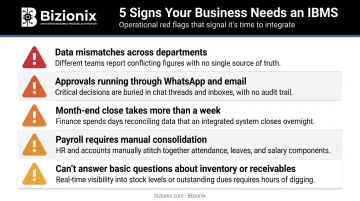
Finance uses one system, operations uses another, and leadership gets conflicting numbers at every review meeting. If your teams spend significant time reconciling data rather than acting on it, fragmentation is already costing you more than fixing it would.
Manual Approvals Are Slowing You Down
Growing businesses often manage approvals through emails, calls, and WhatsApp messages. When a purchase order needs three levels of approval and each requires a separate phone call, the process is already broken.
Key warning signals:
- Invoice disputes are common
- Delivery timelines are missed frequently
- Month-end close takes more than a week
- Attendance or payroll processing requires manual consolidation from multiple sources
Your Growth Is Outpacing Your Systems
These approval bottlenecks and data gaps tend to compound as the business grows. The clearest sign of a deeper problem is when adding a new location or 10 new employees creates operational chaos instead of structured scale.
If leadership can't confidently answer basic questions — "How much inventory do we have across all branches?" or "What is our exact outstanding receivable today?" — the systems haven't kept up with the business.
Bizionix is built for exactly this stage: giving Indian MSMEs the structure to scale without the cost or complexity of enterprise systems designed for organizations ten times their size.
How to Implement an Integrated Business Management System
Step 1: Audit Your Current State
Start with an honest assessment of every system currently in use. Document where data breaks down across three areas:
- Manual handoffs — where information moves by email, phone, or spreadsheet
- Duplicate entry — the same data typed into two or more systems
- Reconciliation errors — month-end mismatches that consume finance team hours
This audit becomes the basis for prioritising modules and setting realistic timelines.
Step 2: Define Clear Objectives and Success Metrics
Vague goals fail. Implementation goals should be specific:
- Reduce invoice processing time from three days to same-day
- Achieve real-time inventory visibility across all branches
- File GST returns without manual data compilation
- Close monthly accounts within three working days
These metrics become the benchmark for evaluating the system after go-live.
Step 3: Choose the Right Platform
With your objectives defined, evaluate platforms against what your business actually needs — not what a vendor's sales deck promises. Key selection criteria for Indian MSMEs:
| Criteria | What to Check |
|---|---|
| Module coverage | Finance, inventory, HR, CRM, compliance — all in one? |
| GST compliance | Automated e-invoicing, IRN generation, GSTR auto-population? |
| Cloud access | Real-time visibility for remote teams and multiple locations? |
| Industry fit | Manufacturing BOMs, hotel property management, distribution workflows? |
| Scalability | Can new users, entities, and modules be added without rebuilding? |
| Cost | Practical pricing without SAP-level complexity? |
Avoid over-buying. A large enterprise ERP is not the right choice for a 50-person manufacturing company that needs practical, usable tools.
Step 4: Plan a Phased Rollout
Going live on all modules simultaneously is one of the most common causes of IBMS failure. A phased rollout reduces the risk of overwhelmed teams and abandoned adoption:
- Phase 1 — Finance and inventory (the operational core)
- Phase 2 — HR, payroll, and procurement
- Phase 3 — CRM, document workflows, and advanced reporting
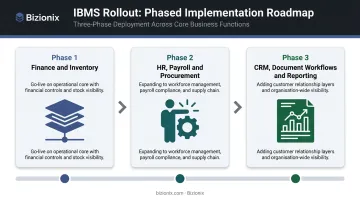
Pair each phase with employee training, clear communication about why the system is changing, and designated internal champions who support adoption.
Step 5: Monitor and Continuously Improve
The work doesn't stop at go-live. How the system is used in the first 90 days determines whether it delivers the outcomes defined in Step 2:
- Track adoption rates by module and department
- Measure against the success metrics defined in Step 2
- Identify processes still being done manually outside the system
- Hold quarterly review sessions to refine configuration as the business evolves
Most businesses find that 20–30% of their configured workflows need adjustment once real usage patterns emerge — building in regular review cycles is what separates teams that get full value from those that revert to old habits.
Frequently Asked Questions
What is an integrated business management system?
An IBMS is a unified software platform that connects all core business functions — finance, operations, HR, sales, and inventory — through a shared database. Every department works from the same real-time data, eliminating silos and the reconciliation work that comes with disconnected systems.
What is the purpose of an integrated management system?
The purpose is to align all business processes under a single framework so departments operate in sync, decisions are based on accurate shared data, and the business can maintain operational control as it scales. It replaces manual coordination with structured, automated workflows.
What is the difference between an IBMS and an ERP system?
ERP focuses on core operational modules — finance, inventory, HR. IBMS is a broader term that can also include compliance, governance, and collaboration layers. In practice, modern cloud ERP platforms designed for MSMEs typically deliver full IBMS functionality within a single platform.
How long does it take to implement an integrated business management system?
Timelines vary based on scope, data migration complexity, and organisational readiness. Smaller businesses can go live in as little as one to four weeks for simpler deployments, while a phased MSME rollout typically spans a few weeks to a few months.
Is an IBMS suitable for small and mid-sized businesses in India?
Modern cloud-based IBMS platforms are built for MSMEs — delivering enterprise-grade capabilities without the cost or complexity of legacy systems. Indian MSMEs get added value from built-in GST compliance, direct IRN generation via API, and multi-company management built for local regulatory requirements.
What are the most common challenges when implementing an IBMS?
The most common issues are employee resistance to changing familiar processes, attempting to go live on all modules at once, insufficient training, and failing to define clear success metrics before starting. A phased rollout paired with strong internal change management drives measurably better adoption.