A corporate management system (CMS) gives businesses a structured framework to coordinate operations, enforce accountability, and make decisions on accurate, current data. This guide covers the definition, key types, core components, warning signs your business needs one, and best practices for implementation.
Key Takeaways
- A CMS is an integrated framework of tools, processes, and policies that helps businesses manage operations consistently across departments
- ERP, CRM, HRMS, QMS, and SCM each solve a distinct operational bottleneck — connecting them under one platform multiplies the impact
- Effective CMS implementations share five foundations: standardised processes, centralised data, KPI tracking, compliance controls, and structured workflows
- Businesses that implement CMS correctly gain faster decisions, tighter compliance, and clearer cash flow visibility — with fewer manual bottlenecks
- Before evaluating software, map your existing processes — then select a scalable, GST-compliant platform that fits how you actually operate
What Is a Corporate Management System?
A corporate management system is an integrated set of processes, policies, and software tools designed to manage, monitor, and optimise an organisation's core business functions — from finance and HR to inventory and compliance. ISO defines a management system as how an organisation manages the interrelated parts of its business to achieve its objectives.
CMS vs. Standalone Software
Many businesses confuse a CMS with individual business software. The distinction matters:
- Standalone software handles one function — an invoicing tool, a payroll app, a stock tracker
- A corporate management system connects all these functions under a shared data model and governance framework
- Modern CMS platforms combine both — software that enforces process discipline across the whole organisation
CMS vs. a Business Operating System
These terms overlap but aren't identical. A CMS defines the strategic structure: accountability, compliance, reporting hierarchies, and performance benchmarks. A business operating system governs how day-to-day tasks get executed within that structure.
In practice, a well-implemented CMS becomes your operating system — the two converge once adoption is complete.
For Indian MSMEs specifically, getting that structure right has measurable consequences.
Why It Matters for Indian MSMEs
India has over 57 million registered MSMEs (Ministry of MSME, 2024-25), yet system adoption remains low. A 2026 RIS survey of 2,882 Indian MSMEs found that while 95% used at least one digital product, only 12% had adopted ERP and 11% had deployed SCM systems.
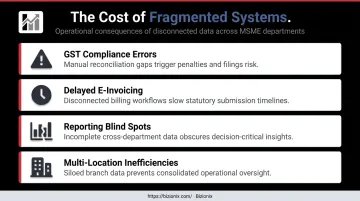
Most MSMEs have internet access, UPI, and basic apps — but departments still run on separate data sources. That fragmentation has real costs:
- GST compliance errors from mismatched records across tools
- Delayed e-invoicing due to manual reconciliation between systems
- Reporting blind spots when finance, inventory, and HR don't share data
- Compounding inefficiencies as businesses expand to multiple locations
Types of Corporate Management Systems
Not all corporate management systems do the same job. Understanding the major types helps growing businesses choose tools that work together rather than creating new silos.
Enterprise Resource Planning (ERP)
ERP is the broadest type of CMS. Gartner defines ERP as an integrated suite of applications sharing a common process and data model across end-to-end operational processes — covering finance, procurement, inventory, HR, and operations in one unified database.
The global ERP market grew 11.3% to $66 billion in 2024, reflecting how central this category has become to business operations. For Indian MSMEs, ERP eliminates the version-control chaos of department-level spreadsheets and gives leadership a single, real-time operational view.
Platforms like Bizionix are built specifically for this gap — delivering ERP-grade integration across finance, inventory, sales, HRMS, and GST compliance without the complexity or cost of SAP-level enterprise systems.
Customer Relationship Management (CRM)
CRM manages the full customer lifecycle — lead capture, sales pipeline, quotation history, post-sale service, and communication records. It's particularly essential for service businesses, distribution companies, and franchise networks where customer relationships drive repeat revenue.
Forrester found that 57% of surveyed organisations expected CRM spending to increase in the following 12 months. That appetite reflects a practical reality: businesses that lose track of customer interactions lose repeat business with them.
Human Resource Management System (HRMS)
HRMS covers employee records, recruitment, payroll, attendance, leave, performance tracking, and statutory compliance. SHRM describes HR technology as a way to cut administrative costs and streamline compliance — replacing the manual HR processes that create payroll errors, attendance disputes, and missed compliance deadlines in growing companies.
Quality Management System (QMS)
A QMS is a structured framework for ensuring products and services meet defined standards. ISO 9001 is the most widely adopted benchmark globally — relevant to any organisation where product quality, food safety, or regulatory compliance is non-negotiable.
Supply Chain Management (SCM)
Gartner defines SCM as integrating and orchestrating planning, sourcing, manufacturing, and distribution to create and fulfil demand. Yet only 11% of Indian MSMEs in the RIS survey had adopted SCM tools — leaving most businesses exposed to stockouts, overstocking, and poor vendor visibility.
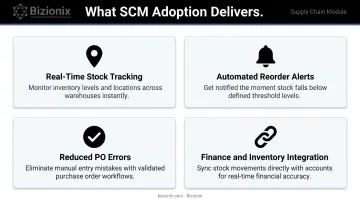
The gap matters. SCM adoption is where many Indian MSMEs can gain the most ground with relatively straightforward tooling:
- Tracks stock levels across locations in real time
- Flags vendor lead times and reorder points automatically
- Reduces manual purchase order errors
- Connects procurement data to finance and inventory modules
Key Components of an Effective Corporate Management System
Process Standardisation
A CMS must document and formalise how work gets done — through SOPs, defined workflows, and role-based approval chains. Standardisation is what makes training, auditing, and scaling possible. Without it, every employee follows their own version of the process.
Bizionix includes document workflows and configurable approval hierarchies so staff follow established procedures rather than informal shortcuts. Every action is logged, creating an audit trail that disconnected spreadsheets simply cannot provide.
Centralised Data Management
A CMS must serve as a single source of truth. When customer records, inventory levels, financial data, and HR information live in separate systems or Excel files, reconciliation errors are inevitable.
Gartner estimates poor data quality costs organisations at least $12.9 million per year on average. For an MSME, the impact is just as damaging in proportion — duplicate SKUs, inconsistent customer GSTINs, and invoice mismatches create rework, filing errors, and cash flow gaps.
Performance Monitoring and KPI Tracking
Dashboards and reporting tools let managers track revenue, inventory ageing, fulfillment rates, and compliance status — and act on deviations before they become larger problems. MIT research found that data-driven decision-making was associated with 3% or more higher productivity in manufacturing environments.
Waiting for a weekly summary report means acting on stale information. For MSMEs managing tight margins, real-time visibility is the difference between catching a cash flow gap early and discovering it at month-end.
Compliance and Audit Controls
In India, compliance is not optional. Under CGST Act Section 47, late GST return filing attracts ₹100 per day in penalties. Section 50 applies interest at up to 18% on delayed tax payments.
A CMS must build compliance workflows into daily operations — due-date alerts, invoice validation, maker-checker review — not treat them as afterthoughts.
Bizionix integrates directly with the GST e-Invoice IRP via API, generating IRNs instantly and auto-populating GSTR-1, with pre-validation preventing submission errors before they reach the portal.
Communication and Collaboration Infrastructure
A CMS connects departments through shared information flows, task assignments, and approval workflows. This replaces informal coordination channels that leave no structured record. Specifically, a CMS provides:
- Shared task assignments with ownership and deadlines
- Approval workflows tied to financial documents and purchase orders
- A traceable record of decisions — something WhatsApp threads and email chains cannot offer
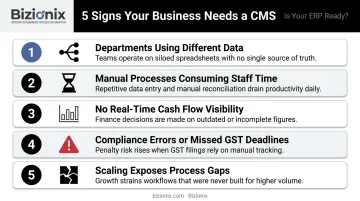
5 Signs Your Business Needs a Corporate Management System
If any of these describe your business, informal systems are already costing you — in wasted hours, missed revenue, or compliance risk.
Departments working from different data: Finance has one inventory number, the warehouse has another, and sales quotes from a third. Reconciliation happens monthly, if at all.
Manual processes consuming staff time: Invoicing, attendance tracking, stock counts, and payroll inputs done by hand create errors and delay processes that should be automated.
No real-time cash flow or inventory visibility: Leadership relies on memory or weekly reports to understand cash position. MSME SAMADHAAN received 216,221 delayed-payment applications involving ₹47,677 crore through December 2024 — a direct consequence of weak receivables tracking.
Compliance errors or missed GST deadlines: GST filings are date-sensitive and increasingly system-dependent. GSTN data shows 24,267 sub-₹5 crore businesses actively generating IRNs — the compliance baseline is rising.
Scaling exposes every process gap: Adding a new location, product line, or team reveals exactly where informal systems fail. Processes that worked for 20 employees tend to break at 50.
Best Practices for Implementing a Corporate Management System
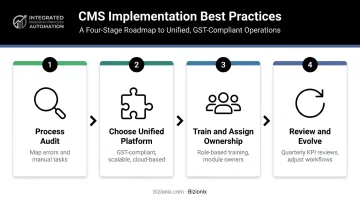
Start with a Process Audit
Before evaluating software, map what actually happens in your business. Where do errors occur? Which tasks consume the most manual effort? What compliance tasks rely on one person's knowledge?
Define measurable KPIs before go-live — receivables aging, stock accuracy, GST filing timeliness, payroll error rates. Without a baseline, you can't measure improvement.
Choose a Unified, Scalable Platform
Running separate tools for accounting, HR, inventory, and CRM carries hidden costs:
- Integration failures between systems
- Data inconsistencies across reports
- Duplicate data entry across platforms
- No single audit trail
For Indian MSMEs, a cloud-based, GST-compliant platform like Bizionix delivers integrated finance, inventory, HRMS, CRM, and GST compliance on a single database — without SAP-level complexity or cost.
Train Teams, Assign Ownership, and Review Regularly
Even a well-selected system fails without adoption. Gartner warns that low end-user adoption is one of the leading causes of ERP implementation failure — users who don't understand the rationale behind workflow changes tend to revert to old habits. Follow this implementation approach:
- Assign internal system administrators with ownership of specific modules
- Run role-based training so users understand their workflows, not just the software
- Schedule quarterly KPI reviews to assess whether the system is delivering against the targets set during the process audit
- Adjust workflows as the business grows — the system should evolve with operations, not remain static after go-live
Start with the highest-risk functions: finance, inventory, GST compliance, and receivables. Add HRMS, CRM, and advanced analytics once master data and approval rules are stable.
Frequently Asked Questions
What is a corporate management system?
A corporate management system is an integrated framework of tools, processes, and policies used to plan, monitor, and control business operations across departments. It helps organisations meet strategic goals consistently by replacing fragmented manual processes with structured, accountable workflows.
What are the 4 pillars of a performance management system?
The four pillars are goal setting, continuous feedback, performance measurement/KPI tracking, and employee development. Together, these create the accountability structure that drives consistent, measurable performance across teams.
What are the 4 components of a management information system?
The four core components are people (users and IT staff), processes (workflows and procedures), data (information inputs and outputs), and technology (hardware and software). These combine to produce actionable business intelligence that supports decision-making.
What are the 4 pillars of corporate governance?
The four pillars are accountability, transparency, fairness, and responsibility. A corporate management system enforces these through structured approval workflows, audit trails, role-based access, and escalation policies.
How is a corporate management system different from ERP software?
ERP is one type of corporate management system — it focuses on integrating operational data across departments and typically serves as the software backbone of a broader CMS. A CMS also encompasses governance frameworks, compliance systems, and performance management.
How do I choose the right corporate management system for my business?
Start by identifying your biggest operational pain points, then verify the system meets your compliance requirements — especially GST in India. Prioritise scalability and ease of adoption over feature quantity; a cloud-based, modular platform typically suits growing MSMEs best.