Introduction
Picture this: a sales order arrives on WhatsApp, gets manually typed into a billing spreadsheet, then re-entered into a separate accounting tool, and finally emailed to the warehouse. By the time the order ships, three people have touched the same data, two versions exist, and nobody knows which one is current.
The problem is structural, not human — and it plays out across thousands of growing Indian businesses every day.
Digital solutions are the infrastructure that fixes this. Not technology for technology's sake, but systems that replace fragmented, manual processes with structured workflows that scale. Businesses that delay this shift do not just fall behind competitors — they absorb avoidable costs with every transaction and every month-end scramble.
This article covers:
- What digital solutions actually mean for a growing MSME
- How they drive measurable growth
- Where they apply across business functions
- How to adopt them without disrupting ongoing operations
Key Takeaways
- Nearly half of Indian MSMEs still operate fully offline or on disconnected tools — a gap that costs productivity daily
- Digitally connected enterprises show almost 50% higher labour productivity than non-digital ones
- Fragmented systems that work at ₹2 Cr revenue collapse at ₹20 Cr — more transactions expose every broken process
- GST e-invoicing is now mandatory for businesses with turnover above ₹5 Cr — compliance is no longer optional
- Phased adoption starting with the highest-pain function reduces implementation risk and avoids operational disruption
What Are Digital Solutions and Why Do They Matter for Business Growth?
Digital solutions are tools and systems — cloud platforms, ERP software, automation engines — that replace disconnected manual processes with structured, repeatable workflows. The goal is never "going digital" for its own sake. It is operational control and the business outcomes that follow.
For a growing MSME, this means:
- Financial data that updates in real time instead of at month-end
- Approvals that follow a defined chain instead of a WhatsApp group
- Inventory levels that are visible across locations without a phone call
- Invoices generated and filed in seconds, not hours
Why This Is No Longer Optional
According to RIS research on MSME digitalisation in India, digitally connected enterprises show almost 50% higher labour productivity than enterprises using no digital tools. A 10% increase in digitalisation levels correlates with a 1.6% increase in enterprise growth.
Despite this, the adoption gap remains wide. The India SME Forum found that 46.2% of surveyed MSMEs still operate fully offline — running on spreadsheets, phone calls, and informal coordination that cannot keep pace with customer expectations, multi-location operations, or India's GST compliance framework.
The Difference Between Using Technology and Having a Digital Solution
Many businesses already use email, Excel, and WhatsApp. Using separate tools for separate tasks is fragmented tool usage — not a digital solution. A true digital system integrates data, workflows, and people across the entire business.
The contrast looks like this:
| Fragmented Tools | Unified Digital System |
|---|---|
| Scattered Excel files, version conflicts | Single source of truth, real-time data |
| WhatsApp approvals, no audit trail | Structured approval chains, full log |
| Month-end data reconciliation | Live dashboards, daily visibility |
| Data re-entered across multiple tools | One entry, flows across all functions |
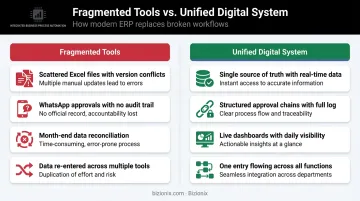
That table describes exactly the problem Bizionix was built to solve. Designed for Indian growing enterprises, the platform replaces five to six separate tools with one unified cloud ERP — eliminating Excel sprawl, WhatsApp approvals, and month-end reconciliation in a single move.
The Hidden Cost of Running on Fragmented, Manual Systems
Manual systems have a cost that rarely shows up in the accounts — but compounds with every transaction.
Financial Leakage
When purchases, expenses, and approvals happen across disconnected channels, money slips through the gaps. Untracked expenses, unrecovered vendor credits, and missed billing windows are common symptoms. India's MSME sector carries a visible indicator of this stress: MSME Samadhaan data shows ₹55,244.29 Cr in total delayed payments across filed applications, with ₹21,910.08 Cr still pending — reflecting a systemic cash flow problem that manual billing processes make worse.
Operational Drag
Manual data entry is deceptively expensive. Consider a single sales order that must be typed into a billing spreadsheet, entered into accounting software, and then relayed to the warehouse via WhatsApp. Each hand-off introduces error risk, delay, and wasted time. Multiply this across hundreds of transactions per month and the capacity loss becomes significant.
Decision-Making Blindness
When data lives in different tools and people's heads, business owners cannot see the full picture in real time. Only 37.7% of India SME Forum respondents actively use data to optimize operations — which means the majority are making strategic decisions with incomplete or delayed information.
Poor inventory calls, missed collection windows, and cash flow surprises follow — problems that better visibility would have flagged weeks earlier.
The Accountability Gap
Without a single system tracking activity across teams, there is no reliable record of who actioned what, when, and why. The practical fallout shows up quickly:
- Audits become imprecise and time-consuming
- Escalations rely on memory rather than documented records
- Performance reviews are based on impression, not data
- Compliance gaps surface only after the fact
Bizionix addresses this directly through complete activity tracking — every action logged with full traceability, creating accountability that rewards good performance and surfaces weak execution without guesswork.
Why Growth Amplifies the Problem
A business can survive on manual systems at ₹2 Cr revenue. The same approach collapses at ₹20 Cr. Higher transaction volumes, larger teams, and multiple locations all pile pressure onto infrastructure that was never built to handle it. As the platform's own onboarding notes put it: "Excel feels 'good enough' when 1–2 people handle data and transaction volume is low. Real growth changes that fast."
Bizionix is built to absorb that growth, replacing disconnected tools with a unified environment that handles increasing complexity without demanding proportional headcount increases.
How Digital Solutions Drive Business Growth: Key Mechanisms
Operational Efficiency Through Automation
Digital solutions eliminate repetitive manual tasks — invoice generation, stock updates, approval routing, bank reconciliation — freeing teams to do work that actually moves the business forward.
FICCI's survey of 600+ manufacturing SMEs found that 35% saw 11%–20% annual cost reduction after adopting digital tools, and 30% saw reductions exceeding 20%. Bizionix automates across functions:
- GST-compliant invoices with IRN generation in seconds
- GSTR-1 auto-populated from sales data
- Real-time stock updates across warehouse locations
- Structured digital approval chains replacing WhatsApp
Data-Driven Decision Making
When all business data flows through a single system, leadership gains real-time visibility into revenue, costs, inventory, receivables, and performance — all from one dashboard. Decisions shift from gut-feel to structured insight.
Bizionix surfaces this across integrated modules:
- Finance & Accounting — live P&L, outstanding receivables, and cash position
- Sales & CRM — pipeline status and order conversion in real time
- Inventory — stock levels and movement across all warehouse locations
- HRMS — headcount costs and attendance without manual collation
The result: management knows what is happening now, not after month-end.
Faster Billing and Cash Flow Acceleration
GST e-invoicing mandates apply to businesses with aggregate turnover exceeding ₹5 Cr (effective 1 August 2023). Businesses already required to comply — and those approaching that threshold — cannot afford slow manual invoicing.
Bizionix's direct API integration with the GST e-Invoice system works through four automated steps:
- Create the invoice in Bizionix ERP (from a sales order or directly)
- Validate — invoice data is automatically checked against GST rules
- Generate IRN — instantly via direct IRP connection, with QR code embedded
- Distribute — PDF ready to email or download within seconds
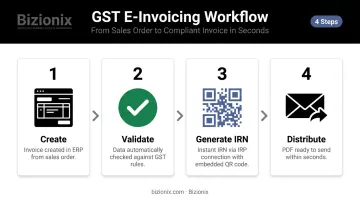
This eliminates manual JSON uploads, IRN delays, and rejections from formatting errors. Shorter invoice cycles mean faster payment collection — and for an MSME managing tight cash flow, even a few days' improvement in receivables turnaround has a measurable impact on operations.
Scalability Without Proportional Cost Increase
A business adding three new branches should not need to triple its back-office team. Bizionix's multi-company architecture allows management of multiple entities, branches, and GST registrations from a single secure login — with consolidated reporting across all entities while maintaining independent books per GST registration.
Role-based access control enforces accountability across users and locations without adding supervisory layers. The platform standardises processes so employees follow defined workflows rather than improvising.
Competitive Differentiation
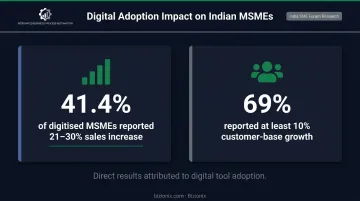
The India SME Forum found that 41.4% of digitised MSMEs reported a 21%–30% sales increase directly attributable to digital tools, and 69% reported at least 10% customer-base growth after adopting digital solutions. Businesses on organised digital systems respond faster to customers, close orders more quickly, and present professional, error-free documentation — the kind of operational consistency that turns first-time buyers into repeat accounts.
Digital Solutions Across Business Functions
Finance and Compliance
GST compliance is the most acute pain point for growing Indian businesses. With e-invoicing mandatory above ₹5 Cr and CBIC Section 122 penalties reaching ₹10,000 or the equivalent tax amount (whichever is higher) for invoice and tax offences, errors are expensive.
Bizionix's finance module handles:
- GST-ready accounting with automated invoicing and bank reconciliation
- GSTR-1 auto-population from sales data
- Direct API integration with the GST e-Invoice system (no third-party tools)
- Pre-validated invoice generation to prevent rejections
- Audit-ready financial records with full traceability
Inventory and Supply Chain
Without real-time stock visibility, procurement decisions rely on guesswork. Bizionix's inventory module covers multi-location stock tracking, purchase orders, GRN management, and consumption analytics — all integrated with finance so procurement costs flow directly into the books.
FICCI data shows only 48% of manufacturing SMEs currently use digital tools in finance, and even fewer have integrated inventory visibility. That gap represents competitive opportunity for businesses that do.
Sales and Customer Management
Bizionix's CRM and sales module tracks the complete order-to-cash cycle: lead management, quotations, sales orders, delivery challans, invoices, and follow-ups — in one place. Sales teams gain clarity on pipeline status; customers receive accurate, timely invoices. Fewer billing disputes and faster collections follow.
Multi-Entity and Multi-Location Management
As businesses scale across locations or entities, the operational picture gets fragmented. Bizionix's multi-company management addresses this directly — built for business groups, franchise networks, and companies with multiple GST registrations across states. Independent books per entity maintain compliance and financial isolation, while group-level dashboards provide consolidated visibility — all from a single secure login, without repeated logins or data reconciliation across systems.
How Indian MSMEs Can Adopt Digital Solutions Without Disruption
Start with Process Clarity
The most common adoption failure is choosing software before understanding the business's actual workflows. Before evaluating any platform, map where data gets stuck, who does manual follow-ups, and where approvals are delayed. The highest-pain function — usually finance and billing — is the right place to start.
Choose Platforms Built for Your Context
Generic tools designed for global markets frequently fail to account for India-specific requirements: GST structure, TDS handling, e-way bills, and MSME operational realities. Gartner projects that by 2027, more than 70% of recently implemented ERP initiatives will fail to fully meet their original goals. Misalignment between the tool and the business's actual needs is a leading cause.
Bizionix is built specifically for Indian MSMEs: GST-compliant by design, scalable without SAP-level complexity or cost. The platform is configured for Indian business workflows from day one, not adapted from a global template.
Key criteria when evaluating any platform:
- GST e-invoicing and GSTR compliance built in (not bolted on)
- Ease of use without requiring IT specialists
- Scalability from current size to target size
- Vendor reliability and India-specific support
Phase Implementation and Involve Teams Early
Adoption risk drops significantly when implementation starts with one high-pain function rather than a full deployment. The data reflects how real this challenge is: according to India SME Forum research, 52.6% of MSME respondents found selecting the right digital tools difficult. Separately, 40% of FICCI respondents cited lack of skilled resources as a barrier to digital adoption.
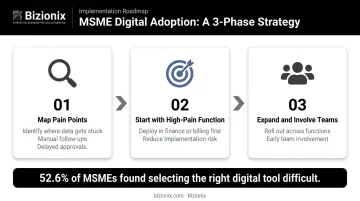
A solution the team actually uses consistently outperforms a feature-rich system that gets ignored. That's why low-friction onboarding matters. Bizionix's implementation approach emphasises quick setup: e-invoicing integration, for example, requires only an API key and GST credentials.
Frequently Asked Questions
What is the difference between digital transformation and digital solutions?
Digital solutions are specific tools or systems — like a GST-compliant ERP or inventory platform — implemented to improve defined operations. Digital transformation is the broader organisational shift in how work gets done using technology. Solutions are the building blocks that, collectively, drive transformation.
How do digital solutions help small and medium businesses grow?
Digital solutions reduce manual workload, improve data visibility, accelerate billing cycles, and enable informed decisions. Together, these free up capacity and capital — the two resources that directly fuel growth in an MSME context.
What are the most important digital solutions for Indian MSMEs?
GST-compliant accounting, e-invoicing, inventory management, and billing automation are the highest priorities. India's regulatory complexity, multi-location operations, and mandatory e-invoicing above ₹5 Cr turnover make these non-negotiable for growing MSMEs.
Can a single platform replace multiple disconnected tools?
Yes. A unified ERP like Bizionix consolidates finance, inventory, sales, HRMS, and reporting into one platform. This eliminates fragmented data, cuts the cost of managing multiple subscriptions, and gives every team access to consistent, up-to-date business information.
How long does it take to see results after implementing a digital solution?
Reduced manual effort, faster invoicing, and real-time visibility typically appear within weeks of adoption. Strategic benefits like better decision-making and measurable cost reduction compound over months as data accumulates and processes stabilise.
What should a business look for when choosing a digital solution?
Prioritise ease of use, alignment with your actual workflows, scalability for your growth trajectory, and compliance features relevant to your market — GST readiness is non-negotiable for Indian businesses. Vendor reliability and local support matter more than feature count.