For Indian MSMEs, this shift isn't abstract. With over 1.51 crore active GST registrations as of April 2025 and tightening e-invoicing mandates, staying on fragmented or legacy systems is no longer a neutral choice. Businesses that fail to modernise risk compliance exposure, operational inefficiency, and a widening gap versus competitors who already run on modern platforms.
This article breaks down the five most consequential ERP trends in 2025, what's driving them, and what they mean for growing businesses in India.
Key Takeaways
- Invoice processing, demand forecasting, and anomaly detection are now automated through AI embedded directly in core ERP modules
- Cloud ERP is the dominant deployment model, projected to grow from USD 87.73 billion in 2024 to USD 172.74 billion by 2029
- Low-code configurability lets business users adapt workflows without touching a line of code
- Real-time shop-floor and logistics data flows directly into ERP dashboards via IoT integration
- For Indian MSMEs, compliance-ready ERP covering GST, e-invoicing, and IRN generation is non-negotiable
Key Trend 1: AI-Powered Analytics & Intelligent Automation
AI has moved from a feature on a vendor's roadmap to a functional component of live ERP deployments. In 2025, it's embedded directly inside finance, procurement, HR, and supply chain modules, running in the background to automate routine tasks and surface insights without waiting for a human prompt.
Gartner predicts that 40% of enterprise applications will feature task-specific AI agents by end-2026, up from less than 5% in 2025. SAP alone has announced 14 Joule Agents spanning finance, HR, procurement, and supply chain, with over 400 AI use cases planned across its applications by end-2025.
What AI Does Inside ERP Today
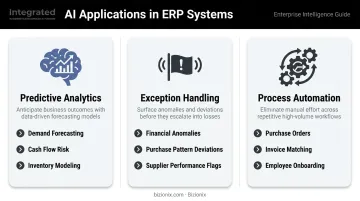
The most mature applications fall into three categories:
- Predictive analytics — ERP systems forecast demand, flag cash flow risks, and model inventory scenarios based on historical data, enabling decisions ahead of disruptions rather than responses after them
- Exception handling — AI surfaces anomalies in financial data, purchase patterns, or supplier performance before they become problems
- Process automation — Routine workflows like purchase order recommendations, invoice matching, and employee onboarding run without manual intervention
A Concrete Example
Careem, the ride-hailing and delivery platform, extended Oracle Fusion Cloud Financials ERP with AI-powered document understanding. The result: invoice processing time fell 70%—from 3 minutes to under 1 minute per invoice—freeing 332 hours per month while processing over 10,000 invoices monthly. Volume scaled 37% with no additional headcount.
For Indian MSMEs still processing invoices manually, the math translates directly. Automating just this one workflow can recover 10–15 hours of accounting work per week—without adding staff or changing how the rest of the business runs.
Key Trend 2: Cloud ERP & Mobile-First Access
On-premise ERP made sense when data had to live on servers you controlled. That logic has eroded. Cloud ERP now offers lower total cost of ownership, automatic compliance updates, elastic scalability, and access from any device—none of which legacy systems can match without significant infrastructure investment.
According to MarketsandMarkets, the global cloud ERP market is projected to grow from USD 87.73 billion in 2024 to USD 172.74 billion by 2029—a 14.5% CAGR. For context, the overall ERP software market grew 11.3% to USD 66 billion in 2024, meaning cloud deployment is outpacing the category itself.
Why This Matters for MSMEs
For businesses with distributed teams, multiple branches, or field operations, mobile-first access is especially critical. Employees can complete approvals, monitor dashboards, track inventory, and review financials from anywhere—without needing a desktop at the main office.
What cloud ERP eliminates:
- Dedicated server rooms and IT maintenance costs
- Manual software update cycles that create version inconsistencies
- Data silos between departments or locations
- Delayed access to financial or operational data
How Bizionix Delivers on This
Bizionix is built as a 100% cloud-based ERP for Indian MSMEs, offering 24/7 access with real-time visibility across all business operations. The platform's single secure login for multi-company management lets holding companies, franchise networks, and multi-entity businesses manage all subsidiaries and GST-registered entities from one dashboard—with role-based access controls governing exactly who sees what.
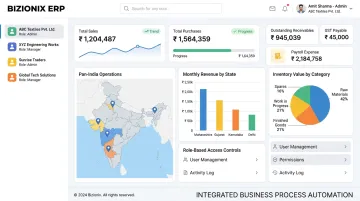
At ₹999/year for the NEO plan, the savings over on-premise implementations are immediate: no infrastructure overhead, no dedicated IT team, and no months-long deployment timeline before going live.
Key Trend 3: Low-Code/No-Code ERP & Industry-Specific Solutions
Two years ago, ERP customisation required a developer, a project plan, and significant budget. That's changing. Low-code and no-code tools within modern ERP platforms now let business users configure workflows, build custom reports, and adapt modules to their actual processes—without raising an IT ticket for every change.
Forrester reports that 87% of enterprise developers already use low-code platforms for at least some development, with the market potentially approaching USD 50 billion by 2028. The implication for ERP buyers: the ability to self-configure is becoming a standard expectation, not a premium feature.
Industry-Specific ERP Is Gaining Ground
Alongside configurability, vendors are building pre-configured modules for specific sectors—manufacturing, distribution, hospitality, retail—rather than expecting every business to adapt a generic platform to their needs. This reduces implementation friction.
Bizionix is one example of this in practice. Its core ERP covers production planning, inventory control, warehouse management, purchase management, and HRMS. Its dedicated HotelEase HMS module goes further—purpose-built for hospitality with pre-configured workflows covering:
- Reservations, front office, and housekeeping
- Billing, POS, and guest CRM
- Restaurant, banquets, and analytics
The result is a full hotel operational cycle covered out of the box, without custom development.
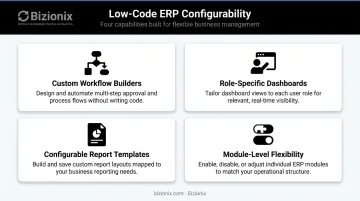
Key configurability features across modern ERPs:
- Custom workflow builders that match organisational SOPs
- Role-specific dashboards tailored to finance, operations, or sales teams
- Configurable report templates without writing queries
- Module-level flexibility that lets businesses activate only what they need
For MSMEs juggling multiple operational roles, this kind of adaptability closes the gap between "how the software works" and "how we actually work."
Key Trend 4: IoT Integration & Real-Time Business Visibility
Manufacturing equipment, warehouse sensors, delivery vehicles, and smart meters are generating continuous operational data. IoT-enabled ERP systems collect that data and push it directly into dashboards, closing the gap between what's happening on the floor and what managers see on their screens.
The numbers reflect how fast this is moving: IoT Analytics forecasts 21.1 billion connected IoT devices globally in 2025, with enterprise IoT growing 13% year-on-year to USD 324 billion worldwide. ERP platforms that can't consume this data will increasingly lag behind those that can.
From End-of-Day Reports to Live Decisions
The real operational shift is timing. Without IoT-ERP integration, a factory manager learns about equipment downtime from yesterday's report. With integration, the ERP receives the signal in real time, cross-references maintenance schedules and spare parts inventory, and triggers a service request automatically.
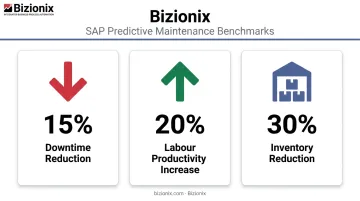
SAP's predictive maintenance benchmarks illustrate the potential: up to 15% downtime reduction, 20% labour productivity increase, and 30% inventory reduction when asset performance data feeds directly into planning workflows.
Where IoT-ERP integration has the clearest impact:
- Warehouse inventory levels updated automatically via sensors, triggering reorders before stockouts occur
- Production line performance monitored in real time, with exceptions flagged before they impact output
- Fleet or delivery tracking integrated with dispatch and invoicing workflows
- Energy consumption monitoring for multi-site operations
Those enterprise-scale results don't require enterprise-scale investment to start seeing. For Indian MSMEs in manufacturing or distribution, even basic sensor integrations — barcode scanners feeding into inventory modules, for example — can eliminate the manual stock reconciliation that absorbs hours each week.
Key Trend 5: Compliance-Ready ERP & Cybersecurity Enhancements
GST and E-Invoicing as a Forcing Function
India's GST e-invoicing mandate now covers businesses with aggregate turnover above ₹5 crore, a threshold that came into effect from 1 August 2023. With over 1.51 crore active GST registrations and gross GST collections reaching ₹22.08 lakh crore in 2024-25, the compliance infrastructure is not optional—it's foundational.
A modern ERP built for Indian businesses must:
- Automate GST computation at the point of transaction
- Generate IRN (Invoice Reference Numbers) via direct API integration with the Invoice Registration Portal
- Auto-populate GSTR-1 returns to keep sales, GST filings, and accounting aligned
- Produce audit-ready reports without manual data extraction
Bizionix handles this end-to-end. When a sales invoice is created, the system automatically validates it against GST rules and generates the IRN and QR code instantly via direct IRP API connection, with no manual steps or third-party tools involved.
This matters most for MSMEs approaching or crossing the ₹5 crore threshold, where non-compliance under CGST Section 122 carries direct financial penalties.
ERP Security Has to Match the Data Inside It
GST compliance data sits alongside an organisation's most sensitive records in ERP: financial statements, employee information, customer contracts, supplier agreements. The security layer protecting all of it needs to be built in, not bolted on.
Security features that belong in any 2025 ERP evaluation:
- Role-based access controls limiting visibility by department, branch, or function
- End-to-end encryption for data at rest and in transit
- Complete activity logs per user and entity
- Automated backup with restoration support
- Secure cloud infrastructure with regulatory compliance alignment
Bizionix incorporates role-based access controls with entity-level permissions, end-to-end encryption, and full activity logging across its multi-company management architecture. Each user's actions are traceable, and access is scoped strictly to what their role requires.
What's Driving These ERP Trends
These trends aren't emerging independently. They're converging because the underlying conditions that held them back—immature technology, high implementation costs, low vendor readiness—have largely resolved.
Gartner forecasts worldwide IT spending at USD 5.61 trillion in 2025, up 9.8% from 2024, with software specifically growing 14.2%. ERP sits inside a broader software modernisation wave that's accelerating, not plateauing.
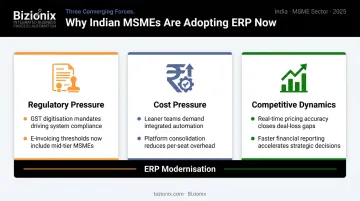
Three forces are compressing the adoption timeline for Indian MSMEs:
Regulatory pressure — GST digitisation, mandatory e-invoicing thresholds, and evolving data protection requirements are pushing businesses off spreadsheets and legacy systems. Compliance is no longer achievable without software that automates it.
Cost pressure — Leaner teams are expected to do more. Cloud ERP replaces five or six disconnected tools with one integrated platform at a fraction of the combined cost.
Competitive dynamics — MSMEs still on manual systems fall behind on pricing accuracy, delivery speed, and financial reporting as peers modernise. The gap widens every quarter.
These are precisely the pressures Bizionix was built around — GST-ready compliance, plans starting at ₹999/year, and a unified platform that replaces the disconnected tools most growing MSMEs are still managing separately.
Future Signals: What's Next for ERP
Three developments are worth tracking, even if they're not yet mainstream for most Indian MSMEs:
Agentic AI moves beyond recommendations — it takes action directly. Inventory gets replenished, collections get triggered, and suppliers get switched based on live performance data, all with minimal human sign-off. Gartner projects 40% enterprise app AI-agent penetration by end-2026, which signals how quickly this shift is arriving.
Composable ERP architecture takes a different approach to platform design. Instead of one monolithic system, businesses connect a core ERP (finance, compliance, inventory) with specialised modules via API — what Gartner calls composable ERP. The architecture is adaptive by design, letting companies swap or add capability without replacing the whole platform. Bizionix reflects this principle through its direct API integration with India's GST e-Invoice system and OTA connectivity in its HMS module.
Blockchain for supply chain traceability is the longest-horizon signal of the three. SAP and Unilever piloted blockchain-based provenance tracking for palm oil supply chains, creating auditable records across complex supplier networks. Most MSMEs won't need this today — but if you operate in a regulated sector like food, pharma, or textiles, ask your ERP vendor directly what their blockchain roadmap looks like before signing a long-term contract.
Conclusion
The ERP trends shaping 2025—AI-driven analytics, cloud and mobile access, low-code configurability, IoT visibility, and compliance automation—aren't incremental software updates. They determine whether a business has real-time visibility or blind spots, whether compliance runs automatically or becomes a liability, and whether growth scales or stalls behind manual processes.
For Indian MSMEs, the decision to modernise is urgent. Regulatory thresholds are tightening. Competitors are moving. The cost of waiting—in penalties, inefficiency, and lost ground—compounds with each passing quarter.
Businesses that choose ERP platforms aligned with these trends now position themselves for greater efficiency, lower costs, and stronger compliance. For Indian MSMEs specifically, platforms like Bizionix—built around GST compliance, cloud access, and modular scalability—are designed to meet exactly these demands without the complexity or cost of enterprise-grade alternatives. The window to act is open; the question is whether you move now or spend next year catching up.
Frequently Asked Questions
What are emerging ERP solutions?
Emerging ERP solutions are modern, cloud-based platforms that go beyond traditional resource tracking to incorporate AI, automation, real-time analytics, IoT integration, and industry-specific modules. They replace fragmented legacy systems with a single, intelligent business management platform that scales with the organisation.
What ERP trends matter most for small and medium businesses in India?
For Indian MSMEs, the most impactful trends are cloud ERP adoption (for affordability and scalability), GST and e-invoicing compliance automation, and AI-driven analytics. These directly address the cost pressures, regulatory requirements, and operational inefficiencies most common in this segment.
How is AI changing ERP systems in 2025?
AI is being embedded into ERP workflows to automate tasks like invoice processing and demand forecasting, surface predictive insights from historical data, and flag anomalies before they escalate. The result is faster, data-backed decisions with significantly less manual effort.
What is the difference between cloud ERP and on-premise ERP?
Cloud ERP is hosted by the vendor and accessible from any device via the internet, with lower upfront costs and automatic updates. On-premise ERP is installed on company servers and requires significant IT infrastructure and ongoing maintenance — making cloud the faster, lower-cost choice for most growing businesses.
How does GST compliance factor into modern ERP systems?
Modern ERP systems built for Indian businesses automate GST computation, generate e-invoices with IRN via direct API integration with the Invoice Registration Portal, and auto-populate GSTR-1 returns. This eliminates manual compliance work and reduces the risk of errors or penalties.
How should a growing business choose the right ERP in 2025?
Prioritise cloud-first deployment, compliance readiness, modular scalability, ease of use, and total cost of ownership. Choose a platform purpose-built for your industry and size — not an enterprise solution that brings unnecessary complexity and cost.