Introduction
Most growing Indian MSMEs run their business across a patchwork of tools — Tally for accounting, Excel sheets for inventory, the GST portal for compliance, WhatsApp for approvals, and perhaps a standalone HR system. Each works independently. None talk to each other.
The result? Finance teams manually re-enter data that sales already captured. Inventory counts don't match financial books. GST reconciliation becomes a month-end fire drill. And leadership makes decisions based on reports that are already three days old.
According to the India SME Forum's 2025 survey of 7,835 MSMEs, only 53.8% have adopted even one digital tool — and the gap between basic digitisation and genuinely integrated systems is wider still.
This guide breaks down what cloud ERP integration actually means for an MSME, what it costs in the Indian market, and what separates implementations that deliver results from those that don't.
TL;DR: Key Takeaways
- Cloud ERP integration connects your ERP with other tools — CRM, payroll, GST portals — so data flows automatically between them
- Core benefits: no data silos, automated processes, real-time decisions, and scalable growth
- Integration methods include point-to-point connections, iPaaS platforms, and native built-in modules
- For Indian MSMEs, an ERP with built-in compliance modules (GST, e-invoicing, payroll) costs far less than connecting separate tools
- Best practices: set KPIs upfront, cleanse data before migration, phase the rollout, and train staff
What Is Cloud ERP Integration?
Cloud ERP, Defined
A cloud ERP is business management software hosted on the internet that centralises all core operations — finance, inventory, HR, procurement, sales — into one platform. There are no on-premise servers to maintain; the vendor handles upgrades, security, and storage. You pay a subscription and access the system from anywhere.
The India ERP software market was valued at USD 4.5 billion in 2024 and is projected to reach USD 12.0 billion by 2035, reflecting how fast businesses are moving toward centralised digital operations.
ERP Integration, Defined
ERP integration is the process of connecting your ERP system to other business applications so data flows automatically between them — no manual re-entry required.
A simple example: a sales order is placed. An integrated system automatically updates inventory stock levels, creates an accounts receivable entry, and flags the warehouse for dispatch. No one typed anything twice.
Why Integration Matters Right Now
Businesses accumulate tools as they grow. Each tool solves one problem well, but creates a new one: information locked in silos. The result is fragmented visibility across the organisation:
- Finance operates without knowing what sales has committed
- Purchasing doesn't see current stock levels until it's too late
- Leadership works from reports that are hours or days old
- Teams duplicate data entry across disconnected systems
ERP integration connects these tools so data flows across departments automatically. Every department works from the same accurate, live data — purchases, invoices, stock levels, and payroll all updated in one place, in real time.
Types of Cloud ERP Integration Methods
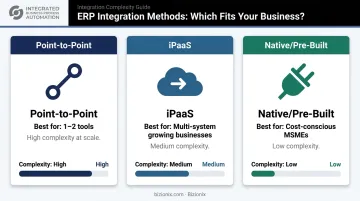
Three main approaches exist, each suited to different business contexts:
| Method | Best For | Complexity |
|---|---|---|
| Point-to-Point (P2P) | 1–2 external tools, no growth plans | High at scale |
| iPaaS | Multi-system, growing businesses | Medium (low-code) |
| Native/Pre-Built | Cost-conscious MSMEs, India-specific needs | Low |
Point-to-Point (P2P) Integration
A direct, custom-coded connection between two specific systems (for example, linking your ERP directly to an e-commerce platform). It works for very simple setups, but scaling is painful. Each new system you add requires another custom connection. With five tools, you're managing ten separate integrations — and maintenance quickly becomes a full-time job.
Best for: Businesses with only one or two external tools to connect, and no plans to add more.
iPaaS (Integration Platform as a Service)
iPaaS is a cloud-native middleware layer that connects multiple systems simultaneously using pre-built connectors and low-code tools. Gartner defines iPaaS as a vendor-managed cloud service for integrating applications, services, and data sources — and the market grew 23.4% to USD 8.5 billion in 2024, reflecting strong adoption across global markets including India.
iPaaS is the current standard for growing businesses because:
- It handles complex, multi-system integrations without heavy custom coding
- Vendors manage updates, reducing internal IT burden
- It scales as you add new applications
Native/Pre-Built Integrations
Many cloud ERP platforms include built-in integrations that connect out-of-the-box with commonly used tools (GST portals, payment gateways, accounting standards) without any third-party middleware.
For Indian MSMEs, this is often the most cost-effective path. A platform like Bizionix, built specifically for Indian businesses, includes native modules for GST e-invoicing, accounting, payroll, inventory, and CRM within a single system. This eliminates the need for many third-party integrations, cutting both cost and operational overhead.
Key Benefits of Cloud ERP Integration
Real-Time, Unified Data Visibility
When systems are integrated, data feeds into one central dashboard. Business owners and managers see live sales figures, current stock levels, cash flow, and operational status — all updated continuously, not compiled at month-end.
The SMB Group/Workday research found that 45% of SMBs cite difficulty integrating new applications with existing systems as a major technology challenge. The businesses that solve this problem gain a clear operational advantage: decisions based on what's happening now, not on last week's manually compiled spreadsheet.
With siloed tools, a finance manager compiling a cash flow report spends hours pulling data from three different systems. With integrated ERP, that same report is live on a dashboard, updated automatically.
Elimination of Manual Data Entry and Errors
Integration automates data flow between departments. A purchase order placed in the system automatically triggers inventory updates and accounts payable entries, with no manual re-entry required.
The scale of the error risk is real. A Gartner survey of 497 controllership professionals found 18% of accountants make financial errors at least daily, and roughly 59% make several errors per month — largely due to capacity constraints and manual processes. Integration doesn't eliminate human error entirely, but it removes the highest-frequency causes.
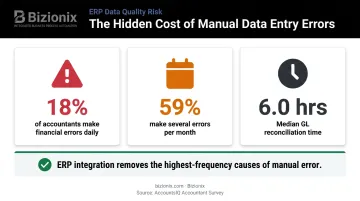
APQC benchmarking data shows the median time to reconcile a general ledger is 6.0 hours across thousands of companies. Integrated systems cut this significantly by keeping books updated automatically throughout the month rather than requiring a manual catch-up at close.
Faster Billing Cycles and Better Cash Flow
For Indian MSMEs, payment delays are a persistent operational reality. Integrated ERP directly addresses this by:
- Auto-generating GST-compliant invoices the moment a delivery is confirmed
- Triggering payment reminders automatically
- Reconciling receipts without manual effort
Bizionix's direct API integration with the GST e-Invoice system (IRP) generates IRN and QR codes in seconds. Manual JSON uploads, by comparison, can take hours and introduce format errors that trigger rejections.
The result: invoices that previously failed due to data mismatches go through cleanly, and billing cycles that once stretched five days compress to same-day.
Regulatory Compliance and Audit Readiness
GST compliance is non-negotiable for Indian businesses. Since GST Council Notification 10/2023-Central Tax, businesses with aggregate turnover exceeding ₹5 crore must use e-invoicing, effective 1 August 2023, with thresholds expected to tighten further.
Non-compliance carries real financial risk. Key exposures include:
- Penalties under Section 122 (CGST Act): ₹10,000 or the tax evaded, whichever is higher
- Discrepancy scrutiny: Siloed tools routinely create mismatches between GST returns and financial books — the most common trigger for audits
- Audit trail gaps: Without integrated systems, reconstructing transaction history is slow and error-prone
Integrated ERP captures compliance data automatically across every transaction. Bizionix maintains full traceability — who did what, when, and why — making audits straightforward rather than stressful.
Scalability Without Proportional Overhead
A properly integrated cloud ERP grows with the business. Adding a new warehouse, a new product line, or a new sales channel doesn't require a new set of disconnected tools. Data from all entities flows into the same system.
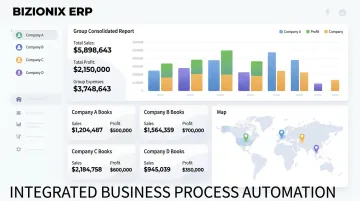
Bizionix's multi-company architecture makes this concrete: a business can manage multiple subsidiaries, branches, GST entities, or franchise locations from a single secure login, with independent books per entity and consolidated group-level dashboards. Scaling from one location to five doesn't mean five times the administrative work.
Research from RIS across 2,882 Indian MSMEs found that a 10% increase in digitalisation levels correlates with a 1.6% increase in enterprise growth. With only 12% of surveyed MSMEs having adopted ERP, most growing businesses are leaving measurable gains on the table.
Common Integration Challenges and How to Address Them
Data Quality and Compatibility Issues
The most common reason ERP integrations fail isn't technical — it's poor data quality. Duplicate customer records, inconsistent product codes, incomplete vendor information across legacy systems all create problems when you try to connect them.
Before any integration begins:
- Audit existing data across all current systems
- Standardise field definitions — how both systems define "customer name" or "product SKU"
- Cleanse duplicates and incomplete records before migration begins
- Establish validation rules that prevent bad data from entering the new system
Migrating poor data into a new system just multiplies the problem — faster and at greater cost.
Resistance to Change and User Adoption
Gartner predicts that by 2027, more than 70% of recently implemented ERP initiatives will fail to fully meet their original business-case goals — with up to 25% failing catastrophically. Low user adoption is consistently identified as a contributing factor.
Technically sound integrations still fail when employees revert to old workflows. More training manuals rarely solve this. What works:
- Involve key users during design, not just rollout
- Communicate clearly why the change is happening
- Show each person how the new system affects their specific daily tasks
Integration Complexity and Ongoing Maintenance
Every integration creates an ongoing maintenance responsibility. When one connected system updates its API, integrations can break. Custom-coded point-to-point connections are fragile — they require internal IT resources to diagnose and fix each time.
A more sustainable approach is choosing integration methods where the vendor manages updates — iPaaS platforms or native built-in connectors both fit this model. Maintenance responsibility shifts to the platform provider, not your internal team.
Cloud ERP Integration Best Practices
Most cloud ERP integrations fail not because of the technology but because of the approach. These practices help Indian MSMEs avoid the common pitfalls.
Define Clear Objectives and KPIs Before Starting
Integration projects without defined outcomes lose focus quickly. Before selecting tools or beginning technical work, document specific, measurable goals:
- "Reduce monthly book-closing time from 10 days to 3 days"
- "Eliminate manual GST reconciliation entirely"
- "Cut invoice generation time from 24 hours to same-day"
These benchmarks guide prioritisation and provide the basis for evaluating whether the integration delivered real value.
Conduct a Systems Audit and Map Data Flows
Inventory every tool currently used across departments. Document how data moves — or fails to move — between them. Identify:
- Where manual hand-offs occur
- Where the same data is entered twice
- Where reporting gaps leave management without visibility
This mapping exercise surfaces which integrations will deliver the highest immediate return, and which can be deferred to later phases.
Use a Phased Implementation Approach
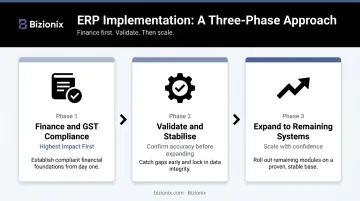
Don't integrate every system simultaneously. Start with the highest-impact integration — for most Indian MSMEs, this means finance and GST compliance first — validate that it works correctly, then expand.
A phased approach:
- Reduces risk of operational disruption
- Builds internal confidence before tackling complex integrations
- Delivers visible value early, which sustains organisational commitment
Prioritise Data Governance
Shared data requires shared standards. As part of any integration:
- Assign clear data ownership per record type (who maintains customer records, who maintains inventory counts)
- Establish validation rules that prevent incorrect data from entering the system
- Schedule periodic data audits
Without governance, integration doesn't fix bad data — it spreads it faster across every connected system.
Invest in Training and Establish Clear Support Channels
The technology is only as effective as the people using it. Role-specific training — showing each team member exactly how the integrated system changes their daily workflow — is essential, not optional.
For MSMEs adopting cloud ERP for the first time, vendor support is a deciding factor. Look for providers that offer:
- Guided onboarding and implementation support
- Role-based training (not just generic product walkthroughs)
- Accessible post-go-live support via phone, email, or chat
Bizionix, for instance, offers dedicated implementation guidance and multi-channel support designed specifically for Indian businesses — including a free trial period that lets teams build confidence before full commitment.
Cloud ERP Integration Costs: What MSMEs Should Know
Core Cost Components
ERP integration costs typically fall into three categories:
| Cost Area | What It Includes |
|---|---|
| Licensing | ERP platform subscription + any third-party iPaaS tools |
| Implementation | Data mapping, configuration, testing, go-live support |
| Data Migration | Cleaning, formatting, and transferring legacy data |
Panorama Consulting's 2024 global ERP report puts the median implementation cost at USD 450,000 — but that sample covers mid-to-large organisations worldwide, not Indian MSMEs. The relevant benchmark for MSMEs is very different.
Key cost drivers specific to Indian MSMEs, per RIS research:
- 20% cite financial constraints and high upfront technology costs as barriers
- 22% cite lack of technical expertise
- Implementation partner availability in tier-2 cities can inflate costs and delay deployments
Hidden Ongoing Costs
The upfront figures only tell part of the story. Businesses frequently underestimate:
- API maintenance costs when connected systems update
- Staff productivity dips during the transition period
- Training time during rollout
These are real, but they're offset by long-term savings: fewer manual data entry staff, faster close cycles, lower compliance risk, and fewer billing errors.
The MSME-Specific Cost Advantage
For Indian MSMEs, the most cost-effective path is choosing a cloud ERP that comes with natively integrated compliance and operational modules — rather than buying best-of-breed tools and paying to connect them.
Bizionix's NEO plan starts at ₹999 per year (with a 14-day free trial), covering nine core modules including accounting, finance, GST, sales, warehouse management, CRM, and HRMS. The Enterprise plan provides access to all 12+ modules with custom pricing for organisations with more complex requirements.
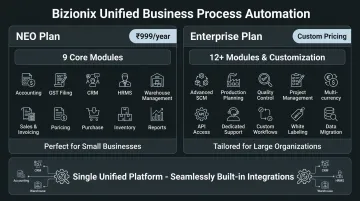
Replacing five or six separate tools, each carrying its own subscription and integration overhead, with one unified platform typically cuts total software costs by 40–60%. That's before accounting for the time saved on maintaining data consistency across disconnected systems.
Frequently Asked Questions
What is a cloud ERP?
A cloud ERP is business management software hosted on the internet that centralises all core operations — finance, inventory, HR, sales — into one platform. It's accessible from anywhere and requires no on-premise servers, with the vendor managing security, updates, and storage on a subscription basis.
What is an ERP integration?
ERP integration connects an ERP system to other business applications so data flows automatically between them, without manual re-entry. When one system updates, all connected systems reflect the change — giving you a unified view of operations in real time.
What are the most common types of cloud ERP integration?
Three main methods exist: point-to-point integration (direct custom connections between two systems), iPaaS (cloud-native middleware connecting multiple systems via pre-built connectors), and native/built-in integrations that ship with the ERP platform and require no third-party tools.
How much does cloud ERP integration cost for Indian MSMEs?
Costs depend on the number of systems being integrated, data volume, and whether custom development is required. For Indian MSMEs, choosing a cloud ERP with built-in compliance and operational modules — like Bizionix — reduces costs compared to connecting multiple separate tools. Bizionix entry-level plans start at ₹999/year, covering core modules without additional integration fees.
How long does cloud ERP integration typically take?
Timelines vary from a few weeks for simple native integrations to several months for complex multi-system deployments. A phased approach — starting with the highest-priority integration first — helps businesses see value faster. Platforms with built-in GST and e-invoicing support, for instance, can be operational within minutes of entering API credentials.
Is cloud ERP integration suitable for small and medium-sized businesses in India?
Yes. Indian MSMEs face specific operational pressures — GST compliance, multi-location coordination, limited IT resources — that cloud ERP integration directly addresses. Platforms built for the MSME context handle these requirements out of the box, without the cost or complexity of enterprise deployments.