The pressure is real. MSMEs contribute 30% of India's GDP and over 45% of exports, yet only 12% of MSMEs use ERP software, and manufacturing subsectors lag further — ERP adoption sits at just 9.5% in auto components and 12.9% in food products, according to the RIS MSME Digitalisation Report. The gap between operational complexity and digital capability is widening.
Cloud ERP is frequently positioned as the fix. But the real question isn't whether to adopt it — it's what specifically changes when you do, and whether those changes are worth the transition. This article answers that directly: what cloud ERP for manufacturing is, what advantages it delivers operationally, and when those advantages matter most.
Key Takeaways
- Cloud ERP is a single, web-hosted platform connecting production, inventory, procurement, and finance in real time — no on-site servers required
- Core advantages: unified visibility, lower total cost of ownership versus on-premise systems, and built-in compliance readiness
- Without it, manufacturers face reactive decisions, mounting reconciliation work, and a growth ceiling tied to data chaos — not production limits
- For Indian MSMEs above ₹5 crore turnover, e-invoicing compliance is now mandatory — manual handling creates both regulatory exposure and cash flow delays
- Full cross-department adoption drives ROI — partial rollouts alongside legacy tools dilute results
What Is Cloud ERP for Manufacturing?
Cloud ERP for manufacturing is an enterprise resource planning system delivered entirely over the internet. No on-site servers, no IT team managing upgrades, no major infrastructure projects when you add a new location. The vendor hosts and maintains the system; your teams access it from any device with a login.
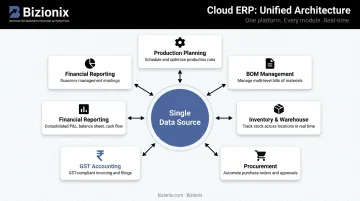
What it unifies matters more than where it lives. A manufacturing cloud ERP connects:
- Production planning and scheduling — work orders, production targets, resource allocation
- Bill of materials (BOM) management — component requirements linked to production runs
- Inventory and warehouse tracking — real-time stock levels across locations
- Procurement — purchase orders, goods receipt, vendor management
- GST-compliant accounting — invoicing, returns filing, receivables, payables
- Financial reporting — P&L, balance sheet, MIS reports accessible in real time
Each of these modules feeds the same data pool. That shared architecture replaces the manual coordination layer — the emails, calls, and spreadsheet compilations that currently connect your departments — with a single source of truth every team accesses simultaneously.
When a production update happens in a cloud ERP, it immediately reflects in inventory levels, which feeds procurement triggers, which updates the accounts. There's no data handoff, and no one needs to compile a report before someone else can act.
Key Advantages of Cloud ERP for Manufacturing
The advantages below are tied to outcomes manufacturers actually measure: cost, inventory accuracy, billing cycle time, and compliance exposure. They compound over time — which is why growing businesses see the most pronounced returns.
Real-Time Visibility Across Production and Finance
Every operational decision in manufacturing depends on current data. When that data is stale, the consequences aren't abstract — excess stock ties up working capital, material shortfalls halt production, and delivery commitments get missed because no one saw the problem coming.
Cloud ERP eliminates this by making one version of operational reality available to every stakeholder simultaneously. A production supervisor sees live work-in-progress. A finance lead sees current cash outflows. A procurement manager sees inventory positions before raising a purchase order. No report compilation required.
The benchmarks here are meaningful. Forrester's manufacturer-specific study on Epicor Kinetic reported 270% ROI over five years, a 30% improvement in inventory levels, and 20% faster time to revenue for manufacturers using cloud ERP. These aren't generic software figures — they come from manufacturing operations specifically.
KPIs affected:
- Production cycle time
- Order fulfilment rate
- Inventory turnover
- Monthly close time
- Accounts receivable aging
When this matters most: Multi-step production environments where delays cascade downstream, manufacturers managing more than one warehouse or location, and businesses with high component variability in their product mix. Platforms like Bizionix deliver this through multi-department synchronisation — production, inventory, finance, and sales working from one live data set rather than periodic exports.
Lower Total Cost of Ownership vs. On-Premise Systems
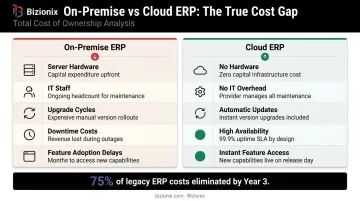
On-premise ERP has a visible cost: the license. The less visible costs are what make it expensive — server hardware, IT staff, periodic refresh cycles, downtime during upgrades, and feature adoption delays as upgrade projects get deprioritised.
Cloud ERP replaces all of this with a subscription. The vendor manages infrastructure, security patches, and system updates. IT spend becomes predictable, and you scale usage as the business grows without a corresponding infrastructure investment.
The analyst data is unambiguous. Forrester's SMB cloud ERP study found that Business Central deployments cost approximately 25% of previous ERP solutions, with 75% of legacy ERP costs eliminated by year three — driven by avoided licensing fees, on-premises infrastructure retirement, and reduced IT maintenance hours.
For Indian MSMEs, this matters in a specific way. RIS research shows that 20% of non-adopters cite financial constraints and high upfront costs as barriers, and 22% cite lack of technical expertise. Cloud ERP directly addresses both: no capital outlay for infrastructure, and no specialised IT staff required to keep the system running.
KPIs affected:
- IT cost as a percentage of revenue
- ERP-related downtime
- Time-to-value for new modules or locations
- Operational cost per unit produced
Manufacturers weighing production capacity investment against back-office infrastructure costs — or businesses that have outgrown spreadsheets but cannot justify SAP-level implementation — are exactly where this trade-off is sharpest. Bizionix is architected specifically for this space: enterprise-grade capability at MSME-appropriate cost, without the complexity that makes large ERP deployments prohibitive.
Compliance, Traceability, and Audit-Readiness Without Additional Overhead
Compliance in manufacturing is not a once-a-year activity. GST filing, e-invoice generation, lot traceability, quality inspection records, vendor documentation — these touch every transaction and every production run.
Managing them manually, or across disconnected tools, creates two compounding problems. The first is regulatory exposure: as of CBIC Notification No. 10/2023-Central Tax, e-invoicing is mandatory for manufacturers with aggregate turnover above ₹5 crore. An invoice issued without a valid IRN is not treated as a valid invoice under Rule 48(5) of the CGST Act — creating disputes with customers, payment delays, and potential penalties under Section 122 of the CGST Act (₹10,000 or the tax amount, whichever is higher).
The second is operational overhead: finance and operations teams reconcile data manually before each filing rather than using that time productively.
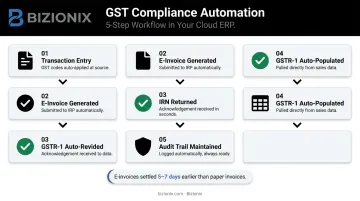
Cloud ERP removes both problems by embedding compliance into the transaction workflow itself:
- GST codes are applied at the point of entry — no post-facto mapping
- E-invoices are validated and submitted to the IRP automatically, with IRN generated in seconds
- GSTR-1 is auto-populated from sales transactions
- Lot and batch tracking is maintained through goods receipt and production issue events
- Audit trails are maintained automatically — no manual recordkeeping required
The cash flow impact is direct. When e-invoicing is automated and invoices are pre-validated before submission, billing cycles shorten and payment collection accelerates. A European Commission analysis found that e-invoices are typically settled 5–7 days earlier than paper-based invoices and that 15.1% of invoice delays are caused by incorrect invoice information — errors that pre-validation eliminates. Bizionix includes direct API integration with the GST e-Invoice system for instant IRN generation as part of the core product, not an add-on.
KPIs affected:
- GST filing accuracy rate
- Invoice dispute rate
- Days sales outstanding (DSO)
- Audit preparation time
- Material traceability coverage
When this matters most: Manufacturers with high transaction volumes, businesses supplying to large enterprises that require compliant documentation, and any manufacturer subject to quality standards — ISO, BIS QCOs, or FSSAI recall requirements — that mandate traceable production records.
What Happens When Cloud ERP Is Missing
The consequences of running on disconnected systems are not dramatic failures. They are slow accumulations of friction that eventually cap how large the business can grow.
Without a unified system, the gaps show up in predictable ways:
- Production planning runs out of sync with actual inventory levels, creating excess stock or material shortfalls
- Finance teams chase data from operations instead of analysing it
- Billing gets delayed because invoice inputs depend on manually collated delivery records
- Decisions get made on incomplete information, with no single source of truth
None of this is a one-time problem. Each month of operating this way adds to the coordination burden. Workarounds multiply. When the business tries to grow — adding a production line, opening a second warehouse, taking on a larger customer — every existing inefficiency gets amplified.
The RIS data makes this concrete: only 12% of Indian MSMEs use ERP, and adoption in manufacturing subsectors is even lower. The remaining 88% are not immune to fragmented systems — they are absorbing the cost in time, accuracy, and growth capacity. That cost stays invisible precisely because it's spread across dozens of small daily frictions rather than one obvious failure.
Hiring more coordinators and adding more spreadsheets treat symptoms. The underlying problem is the absence of a unified information layer — and that requires a systemic fix, not more headcount.
How to Get the Most Value from a Cloud ERP System
Cloud ERP delivers its highest value when it replaces existing processes entirely, not when it runs alongside them. Running old spreadsheets and a new system simultaneously undermines adoption and delays the point at which the business starts capturing real operational benefits.
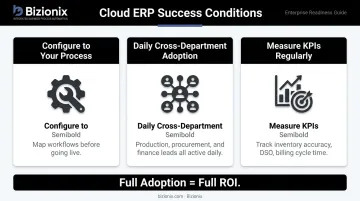
Three conditions consistently determine whether a cloud ERP implementation succeeds:
Configure around your actual process, not generic defaults. A system set up on default templates forces your team to adapt their workflows to the software rather than the reverse. A configurable platform that maps to how your business actually operates avoids the workarounds that undermine adoption from day one.
Get daily adoption from production, procurement, and finance leads — not periodic report exports. If team leads are pulling data out of the system and working in other tools, the ERP's real-time advantage disappears. Active daily use is what creates the unified data layer that drives the visibility and compliance benefits.
Review outcomes against defined KPIs at regular intervals. Cloud ERP is not a one-time project; it's an operational infrastructure. Tracking inventory accuracy, billing cycle time, DSO, and GST filing accuracy at regular intervals makes it possible to identify where the system is underused or misconfigured — and fix it before the gap compounds.
For Indian manufacturing MSMEs, the biggest gains come when one system handles GST compliance, inventory valuation, and production cost tracking together. Separate accounting software, a separate GST filing tool, and a separate inventory tracker each create reconciliation requirements that erode the efficiency you're trying to build.
Bizionix is built for this unified approach — combining manufacturing operations, GST-ready accounting, and multi-company visibility in a single platform designed for Indian business conditions.
Conclusion
Cloud ERP for manufacturing earns its value through what it makes possible on the ground:
- Inventory accuracy that reflects what's actually on the shop floor
- Billing cycles that close in days rather than weeks
- GST filings that require no manual compilation
- Production decisions made on data from this morning, not last Tuesday
These outcomes compound. A manufacturer that implements cloud ERP fully, measures outcomes consistently, and extends adoption across departments will see stronger returns at year three than at year one. Businesses that treat it as a partial implementation or a one-time project capture only a fraction of that potential.
For Indian manufacturers above ₹5 crore turnover, GST compliance alone makes this a business necessity, not a discretionary upgrade. The practical next step is choosing a system built specifically for how Indian manufacturing businesses operate — one that handles compliance, production tracking, and financial visibility within a single platform.
Frequently Asked Questions
What is a cloud-based ERP system for manufacturing?
It is a web-hosted software platform that connects production, inventory, procurement, and finance into one unified system, accessible from any device without on-site servers or IT infrastructure. All departments work from the same live data, eliminating the coordination layer that manual or disconnected systems require.
How is cloud ERP different from on-premise ERP for manufacturers?
Cloud ERP is hosted by the vendor with automatic updates, no hardware investment, and a predictable subscription cost. On-premise ERP requires the manufacturer to own, maintain, and upgrade both hardware and software. This means higher IT overhead, slower feature adoption, and capital tied up in infrastructure rather than production.
What core modules should a manufacturing cloud ERP include?
Core modules should include:
- Production planning, scheduling, and BOM management
- Inventory and warehouse tracking with procurement workflows
- GST-compliant accounting with automated e-invoicing
- Real-time financial reporting
Multi-company management is essential for manufacturers operating more than one entity or location.
Is cloud ERP suitable for small and mid-sized manufacturers in India?
Cloud ERP is particularly well-suited for Indian MSMEs because the subscription model avoids large capital outlay, the system scales with business growth, and India-focused platforms include GST compliance and e-invoicing as built-in features. Manufacturers above ₹5 crore turnover also have a compliance obligation that manual systems handle poorly.
How long does it take to implement a cloud ERP for manufacturing?
Cloud ERP typically deploys within weeks for core modules since there is no hardware setup or network infrastructure to configure. Exact timelines vary by business complexity, number of modules, and how much configuration is needed to match existing workflows.
What are the signs that a manufacturing business is ready to move to cloud ERP?
Key signals: finance and operations teams are spending significant time reconciling data manually, production decisions are regularly based on information that is 24–48 hours old, GST filing requires manual compilation from multiple sources, and the business is planning to expand capacity or add a second location.