Introduction
Picture a typical Tuesday at a growing MSME. The purchase team is coordinating vendor quotes over WhatsApp. The accounts team is working off three different spreadsheet versions — nobody is sure which one is current. The operations head wants to know current inventory levels before committing to a new order, but that report won't be ready until Friday.
None of this feels urgent. But the cumulative cost of these coordination gaps is real.
According to McKinsey research cited by Harvard Business Review, the average professional spends 28% of their workday — roughly 2.6 hours — on email and messaging coordination alone. For a business running on WhatsApp approvals and manual spreadsheets, that number likely runs higher.
This guide explains exactly what a Business Process Management System is, how it works, which type fits your business, and how to evaluate one as an Indian MSME — so you can make a confident, informed choice.
TLDR: Key Takeaways
- BPM is a management discipline for designing, executing, monitoring, and improving repeatable business processes — not a one-time fix
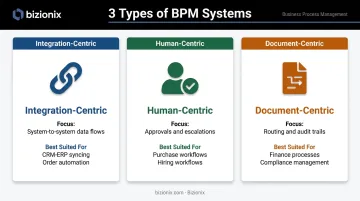
- Three practical BPM types exist: integration-centric, human-centric, and document-centric
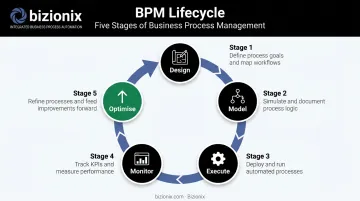
- The BPM lifecycle runs through five stages: Design, Model, Execute, Monitor, and Optimise — then repeats
- For Indian MSMEs, a unified ERP platform delivers BPM outcomes without requiring a standalone BPM tool
- GST e-invoicing (mandatory above ₹5 crore turnover) makes structured invoice workflows a regulatory necessity, not just a convenience
What is a Business Process Management System?
BPM the Discipline vs. BPMS the Software
BPM (Business Process Management) is the management discipline of identifying, designing, executing, measuring, monitoring, and continuously improving the processes that produce business outcomes. The ABPMP defines it as "a disciplined approach to identify, design, execute, document, measure, monitor, and control automated and non-automated business processes to achieve targeted results aligned with strategic goals."
A BPMS (Business Process Management System or Suite) is the technology platform that enables and automates that discipline. BPM is the methodology practised by people; a BPMS is the software that makes it scalable and measurable.
Keep this distinction in mind when evaluating tools. Buying software does not automatically mean your business practises BPM. The discipline requires process ownership, governance, and a continuous improvement mindset — the system enforces that structure at scale.
What BPM Is Not
Three things are frequently confused with BPM:
- Project management handles unique, time-bound work with a defined end date. BPM manages repeatable, ongoing processes like purchase-to-pay or invoice approval that run indefinitely
- Workflow automation executes specific steps faster — it is one tool within BPM, not the whole discipline
- Business Process Outsourcing (BPO) transfers process ownership to a third party. BPM keeps processes in-house but makes them structured and measurable
The Core Components of BPM Practice
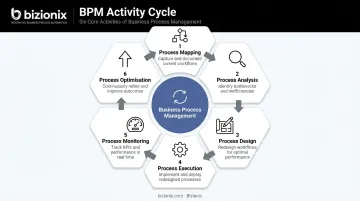
Once you understand what BPM excludes, it becomes easier to see what it actually involves. A functioning BPM practice runs on six interconnected activities:
- Process mapping — visualising how work actually flows today
- Process analysis — identifying bottlenecks, redundancies, and gaps
- Process design — engineering the improved future state
- Process execution — deploying the redesigned workflow
- Process monitoring — tracking KPIs against defined targets
- Process optimisation — acting on monitoring data to improve further
A Concrete MSME Example
Consider invoice approval at a growing business without BPM. Invoices arrive by email, get forwarded to WhatsApp, sometimes get approved verbally, occasionally go missing entirely, and payments are late because no one knows what stage an invoice is at.
Under BPM, that same process looks entirely different:
- A defined entry point replaces the email-and-WhatsApp chain
- An assigned approver at each stage eliminates ambiguity over ownership
- Automated reminders fire if action is not taken within a set time
- A complete audit trail makes every delay visible
The accounts team stops chasing approvals manually. The underlying work has not changed — but now it runs on a structure that makes progress trackable and exceptions impossible to ignore.
The 3 Types of BPM Systems
Integration-Centric BPM
This type coordinates processes across multiple software systems with minimal human involvement. The primary challenge it solves is data fragmentation : your CRM not talking to your accounting system, or sales orders failing to update inventory levels automatically.
Best suited for: Order-to-cash automation, payroll processing, CRM-to-ERP data syncing, and any workflow where the bottleneck is systems rather than people.
For MSMEs running on disconnected tools (separate accounting software, a standalone CRM, a third-party inventory tool), this is the logical entry point. A unified ERP can also solve this at the root by eliminating the need for integration entirely.
Human-Centric BPM
This type is built for processes where human judgement is the central activity. The system acts as a coordinator: assigning tasks to the right person, sending reminders when action is overdue, and escalating when deadlines are missed.
Best suited for:
- Purchase approvals and credit sanction flows
- Hiring workflows and leave sanctions
- Any process with a maker-checker requirement
The system does not replace the human decision . It ensures the right human makes that decision at the right time, and that there is a record of it.
Document-Centric BPM
This type centres the entire process around a document (a contract, invoice, purchase order, or compliance record) being routed for review, editing, approval, and sign-off.
Best suited for: Finance, legal, and compliance-heavy departments where version control and audit trails are non-negotiable.
For MSMEs subject to GST e-invoicing requirements, document-centric BPM directly addresses a hard legal requirement: every invoice must be validated, submitted to the IRP, and returned with an IRN before it is legally valid.
The 5 Stages of the BPM Lifecycle
The BPM lifecycle is a continuous loop, not a one-time project. Unlike a standard process improvement initiative, it does not end after deployment. Each cycle through the stages produces a better process than the last.
Stage 1 – Design
The design stage begins with the "as-is" analysis: documenting how work actually happens today, not how it is supposed to happen according to a policy document.
This involves stakeholder interviews, direct observation, and process mapping. The goal is honest documentation of gaps, bottlenecks, and workarounds before designing the improved "to-be" state.
Stage 2 – Model
Modelling converts the redesigned process into a precise visual representation — complete with task owners, decision points, timelines, and data flows. BPMN (Business Process Model and Notation), an ISO/IEC standard graphical notation, is the industry standard format for this.
"What-if" scenario testing happens here. What if invoice volume doubles next quarter? What if the approving manager is on leave? Stress-testing the design before going live catches problems that only become visible under real operating conditions.
Stage 3 – Execute
Execution moves the process from design into reality: configuring the BPM platform, setting automation rules, integrating connected systems, and training the people involved.
Starting with a pilot group before full rollout is critical. A pilot surfaces issues at a scale where they are still manageable:
- Unclear task ownership
- Missing data fields
- Approval chains that do not match how decisions actually get made
Stage 4 – Monitor
Monitoring is the ongoing measurement of process performance against defined KPIs. Without this stage, you cannot distinguish between a process that is working well and one that is masking a hidden problem.
Key metrics to track include:
- Cycle time and throughput
- Error and rework rates
- Approval turnaround time
- SLA compliance
Dashboards and real-time reporting replace the status meeting. Data becomes the primary management tool.
Stage 5 – Optimise
Optimisation acts on what monitoring reveals. A step that has become a bottleneck gets automated. An approval chain that creates delays gets restructured. A sub-process that no longer meets regulatory requirements gets redesigned.
This stage loops back into Stage 1, triggering a new round of design and modelling. The cycle repeats, and the process improves with each pass.
Key Benefits of Implementing a BPM System
Operational Efficiency and Cost Reduction
Every unmanaged process carries a hidden cost: the workarounds, the re-work, the manual follow-ups, the version conflicts. Collectively, this is sometimes called the "hidden factory" — work being done to fix problems that a structured process would have prevented.
McKinsey's research on automation programmes found that only 61% of organisations met their automation targets, with the gap most commonly explained by scope being too narrow. BPM addresses this by treating the entire end-to-end process as the unit of improvement, not just one isolated step.
Transparency and Accountability
BPM creates clear process ownership, real-time status visibility, and complete audit trails. Managers know exactly where a task stands, who is responsible, and where delays are occurring.
Relying on status meetings, email chains, and WhatsApp threads gives the appearance of coordination while concealing how work actually moves through the organisation.
Reduced Compliance Risk
BPM systems enforce consistent application of business rules across every process instance, automatically generating audit logs. For Indian MSMEs, this matters most in areas where documentation is a legal requirement, not just good practice.
Under GST Council Notification 10/2023, e-invoicing is mandatory for businesses with aggregate turnover exceeding ₹5 crore (effective 1 August 2023). Non-compliance carries penalties under CGST Act Section 122 of up to ₹25,000 per violation. For eligible MSMEs, a structured invoice workflow is a compliance requirement.
Scalability Without Proportional Headcount Growth
Well-designed BPM workflows let a business handle higher transaction volumes — more orders, more invoices, more customer requests — without proportionally growing headcount. Routing, reminders, and escalations are handled automatically by the system.
For growing MSMEs, this is the practical payoff: doubling transaction volume without doubling the coordination overhead that typically comes with it.
A Note on Platform Choice
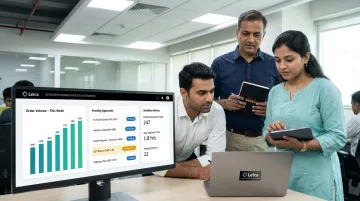
For Indian MSMEs, a unified ERP platform like Bizionix consolidates procurement, accounts, inventory, GST compliance, HRMS, and CRM under a single login — removing the need to manage separate tools across departments. When all teams operate from the same data, BPM principles become embedded in how the business runs rather than added on top of existing fragmentation.
How to Choose the Right BPM System for Your Business
Step 1: Audit Your Process Types First
Before evaluating any platform, identify what kinds of processes you are actually trying to fix:
- Primarily document-heavy? You need document routing, version control, and audit trails
- Primarily approval-driven? You need human-centric task assignment, reminders, and escalation logic
- Primarily system-to-system? You need integration capability or a unified platform that removes the integration problem entirely
Most MSMEs have all three. Start with whichever type is causing the most visible delays or errors — that's your highest-leverage entry point.
Step 2: Evaluate Cloud-Readiness and Total Cost of Ownership
For MSMEs, cloud-based systems offer clear practical advantages:
- No on-premise infrastructure or server maintenance
- Lower upfront cost with subscription-based pricing
- Automatic updates and compliance changes handled by the vendor
- Accessible from any device without IT support
natively. This means:
- Direct API integration with the Invoice Registration Portal (IRP) for instant IRN generation
- Pre-validation of invoice data against GST rules before submission
- Automatic QR code embedding and GSTR-1 auto-population
- Full audit trail on every invoice transaction
Bizionix handles this through direct API integration with the GST e-Invoice system — invoice creation triggers automatic validation and IRN generation within seconds, with no manual portal uploads or third-party tools required.
Frequently Asked Questions
What is a business process management system?
A BPMS is the technology platform that enables organisations to design, automate, execute, monitor, and continuously improve their business processes. It is distinct from BPM the discipline (a management methodology) — the system is the software that makes the methodology scalable and measurable.
What are the stages of business process management?
The five stages are Design, Model, Execute, Monitor, and Optimise. These form a continuous loop rather than a one-time sequence — each cycle feeds monitoring data back into the design stage, improving the process further with every iteration.
Is BPM better than business process outsourcing (BPO)?
They serve different purposes. BPO transfers process ownership to a third party, reducing internal control and visibility; BPM keeps processes in-house and structures them for efficiency and transparency. For businesses wanting to build internal capability, BPM is typically the stronger choice for retaining long-term control.
What are the three types of BPM systems?
Integration-centric (system-to-system data flows with minimal human input), human-centric (approval and decision-driven processes requiring task assignment and escalation), and document-centric (routing and managing key documents through review and sign-off workflows).
How is BPM different from workflow automation?
Workflow automation executes specific steps faster; BPM is the broader discipline of designing, managing, and continuously improving the entire end-to-end process. Automation is one component of BPM — which is why 66% of organisations piloting automation alone frequently miss their targets.
Can small and mid-sized businesses benefit from BPM systems?
MSMEs benefit significantly, particularly from cloud-based solutions that require no IT infrastructure investment. Starting with one high-volume process — invoice approvals or purchase order routing — produces measurable savings quickly, provided the platform is sized for MSME complexity rather than enterprise-scale implementation.