Introduction
Running a small business in India means juggling GST filings, inventory across locations, payroll compliance, and billing across three or four disconnected tools. Finance lives in a spreadsheet. Sales data is in WhatsApp. Invoices go out manually. And when the GST return deadline hits, someone spends two days reconciling everything.
This is the reality for millions of Indian MSMEs, and it's expensive — costing time, creating errors, and creating real compliance risk.
According to Statista, the global ERP software market is on track to reach $183 billion by 2030, with cloud-based adoption accelerating fastest among small and midsize businesses. In India, the shift is driven by one clear pressure: growing operations and tightening GST compliance move faster than manual processes can handle.
SaaS ERP systems address this directly. A single platform replaces the fragmented stack, accessible from any device, with no servers to maintain and automatic updates whenever GST rules change.
This guide covers the five best SaaS ERP systems for Indian small businesses in 2024, evaluated for affordability, compliance readiness, and fit for how Indian MSMEs actually operate.
Key Takeaways
- SaaS ERP unifies finance, inventory, billing, HR, and compliance in one cloud platform — no on-premise setup needed
- Indian MSMEs specifically benefit from automated GST e-invoicing, real-time inventory visibility, and faster billing cycles
- Key selection criteria: GST readiness, total cost of ownership, ease of implementation, and scalability
- Top picks for 2024: Bizionix, Oracle NetSuite, Zoho One, Microsoft Dynamics 365 Business Central, and SAP Business One
- Bizionix is the most affordable India-specific option — starting at ₹999/year with direct GST e-invoicing integration
What Is a SaaS ERP and Why Do Small Businesses Need One?
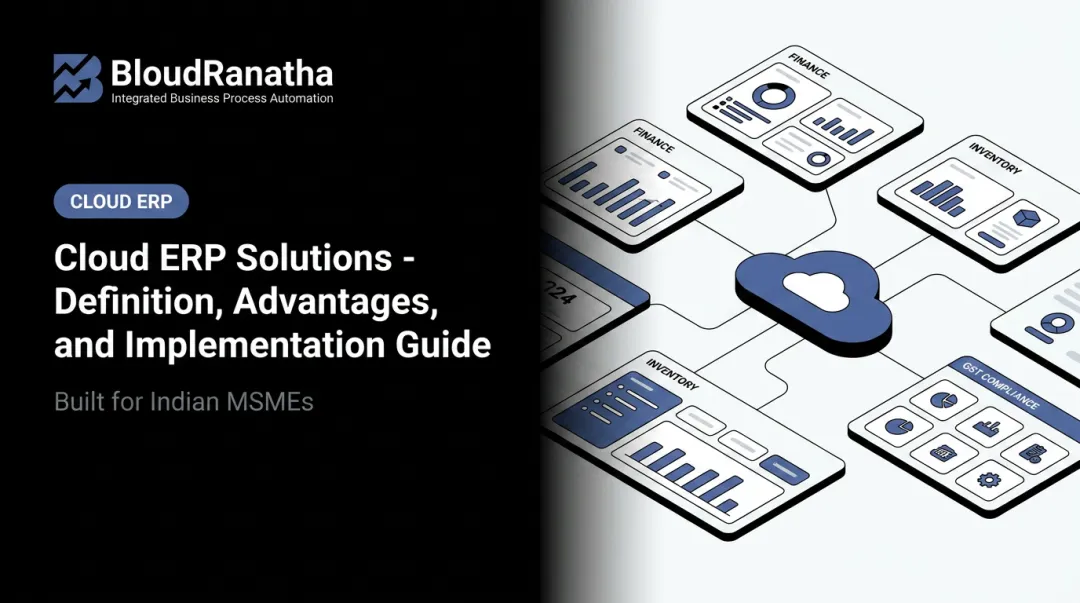
A SaaS ERP (Software-as-a-Service Enterprise Resource Planning) is a cloud-hosted business management platform where modules like accounting, inventory, billing, and HR are connected in a single system. You access it through a browser — no installation, no server setup. The vendor hosts everything, handles updates, and manages compliance integrations.
The alternative most MSMEs live with: separate accounting software, a different inventory tool, manual GST filing, and HR managed through spreadsheets. Every department operates in isolation, and reconciling data across them wastes hours every week.
Why SaaS ERP Makes Sense for Indian MSMEs Specifically
Traditional on-premise ERP requires upfront server investment, a dedicated IT team, manual patches every time GST rules change, and months of implementation before the system goes live. For a small business, none of that is practical or affordable.
SaaS ERP removes all three problems:
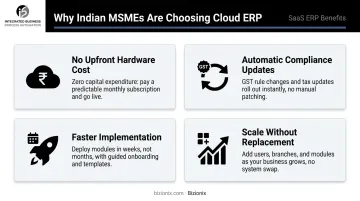
- No upfront hardware cost — pay a monthly or annual subscription and start immediately
- Automatic compliance updates — when GST thresholds or e-invoicing rules change, the platform updates without any action from your team
- Faster implementation — cloud ERPs typically go live in weeks, not months
- Scale without replacement — add users or modules as the business grows, without switching systems
Indian MSMEs face a specific dual pressure: growing operational complexity and increasing GST compliance obligations. Businesses above ₹5 crore turnover are already mandated for e-invoicing, and the threshold is expected to drop further. For businesses in that range — or approaching it — a SaaS ERP with built-in GST integration is operational infrastructure, not a nice-to-have.
Each of the five systems reviewed below was assessed against these specific criteria: GST compliance depth, ease of implementation, module coverage, and total cost of ownership for a growing MSME.
Best SaaS ERP Systems for Small Businesses in 2025
Each system below was assessed for cloud-native delivery, SMB affordability, core module coverage, and suitability for Indian business operations. Each system below was assessed for cloud-native delivery, SMB affordability, core module coverage, and suitability for Indian business operations. The list spans India-native platforms built around GST compliance to global solutions used by scaling enterprises — so the right fit depends heavily on your growth stage and operational complexity.
Bizionix
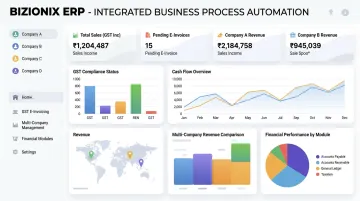
Bizionix is a 100% cloud-based ERP built specifically for Indian MSMEs by IIS-LLP, a subsidiary of Protocol India Private Limited with over two decades of industry experience. It replaces fragmented tools with a unified platform covering finance, inventory, billing, HR, and multi-company management.
Unlike generic ERP platforms adapted for India after the fact, Bizionix was designed from the ground up around GST compliance and the actual operational realities of Indian businesses.
Key differentiators include:
- Direct API integration with India's GST e-Invoice system — instant IRN generation and QR code embedding with zero manual uploads
- Automatic GSTR-1 auto-population — sales, GST returns, and accounting stay aligned without manual data entry
- **Single secure login for multiple companies** — manage multiple GST-registered entities, subsidiaries, or client portfolios from one dashboard
- Activity tracking and role-based access control — full audit trails with entity-level permissions, view/edit/admin tiers per department
- 14-day free trial on the NEO plan before any financial commitment
| Category | Details |
|---|---|
| Pricing | NEO plan: ₹999/year (trial available); Enterprise: custom pricing |
| Key Modules | GST e-invoicing, financial accounting, inventory, HRMS & payroll, CRM, hotel management (HotelEase), multi-company management |
| Best For | Indian MSMEs, CA firms, manufacturing, distribution, hotels, franchise networks, multi-location enterprises |
Oracle NetSuite
Oracle NetSuite is one of the most widely deployed cloud ERP platforms globally, purpose-built as a SaaS solution used by thousands of growing businesses. It unifies financials, inventory, order management, CRM, and HR in a single cloud-native platform with true multi-tenant architecture.
Key differentiators:
- Multi-currency and multi-subsidiary support — built for businesses with international or multi-entity operations
- SuiteSuccess pre-configured templates — industry-specific configurations that reduce implementation time
- Automatic updates — new features and compliance changes push without downtime
| Category | Details |
|---|---|
| Pricing | Starts around $99/user/month plus a base platform license (billed in USD; INR equivalent varies by exchange rate) |
| Key Modules | Financial management, inventory control, CRM, order management, multi-currency, built-in analytics |
| Best For | Fast-growing SMBs with multi-entity or global requirements, wholesale distributors planning significant scale |
NetSuite's power comes with a price point that makes it better suited to businesses with larger budgets or imminent international expansion.
Zoho One
Zoho One is a comprehensive suite of 45+ cloud applications covering ERP, CRM, HR, and finance — built by Zoho Corporation, an Indian company headquartered in Chennai.
It's widely adopted by Indian SMBs for its affordability, strong local support network, and native GST and TDS compliance built directly into the platform.
Key differentiators:
- Unified platform pricing — one subscription covers 45+ business applications
- Strong India localization — GST billing, TDS compliance, and Indian payroll built in
- Large Indian partner ecosystem — easier to find local implementation support
| Category | Details |
|---|---|
| Pricing | ₹1,994/employee/month (all-employee plan) for the Indian market; per-user options available |
| Key Modules | GST billing, CRM, HR management, finance, project management, inventory, 45+ integrated apps |
| Best For | Indian small businesses needing an affordable all-in-one suite, service-based businesses, SMBs already using Zoho products |
Zoho One is compelling for businesses that want broad coverage at a predictable per-employee cost, though the sheer number of applications can feel overwhelming without a clear implementation plan.
Microsoft Dynamics 365 Business Central
Microsoft Dynamics 365 Business Central is a cloud ERP designed for small to midsize businesses, deeply integrated with the Microsoft ecosystem — Outlook, Excel, Teams, and SharePoint. It covers finance, inventory, sales, and project management.
Key differentiators:
- Native Microsoft 365 integration — users work inside tools they already know, driving faster adoption
- Power Platform automation — build workflows and custom reports without a developer
- Biannual automatic updates — Microsoft pushes improvements twice a year with minimal disruption
| Category | Details |
|---|---|
| Pricing | Essentials: $70/user/month; Premium: $100/user/month (billed in USD; INR equivalent varies by exchange rate) |
| Key Modules | Financial management, inventory, project accounting, CRM integration, Power BI analytics, Microsoft Office integration |
| Best For | Businesses already on Microsoft 365, service-based companies, teams needing strong reporting without custom development |
Business Central's advantage is user adoption — when the ERP lives inside Outlook and Excel, teams resist it less. The GST localization for India exists but requires partner implementation to configure correctly.
SAP Business One
SAP Business One is SAP's dedicated ERP for small and midsize businesses, available on-premise or in the cloud. It covers financials, sales, purchasing, inventory, production, and reporting — widely used in manufacturing and distribution.
Key differentiators:
- Robust manufacturing and inventory functionality — particularly strong for product-based businesses with production planning needs
- Integration with SAP's broader ecosystem — a clear path to enterprise-level SAP solutions as businesses scale
- Global partner network — deep implementation coverage across industries
| Category | Details |
|---|---|
| Pricing | Cloud/SaaS pricing starts around $100–$150/user/month through SAP partners (billed in USD); implementation costs are substantial |
| Key Modules | Financial accounting, inventory management, production planning, sales and purchase management, multi-currency reporting |
| Best For | Manufacturing and product-based SMBs, businesses planning long-term growth into enterprise operations |
SAP Business One is the most implementation-intensive option on this list. Partner involvement is required, and total cost of ownership over two to three years runs higher than most alternatives here — worth it for manufacturing-focused businesses, less so for leaner operations.
How We Chose These SaaS ERP Systems
Each system on this list was evaluated against criteria tied directly to SMB outcomes — not feature count or brand name.
Evaluation criteria:
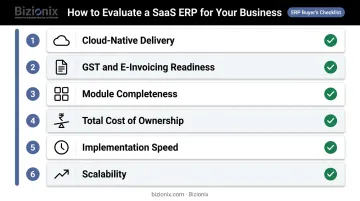
- Cloud-native delivery — no on-premise server requirement
- GST and e-invoicing readiness — built-in compliance for Indian regulatory requirements
- Module completeness — finance, inventory, billing, and HR as a baseline
- Total cost of ownership — subscription cost plus implementation, training, and customization
- Implementation speed — how quickly a small business can go live without a large IT team
- Scalability — whether the system grows with the business or requires replacement at the next stage
The most common selection mistake is choosing based on an impressive demo rather than operational fit. A platform designed for 500-user enterprises will overwhelm a 15-person MSME, and an entry-level tool will hit a ceiling just as the business starts to grow.
These criteria also shaped the vendor questions worth asking before you commit:
- What is the full implementation timeline, and what's included?
- How is data migrated from existing systems?
- How are GST rule changes applied — automatically or manually?
- What does the system cost at 2x current headcount?
- Are there fees for customisation or additional modules?
Conclusion
The right SaaS ERP for an Indian small business is not necessarily the most feature-rich one — it's the one that fits where the business is now, meets its GST compliance obligations without patching gaps manually, and won't require replacement in two years.
For most Indian MSMEs, GST readiness and affordability are non-negotiable starting points. A system that automates IRN generation, keeps GSTR-1 auto-populated, and manages multiple entities from one login removes the compliance burden that currently consumes hours every month.
Bizionix was designed to address exactly that burden. Starting at ₹999/year, it includes direct API integration with India's GST e-Invoice system and covers finance, inventory, HRMS, CRM, and hotel management in one platform — giving MSMEs the depth of a full ERP without the price tag or implementation overhead that larger systems carry.
If you're evaluating options, start with Bizionix's 14-day free trial or request a demo to see how the platform fits your specific operations — whether you're managing a single entity or multiple GST-registered companies under one group.
Frequently Asked Questions
What is the best SaaS ERP for a small business?
The best option depends on your industry, size, and compliance needs. For Indian MSMEs prioritising GST compliance and affordability, Bizionix and Zoho One are strong fits. NetSuite and Dynamics 365 Business Central suit faster-growing businesses with larger budgets and multi-entity requirements.
Is SaaS ERP suitable for small businesses?
SaaS ERP suits small businesses because it eliminates upfront server costs, offers pay-as-you-go pricing, and scales with growth. Automatic compliance updates mean your team never needs to manually track GST rule changes.
What is a SaaS-based ERP system?
A SaaS ERP is cloud-hosted enterprise resource planning software where the vendor manages infrastructure and updates. Businesses access it via browser, covering accounting, inventory, billing, and HR, with no local installation required.
What features should a small business look for in a SaaS ERP?
For Indian businesses, look for:
- GST and e-invoicing compliance built into the core
- Real-time inventory tracking across locations
- Automated billing and payment workflows
- Multi-company or multi-location support
- Role-based access control
- Modular structure so you start lean and expand as needed
What is the difference between SaaS ERP and on-premise ERP?
SaaS ERP is hosted by the vendor with no local servers and includes automatic updates. On-premise ERP is installed on company infrastructure, requiring IT maintenance. For most small businesses, SaaS offers faster deployment, lower upfront cost, and easier compliance management.
How much does a SaaS ERP cost for a small business in India?
Pricing ranges from ₹999/year (Bizionix NEO) to ₹1,994/employee/month (Zoho One). International platforms like NetSuite and Dynamics 365 are priced in USD, typically $70–$100/user/month. Always evaluate total cost of ownership (implementation, training, and customisation fees), not just the base subscription.