This guide cuts through the noise. You'll get a plain-language breakdown of cloud ERP and on-premise ERP, their real trade-offs, and a practical framework to help MSMEs and mid-sized enterprises make the right call — without second-guessing it later.
Key Takeaways
- Cloud ERP runs on vendor servers via a subscription model; on-premise installs on your own hardware managed by internal IT
- Cloud wins on lower upfront cost, faster deployment, and automatic compliance updates
- On-premise offers deeper customisation and complete data sovereignty — at the cost of higher capital investment and dedicated IT staff
- Growing MSMEs and distributed teams fit cloud ERP; large regulated enterprises with complex customisation needs lean toward on-premise
- Indian MSMEs under GST e-invoicing mandates (applicable from ₹5 crore turnover) get automatic compliance updates with cloud ERP — no manual upgrades needed
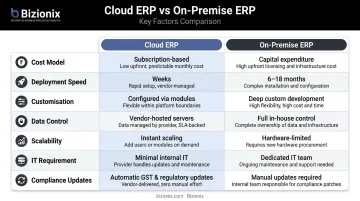
Cloud-Based ERP vs. On-Premise ERP: At a Glance
| Factor | Cloud ERP | On-Premise ERP |
|---|---|---|
| Cost Model | Subscription-based; low upfront cost | High capital spend on hardware, licenses, and implementation |
| Deployment Speed | Weeks to a few months | Months to over a year |
| Customisation | Configurable within platform framework | Full code-level customisation |
| Data Control | Vendor-hosted; vendor manages security | Company owns data and bears full security responsibility |
| Scalability | Add users or modules on demand | Requires hardware upgrades |
| IT Requirement | Minimal; vendor handles maintenance | Dedicated internal IT team required |
| Compliance Updates | Automatic; rolled out by vendor | Manual upgrades handled by your team |
What Is Cloud-Based ERP?
Cloud ERP is software hosted on a vendor's remote servers and delivered over the internet as a Software-as-a-Service (SaaS) subscription. There are no physical servers to procure, no upgrade cycles to manage manually, and no dedicated IT specialists needed just to keep the lights on.
IDC's 2024 medium-sized business ERP research found that 87% of medium-sized businesses with full-time IT staff employ four or fewer people. For those organizations, carrying on-premise infrastructure is a genuine operational strain — not just a cost concern.
Why Cloud ERP Has Become the Dominant Model
The operational case is straightforward:
- Lower upfront cost frees capital for growth instead of infrastructure
- Automatic updates mean the system always runs current features and security patches
- Remote access supports distributed teams and multi-location management from a single login
- Minimal IT burden reduces headcount dependency and ongoing maintenance costs
According to Panorama Consulting's ERP deployment data, recent ERP deployment choices break down as 65% SaaS, 22% cloud, and 13% on-premise — on-premise is clearly the minority model now. That shift is especially pronounced in India, where regulatory complexity makes cloud delivery a practical necessity.
Cloud ERP for Indian MSMEs
Modern cloud ERPs built for the Indian market go beyond the basics. GST e-invoicing now applies to businesses with aggregate turnover above ₹5 crore (effective 1 August 2023), meaning a significant portion of India's 5.77 crore registered MSMEs face live compliance obligations.
Bizionix addresses this directly. The system connects with the GST e-Invoice system via API, generating IRNs and QR codes instantly within the platform — no third-party tools, no manual portal uploads. GSTR-1 auto-populates from sales data, and compliance updates roll out automatically.
For a business near or above the ₹5 crore threshold, this eliminates the single most disruptive upgrade cycle in on-premise ERP.
Best-Fit Use Cases for Cloud ERP
Cloud ERP is the natural fit for:
- Rapidly scaling MSMEs without large internal IT teams
- Businesses managing multiple locations, entities, or GST registrations
- Distributed teams needing a single source of truth across departments
- CA firms managing multiple client accounts from one platform
- Retail, distribution, hospitality, and service-based businesses requiring real-time operational visibility
What Is On-Premise ERP?
On-premise ERP is enterprise software installed and run on a company's own servers and physical hardware, managed entirely by an internal IT team. This was the standard deployment model from the 1990s through the early 2010s, and it remains legitimate in specific contexts.
The appeal centres on control. The company owns the software outright under a perpetual licence, retains complete data sovereignty, can operate independently of internet connectivity, and has the freedom to customise at the code level — including deep integrations with legacy systems.
Enterprise Platforms in This Category
The major on-premise ERP platforms are built for large enterprises and carry corresponding complexity:
- SAP ECC / SAP ERP — SAP's own documentation describes it as "an industry standard for on-premise ERP software" and a "proven, on-premise ERP system for large enterprises"
- SAP S/4HANA (on-premise deployment option)
- Oracle E-Business Suite — covers financials, manufacturing, HCM, procurement, and logistics
- Oracle JD Edwards EnterpriseOne — supports on-premise, private cloud, and hybrid deployments
- Microsoft Dynamics 365 Finance + Operations (on-premises) — described by Microsoft as an "enterprise-class, high-scale application"
None of these are designed for SMEs. Their complexity and cost reflect their intended audience.
The Cost Reality
Panorama Consulting's 2024 ERP Report — based on 131 global respondents with a median revenue of USD $200.5M — puts the benchmarks in sharp focus:
- Median implementation cost: USD $450,000
- Median implementation duration: 15.5 months
That's the mid-market average across all deployment types. On-premise projects involving hardware procurement, network setup, and deep customisation typically sit at the higher end.
The arithmetic rarely works for Indian MSMEs. High capital expenditure, long rollout timelines, and the need for specialised IT staff create a total cost of ownership that most growing businesses cannot justify — particularly when compliance requirements like GST e-invoicing demand frequent updates that on-premise systems cannot deliver automatically.
When On-Premise Actually Makes Sense
On-premise ERP is a legitimate choice for:
- Large enterprises in defence, aerospace, government, or healthcare operating under strict data residency or air-gap security mandates
- Manufacturers with complex, low-latency shop floor integrations requiring dedicated hardware
- Organisations in low-connectivity regions where reliable internet is unavailable
Outside these scenarios, the control advantage of on-premise rarely justifies the operational overhead for most businesses.
Cloud ERP vs. On-Premise ERP: Which Is Right for Your Business?
The Total Cost of Ownership Question
On-premise ERP can appear cheaper long-term because of perpetual licensing. That calculation breaks down when you include the full cost picture.
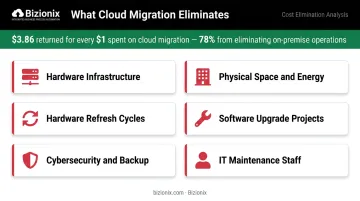
Nucleus Research's 2023 study of 480 organisations found that cloud migration returns $3.86 for every $1 spent — with 78% of that return coming directly from eliminating on-premise operations. The cost components being eliminated include:
- Hardware infrastructure and server procurement
- Physical space and energy costs for server racks
- Hardware refresh cycles (typically every 5–7 years)
- Software upgrade projects and associated consulting fees
- Ongoing cybersecurity management and backup infrastructure
- IT staff dedicated to system maintenance
Over a five-year horizon, a cloud subscription frequently costs less than the cumulative burden of these on-premise components — even before accounting for the productivity cost of downtime during upgrade cycles.
Decision Framework
Choose cloud ERP when:
- Capital preservation matters more than perpetual licensing
- Your team lacks dedicated IT infrastructure capacity
- You need remote access across locations or distributed teams
- GST compliance, e-invoicing, and automatic regulatory updates are priorities
- You expect to scale users, modules, or entities without hardware changes
- Fast deployment (weeks to months) outweighs deep customisation needs
Choose on-premise ERP when:
- Your industry mandates complete data sovereignty or air-gap security
- You require code-level customisation not achievable within a cloud platform's framework
- Your facilities operate in areas without reliable internet connectivity
- You have existing infrastructure, a robust IT team, and the capital to absorb high upfront costs
The Indian MSME Context
India's MSME sector accounts for 30.1% of GDP, 35.4% of manufacturing output, and 45.73% of exports — the operational decisions these businesses make genuinely matter at scale. For most of them, the ERP decision comes down to a practical question: how much time and capital can you afford to spend managing the system rather than running the business?
Cloud ERP shifts that burden off the business entirely. Bizionix is built specifically for Indian MSMEs — it handles multi-company management (single login across multiple entities, GST registrations, or branches), GST-ready accounting with automated e-invoicing, and real-time dashboards across operations.
The entry point starts at ₹999 per year. The platform scales to an Enterprise tier with full module access — production planning, advanced HRMS, and custom workflows — as the business grows.
For businesses wanting to see the platform before committing, a 14-day free trial is available on the NEO plan.
A Note on Hybrid ERP
Some larger organisations choose a two-tier or hybrid model — cloud ERP for regional offices or subsidiaries, on-premise at headquarters. This allows a phased transition, maintains centralised control where needed, and gives distributed locations the accessibility and scalability of cloud. A practical fit for enterprises with existing on-premise investments that aren't yet ready for full migration.
Conclusion
Cloud ERP fits the needs of most growing businesses — Indian MSMEs included — because it eliminates infrastructure overhead, keeps GST and compliance current without manual intervention, and scales with subscription costs rather than capital spend. On-premise still makes sense for large enterprises in heavily regulated sectors that need deep customisation and have dedicated IT teams to support it.
For most MSMEs, the real decision isn't whether to go cloud — it's which cloud ERP is built for your industry and business context. Before committing, evaluate:
- IT capacity — do you have the team to manage and maintain local infrastructure?
- Compliance obligations — how often do GST rules, e-invoicing thresholds, or sector regulations change for you?
- Growth trajectory — will you need to add users, locations, or modules within the next two years?
- Budget structure — is a predictable monthly subscription easier to manage than large upfront capital expenditure?
For most Indian MSMEs, those four questions lead to the same answer: a cloud ERP designed specifically for the Indian regulatory environment, one that handles compliance automatically and grows without requiring a fresh investment every time the business does.
Frequently Asked Questions
What is the difference between cloud ERP and on-premise ERP?
Cloud ERP is hosted on a vendor's remote servers and accessed via the internet on a subscription basis, while on-premise ERP is installed on a company's own hardware and managed internally. The core differences lie in deployment location, cost structure (OpEx vs. CapEx), and who bears maintenance and upgrade responsibility.
What is an on-premise ERP system?
On-premise ERP is enterprise software installed directly on a company's local servers and managed by internal IT staff. It offers full data control and deep customisation at the cost of high upfront investment, ongoing maintenance burden, and manual upgrade cycles for compliance changes.
Is on-premise ERP cheaper than cloud ERP?
Not typically. While perpetual licensing avoids subscription fees, total cost of ownership — covering hardware, IT salaries, upgrade projects, and security management — frequently makes on-premise more expensive over a five-year period, especially for mid-sized businesses.
Which is better, cloud ERP or on-premise ERP?
It depends on your organisation's size, IT capability, and budget. Cloud ERP suits most SMBs and growing businesses needing scalability and automatic compliance updates; on-premise fits large regulated enterprises requiring complete data sovereignty and deep customisation.
What are the top on-premise ERP systems?
Leading on-premise platforms include SAP ECC, SAP S/4HANA, Oracle E-Business Suite, Oracle JD Edwards EnterpriseOne, and Microsoft Dynamics 365 Finance + Operations. All are designed for large enterprises and carry significant implementation complexity and cost — typically out of reach for most MSMEs.
Can cloud ERP support GST compliance for Indian businesses?
Yes. Indian-market cloud ERPs such as Bizionix include GST-ready accounting, automated e-invoicing with direct API integration for instant IRN generation, and GSTR-1 auto-population. Compliance updates roll out automatically, removing the manual upgrade burden on-premise users face each time GST rules change.