ERP hosting is the model that solves this. Instead of buying servers and building your own IT setup to run an ERP system, you access one over the internet — managed, maintained, and secured by someone else. For most Indian MSMEs, this is what makes enterprise-grade software practical.
This article covers exactly what ERP hosting means, the four main types, what it actually delivers for growing businesses, and how to pick the model that fits your stage.
Key Takeaways
- ERP hosting means running your ERP system on remote servers managed by a provider — not on hardware you own and maintain
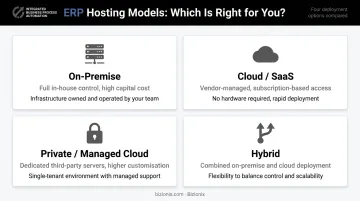
- Four main models: on-premise, cloud/SaaS, private/managed cloud, and hybrid
- Cloud/SaaS hosting offers the lowest barrier to entry and zero IT overhead — the right fit for most Indian MSMEs
- Hosted ERP handles software updates automatically — GST and e-invoicing compliance included
- Evaluate hosting options based on your IT capacity, customisation needs, compliance requirements, and growth pace
What Is ERP Hosting?
ERP software brings your core business functions — finance, inventory, procurement, HR — into a single system. ERP hosting simply refers to where that software runs and who manages the infrastructure underneath it.
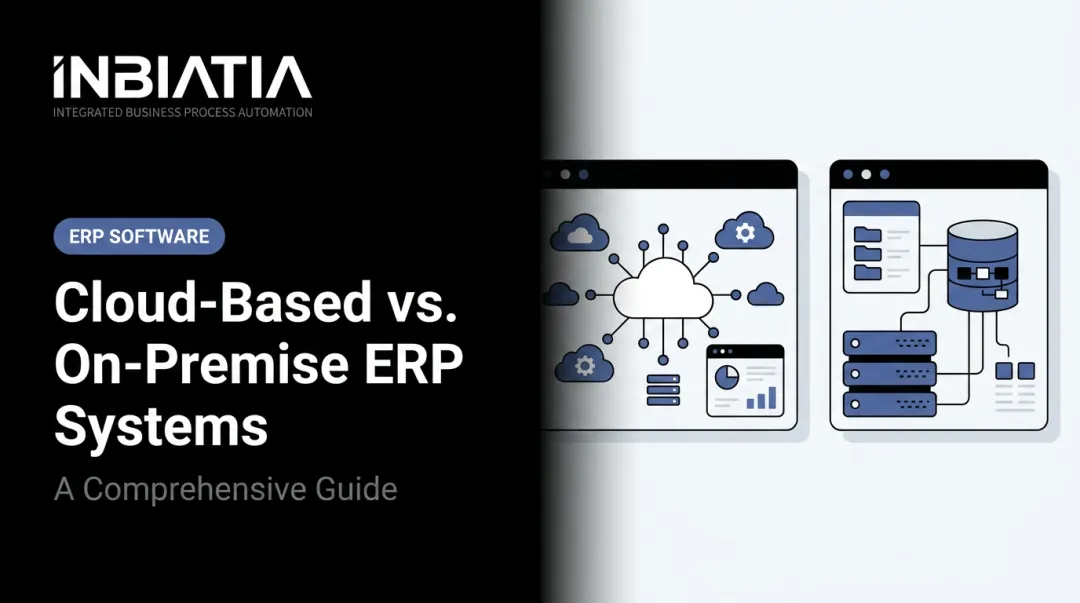
In a traditional on-premise setup, the company owns the servers, installs the ERP software locally, and takes full responsibility for hardware maintenance, security, upgrades, and backups. Think of it like owning a generator: full control over the power supply, but full responsibility when something fails at 2 a.m.
Hosted ERP flips that model. The servers, maintenance, security patches, and uptime are someone else's problem — either the ERP vendor or a third-party hosting provider. You access the system through a web browser from any device, anywhere with an internet connection.
Hosted ERP vs. SaaS ERP — What's the Difference?
This is where most people get confused, and the distinction matters:
- Hosted ERP — You own or license the ERP software; a third-party provider installs it on their dedicated servers and manages the infrastructure for you
- SaaS ERP — The vendor owns the software and delivers it as a subscription service over the internet; you never touch the infrastructure at all
Both are forms of ERP hosting. SaaS is the simpler, lower-overhead version — and the one most relevant to businesses without in-house IT teams. The global ERP software market grew 11.3% in 2024, with cloud adoption cited as the primary driver — a shift that's especially visible among MSMEs moving away from expensive on-premise setups toward more accessible hosted solutions.
The 4 Types of ERP Hosting Options
Each model distributes responsibility differently. The right choice depends on your IT capacity, budget, and how much control you need.
On-Premise ERP
The ERP software runs on servers physically inside your facility. Your team owns and manages everything — hardware, software, updates, backups, and security.
Pros:
- Maximum control over data and infrastructure
- No internet dependency for daily operations
- Sensitive data stays entirely in-house
Cons:
- High upfront capital expenditure on servers and licensing
- Requires dedicated IT staff to maintain
- Scaling means buying more hardware
- Slow to deploy, slow to upgrade
For most MSMEs, on-premise is impractical. The infrastructure costs alone — before a single user logs in — can be prohibitive.
Cloud ERP Hosting (SaaS)
The ERP vendor hosts the software on their own cloud infrastructure and delivers it as a subscription. Updates, security, and infrastructure are fully managed by the vendor. You pay a recurring fee and access the system through a browser.
Pros:
- No upfront infrastructure cost
- Automatic updates, including compliance changes
- Accessible from any device, anywhere
- Fastest to deploy
Cons:
- Less customisation flexibility than self-hosted options
- Data sits on shared (multi-tenant) infrastructure
- Vendor dependency for uptime and feature roadmap
This is the model Bizionix follows — a 100% cloud-based ERP built specifically for Indian MSMEs. Customers need no servers, no IT team, and no complex setup. The NEO plan starts at ₹999/year, with enterprise pricing available for larger or more complex operations.
Private/Managed Cloud Hosting
A third-party hosting provider (not the ERP vendor) sets up dedicated servers for a single client and manages them remotely. The business usually owns or licenses its own ERP software but runs it on the provider's infrastructure.
Pros:
- More control and isolation than shared SaaS
- Dedicated resources — no competing with other tenants
- Higher customisation potential
Cons:
- More expensive than SaaS
- Still requires IT coordination between your team and the provider
- Longer deployment timelines
This model suits mid-to-large businesses with specific compliance or customisation requirements that SaaS can't accommodate.
Hybrid ERP Hosting
Hybrid combines on-premise and cloud deployment — keeping mission-critical or sensitive data on local servers while pushing other functions to the cloud. In practice, this means two separate environments running in parallel, with data syncing between them.
Pros:
- Useful during phased cloud migration
- Reduces full on-premise cost while retaining local control
- Flexibility to move functions incrementally
Cons:
- Managing two environments simultaneously adds complexity
- Integration between on-premise and cloud components requires maintenance
- Not practical for small businesses starting fresh
Hybrid works best for businesses already running on-premise ERP that need to migrate gradually, not for those building from scratch.
Key Benefits of ERP Hosting for Growing Businesses
Cost Efficiency
On-premise ERP requires capital expenditure on servers, software licences, and IT personnel before you've processed a single transaction. Hosted ERP — especially SaaS — replaces that with a predictable subscription fee.
For MSMEs, this matters because cash flow is finite. A fixed monthly or annual cost is far easier to budget than unpredictable hardware refresh cycles and emergency IT support bills.
Anywhere Access and Real-Time Visibility
Hosted ERP gives owners, managers, and field teams live access to business data — inventory levels, pending invoices, sales figures — from any device with an internet connection.
For businesses operating across multiple locations, this eliminates the data silos that come from branch-level spreadsheets. Bizionix, for example, supports multi-company management through a single login, letting management switch between entities, view consolidated dashboards, and monitor operations across branches in real time — without logging in and out of separate systems.
Automatic Updates and Compliance Readiness
GST regulations in India don't stand still. GST Council Notification 10/2023 mandated e-invoicing for businesses with aggregate turnover exceeding ₹5 crore from 1 August 2023 — and thresholds continue to evolve.
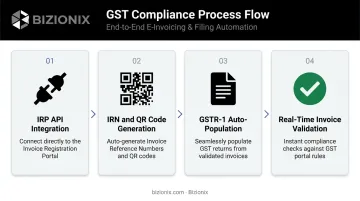
With hosted ERP, the vendor absorbs these changes. When a GST rule changes, the vendor updates the software centrally. Bizionix's GST compliance capabilities include:
- Direct API integration with the Invoice Registration Portal (IRP)
- Automatic IRN and QR code generation
- GSTR-1 auto-population
- Real-time invoice validation before submission
There are no manual patches to apply and no risk of running outdated compliance logic when filing deadlines hit.
Scalability Without Infrastructure Investment
Adding a new branch, 20 more users, or a payroll module shouldn't require buying servers. With cloud ERP, it doesn't. The hosting provider's infrastructure scales to accommodate growth — you just adjust your subscription.
Bizionix's architecture reflects this directly. Both plans run on the same infrastructure — no hardware changes required on your end:
- NEO plan: Core modules for smaller teams getting started
- Enterprise plan: All 12+ modules, including Production Planning, advanced Warehouse Management, and full HRMS with Payroll
Built-In Security and Data Protection
The Veeam Data Protection Trends Report 2024, based on 1,200 IT leaders globally, found that cyberattacks were the number one cause of business outages, and 92% of organisations planned to increase data protection spending. Less than one-third believed they could recover quickly from even a small incident.
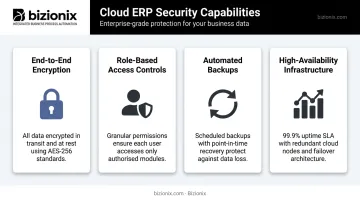
A well-configured hosted ERP addresses this with:
- End-to-end data encryption
- Role-based access controls
- Automated backups
- High-availability infrastructure
Most small businesses cannot replicate these protections on-premise without significant ongoing investment.
On-Premise vs. Cloud ERP Hosting: A Quick Comparison
| Dimension | On-Premise | Cloud/SaaS |
|---|---|---|
| Upfront cost | High — servers, licences, setup | Low — subscription-based |
| Ongoing maintenance | Managed entirely in-house | Managed by vendor |
| Scalability | Tied to physical hardware | Scales on demand |
| Accessibility | Local network or VPN | Any browser, any device |
| Security & DR | Customer's responsibility | Provider-managed |
| Deployment time | Weeks to months | Days to weeks |
| IT staff required | Yes | No |
On-premise hosting makes sense in specific situations — strict data residency requirements, unreliable internet connectivity, or an existing in-house IT team built to manage infrastructure. For most growing Indian businesses, none of those conditions apply.
Cloud and SaaS hosting deliver a far better cost-to-value ratio — and remove the hosting decision entirely, so the business can focus on operations.
That said, not every business is ready to move fully to the cloud. Hybrid hosting offers a workable path for companies still running legacy on-premise systems — a bridge to managed infrastructure, not a permanent destination.
How to Choose the Right ERP Hosting Model
Before committing to any hosting model, ask four questions:
What is your IT capacity? Do you have in-house technical staff who can manage servers, handle updates, and respond to outages? If not, managed cloud or SaaS is the practical choice.
How much customisation do you need vs. how fast do you need to go live? Heavily customised ERP implementations take longer and cost more. SaaS platforms prioritise speed and standard workflows.
What are your compliance requirements? If GST compliance, e-invoicing mandates, and audit-ready records are non-negotiable — and for most Indian businesses they are — choose a hosted ERP vendor with built-in, automatically updated compliance logic.
What does your growth trajectory look like? If you're adding locations, users, or product lines within the next 12-24 months, choose a model that scales without requiring new infrastructure purchases.
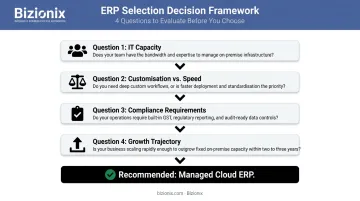
For most Indian MSMEs in manufacturing, distribution, retail, hospitality, or professional services, a fully managed cloud ERP is the most sensible starting point. The vendor handles infrastructure, compliance updates, and security. Your team focuses on selling, fulfilling, and growing.
Bizionix is built around exactly this model — 100% cloud-hosted, with built-in GST compliance and automated e-invoicing, multi-company management, and real-time dashboards. There's no SAP-level complexity or cost, and implementation is measured in days, not months.
When evaluating any ERP vendor, verify:
- Data centre location and data residency policies
- Uptime SLA and support availability
- Track record with businesses of similar size and industry
- Whether compliance updates are pushed automatically or require manual action
Frequently Asked Questions
What is ERP hosting?
ERP hosting is the practice of running an ERP system on remote servers managed by a third-party provider or cloud platform, rather than on hardware the business owns. Users access the system via the internet — no local servers required.
What are the 4 types of ERP hosting?
The four models are:
- On-premise — in-house servers, full IT responsibility on the business
- SaaS/cloud — vendor-managed, subscription-based access
- Private/managed cloud — dedicated third-party hosted environment
- Hybrid — combination of on-premise and cloud
Each suits different business sizes, budgets, and control requirements.
What is the difference between SaaS ERP and hosted ERP?
SaaS ERP means the vendor owns and operates the software on shared cloud infrastructure — you subscribe to access it. Hosted ERP typically means your own licensed software runs on a third-party provider's dedicated servers, giving more control but requiring more management involvement.
Is cloud ERP hosting secure for business data?
Reputable cloud ERP providers use enterprise-grade security — data encryption, role-based access controls, automated backups, and compliance certifications. For most small and mid-sized businesses, this level of protection exceeds what an in-house server setup can realistically deliver.
Can hosted ERP support multi-location businesses?
Yes. Cloud-hosted ERPs are well-suited for multi-location operations because all branches access the same centralised system in real time. Management gets a unified view across locations, and each branch works from the same live data.