This isn't a resource problem. It's an architecture problem. And it's exactly what ERP as a Service was built to solve.
This article breaks down what SaaS ERP actually is, how it differs from on-premises and cloud-hosted alternatives, which features matter most for Indian MSMEs, and how to tell whether your business is ready for it.
Key Takeaways
- SaaS ERP delivers integrated business management software via a browser subscription — no servers, no large upfront investment
- It differs from on-premises ERP in cost structure, who manages the system, and how fast you can go live
- Benefits include lower total cost of ownership, faster deployment, real-time data visibility, and built-in compliance
- Indian businesses above ₹5 Cr turnover must issue e-invoices; a GST-ready SaaS ERP automates this end to end
- The right platform should match your business type, scale with growth, and require minimal IT overhead
What Is ERP as a Service?
Enterprise Resource Planning (ERP) is software that integrates core business functions — finance, inventory, procurement, sales, HR — into a single system with a shared database. Every department works from the same real-time data, eliminating the duplication and reconciliation that slows down businesses using disconnected tools.
The "as a Service" part changes how that software is delivered. Instead of buying a licence and installing it on internal servers, you access the ERP through a web browser and pay a monthly or annual subscription. The vendor hosts the system, manages updates, and handles all infrastructure. Your team logs in from any browser — no installation, no server management required.
How SaaS ERP Has Evolved
The shift from on-premises ERP to today's SaaS model happened in stages:
- 1990s–2000s: ERP was expensive, server-based, and built for large enterprises with dedicated IT teams
- Mid-2000s: Cloud-hosted ERP emerged — still complex, but infrastructure moved off-site
- 2010s onward: True multi-tenant SaaS ERP arrived, making enterprise-grade capabilities accessible to mid-market and smaller businesses
The numbers reflect this shift. According to MarketsandMarkets, the cloud ERP market is projected to grow from USD 87.73 billion in 2024 to USD 172.74 billion by 2029, at a 14.5% CAGR. That growth is being driven by businesses of all sizes moving away from legacy systems — and Indian MSMEs are a significant part of that shift.
For growing businesses in India, SaaS delivery removes the two barriers that historically kept teams on spreadsheets: cost and complexity. No server room. No dedicated IT department. Just a browser and a subscription.
SaaS ERP vs. On-Premises vs. Cloud ERP: Key Differences
A common source of confusion: "cloud ERP" and "SaaS ERP" are often used interchangeably, but they are not the same thing. SaaS ERP is a subset of cloud ERP. All SaaS ERP is cloud-based, but not all cloud ERP is SaaS.
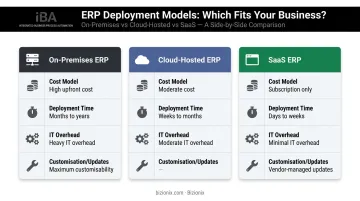
Here's how the three models compare:
| Factor | On-Premises ERP | Cloud-Hosted ERP | SaaS ERP |
|---|---|---|---|
| Where it runs | Your servers | Cloud infrastructure | Vendor's cloud (multi-tenant) |
| Who manages updates | Your IT team | Varies | Vendor |
| Upfront cost | High (hardware + licences) | Moderate | Low (subscription only) |
| Deployment speed | Months to years | Weeks to months | Days to weeks |
| Customisability | Maximum | High | Configurable |
| IT overhead | Heavy | Moderate | Minimal |
On-Premises ERP
The software lives on the company's own servers, managed by an internal IT team. You get maximum control and customisability, but at significant cost. Panorama Consulting's 2024 ERP Report found a median ERP project cost of USD $450,000 (roughly ₹3.7 crore) across surveyed implementations, with a median duration of 15.5 months. Add ongoing maintenance, security patching, and upgrade costs, and on-premises ERP becomes a sustained operational burden well beyond the initial deployment.
Cloud-Hosted ERP vs. SaaS ERP
Cloud-hosted ERP runs on cloud infrastructure, but the customer may still manage application-level configuration, updates, or integrations. In SaaS ERP, the vendor manages everything — infrastructure, application updates, security, and backups. The customer accesses via browser with a subscription.
The practical difference: with SaaS, your team focuses on running the business. With cloud-hosted ERP, some IT responsibility remains with you.
Hybrid ERP
Some large enterprises run certain functions on-premises (for data residency or regulatory reasons) while using SaaS ERP for other departments. This adds integration complexity and makes poor sense for MSMEs with limited IT teams.
That complexity points directly to why SaaS ERP suits Indian MSMEs best. With constrained IT budgets and active GST/e-invoicing compliance requirements, the ability to have vendors embed regulatory updates automatically — no manual patching required — removes a genuine operational risk.
Core Features of a Modern SaaS ERP System
Not all SaaS ERP platforms are equal. Here's what a well-built system should include:
Integrated Modules on a Single Database
The value of ERP lies in integration. A purchase order raised in procurement should automatically update inventory and reflect in accounting — no manual re-entry. Core modules to look for:
- Finance and accounting: General ledger, accounts payable/receivable, bank reconciliation, P&L, balance sheet
- Inventory management: Multi-location stock tracking, real-time movement monitoring
- Purchase management: Vendor management, purchase orders, GRN workflows
- Sales and CRM: Quotations, sales orders, customer lifecycle management
- Warehouse management: Storage optimisation, material issue tracking
- HRMS and payroll: Attendance, salary processing, statutory compliance
Bizionix integrates all of these into a single database — meaning sales, finance, and operations always work from the same real-time numbers. For a business managing 50+ purchase orders a day, that means zero manual re-entry between procurement and accounts.
Real-Time Dashboards
That unified data layer is what makes live dashboards possible. SaaS ERP replaces end-of-month reports with real-time visibility — business owners can track cash flow, receivables, stock levels, and order status at any point in the day.
The IDC MarketScape for SaaS Small Business ERP notes that ERP gives small businesses "actionable insights" and a "single source of data truth" — particularly valuable for MSMEs managing GST deadlines and collection cycles simultaneously.
India-Specific Compliance Features
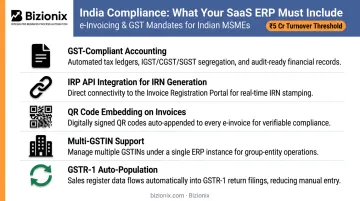
For Indian businesses, compliance capability is non-negotiable. Per GST Council Notification 10/2023-Central Tax, e-invoicing is mandatory for taxpayers with aggregate turnover exceeding ₹5 Cr from 1 August 2023. Any SaaS ERP you evaluate must include:
- GST-compliant accounting and return preparation
- Direct API integration with the IRP for automated IRN generation
- QR code embedding on invoices
- Multi-GSTIN support for businesses with multiple registrations
- GSTR-1 auto-population from sales data
Key Benefits of ERP as a Service for Growing Businesses
Lower Total Cost of Ownership
On-premises ERP requires capital expenditure on hardware, software licences, implementation, annual maintenance, and periodic upgrade projects. SaaS ERP converts this to a predictable operational expense — subscription fee, everything included.
For an MSME, this difference can determine whether ERP is affordable at all. Bizionix's NEO plan starts at ₹999 per year, covering nine functional areas:
- CRM and sales management
- Accounts and finance
- HRMS and payroll
- GST compliance and e-invoicing
- Reporting and dashboards
No per-user fees, no separate module licences.
Faster Deployment
IDC reports average implementation times of 1–4 weeks for smaller organisations on SaaS ERP — compared to the 15.5-month median for larger ERP projects tracked by Panorama. For an MSME that needs to be operational quickly, this difference matters.
Bizionix's e-invoicing module illustrates this well: enter your API key and GST credentials, and you're generating compliant invoices in minutes — no IT specialist required.
Scalability Without Capital Investment
As your business grows — adding locations, users, entities, or business lines — SaaS ERP scales through configuration changes and subscription adjustments, not infrastructure purchases.
Bizionix's multi-company management handles this directly: multiple GST-registered entities, branches, or franchise locations managed from a single login, each with independent books of accounts and consolidated group-level reporting.
Real-Time Visibility Across Departments
With all departments on one platform, business owners see a unified picture of operations — from purchase orders to cash flow to invoice status — without chasing data across systems. IDC found that nearly 40% of small businesses prioritise migrating spreadsheet data into ERP specifically to eliminate this fragmentation.
Automatic Updates and Compliance Continuity
When GST rules change or e-invoice mandates expand, SaaS vendors push updates to all customers automatically. Businesses don't manually patch systems or monitor regulatory notifications. For Indian MSMEs navigating frequent GST amendments, this eliminates a real operational risk — one that on-premises users absorb every time a rule changes.
Signs Your Business Needs a SaaS ERP Solution
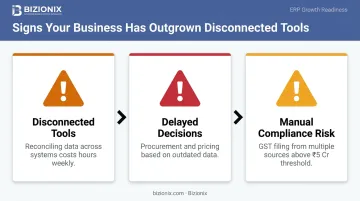
If your business is hitting any of these friction points, fragmented systems are likely the root cause — and a SaaS ERP is the practical fix.
You're managing operations across disconnected tools. If reconciling data across your accounting software, inventory tracker, and procurement spreadsheets costs your team hours every week — manual re-entry, version conflicts, calls to confirm numbers — that fragmentation already costs more than a SaaS ERP subscription.
Your decisions are based on delayed or incomplete data. Making procurement, pricing, or staffing decisions on last week's data leads to predictable downstream problems: overstocking, missed opportunities, cash flow surprises. Real-time ERP visibility closes this gap.
Compliance management is manual and error-prone. If GST filing involves pulling data from multiple sources, manually reconciling mismatches, and validating invoices by hand — and your turnover crosses the ₹5 Cr e-invoice threshold — the risk of penalties and audit exposure is real. Built-in compliance automation handles IRN generation, e-way bills, and GST returns without the manual effort.
What to Look for When Choosing a SaaS ERP
Module Coverage for Your Business Type
Map your core processes before evaluating vendors. A manufacturing business needs Bill of Materials and production tracking. A distributor needs multi-location warehouse management. A services business needs project billing and CRM. Generic ERP that forces heavy customisation to fit your industry adds cost and complexity — the opposite of what SaaS is meant to solve.
Ease of Implementation and Vendor Support
Getting the right module fit matters, but so does how smoothly you actually go live. For MSMEs without in-house IT teams, a platform that requires months of external consulting before you see value is a red flag. Look for:
- Guided onboarding with training included
- Configurable (not just customisable) workflows that match your SOPs
- Accessible support via phone, email, and ticketing
- Clear go-live timelines communicated upfront
Bizionix supports clients from implementation through post-deployment, with dedicated support channels at +91 91779 99277 and support@bizionix.com, and training as part of the onboarding process.
India-Specific Compliance Readiness and Pricing Fit
For Indian businesses, verify:
- GST-compliant accounting built in (not bolted on)
- Direct IRP API integration for IRN generation
- Multi-GSTIN support
- Pricing appropriate for MSME budgets
Bizionix was built specifically for Indian MSMEs, covering these requirements out of the box:
- Direct API integration with the GST e-Invoice system
- Automated IRN and QR code generation
- Multi-company management under a single login
- Flat-fee pricing without SAP-level complexity
For businesses near or above the ₹5 Cr turnover threshold, this compliance infrastructure is not optional — it's foundational.
Frequently Asked Questions
What is an ERP in SaaS?
ERP in SaaS means enterprise resource planning software delivered over the internet via a subscription model. The vendor hosts and manages the system, and users access it through a browser — no hardware or on-site installation required.
What is the difference between SaaS ERP and cloud ERP?
All SaaS ERP is cloud-based, but not all cloud ERP is SaaS. SaaS ERP means the vendor manages everything — infrastructure, updates, and security — in a shared multi-tenant environment. Other cloud ERP models may still require customers to manage parts of the application layer themselves.
Is SaaS ERP secure for small and mid-sized businesses?
Reputable SaaS ERP vendors provide enterprise-grade security — encryption, role-based access control, automated backups, and continuous monitoring — that most MSMEs couldn't replicate independently. For smaller businesses with limited IT staff, SaaS typically delivers stronger security than an in-house setup.
What modules are typically included in a SaaS ERP system?
Core modules include financial accounting, inventory management, procurement, order management, and HRMS. Industry-specific modules add manufacturing (BOM, production planning), warehouse management, CRM, and project accounting depending on the platform and business type.
How long does a SaaS ERP implementation typically take?
For smaller organisations, SaaS ERP implementations typically take a few weeks to a few months — far shorter than the 15.5-month median reported for larger ERP projects. Complexity, module count, and data migration requirements are the main variables.
Can SaaS ERP handle GST compliance for Indian businesses?
India-built SaaS ERP platforms include GST-compliant accounting, automated e-invoicing, direct IRP API integration for IRN generation, and multi-GSTIN support. Compliance updates are pushed automatically as regulations change — eliminating the manual burden for growing businesses.