The global ERP market is valued at USD 78.15 billion in 2026, projected to reach USD 120.96 billion by 2031 — driven by cloud adoption, AI integration, and compliance digitisation across markets. India's ERP market grew from USD 1.07 billion in 2025 to USD 1.24 billion in 2026, reflecting how seriously Indian businesses are now taking structured operations.
This guide evaluates the top ERP vendors across different business sizes and contexts — from global enterprise platforms to purpose-built Indian MSME solutions — so you can make an informed decision rather than a brand-driven one.
Key Takeaways
- ERP software unifies finance, inventory, procurement, HR, and compliance into one platform — eliminating silos and manual workarounds
- Global leaders like SAP, Oracle NetSuite, and Microsoft Dynamics 365 serve large enterprises but come with high costs and complex implementations
- Indian MSMEs need GST compliance, affordable pricing, and scalability — not enterprise-level overhead
- The right vendor must match your industry, business size, compliance needs, and growth stage
- Bizionix is built specifically for Indian MSMEs — GST-ready, cloud-based, and priced without the SAP-level overhead
ERP Software in Today's Business Market
ERP Software: From Enterprise Tool to Business Standard
ERP (Enterprise Resource Planning) software connects all core business functions — accounting, inventory, procurement, HR, and customer management — into a unified digital platform, giving leadership real-time visibility across the entire organisation.
The numbers behind this market reflect a structural shift, not a trend:
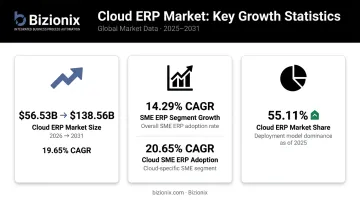
- Cloud ERP is projected to grow from USD 56.53 billion in 2026 to USD 138.56 billion by 2031 at a 19.65% CAGR
- SMEs are the fastest-growing ERP segment, projected at 14.29% CAGR through 2031 — with cloud ERP adoption among SMEs at 20.65% CAGR
- Cloud models already account for 55.11% of the ERP market as of 2025
Three forces are driving this growth:
- Cloud deployment removing infrastructure barriers for smaller businesses
- AI-driven analytics embedded directly into ERP workflows
- Compliance mandates — particularly in markets like India — pushing businesses toward structured digital systems
With over 7.71 crore MSME registrations on India's Udyam Portal supporting nearly 34 crore jobs, ERP has become a standard operational requirement across businesses of every size — not just large enterprises.
With more vendors entering the market each year, choosing the right platform comes down to fit — industry, scale, and compliance needs. The section below evaluates the top ERP software providers across different business contexts.
Top ERP Solution Providers: Best Software Vendors
These vendors were selected based on six key criteria:
- Market presence and industry track record
- Feature depth and module coverage
- Scalability across business sizes
- Deployment flexibility (cloud, on-premise, hybrid)
- Pricing transparency
- Real-world fit across industries
SAP S/4HANA
SAP S/4HANA is an enterprise-grade ERP platform built on in-memory computing, designed for large organisations with complex, global operations. It covers finance, supply chain, manufacturing, and procurement within a tightly integrated suite — and was named a Leader in the 2025 Gartner Magic Quadrant for Cloud ERP for Product-Centric Enterprises.
Core capabilities include real-time analytics, multinational compliance across 60 countries and regions, and AI-driven process automation. SAP also supports localisation through 1,000+ local product versions globally.
That said, implementation complexity and licensing costs make it a poor fit for lean or growing businesses without dedicated IT teams.
| Dimension | Detail |
|---|---|
| Best For | Large enterprises and multinationals with complex, multi-department operations |
| Deployment Options | Cloud, on-premise, and hybrid |
| Key Consideration | High implementation cost; requires dedicated IT teams; not suited for MSMEs or lean businesses |
Oracle NetSuite
Oracle NetSuite is a cloud-first ERP used by 43,000+ customers globally, covering financial management, inventory, order management, CRM, and e-commerce under one roof. It was also named a Leader in the 2025 Gartner Magic Quadrant for Cloud ERP.
NetSuite's strength is its cloud-native architecture and scalability — from startups through large enterprises. Its licensing structure combines a core platform fee, optional modules, and per-user pricing, plus a one-time implementation fee. NetSuite's SuiteSuccess programme targets a "zero to cloud in 100 days" deployment window.
The pricing model, while structured, lacks public transparency for smaller buyers — making it less accessible for budget-constrained MSMEs.
| Dimension | Detail |
|---|---|
| Best For | Mid-market to enterprise businesses needing cloud-first, scalable ERP with strong financial reporting |
| Deployment Options | Cloud only |
| Key Consideration | Implementation can be resource-intensive; pricing not always transparent for smaller businesses |
Microsoft Dynamics 365
Microsoft Dynamics 365 is a modular ERP and CRM platform that integrates deeply with the Microsoft ecosystem — Office 365, Power BI, Azure, and Copilot AI. It operates across two distinct product tiers:
- Business Central — AI-powered ERP for small and midsize businesses, trusted by 50,000 companies
- Finance & Supply Chain Management — for larger, more complex enterprise operations
Copilot AI integration automates supply chain and finance workflows in ways that stand out from most mid-market ERP tools. For businesses already running Microsoft tools, Dynamics 365 extends ERP capability without a complete tech overhaul.
The catch: optimal value requires existing Microsoft infrastructure. Managing multiple modules without that foundation adds complexity that lean teams often underestimate.
| Dimension | Detail |
|---|---|
| Best For | Organisations already in the Microsoft ecosystem; SMBs (Business Central) to enterprise (Finance & Operations) |
| Deployment Options | Cloud, on-premise, and hybrid |
| Key Consideration | Full value requires other Microsoft tools; consulting support often needed for setup |
Odoo
Odoo is an open-source ERP offering 30+ integrated business applications — CRM, accounting, inventory, manufacturing, and HR — across both a free Community edition and a paid Enterprise edition. Its app ecosystem extends to 40,000+ community apps.
The open-source model allows deep customisation across industries. Without skilled IT resources, however, configuration and ongoing maintenance costs escalate quickly. The free Community version also carries meaningful feature limitations compared to the Enterprise tier.
| Dimension | Detail |
|---|---|
| Best For | Businesses seeking a highly customisable, modular ERP with a lower entry cost |
| Deployment Options | Cloud and on-premise |
| Key Consideration | Customisation and maintenance costs can escalate; requires IT expertise for configuration |
Bizionix
Bizionix, developed by IIS-LLP (a subsidiary of Protocol India Private Limited), is a 100% cloud-based ERP built specifically for Indian MSMEs. Backed by over two decades of industry experience, it integrates accounting, inventory, procurement, billing, HR, production planning, and multi-company management into a single unified platform.
Key differentiators from global alternatives:
- Generates IRN and QR codes within seconds via direct GST e-Invoice API integration, with pre-validation before IRP submission — eliminating manual JSON uploads and rejection risk
- Lets users switch between entities, subsidiaries, or GST-registered branches within a single login session, with entity-level permissions and consolidated dashboards
- Includes GST-ready accounting, GSTR-1 auto-population, and e-invoicing as native features — not add-ons or retrofits
- NEO package starts at ₹999/year with a 14-day free trial; Enterprise pricing available on request for advanced module needs
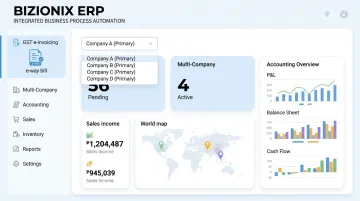
Unlike SAP or NetSuite, which require implementation consultants and extended timelines, Bizionix is designed for quick deployment — with e-invoicing setup taking minutes using an API key and GST credentials.
| Dimension | Detail |
|---|---|
| Best For | Indian MSMEs, manufacturing units, distributors, CA firms, and multi-entity enterprises needing affordable, GST-compliant cloud ERP |
| Deployment Options | 100% cloud-based (SaaS) |
| Key Consideration | Purpose-built for India; includes direct GST e-invoicing API, multi-company management, and configurable modules without enterprise-level cost |
How We Chose the Best ERP Vendors
These vendors were evaluated on real-world applicability — not brand recognition alone. The most common mistake buyers make is selecting an ERP based on a peer recommendation or industry reputation without checking whether the platform suits their company size, regulatory environment, or operational complexity.
Evaluation criteria used:
- Functional depth — which core modules are included vs. paid add-ons
- Deployment flexibility — cloud, on-premise, or hybrid options
- Industry and compliance fit — GST readiness and local compliance fit for Indian businesses
- Total cost of ownership — licensing, implementation, ongoing support, and hidden costs
- Scalability — can the system grow from 20 users to 200 without a platform change?
- Vendor support quality — what does onboarding and post-go-live support actually look like?
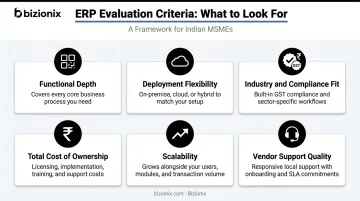
As TechTarget notes, ERP total cost of ownership must include implementation costs, hardware acquisition and maintenance, and ongoing operational costs — not just licensing fees. Wrong ERP selection often leads to expensive change requests and third-party tools to fill gaps.
For Indian businesses specifically, GST compliance readiness and local support are non-negotiable. A platform that requires manual workarounds for e-invoicing or lacks IRP integration adds ongoing compliance risk, regardless of how strong its other features are.
These criteria shaped every vendor assessment that follows. A large enterprise with global operations has fundamentally different needs from an Indian MSME scaling from 20 to 200 employees — so each vendor below is evaluated against the factors that actually determine fit: growth stage, team size, industry, and turnover relative to e-invoicing thresholds.
Conclusion
ERP selection is one of the most consequential technology decisions a business makes. The right system isn't necessarily the most feature-rich — it's the one that fits your operations, your team, and your compliance requirements.
That means evaluating scalability, compliance readiness, realistic implementation timelines, and the quality of ongoing support before you commit. Be cautious about over-investing in enterprise systems that take 6–18 months to deploy and require dedicated consultants when purpose-built platforms can deliver results in weeks.
For Indian MSMEs that need GST-compliant, cloud-based ERP without the overhead of an enterprise rollout, Bizionix covers accounting, inventory, HR, procurement, and e-invoicing in a single platform — at pricing designed for growing businesses.
Start with a 14-day free trial, request a demo, or reach out to the Bizionix team at info@bizionix.com or +91 91779 99277 to explore how it can replace fragmented tools and bring your operations under one system.
Frequently Asked Questions
What is an ERP solution?
ERP (Enterprise Resource Planning) software integrates core business functions — finance, inventory, procurement, HR, and operations — into a single platform. It replaces fragmented tools with a unified system that provides real-time data and process automation across the organisation.
Which ERP is best for small businesses in India?
Look for India-specific features like GST compliance and e-invoicing readiness, affordable cloud-based pricing, and modules that match your operational needs. Platforms like Bizionix are purpose-built for Indian MSMEs with these requirements built in from the ground up.
What are the key features to look for in an ERP system?
Look for these in any ERP shortlist:
- Financial management and accounting
- Inventory tracking and warehouse visibility
- Multi-user access with role-based controls
- Reporting dashboards for real-time decisions
- Third-party integration support
- Scalability as your business grows
For Indian businesses, GST and e-invoicing compliance are mandatory — not optional add-ons.
What is the difference between cloud ERP and on-premise ERP?
Cloud ERP is hosted on the vendor's servers and accessed via the internet — lower upfront cost, automatic updates, accessible from anywhere. On-premise ERP is installed on company servers, offering more control but requiring higher upfront investment and ongoing IT maintenance.
How long does ERP implementation take?
Timelines vary widely — from a few weeks for cloud-based, pre-configured platforms to 6–18 months for large enterprise systems. Factors include business complexity, number of users, customisation needs, and vendor support quality.
How do I choose the right ERP vendor for my business?
Evaluate vendors across these criteria before committing:
- Industry fit and sector-specific functionality
- Regulatory compliance, especially GST readiness for Indian businesses
- Total cost of ownership across setup, licensing, and support
- Deployment model (cloud vs. on-premise)
- Scalability to support future growth
- Vendor track record with businesses of similar size
Brand recognition alone is not a reliable selection criterion.