For Indian MSMEs evaluating ERP or business management software, this complexity is a real problem. No two vendors price the same way. Proposals look incomparable. And the advertised price rarely reflects what you'll actually pay.
This guide cuts through that confusion. It covers the most common enterprise software pricing models, explains what drives costs up or down, decodes total cost of ownership, and helps you choose the model that fits how your business actually operates — not just the one with the lowest sticker price.
Key Takeaways
- Enterprise software pricing varies by model, company size, customization depth, and deployment method; no two quotes will look the same
- The main models: subscription-based, tiered, per-user, usage-based, and custom enterprise pricing
- Total cost includes implementation, training, compliance features, and ongoing support, which can collectively exceed the first year's license fee
- For Indian MSMEs, GST compliance and e-invoicing capability should be verified as included in the base plan — not hidden in a premium tier
- The right model aligns with how your business uses the software today and where it needs to be in two to three years
What Are Enterprise Software Pricing Models?
Enterprise software doesn't carry a price tag you can read off a shelf. Costs vary based on the pricing model the vendor uses, the size of your organisation, and how much customisation your operations require.
When buyers don't understand this upfront, three problems follow:
- Underbudgeting for implementation — assuming the licence fee is the total cost
- Choosing the wrong model — picking per-user pricing when usage-based would be cheaper at their transaction volume
- Surprise renewal costs — discovering that compliance modules or additional users push the renewal price far above year one
Enterprise pricing is fundamentally different from SMB-level software pricing. SMB tools use fixed, self-service tiers you can subscribe to with a credit card. Enterprise pricing is negotiated, customised, and involves finance, legal, and multiple decision-makers.
G2's 2024 buyer behaviour research found that 82% of enterprise software selection processes are consensus-based across global markets, with finance sign-off involved in 79% of purchases. For deals above $20,000 USD, nearly half take four or more months to close.
Knowing which pricing model applies to your purchase — before negotiations begin — determines whether your budget holds through renewal and whether the contract terms work in your favour.
The Main Pricing Models Explained
Flat-Rate and Subscription-Based Pricing
Flat-rate pricing charges one set fee for all users and features. Subscription-based pricing — the dominant model in SaaS — charges a recurring monthly or annual fee for access to core modules, standard support, and cloud hosting.
Subscription pricing's main appeal is predictability. You know what you'll pay each quarter. For businesses transitioning from manual processes or fragmented spreadsheets, it removes the upfront capital barrier that perpetual licences typically demand.
Best for: Early-stage businesses and MSMEs that want predictable costs, lower upfront commitment, and don't need heavy customisation. It's a natural entry point for companies moving from Excel-based operations to a unified digital system.
Bizionix, for example, offers its NEO plan at ₹999 per year — a flat subscription that gives growing businesses access to nine core modules covering finance, sales, inventory, HRMS, and GST-ready accounting without requiring enterprise-level investment.
Tiered and Per-User Pricing
Tiered pricing offers multiple packages — typically Basic, Professional, and Enterprise — at increasing price points with more features at each level. Per-user (or per-seat) pricing charges based on the number of active users in the system.
The table below shows current public pricing from major international vendors (prices in USD) as a benchmark reference:
| Vendor | Entry Tier | Mid Tier | Enterprise Tier | Unit |
|---|---|---|---|---|
| Salesforce Sales Cloud | $25 | $100–$175 | $350–$550 | USD/user/month |
| Microsoft Dynamics 365 BC | $8 (Team) | $80 (Essentials) | $110 (Premium) | USD/user/month |
| HubSpot Sales Hub | $7 | $90 | $150 | USD/seat/month |
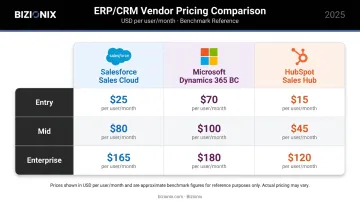
Per-user pricing works cleanly for small, stable teams. The risk appears when headcount grows — each new employee adds directly to your licence cost. This "seat inflation" problem catches many growing businesses off-guard mid-year.
Ideal when: Your team has defined user roles and moderate, predictable headcount. Before committing, model three scenarios: current users, your 12-month hiring plan, and limited-access users (approvers, auditors, finance reviewers) who may qualify for cheaper restricted licences.
Usage-Based and Custom Enterprise Pricing
Usage-based pricing charges based on actual consumption — transactions processed, API calls made, storage used, or invoices generated. OpenView's research found that 61% of SaaS companies were expected to use some form of usage-based pricing by end of 2023, including hybrid models that combine a base subscription with consumption charges.
Usage-based suits: Businesses with variable workloads where consumption fluctuates significantly month to month — you pay for what you actually use rather than a fixed ceiling.
Custom enterprise pricing sits at the other end of the spectrum: negotiated contracts, tailored features, volume discounts, and dedicated service level agreements. Large ERP deployments, analytics platforms, and businesses with highly specific operational requirements typically follow this model.
Custom pricing suits: Large enterprises or businesses with complex, non-standard operational needs — but budget time for a longer procurement cycle. Negotiations, legal review, and procurement approval all add to the timeline.
Key Factors That Affect Enterprise Software Pricing
Enterprise software pricing is shaped by a combination of technical, operational, and business-specific factors. Understanding these prevents budget surprises and vendor lock-in.
Company Size and User Count
User count directly drives cost in per-user and tiered models. Vendors structure pricing around headcount ranges — and the gap between tiers can be significant. Microsoft's Business Central illustrates this well: a Team Member licence costs $8/user/month, while a full Essentials licence runs $80/user/month — a 10x difference for the same platform.
Before requesting quotes, separate your users into categories:
- Full users who manage transactions and workflows
- Light users who approve requests or submit data
- Read-only roles who view reports only
Many vendors offer cheaper restricted licences for each category — knowing your split prevents overpaying for access levels you don't need.
Customisation and Module Requirements
Off-the-shelf software rarely covers every operational need. Custom workflows, specialised integrations, or additional modules each add to both licence and implementation cost. In a modular ERP, every add-on has a price — and those costs compound as the business grows.
Practical approach: List the exact functions you need before engaging vendors, and verify which pricing tier includes them without requiring paid add-ons.
Cloud vs. On-Premise Deployment
Cloud (SaaS) software shifts infrastructure costs to the vendor. You pay a subscription; they handle servers, updates, and security patches. On-premise software typically requires a perpetual licence plus in-house IT infrastructure, ongoing maintenance contracts, and internal resources to manage upgrades.
For Indian MSMEs, cloud is the default choice — lower upfront cost, faster deployment, and automatic compliance updates. India's public cloud market is growing at 24.3% CAGR and is projected to reach $25.5 billion by 2028, reflecting how quickly businesses are moving to subscription-based software.
Compliance and Regulatory Requirements
Businesses operating in India above ₹5 crore aggregate turnover are required to generate e-invoices and submit them to the Invoice Registration Portal (IRP) for an IRN — per CBIC Notification No. 10/2023-Central Tax, effective 1 August 2023.
Some ERP vendors include GST compliance, e-invoicing, and IRN generation in their base plan. Others charge it as an add-on. Bizionix includes direct API integration with the GST e-Invoice system as a core feature — IRN generation, invoice validation, and QR code creation are built into the standard platform. This matters when comparing proposals: a lower base price can quietly disappear once compliance surcharges are added.
The True Cost of Enterprise Software
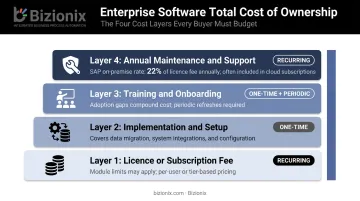
The listed price is rarely the full story. Total Cost of Ownership (TCO) includes several layers across the software's full lifecycle.
| Cost Component | Type | Key Consideration |
|---|---|---|
| Licence / Subscription Fee | Recurring | Confirm which modules and user limits are included |
| Implementation & Setup | One-time | Data migration, configuration, integrations |
| Training & Onboarding | One-time + periodic | Low adoption = wasted investment |
| Annual Maintenance & Support | Recurring | On-premise: often 22%+ of licence cost (SAP's published rate); cloud SaaS typically included |
Implementation Costs Deserve Their Own Budget Line
Implementation covers data migration, system configuration, workflow setup, and integration with existing tools. Panorama Consulting's 2024 ERP Report found a $450,000 median project cost across global enterprise ERP deployments — and notes that implementation services can cost three to four times the initial software licence price. For Indian MSMEs, the absolute figures are smaller — but the proportional weight is just as significant. Budget implementation as a separate workstream, not an afterthought. That discipline carries directly into how you handle training.
Training Determines Whether the Investment Works
Poorly budgeted training leads directly to low adoption — the software sits underused while the subscription keeps billing. Some vendors charge per training session; others bundle it into the contract. Verify this before signing. Bizionix, for instance, includes adoption support within its standard framework, so training doesn't become a surprise line item after go-live.
Annual Maintenance on On-Premise Software
For on-premise enterprise software, annual maintenance and support fees are material. SAP's published Enterprise Support rate is 22% of licence cost per year. Oracle's support terms allow reinstatement fees of 150% of the last annual support fee if coverage lapses. These figures set the benchmark MSMEs should keep in mind when evaluating on-premise options. Cloud SaaS typically includes updates within the subscription — one reason it's increasingly preferred by growing businesses that want cost predictability without a dedicated IT team.
Entry-Level vs. Enterprise-Grade Software: What's the Real Difference?
Both claim to "manage your business." The differences in capability, support, and long-term scalability are significant — and those differences show up directly in pricing.
| Dimension | Entry-Level | Enterprise-Grade |
|---|---|---|
| Functionality | Core invoicing, basic contacts, limited integrations | Full-suite: finance, inventory, GST compliance, CRM, HR, procurement |
| Scalability | Single entity, single location; struggles at scale | Multi-company, multi-location, role-based access, centralised data |
| Compliance | GST features often missing or charged separately | Built-in GST e-invoicing, IRN generation, GSTR auto-population |
| Support | Ticket-based; slow response | Priority support, dedicated SLAs, implementation guidance |
| Long-Term Value | May require replacement as business grows | Platform grows with the business, reducing migration costs |
The hidden cost of entry-level software is replacement. When a growing business outgrows a basic tool, the migration cost — data export, system configuration, staff retraining — hits at the worst possible moment.
Enterprise-grade platforms built for MSMEs, like Bizionix, sidestep this by designing for scale from day one. As the business grows, the same platform expands with it, eliminating the need to switch systems or rebuild processes from scratch.
What Most Businesses Get Wrong About Enterprise Software Pricing
Gartner projects that by 2027, more than 70% of recently implemented ERP initiatives will fail to fully meet their original business-case goals. Pricing mistakes at the evaluation stage contribute directly to that failure rate.
The most common errors:
- Optimising for the monthly fee while ignoring implementation, integration, and training costs, which often exceed the first year's licence fee
- Choosing the cheapest per-user tier, then discovering mid-year that essential features (multi-branch support, GST e-invoicing, advanced reporting) are locked behind a higher tier — triggering an unplanned, budget-breaking upgrade
- Over-specifying features not needed for two to three years, paying for an enterprise-grade tier when a mid-range subscription would have served the business
- Ignoring vendor exit terms: some contracts include data migration fees or early termination penalties that make switching expensive; always check these clauses before signing
The practical fix is to compare vendors across three cost dimensions:
- Licence or subscription cost — the recurring fee you see on the pricing page
- Implementation and compliance cost — setup, training, GST configuration, and integration work
- Growth cost — what happens to the price as you add users, entities, or modules
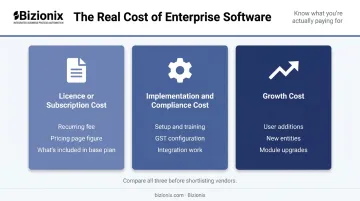
This three-column view surfaces the real total cost of ownership, not just the number on the vendor's homepage.
How to Choose the Right Pricing Model for Your Business
The right pricing model fits how your business operates today — and how it plans to scale. Cost matters, but structure matters more.
Key questions to work through before evaluating vendors:
- What modules do you actually need? List core functions — accounting, inventory, payroll, CRM — and verify which pricing tier includes them without add-ons
- How fast is your team growing? If headcount is rising, flat subscription or tiered models offer more cost predictability than pure per-user pricing
- Are you GST-compliant? For businesses near or above ₹5 crore turnover, confirm that e-invoicing and IRN generation are included in the base plan — not gated behind a premium tier
- What's your realistic TCO over three years? Add licence cost, implementation, training, and annual maintenance before comparing vendors
- What are the exit terms? Check data portability provisions, cancellation policy, and whether there are penalties for early termination
For Indian MSMEs, subscription-based or tiered pricing offers the best combination of cost predictability, lower upfront commitment, and scalability. Before signing anything, confirm that compliance coverage is built in. Platforms that include GST e-invoicing, IRP integration, and IRN generation as core features — rather than billable add-ons — reduce total cost and simplify vendor management.
Conclusion
Enterprise software pricing is not a single number. It's a structure shaped by the pricing model, company size, customisation requirements, compliance obligations, and total lifecycle costs. What vendors quote first is rarely what you'll actually pay — the real negotiation starts once you understand the model behind the number.
Businesses that understand pricing models before entering vendor discussions negotiate better, budget more accurately, and avoid the mid-year upgrade surprises that derail technology investments. Before signing any software contract — whether a ₹999/year subscription or a multi-lakh enterprise agreement — run through these questions first:
- Does the pricing model match your current stage, not just your projected growth?
- Are GST compliance, e-invoicing, and India-specific features included, or billed as add-ons?
- What triggers a tier upgrade, and what does that cost look like in year two or three?
- Have you accounted for implementation, training, and support in your total budget?
The difference between a smart software investment and a regrettable one usually comes down to how thoroughly these questions were asked upfront.
Frequently Asked Questions
What is an enterprise pricing model?
An enterprise pricing model is a structured approach to pricing software for large or complex organizations, typically involving tiered, per-user, usage-based, or custom contract structures rather than a fixed price. Unlike SMB self-service pricing, enterprise models are negotiated and include custom terms, volume discounts, and multi-stakeholder approval.
What are the most common software pricing models?
The main models are flat-rate, subscription-based, tiered or feature-based, per-user, usage-based, freemium, and custom enterprise pricing. Most vendors combine two or more of these — for example, a tiered subscription with usage-based overage charges for transactions above a set limit.
Which enterprise software pricing model is best for a small or mid-sized business?
Subscription-based or tiered pricing generally works best for MSMEs — it offers cost predictability, lower upfront investment, and a clear upgrade path. Confirm that the base plan includes compliance features relevant to your geography (GST and e-invoicing for Indian businesses) before committing.
What hidden costs should I watch out for in enterprise software pricing?
Common hidden costs include:
- Implementation and setup fees
- Training charges
- Integration costs with existing systems
- Compliance module add-ons
- Annual maintenance fees for on-premise software
- Early termination penalties
These can easily exceed the first year's advertised license fee.
How is subscription pricing different from a perpetual licence?
Subscription pricing involves recurring fees that typically include software updates, cloud hosting, and vendor-managed infrastructure. A perpetual license is a one-time purchase, but the buyer manages infrastructure and pays separately for maintenance, upgrades, and support — which SAP, for example, prices at 22% of license cost per year.
What factors should I consider when budgeting for enterprise software in India?
Factor in user count, required modules, deployment model (cloud vs. on-premise), implementation complexity, and vendor support quality. GST compliance is non-negotiable — confirm whether IRP integration and IRN generation are included in the base plan, as this is mandatory above ₹5 crore aggregate turnover.