Introduction
Every vendor deal, customer agreement, and employee onboarding starts with a contract. Yet most small businesses manage these across email threads, shared drives, and informal handshakes — a system held together by memory and goodwill.
For Indian MSMEs, the stakes are especially high. According to a GAME and Dun & Bradstreet report, delayed payments to MSME suppliers totalled ₹10.7 lakh crore annually — equivalent to 5.9% of gross value added. Many of these disputes trace back to poorly tracked payment terms and contract obligations.
WorldCC research puts the wider cost in perspective: poor contract management drains nearly 9% of contract value annually for the average business.
The fix doesn't require a legal team. Modern contract management software handles the full lifecycle — drafting, approval, signing, and renewal tracking — in one place, without the complexity or cost of enterprise-grade CLM tools.
This guide covers five tools built for small businesses, what to look for — including GST-era e-signature compliance and rupee-based pricing — and how Indian MSMEs should think about total cost of ownership.
Key Takeaways
- Poor contract management causes direct revenue leakage, missed renewals, and compliance failures.
- Prioritise tools with built-in e-signatures, template libraries, and automated renewal alerts over feature-heavy platforms that require months to implement.
- Free plans from PandaDoc and Zoho Contracts work as a starting point, but workflow automation is where growing businesses find the most value.
- The five tools reviewed cover distinct use cases — match the one that fits how your team actually works, not just your budget.
- For Indian MSMEs, integration with GST-compliant accounting and vendor management is worth evaluating alongside any dedicated contract tool.
Why Small Businesses Struggle with Contract Management
The Ownership Problem
In small businesses without a legal department, contract ownership tends to float. One deal gets reviewed by the founder, the next by the CFO, and vendor agreements get drafted by whoever raised the purchase order. The result: inconsistent terms, slow turnarounds, and clauses that nobody fully understands or enforces.
The root cause is structural. Without defined workflows, contracts default to whoever has bandwidth — not whoever has expertise.
Tool Sprawl Makes It Worse
The average contract touches multiple disconnected systems. Most small teams draft in Word or Google Docs, negotiate over email, sign via a standalone e-signature tool, and store PDFs in a shared drive. Deloitte research found that contract-related data sits across an average of 24 systems in large organizations — and while smaller businesses have fewer tools, the fragmentation problem is just as damaging.
Version confusion, missed obligations, and duplicate files are inevitable when no single system owns the contract record.
The Real Cost for Indian MSMEs
For Indian MSMEs, this fragmentation creates measurable financial exposure. The GAME/D&B report estimated MSMEs may owe approximately ₹2 lakh crore in GST on revenue not yet received — a direct consequence of payment delays that poor contract visibility enables.
The day-to-day risks compound quickly:
- Delayed payment disputes when payment terms aren't clearly documented or enforced
- Auto-renewal traps on vendor software and service contracts that nobody tracked
- GST compliance gaps when contract terms don't align with invoicing workflows
- Cash flow pressure from lapsed agreements that require renegotiation instead of simple renewals
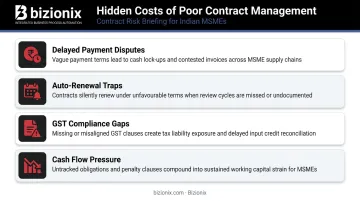
A dedicated contract management tool makes these risks visible before they turn into write-offs, disputes, or compliance notices.
Top 5 Contract Management Software for Small Businesses
These tools were shortlisted based on four criteria for small-business suitability:
- Ease of use — minimal learning curve, no dedicated legal team required
- Pricing transparency — clear tiers with no hidden per-feature fees
- Implementation speed — up and running in days, not months
- End-to-end capability — covers drafting, signing, and post-signature tracking
All pricing below is in USD unless otherwise noted.
PandaDoc
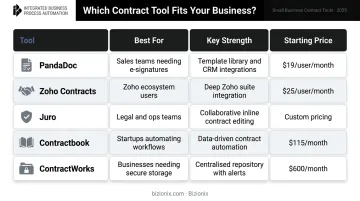
PandaDoc is a document workflow platform popular with sales-driven small businesses and freelancers. Its drag-and-drop editor and template library make it one of the fastest tools for creating professional agreements without starting from scratch.
Standout features for small businesses:
- Free plan supports up to 60 documents per year with basic e-signatures
- Starter plan at $19/user/month (billed annually) covers workflow automation
- Real-time tracking shows when a recipient opens, reads, or signs a document
- Native integrations with HubSpot and Salesforce connect contracts directly to sales pipelines
| Category | Detail |
|---|---|
| Key Features | Drag-and-drop editor, template library, built-in e-signatures, workflow automation, CRM integrations, content locking |
| Pricing | Free (60 docs/year); Starter $19/user/month (USD); Business $49/user/month (USD); Enterprise: custom |
| Best For | Sales teams, freelancers, and small businesses that prioritise fast document creation and execution |
Zoho Contracts
Zoho Contracts is a natural fit for businesses already working within the Zoho ecosystem. It combines contract creation, clause libraries, e-signature capability, and automated renewal tracking in one place. For teams using Zoho CRM, contracts and customer records stay connected without any manual bridging.
Why it works for MSMEs:
- Free plan supports 3 users, 10 contracts, 5 counterparties, and 1 approval workflow
- 15-day free trial, no credit card required
- Zoho Sign included at no extra cost in paid subscriptions
- Automated renewal alerts prevent missed deadlines
- Zoho CRM integration lets teams draft contracts directly from CRM records using mapped field data
Note: Paid tier pricing was not confirmed in official sources at time of writing — check Zoho Contracts pricing directly before committing.
| Category | Detail |
|---|---|
| Key Features | Contract templates, clause library, automated renewal alerts, version control, e-signature integration, audit trails, Zoho CRM integration |
| Pricing | Free (3 users, 10 contracts); paid tiers available — verify current pricing on Zoho's website |
| Best For | Businesses already using the Zoho ecosystem for CRM, sales, or operations |
Juro
Juro is a browser-native contract automation platform designed for growing teams without large legal departments. Drafting, negotiation, and signing all happen in one workspace, with no toggling between Word, email, and PDF.
What sets it apart:
- 29-day average implementation in 2024 (per Juro's published data), compared to 72% of CLM tools that take at least two months
- Browser-based editor requires no software installation
- Self-serve contracting allows non-legal staff to initiate agreements using pre-approved templates
- Real-time collaboration with tracked changes and comments — counterparties can negotiate inside the same document
| Category | Detail |
|---|---|
| Key Features | Browser-based editor, real-time collaboration, native e-signatures, approval workflows, AI contract review, smart repository, CRM and Slack integrations |
| Pricing | Custom pricing based on contract volume and integrations; all plans include unlimited users, workflows, and templates |
| Best For | Growing teams without a large legal department that need fast implementation and clean collaboration |
Contractbook
Contractbook focuses on post-signature visibility. The platform handles drafting, negotiating, and signing, then uses AI to extract key dates and obligations so renewals, deadlines, and task triggers don't require manual tracking.
Key differentiators:
- AI extracts key terms, obligations, and risk flags in plain language
- Automations trigger reminders and tasks when contract status changes (e.g., 30-day renewal alerts)
- Centralised searchable repository — no manual tagging required
- 14-day free trial with access to all features, no credit card needed
- Plans: Essential, Centralize, Accelerate, Custom — note that task automations are an add-on for Centralize and included in Accelerate
| Category | Detail |
|---|---|
| Key Features | Dynamic templates, task and reminder automation, AI data extraction, searchable repository, collaborative editor, Salesforce integration (top tier) |
| Pricing | Limited free plan after trial; Essential and Centralize at $399/month USD (billed annually); Accelerate at $599/month USD; Custom available — verify current pricing before purchase |
| Best For | Teams with moderate contract volumes focused on post-signature automation without enterprise CLM complexity |
ContractWorks
ContractWorks is a security-first contract management platform built for small businesses managing sensitive legal agreements. The emphasis is on organised, efficient storage rather than heavy drafting or negotiation features.
Defining strengths:
- Pricing starts at $600/month USD with unlimited users — not per-seat, which makes it more economical as teams grow
- Smart Document Tagging automatically extracts agreement type, parties, effective dates, and renewal terms
- Role-based permissions control who can view or edit each agreement
- Automated expiry and renewal alerts with custom reporting
- Built-in e-signatures require no APIs or third-party tools
| Category | Detail |
|---|---|
| Key Features | Built-in e-signatures, smart document tagging, secure centralised storage, automatic expiry alerts, custom reporting, user permissions |
| Pricing | Starts at $600/month (USD), unlimited users; free implementation included |
| Best For | Small businesses prioritising secure storage, audit readiness, and deadline management over advanced drafting features |
Key Features to Look For in a Small Business Contract Management Tool
Small businesses cannot afford six-month onboarding cycles. Look for tools that go live within days or weeks, require minimal IT involvement, and can be used by sales, operations, and finance staff without formal training. The five features below separate genuinely useful contract tools from ones that create more overhead than they solve.
Ease of Use and Implementation Speed
Small businesses cannot afford six-month onboarding cycles. Look for tools that go live within days or weeks, require minimal IT involvement, and can be used by sales, operations, and finance staff without formal training.
Built-In E-Signatures
A separate signing tool adds cost and creates friction at the moment a deal should be closing. Every tool on this list handles e-signatures natively — contracts move from draft to executed without switching platforms.
Template Libraries and Clause Management
Pre-approved templates reduce drafting time and ensure language stays consistent across agreements. For businesses without legal counsel, this is the difference between a 30-minute contract and a three-day process of drafting from scratch.
Approval Workflows and Role-Based Access
Approval routing keeps risky terms from slipping through while giving teams the autonomy they need. A well-configured system routes contracts by deal size, contract type, or department automatically. Role-based access also prevents non-legal users from accidentally modifying protected clauses — a common source of costly errors in growing businesses.
Renewal and Deadline Tracking
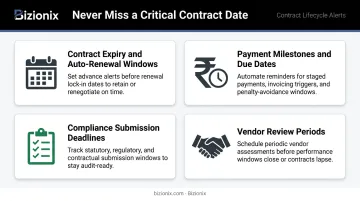
Missed renewals result in either unwanted auto-renewals or lapsed agreements that require full renegotiation. For Indian MSMEs already managing tight payment cycles, a single missed contract expiry can cascade into delayed billing or unplanned vendor negotiations. Automated alerts tied to key dates prevent this without any manual tracking effort.
Key dates to configure alerts for:
- Contract expiry and auto-renewal windows
- Payment milestones and due dates
- Compliance submission deadlines
- Vendor review periods
How We Chose the Best Contract Management Software for Small Businesses
These tools were evaluated through a small-business lens — not enterprise capability, but the features that matter when you have a lean team, a limited budget, and no dedicated legal department.
Common mistakes buyers make:
- Choosing overly complex platforms built for 1,000-person companies
- Ignoring total cost of ownership (implementation, training, and whether e-signatures require a separate paid tool)
- Selecting tools that counterparties find difficult to use — a contract still needs two parties to sign
Evaluation criteria used:
- Affordability and pricing transparency
- Implementation speed
- Ease of use for non-legal staff
- Counterparty experience
- Built-in e-signature capability
- Ability to scale as contract volume grows
For Indian MSMEs, one factor separates a good contract tool from a genuinely useful one: integration with GST-compliant accounting and vendor management systems. Contracts don't exist in isolation — they connect directly to invoicing, vendor payments, and procurement workflows. When those elements live in disconnected systems, operational fragmentation follows.
This is where a unified platform like Bizionix — a cloud ERP built specifically for Indian MSMEs — can complement a dedicated contract tool. Bizionix brings Finance & Accounting, Purchase Management, and Sales & CRM onto a single system, so vendor relationships, payment terms, and invoicing workflows share the same data without manual bridging between tools.
The honest tradeoff: There is no single best tool for every business. A sales-heavy startup benefits most from PandaDoc's fast creation workflow. A compliance-focused business needs ContractWorks' security and audit trail. The right choice depends on where your biggest contract pain points actually sit.
Conclusion
Unmanaged contracts create real costs: missed renewals, compliance gaps, and strained vendor relationships. The tools reviewed here address that directly by centralising the contract lifecycle in one accessible system.
Choose based on your business stage and pain point, not brand recognition or feature count. A tool no one uses is no tool at all. Prioritise ease of use, fast implementation, and room to scale.
As Indian MSMEs grow, contracts become one piece of a larger operational picture. Managing vendor payments, GST compliance, invoicing, and multi-department workflows requires a unified foundation. Bizionix's ERP platform is built for exactly that — helping Indian MSMEs connect contract management to the rest of their business operations in one system.
Frequently Asked Questions
What is contract management software and why does a small business need it?
Contract management software automates the creation, approval, signing, and tracking of agreements in one system. For small businesses without a legal team, it prevents late payments, missed renewals, and compliance failures that directly erode cash flow.
How much does contract management software cost for small businesses?
Pricing varies by model — from free tiers (PandaDoc, Zoho Contracts) to per-user monthly plans and flat-rate unlimited-user subscriptions. When evaluating cost, factor in implementation time and whether built-in e-signatures eliminate the need for a separate tool.
Can a small business manage contracts without a dedicated legal team?
Yes. Modern contract tools are built for cross-functional teams. Template libraries, pre-approved clause libraries, and guided approval workflows allow sales, operations, and finance staff to create and manage contracts without legal expertise.
What is the difference between contract management software and a CRM?
CRM manages customer relationships and sales pipelines. Contract management software handles the legal lifecycle of agreements — drafting, negotiation, execution, storage, and renewal. Some platforms integrate both, allowing contracts to be triggered directly from CRM records.
How long does it take to implement contract management software?
It depends on the tool. PandaDoc and ContractWorks can be set up in days. Juro averaged 29 days in 2024. Legacy enterprise CLM platforms often require 6–12 months — these are unsuitable for small business teams and should be avoided.
Is free contract management software sufficient for a growing small business?
Free plans from PandaDoc (60 documents/year) and Zoho Contracts (3 users, 10 contracts) cover basic needs for very early-stage businesses. Growing businesses quickly outgrow these limits, as approval routing, workflow automation, and renewal tracking are available only on paid tiers.