Introduction
The client said yes. Your sales rep shook hands, sent a follow-up email, and then... the contract sat in someone's inbox for two weeks. By the time it was signed, the billing team had already raised an invoice based on a draft that had since changed — and the client was not happy.
This scenario plays out constantly in growing businesses. Deals get verbally agreed upon, then stall in email threads, WhatsApp approval chains, and shared drives where no one can find the latest version.
Contract management is typically treated as administrative overhead. In practice, it's the operational step where revenue is either captured cleanly or quietly eroded.
This guide covers three things: what contract management software actually does for sales organizations, the measurable damage that happens without it, and how to get real returns from it. The goal is a functional system, not just a tidier filing cabinet.
Key Takeaways
- Contract management software handles the full agreement lifecycle — drafting, approvals, signing, obligation tracking, and renewals — in one system
- For sales teams, the clearest gains are faster deal closure, protected post-signature revenue, and shared visibility across departments
- ACC's 2023 CLM Benchmark found that 56% of organizations miss contract renewals and expirations every month, quietly eroding revenue
- Indian MSMEs managing GST-linked vendor agreements and statutory deadlines face compounding compliance risk without it
- The software delivers results only when embedded into daily sales workflows — adoption drives the ROI, not the tool itself
What Is Contract Management Software
Contract management software centralises and automates the end-to-end handling of business agreements — from drafting and approval routing through to execution, obligation tracking, and renewal.
In a sales workflow, it occupies the space between verbal agreement and recognised revenue: the post-handshake steps that are most prone to delay, version confusion, and overlooked commitments.
Done well, it eliminates the delays, errors, and blind spots that cost sales organisations time, money, and client trust. A signed agreement becomes a monitored, actionable asset — with tracked obligations, renewal alerts, and full visibility into what was promised and when.
Core capabilities typically include:
- Centralised contract repository with version control
- Automated approval routing and e-signature workflows
- Obligation and milestone tracking post-signature
- Renewal and expiry alerts to prevent revenue leakage
Key Advantages of Contract Management Software for Sales Organisations
The advantages below focus on operational outcomes — the kind that map directly to metrics sales leaders and business owners actively monitor. They also compound: the more contracts a business manages, the more pronounced each benefit becomes.
Advantage 1: Faster Deal Closure Through Automated Workflows
Manual contracting is slower than most sales teams realise. Aberdeen's benchmark research found contracts took 20–30 days on average to create, negotiate, and finalise after the initial agreement — before any automation was involved. ACC data shows automated teams turned around NDAs in under a week at nearly three times the rate of manual teams (68% vs. 23.7%).
How it works in practice:
- Pre-approved templates generate contracts in minutes, not hours
- Automated approval routing sends documents to the right stakeholder with deadline-based reminders and escalation triggers
- Integrated e-signatures allow clients to sign from any device — no printing, scanning, or couriering required
- Real-time status tracking shows exactly where each contract is in the process
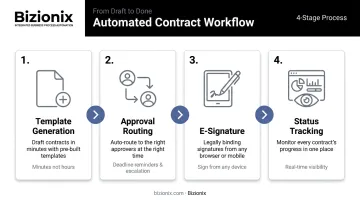
Every day a contract sits waiting for approval is a day revenue recognition is delayed and a sales rep's attention stays on a deal that should already be closed. Faster contracts free reps to move to the next opportunity sooner, and they give clients a smoother close experience — which matters more than most businesses acknowledge.
KPIs this affects: contract cycle time, time-to-signature, revenue recognition lag, sales rep time spent on admin versus selling
When this matters most: high deal volumes, multi-approver agreements, geographically distributed sales teams, or any situation where contract delays are visibly slowing pipeline movement.
Advantage 2: Reduced Revenue Leakage Through Obligation Tracking and Renewal Alerts
Signing a contract shifts the risk rather than removing it. Missed renewal dates, overlooked SLA commitments, and untracked payment milestones silently erode the revenue a business worked hard to close.
WorldCC estimates that poor contract management costs businesses around 9% of annual contract value — with the worst performers losing over 15%. Much of that leakage happens after the signature, not before it.
How it works in practice:
- Renewal dates, payment milestones, and SLA commitments are captured as structured data at the point of signing
- Obligations are assigned to named stakeholders — not just stored as text in a PDF
- Automated alerts fire before deadlines, not after they have passed
- Dashboards show the status of every active obligation across the contract portfolio
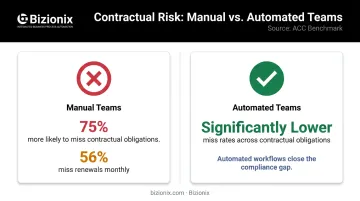
The ACC benchmark found that manual teams miss contractual obligations 75% more often than fully automated teams, and 56% of organisations overlook expirations and renewals on a monthly basis. For businesses managing recurring revenue or multi-year agreements, that exposure compounds quickly.
For Indian MSMEs specifically, the risk has a statutory dimension. Under the MSMED Act, written payment terms to Micro and Small Enterprise suppliers cannot exceed 45 days; if no date is agreed, payment is due within 15 days of acceptance, with interest compounding monthly on delays. Contracts that do not actively track these payment acceptance dates create compliance exposure — not just commercial risk.
KPIs this affects: renewal rate, contract lapse rate, obligation fulfilment rate, penalty incidents, client churn linked to post-signature mismanagement
When this matters most: recurring revenue agreements, multi-year contracts, SLA-backed service commitments, and any vendor relationship subject to statutory payment timelines.
Advantage 3: Better Sales-to-Finance Visibility Through Centralised Contract Data
Contracts contain pricing, payment terms, scope, duration, and renewal conditions. When that information lives in individual inboxes and local folders rather than a shared system, sales and finance end up working from different versions of the truth.
The result is predictable: invoicing errors, billing disputes, and the kind of internal friction that damages both client relationships and team morale.
How centralised contract data changes this:
| Without centralised data | With centralised contract repository |
|---|---|
| Finance invoices from memory or old emails | Finance invoices directly from agreed contract terms |
| Renewals discovered reactively | Renewals flagged proactively weeks in advance |
| Audit prep requires manual document gathering | Audit-ready data accessible on demand |
| Leaders wait for manual reports on exposure | Real-time dashboards show risk and opportunity |
When contract metadata — value, duration, payment terms, renewal status, obligation owners — is structured and searchable, the business can forecast more accurately, reconcile billing without manual cross-referencing, and identify expansion opportunities within the existing client base.
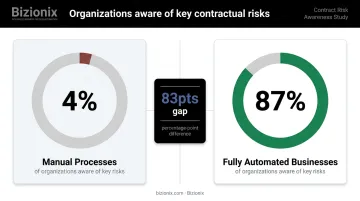
ACC's research found that 87% of fully automated businesses reported awareness of key contractual risks, compared to just 4% of those using manual processes. For growing Indian MSMEs managing multiple client contracts simultaneously, that 83-percentage-point gap in risk awareness is where recoverable revenue quietly disappears.
KPIs this affects: billing accuracy, days-sales-outstanding (DSO), audit preparation time, forecast accuracy, cross-functional alignment on contract status
When this matters most: businesses managing multiple clients simultaneously, multi-location or distributed sales teams, or any organisation where sales and finance currently operate on different information.
What Happens When Contract Management Is Missing
A growing business that has outgrown manual contracting typically looks like this: contracts stored in personal inboxes, renewal dates tracked in a spreadsheet someone forgot to update, approvals chased over WhatsApp, and no single person who knows the current status of every active agreement.
The operational consequences:
- Inconsistent contract terms across deals, leading to disputes and renegotiations that waste sales time
- Invoicing errors when finance teams cannot quickly verify what was actually agreed
- Reactive firefighting when renewals lapse or client obligations go untracked
- Rising admin costs as the business hires people to manage what a system should handle automatically
- Scaling problems — every new salesperson adds more contracts, more versions, and more handoffs without a structured process to absorb the volume
For Indian MSMEs dealing with GST-linked vendor agreements, statutory payment deadlines, and multi-party service contracts, the risk compounds further. One missed document or overlooked payment date can create compliance exposure across multiple business functions simultaneously.
An integrated platform like Bizionix addresses this directly: contracts, billing, and GST compliance run through one system, so data doesn't fragment across tools. When a contract is updated, the corresponding invoice logic and compliance records update with it — no manual handoffs, no version mismatches between departments.
How to Get the Most Value from Contract Management Software
The software only delivers measurable returns when it is embedded into the actual sales workflow. Used as an occasional filing tool, it adds cost without changing outcomes.
Three conditions for maximum value:
Every contract enters the system — not just large or complex ones. Partial adoption creates data gaps that undermine every report and dashboard the system produces.
Analytics get reviewed and acted on — sales leaders track cycle times, renewal rates, and contract obligations, then hold teams accountable to improvement. Data without action is just noise.
Insights drive process changes — if contracts with a particular client segment consistently take longer to close, that is a process problem to solve, not a statistic to file. The software surfaces the issue; fixing it is the team's job.
Bizionix's unified architecture — where sales, finance, and GST compliance run on the same platform — means contract insights are immediately usable across functions. A billing term agreed in the contract is already visible to finance the moment it is signed. No manual handoffs, no version gaps, no missed obligations.
Conclusion
For sales organisations at growing businesses, contract management software is the infrastructure that determines whether a verbally won deal converts to recognised revenue efficiently and without risk.
These three advantages compound over time:
- Faster closures free up sales capacity for the next deal
- Better obligation tracking protects revenue already earned
- Centralised visibility enables smarter decisions across sales, finance, and operations
Each benefit strengthens further as contract volumes grow and the system matures with the business.
The businesses that get the most from contract management treat it as a core part of how sales operates — reviewing outputs regularly, refining workflows over time, and connecting it to the broader systems where revenue is tracked and compliance is maintained.
Frequently Asked Questions
Frequently Asked Questions
What are the 5 C's of a contract?
The 5 C's typically refer to: Consideration, Capacity, Consent, Certainty, and Compliance — the core conditions that make a contract enforceable. Contract management software ensures each element is consistently captured, documented, and traceable across every agreement your business signs.
What is the difference between contract management software and a document storage system?
Document storage archives files. Contract management software actively manages what happens after the file is created — automating approvals, tracking obligations, sending renewal alerts, and surfacing analytics. The distinction is whether contracts are static records or operational assets.
How does contract management software help sales teams close deals faster?
It removes manual steps between verbal agreement and signed contract. Pre-built templates cut drafting time, automated routing clears approval bottlenecks, integrated e-signatures eliminate back-and-forth document handling, and real-time tracking shows the rep exactly where the contract stands.
What features should a small or mid-sized business prioritise in contract management software?
Focus on ease of use, automated approval workflows, e-signature integration, renewal alerts, centralised search, and integration with your existing CRM or accounting system. Features that reduce manual effort without requiring a dedicated legal operations team will deliver the fastest return.
How does contract management software integrate with CRM or ERP systems?
Modern contract management software connects through APIs or native integrations, allowing contract data — deal value, payment terms, renewal dates — to sync automatically with sales pipelines and finance modules. This eliminates duplicate data entry and ensures both teams operate from the same information.
When is the right time for a growing business to invest in contract management software?
Three signals stand out: contract delays are visibly slowing deal closures, your team has missed a renewal or faced a billing dispute due to manual tracking, or managing active obligations across clients has become a dedicated task rather than a routine one.