Introduction
Most Indian MSMEs manage vendor agreements, purchase orders, and service contracts through a combination of spreadsheets, email threads, and physical files. It works — until it doesn't. A missed renewal, a disputed vendor term, or a compliance gap during an audit can cost far more than the software that would have prevented it. According to World Commerce & Contracting, poor contract management can erode up to 9% of average annual revenue — a significant number for any growing business.
Contract management software pricing is genuinely wide-ranging. Entry-level tools start at a few hundred rupees per user per month; enterprise-grade platforms are quoted in custom annual contracts worth several lakhs.
Choosing the wrong tier creates its own problems. Too basic, and you hit tool limitations mid-cycle. Too complex, and you're paying for AI features a five-person procurement team will never touch — on top of surprise integration costs.
This guide covers the full 2026 pricing picture: what each tier includes, what drives costs up, hidden expenses beyond the subscription, and how to estimate a realistic budget before committing.
Key Takeaways
- Entry-level tools (PandaDoc Starter, Zoho Contracts) start at roughly ₹1,600–₹2,100/user/month (approx. USD 19–25); flat-rate options like ContractSafe begin near ₹37,500/month for unlimited users
- Mid-range plans add workflow automation, integrations, and reporting — costs scale with user count and feature tiers
- Enterprise CLM tools (Ironclad, Icertis, DocuSign CLM) are custom-quoted with no publicly listed INR pricing
- Costs shift based on user count, AI features, integrations, implementation complexity, and support tier
- Integrated ERP platforms like Bizionix cut total spend by replacing separate CLM and accounting tools with one system
How Much Does Contract Management Software Cost in 2026?
Contract management software doesn't have a fixed price. Costs vary based on team size, required features, deployment model, and vendor support level. The gap between entry-level and enterprise tools is wide — and picking the wrong tier in either direction causes real problems mid-contract cycle.
Pricing models vary just as much as the price itself. Some tools charge per user, others use a flat platform fee regardless of user count, and enterprise vendors work exclusively on custom annual contracts. Here's how the three tiers break down.
Entry-Level / Basic Tier
What's typically included:
- Contract storage and searchable repository
- Basic templates and e-signature capability
- Renewal reminders and expiry alerts
- Limited document volume per month
Verified 2026 pricing examples:
Note for Indian buyers: Prices below are in USD (as listed by international vendors). Confirm INR pricing, GST applicability, and local billing terms directly with each vendor before purchasing.
| Tool | Pricing Model | Entry Price |
|---|---|---|
| PandaDoc Starter | Per user | USD 19/user/month (annual) |
| Zoho Contracts | Per user | From USD 25/user/month; Free plan (3 users, 5 docs/month) |
| ContractSafe Organize | Platform (unlimited users) | USD 450/month (annual prepay) |
| Concord Essentials | Platform (5 users) | USD 499/month (annual) |
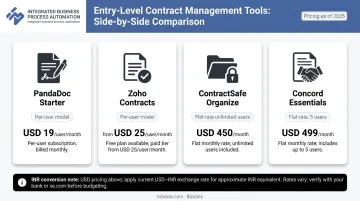
Note: Free tiers exist but are heavily restricted. Zoho Contracts' free plan caps at 3 users and 5 documents per month, with only 1 user able to send for signature. PandaDoc Free eSign allows 60 documents per year and 5 templates — functional for basic storage, not for active contract workflows.
Best for: Startups and small MSMEs with low contract volume and 1–2 departments involved.
Mid-Range / Standard Tier
What's typically included:
- Advanced workflow automation and approval chains
- Multi-user access with role-based permissions
- CRM or ERP integrations
- Compliance tracking, audit logs, and analytics
- Intake forms and document collaboration
Tools like Concord Business (USD 899/month for 5 users annually) and PandaDoc Business (USD 49/user/month annually) sit in this range. Additional users on Concord are charged at USD 49–89 per user depending on tier.
Best for: Growing businesses managing contracts across procurement, sales, legal, and operations.
Enterprise / Custom Tier
Enterprise CLM platforms — Ironclad, Agiloft, DocuSign CLM, Icertis, SAP Ariba Contracts, Coupa — do not publish fixed pricing. All require a demo or custom quote.
Features at this level include:
- AI contract analysis and obligation tracking
- Structured data extraction from existing contracts
- Custom integrations with existing ERP or procurement systems
- SLA-backed support and advanced compliance certifications
One published vendor benchmark: DocuSign states CLM customers see 449% average ROI, though this figure is vendor-published, not independently verified.
Best for: Large enterprises, multi-location businesses, and companies with high contract volume and complex compliance requirements.
Key Factors That Affect Contract Management Software Pricing
Number of Users and Access Levels
Most platforms use per-user pricing, meaning every team member added increases the monthly bill. Some vendors (ContractSafe, Juro) use unlimited-user models priced by contract volume or custom package — a distinct cost structure worth comparing early.
The risk for growing teams is underestimating user count. Once procurement, accounts, and operations all need access, per-user costs escalate faster than anticipated. Map roles before selecting a plan, and distinguish between admin access and view-only access to avoid budget overruns.
Features and Modules Required
Basic plans cover repository, reminders, and simple workflows. Advanced capabilities sit behind higher tiers or as paid add-ons:
- AI clause review and risk scoring
- Obligation tracking and audit trails
- Clause libraries and redlining tools
Before committing to a feature-rich tier, audit what your team will actually use. A business managing 50 vendor contracts monthly doesn't need AI redlining; reliable renewal alerts and approval workflows will handle most of the work.
Integrations with Existing Tools
Connecting CLM software to ERP, CRM, accounting, or e-signature platforms adds implementation complexity and often increases cost through premium plan requirements or per-integration fees.
For Indian MSMEs, GST compliance integration and e-invoicing connectivity are practically non-negotiable. GST Council Notification 10/2023 mandates e-invoicing for businesses with aggregate turnover exceeding ₹5 crore from August 2023, so any CLM tool connecting to billing or procurement workflows needs to be verified for GST compatibility.
Businesses already on an integrated ERP like Bizionix — which includes native GST e-invoicing, procurement, and accounts in one platform — can avoid paying separately for these connections.
Deployment Model and Billing Cadence
Cloud SaaS (the dominant model for MSMEs) involves recurring subscription fees with lower upfront cost and automatic updates. On-premise deployments require larger initial licence fees and internal IT resources.
Billing cadence also matters. PandaDoc Business costs USD 65/user/month on monthly billing versus USD 49/user/month on annual billing (a 24.6% difference). Annual commitments consistently offer better rates across vendors, though the exact discount varies.
Implementation Complexity and Support Tier
Lower base prices often mean minimal onboarding — staff training, data migration, and configuration become your team's responsibility. These hidden time costs don't appear in any subscription comparison.
What to expect across support tiers:
- Self-serve plans: Documentation and community forums only; faster to buy, slower to deploy
- Standard support: Email or chat assistance; suitable for teams with some technical capacity
- Premium tiers: Dedicated account managers and assisted implementation; higher cost, lower internal friction during rollout
Full Cost Breakdown: Beyond the Subscription Fee
The subscription fee is only the most visible part of what you'll actually pay. Here's what the complete cost picture looks like:
| Cost Component | One-Time or Recurring | What to Know | |---------------|----------------------|--------------|\n| Subscription / Licence Fee | Recurring | Per-user or platform fee; annual plans typically cheaper than monthly billing | | Implementation & Configuration | One-time | Platform setup, workflow building, template creation. ContractSafe offers zero implementation fees; others may charge separately | | Data Migration | One-time | Moving contracts from spreadsheets or legacy systems. ContractSafe includes migration in all plans and offers Jump Start extraction from USD 2.50/contract (approx. ₹210/contract). Ironclad describes migration as a multi-step workstream often requiring third-party vendor support | | Training & Onboarding | One-time (recurring for new staff) | Some vendors offer self-serve documentation; others charge for live onboarding sessions | | Integration Setup | One-time + periodic maintenance | Connecting to ERP, CRM, accounting, or e-signature tools. Platforms with native integrations to your existing stack reduce this cost significantly | | Scaling & Upgrades | Periodic | Adding users, crossing contract volume thresholds, or enabling AI modules can trigger tier upgrades |
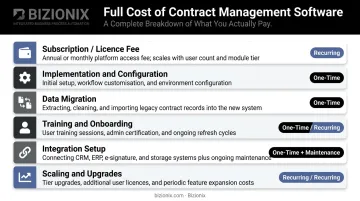
Agiloft explicitly identifies TCO as covering setup, configuration, data migration, integrations, and licensing — well beyond the subscription line item. When comparing vendors, build out the full cost picture before drawing conclusions from headline prices alone.
For Indian MSMEs evaluating these tools, integration costs deserve particular attention: platforms that connect natively with GST workflows and existing procurement systems (rather than requiring custom API work) can meaningfully reduce both setup cost and ongoing maintenance overhead.
Low-Cost vs. High-Cost Contract Management Software: What's the Difference?
Entry-level contract tools handle the basics — document storage, e-signatures, simple approvals. Enterprise platforms go further, offering deep automation, compliance controls, and integrations that reduce manual work at scale. Understanding where the real differences lie helps you avoid overpaying for features you don't need, or underspending on ones you do.
| Dimension | Entry-Level Tools | Enterprise Platforms |
|---|---|---|
| Contract volume | Zoho Free: 5 docs/month; PandaDoc Free: ~60 docs/year | Scales to large repositories; priced by active contracts |
| Workflow automation | Basic approval flows; limited logic | No-code workflow designers, conditional approvals, multi-party collaboration |
| Integrations | Limited or add-on only; CRM integrations typically locked to higher tiers | Pre-built connectors for ERP, CRM, Salesforce, Tally, Workday; integration hubs |
| Governance & security | SSO and custom roles often absent in starter tiers | SSO, IP whitelisting, API access, advanced audit controls |
| Analytics | Basic reporting | Obligation tracking, risk dashboards, metadata extraction, compliance analytics |
| Support | Community or email; slower response | SLA-backed uptime, dedicated account managers |
| Long-term value | Lower upfront cost; hidden costs from manual workarounds, missed renewals | Higher investment; ROI through efficiency gains and risk reduction |
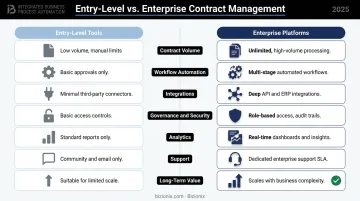
When evaluating which tier fits your business, the four factors that drive the price difference most are:
- Automation depth — how much manual approval and routing work the system eliminates
- Governance controls — audit trails, role-based access, and security features your compliance requirements demand
- Integration breadth — whether the tool connects natively to your ERP, CRM, or accounting system
- Analytics — whether you need obligation tracking and risk dashboards or just basic contract counts
For most growing businesses, the right tier is the one where automation savings outweigh the subscription cost.
How to Estimate the Right Budget for Your Business
The right budget reflects your actual workflow — what your business handles today and where it's headed over the next two to three years.
Four Steps for MSME Buyers
Start with contract volume and complexity. How many contracts does your business manage monthly? Standard vendor agreements justify less investment than complex multi-party deals with milestone tracking and obligation monitoring.
Map the departments involved. If contracts touch procurement, finance, sales, and legal, multi-user access and approval workflows become essential — and should factor into tier selection before you're locked in.
Calculate the cost of your current process. WorldCC's benchmark puts potential revenue leakage from poor contract management at 9% annually. For an MSME with ₹5 crore in revenue, that's ₹45 lakh at risk — most software investments look modest against that number.
Evaluate total cost of ownership over 2–3 years. Add subscription fees, implementation, training, and integrations. MSMEs comparing standalone CLM tools against a unified platform like Bizionix — which covers procurement, billing, GST compliance, and operations in one system — often find the TCO gap is larger than the sticker price suggests. Separate tool subscriptions and integration costs add up fast.
Common Mistakes to Avoid
- Paying for AI and enterprise features when a mid-tier plan covers your actual workflow
- Ignoring integration costs that surface after purchase
- Choosing a tool without checking vendor support quality or scalability terms
- Assuming the cheapest option will grow with you — many entry-level tools hit hard limits on users or contract volume
Conclusion
Contract management software pricing spans a wide range — from a few hundred rupees per user for basic tools to several lakhs annually for enterprise-grade platforms. The licence fee is just the starting point; user count, integrations, implementation, data migration, and support all shape the real cost.
The right investment is one that eliminates contract-related leakage, keeps renewals and compliance on track, and fits how your business actually operates. Start by mapping your contract volume, departmental access needs, and integration requirements. Once those are clear, the right price point — and the right platform — becomes far easier to identify.
Frequently Asked Questions
How much does contract management software cost?
International platforms start around USD 19/user/month (approx. ₹1,600) for tools like PandaDoc Starter, or USD 450/month (approx. ₹37,500) for unlimited-user platforms like ContractSafe. Enterprise platforms — Ironclad, DocuSign CLM, Icertis — use custom pricing. Final cost depends on user count, features, contract volume, and integrations.
What is the difference between per-user and flat-rate contract management software pricing?
Per-user pricing scales with team size — cost-effective for small teams but expensive as headcount grows. Flat-rate or platform pricing charges a fixed monthly fee regardless of user count, making it more economical for larger teams where per-user costs would compound quickly. ContractSafe and Juro use unlimited-user models; PandaDoc charges per user.
Are there hidden costs in contract management software?
Yes. Implementation fees, data migration, training, integration setup, and tier-upgrade charges are rarely included in advertised prices. Contract migration alone can require third-party vendor support — a significant cost even when the software vendor's fees aren't publicised. Request a full total-cost-of-ownership breakdown before signing.
Is free contract management software reliable for small businesses?
Free tiers exist but impose strict limits — Zoho Contracts caps at 3 users and 5 documents/month; PandaDoc Free eSign allows only 60 documents per year. These work for basic storage but fall short for MSMEs managing active vendor relationships or compliance requirements.
How do I calculate the ROI of contract management software?
Measure time saved on manual tasks, penalties avoided from missed renewals, and faster contract cycles — then compare against total ownership cost over 1–3 years. WorldCC's 9% revenue leakage benchmark is a useful starting point for estimating what poor contract visibility is already costing your business.
What features should I prioritise when choosing budget-friendly contract management software?
Focus on: a searchable contract repository, renewal and expiry alerts, basic approval workflows, e-signature capability, and integration with your existing ERP or accounting tool. AI contract review and advanced analytics are valuable at scale — but most MSMEs get more practical return from reliable reminders and structured approvals first.