Introduction
Growing businesses rarely collapse because of a bad product. They struggle because client data lives in five different places — a spreadsheet here, an email thread there, a sticky note on someone's monitor. Follow-ups get missed. Invoices go out late. No one has a complete picture of what's happening with any given client.
According to Gartner, poor data quality costs organizations at least $12.9 million per year on average — and that's before accounting for the revenue lost from broken client relationships.
Client management software addresses this directly by centralizing contact records, communication history, tasks, and billing into one platform that every relevant team member can access and trust.
This guide covers what client management software actually is, which tools are worth evaluating in 2026, what features matter most, and how to choose the right fit — particularly for Indian MSMEs navigating GST compliance alongside day-to-day client operations.
Key Takeaways
- Client management software replaces scattered spreadsheets and email threads with a single, centralised platform for all client data and interactions
- The best tool matches your workflow — CRM-first for sales teams, project-focused for delivery teams, ERP-integrated for businesses managing compliance
- Must-have features: contact management, workflow automation, reporting, and integration depth with your existing tools
- Indian MSMEs should check for GST e-invoicing support, multi-GSTIN management, and local billing compliance
- Bizionix NEO starts at ₹999/year; HubSpot, Zoho, and Freshsales all offer free starting tiers
What Is Client Management Software?
Client management software is a digital platform that helps businesses organise, track, and manage every interaction with current and potential clients — covering contact data, communication history, task tracking, document storage, and billing from a single hub.
CRM vs. Client Management Software
The terms are often used interchangeably, but the difference matters in practice:
- CRM (Customer Relationship Management) tools typically focus on the sales pipeline — lead capture, deal tracking, and pipeline forecasting
- Client management software spans the full lifecycle: onboarding, service delivery, support, invoicing, and long-term relationship management
Most modern platforms overlap considerably. A CRM with invoicing capabilities is effectively client management software. The real question is whether the tool covers the stages your business actually runs — from first contact through to billing and renewal.
Who Benefits Most
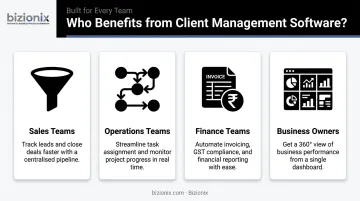
Client management software delivers the clearest value for:
- Sales teams tracking lead status, follow-ups, and pipeline health
- Operations teams coordinating service delivery and client requests
- Finance teams managing billing cycles, receivables, and compliance
- Business owners who need a unified view of all client activity across the organisation
Service-based businesses, CA firms, consulting practices, and growing MSMEs juggling multiple client accounts simultaneously see the fastest ROI — especially when replacing disconnected spreadsheets or fragmented tools.
Top Client Management Software Tools
These tools were selected based on feature depth, ease of use, scalability, integration capability, and fit for different business types and sizes.
Bizionix
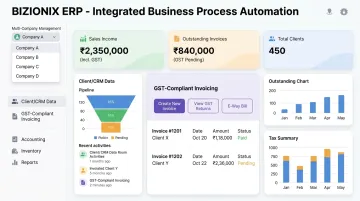
Bizionix is a 100% cloud-based, all-in-one ERP and business management platform built specifically for Indian MSMEs. Developed by IIS-LLP (a subsidiary of Protocol India Private Limited with over two decades of industry experience), it differs from standalone CRM tools by embedding client management within a unified platform that also handles GST-compliant accounting, inventory, billing, HRMS, and multi-company operations.
For Indian businesses, the core advantage is integration: client data doesn't live separately from invoicing or compliance. When a sales order is created, it flows directly into the accounts module, triggers GST-compliant invoice generation, and auto-populates GSTR-1 within the same system. No manual export, no reconciliation across tools.
Key differentiators include:
- Direct API integration with the GST e-Invoice system for instant IRN generation
- Single secure login for managing multiple companies or client entities
- Pre-validated invoicing that prevents rejections before they reach the IRP
| Feature Area | Details |
|---|---|
| Key Features | GST-ready e-invoicing with IRN generation, multi-company management, CRM and sales lifecycle, TDS tracking, audit trails |
| Best For | Indian MSMEs, CA firms, manufacturing, distribution, and service-based businesses |
| Pricing | NEO plan from ₹999/year; Enterprise on custom quote. 14-day free trial available. Contact info@bizionix.com or +91 91779 99277 |
HubSpot CRM
HubSpot is one of the most widely adopted CRM platforms globally, offering a free tier with contact management, email tracking, and deal pipeline visibility. Paid tiers unlock marketing automation, custom reporting, and omnichannel tools.
Its strength is ecosystem breadth — 1,000+ app integrations, a beginner-friendly interface, and well-documented onboarding resources. Cost is the main limitation: advanced features are gated behind Professional and Enterprise tiers that scale up quickly. It also lacks native project delivery capabilities for service-heavy teams.
| Feature Area | Details |
|---|---|
| Key Features | Contact management, sales pipeline, marketing automation, analytics dashboard, 1,000+ integrations |
| Best For | Sales-driven teams and agencies focused on lead generation and customer lifecycle management |
| Pricing | Free plan available; Starter from $7/seat/month (annual billing); Professional from $90/seat/month plus $1,500 onboarding |
Zoho CRM
Zoho CRM offers strong feature depth at competitive pricing, with AI-assisted capabilities (Zia) available from mid-tier plans. It integrates natively with the broader Zoho suite — including Zoho Books, Zoho Projects, and Zoho Desk — making it a reasonable choice for businesses already invested in that ecosystem.
The trade-off is a steeper learning curve than HubSpot or Freshsales. Users on Capterra and G2 frequently cite a cluttered interface and setup complexity as common complaints. For Indian businesses, Zoho CRM's INR-based pricing (Standard at ₹800/user/month) is worth noting, though its accounting compliance features are less integrated than a dedicated ERP.
| Feature Area | Details |
|---|---|
| Key Features | AI-assisted lead scoring, multi-channel communication, social media tracking, workflow automation, 500+ integrations |
| Best For | Businesses wanting an affordable, AI-enhanced CRM with deep customisation and Zoho ecosystem integration |
| Pricing | Free for up to 3 users; Standard from ₹800/user/month; Professional from ₹1,400/user/month |
Freshsales
Freshsales is a sales-first CRM with built-in phone, email, and chat — designed specifically to help teams move leads through the pipeline faster. Freddy AI (available from the Pro tier) handles contact scoring, deal insights, and sales email assistance.
Freshsales holds a 4.5/5 rating across both Capterra and G2, driven largely by ease of use and support quality. Where it falls short is customisation depth — it works well out of the box for straightforward sales pipelines but requires workarounds for more complex delivery or billing workflows.
| Feature Area | Details |
|---|---|
| Key Features | Lead enrichment, AI-powered contact scoring (Freddy AI), automated email sequences, built-in telephony, pipeline management |
| Best For | Sales-driven SMBs and growing teams that prioritise lead conversion and pipeline velocity |
| Pricing | Free for up to 3 users; Growth from $9/user/month (annual); Pro from $39/user/month (annual) |
monday CRM
monday CRM is built on monday.com's work OS — bringing highly visual, drag-and-drop pipeline management to client tracking. Kanban, Gantt, and calendar views make it easy to manage client pipelines and project delivery in the same interface.
On the cost side, there's no free plan (only a 14-day trial), and all plans require a minimum of three seats — making it less suitable for solopreneurs or very small teams. Deep reporting and forecasting are also gated behind higher-tier plans.
| Feature Area | Details |
|---|---|
| Key Features | Drag-and-drop pipeline management, customisable dashboards, one-click automations, resource tracking, 200+ integrations |
| Best For | Teams that want a visually flexible, collaboration-first tool for managing client projects and pipelines together |
| Pricing | Basic from $18/seat/month; Standard from $25/seat/month; Pro from $41/seat/month (3-seat minimum) |
Key Features to Look for in Client Management Software
Contact and Data Management
Every client management tool is only as good as the data inside it. The foundation is a centralised hub where contact details, communication history, documents, and notes are stored, searchable, and accessible to relevant team members — not siloed in individual inboxes.
When that data is fragmented or duplicated, the consequences are tangible: missed follow-ups, incorrect invoicing, and lost client trust. Prioritise tools that make data entry simple and enforce consistency across the team.
Workflow Automation
Manual follow-up reminders, invoice triggers, record updates, and client request routing all consume time that adds up fast across a team. The more configurable the automation rules, the better the tool handles growing operational complexity without adding headcount.
Look for tools that let you define triggers based on client behaviour, deal stage changes, or time-based conditions — not just pre-built templates.
Reporting and Analytics
Forrester data shows 75% adoption among business services firms — but low satisfaction with current CRM solutions. The gap is often analytics: businesses implement a CRM but can't extract the insights that would make it genuinely useful.
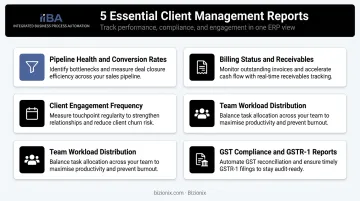
Useful reports for client management include:
- Pipeline health and conversion rates
- Billing status and outstanding receivables
- Client engagement frequency
- Team workload distribution
For Indian MSMEs, GST compliance reports and GSTR-1 auto-population are additional requirements that most global CRM tools don't support natively.
Integration with Existing Tools
Client management software that doesn't connect to your accounting platform, email system, or government portals creates new data silos rather than eliminating existing ones. Native integrations are more reliable than patchwork third-party connectors — and for compliance-critical workflows like GST e-invoicing, that reliability isn't optional.
India's GST e-invoicing mandate (Notification No. 10/2023-Central Tax) requires businesses with aggregate turnover between ₹5 crore and ₹10 crore to generate e-invoices from 01/08/2023. Any client management or ERP tool used by MSMEs at or above this threshold must handle this without manual workarounds.
Scalability and Ease of Adoption
Adoption rate matters as much as feature count. Before committing, evaluate:
- Onboarding support and training resources
- Mobile accessibility for field teams
- Interface simplicity for non-technical users
- Migration path as the business grows
A platform with strong adoption but fewer features will outperform a powerful tool that sits unused.
How We Chose the Best Client Management Software
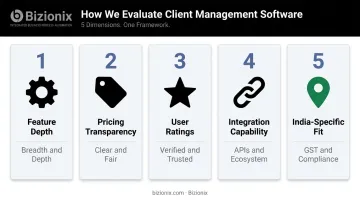
Tools in this guide were assessed across five dimensions:
- Feature depth — contact management, automation, pipeline tracking, and reporting capabilities
- Pricing transparency — using official vendor pricing pages, accessed May 2026
- User ratings — verified ratings from G2 and Capterra across a meaningful review volume
- Integration capability — with accounting, payroll, and e-commerce platforms and, for Indian tools, government GST portals
- India-specific fit — GST compliance, local billing support, and MSME (small and mid-sized business) suitability
Knowing what to look for only helps if you also know what to avoid. These are the most common missteps Indian buyers make during the selection process.
Common Mistakes to Avoid When Choosing
- Selecting based on brand name without checking whether the tool fits your actual workflow
- Choosing a sales-only CRM when what you need is project delivery, billing, and compliance support
- Ignoring implementation complexity — Forrester notes that CRM failures often stem from poor change-management practices, not feature gaps
- Overlooking compliance fit — global CRM tools rarely support GST e-invoicing natively; Indian businesses above the threshold need to verify this before committing
Each tool reviewed below was filtered through this lens — so the shortlist reflects what actually works for Indian businesses, not just what ranks highest globally.
Conclusion
The right client management software fits your team's actual workflow, client complexity, and growth stage — not just the longest feature list.
A quick breakdown by use case:
- Sales-focused teams — HubSpot, Zoho CRM, or Freshsales
- Project and pipeline management combined — monday CRM
- Indian MSMEs needing GST compliance, multi-company support, and integrated finance — Bizionix
Before committing, shortlist two or three options based on the criteria covered in this guide, then:
- Run the free trial or request a live demo
- Involve the team members who'll use it daily
- Evaluate fit before signing any contract
The people using the platform daily will determine whether the investment pays off.
Bizionix offers a 14-day free trial on its NEO plan and custom demos for Enterprise requirements. Reach out at info@bizionix.com or call +91 91779 99277 to see the platform in action.
Frequently Asked Questions
What is client management software?
Client management software is a digital platform that helps businesses organise, track, and manage all client interactions — contact data, communication history, tasks, and billing — from one centralised hub. It replaces disconnected spreadsheets and fragmented email threads with a single system accessible to every relevant team member.
What is the difference between a CMS and a CRM?
CRM tools typically focus on the sales pipeline — lead tracking, deal stages, and pipeline forecasting. A client management system (CMS) covers the broader client lifecycle, including onboarding, service delivery, support, and billing. The terms are often used interchangeably in the market, and most modern platforms overlap significantly.
What are the 4 types of CRM?
The four main types are:
- Operational CRM — automates sales, marketing, and service processes
- Analytical CRM — uses client data for insights and reporting
- Collaborative CRM — improves communication across teams and with clients
- Strategic CRM — focuses on long-term relationship development and retention
What is the best client management software?
It depends on your business type. HubSpot or Zoho CRM suit sales-focused teams; Freshsales works well for high-velocity pipelines; monday CRM fits project-client tracking. For Indian MSMEs needing client management integrated with GST-compliant operations and multi-entity management, Bizionix is built specifically for that use case.
Can small businesses benefit from client management software?
Yes — often more than large enterprises. Client management software reduces manual work, keeps follow-ups on track, and gives owners real-time visibility into client activity without needing a large operations team. HubSpot, Zoho, and Freshsales all offer free plans to get started.
What features should I prioritise when choosing client management software?
Start with contact and data management, workflow automation, reporting, and integration depth. For Indian businesses, specifically verify GST compliance support, e-invoicing capability, and whether the tool handles multi-GSTIN management if you operate multiple entities.