The stakes are high. Forrester's 2024 State of Business Buying report found that 86% of B2B purchases stall and the average buying decision now involves 13 people across multiple departments. That kind of complexity demands more than a shared spreadsheet.
This guide covers what B2B sales management software actually is, how to evaluate your options, and a curated breakdown of the best tools available — with specific attention to what Indian MSMEs need from these platforms.
Key Takeaways
- B2B sales management software tracks leads, pipelines, forecasting, and rep performance from one platform
- The best tools combine pipeline visibility, automation, and analytics without heavy IT overhead
- For Indian MSMEs, a standalone CRM often isn't enough: sales, billing, inventory, and GST compliance need to work together
- Top tools covered: Salesforce, HubSpot, Zoho CRM, Pipedrive, and Bizionix
- Evaluate on ease of adoption, integration depth, scalability, and total cost of ownership
What Is B2B Sales Management Software?
B2B sales management software is a category of digital tools designed to manage the entire sales cycle — from lead capture and pipeline tracking through to deal closure and performance analytics — in one centralised platform.
It's distinct from a basic CRM. A CRM stores contact data. Sales management software actively drives the sales process: it assigns tasks, flags stalled deals, forecasts revenue, and shows managers exactly where every opportunity stands.
Why Structure Matters More in B2B
B2B sales cycles are messier than B2C. Longer timelines, larger deal values, and multiple decision-makers across multiple departments mean that informal tracking simply doesn't scale.
According to Gartner's 2025 research, 74% of B2B buyer teams show unhealthy conflict during the decision process, with buying groups ranging from 5 to 16 people across as many as four functions. Without structured pipeline management, deals stall, fragment across inboxes and spreadsheets, and eventually fall through.
Core Components to Expect
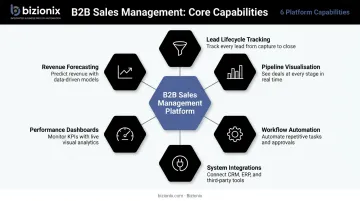
The best platforms unify these capabilities rather than requiring separate tools:
- Captures and tracks leads across their full lifecycle, from first contact to closed deal
- Visualises pipeline stages, deal values, and velocity in one view
- Forecasts revenue using pipeline activity and historical patterns
- Automates follow-ups, task assignments, and deal stage triggers
- Monitors rep-level activity and outcomes through performance dashboards
- Connects with finance and communication tools so sales data stays in sync
Best B2B Sales Management Software Tools
These tools were selected based on feature depth, ease of adoption, integration capabilities, scalability, and relevance across different B2B business sizes.
Salesforce Sales Cloud
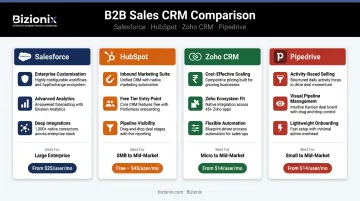
Salesforce is the global benchmark for enterprise B2B sales management. Large organisations choose it for deep customisation, an extensive third-party app ecosystem via AppExchange, and AI-driven capabilities through Einstein AI — available in Performance and Unlimited editions, with an add-on option for Enterprise.
Key differentiators include advanced lead scoring, highly configurable pipeline stages, opportunity tracking across complex multi-stakeholder deals, and territory management. It's best suited for organisations with dedicated admin teams and non-trivial sales process complexity.
| Attribute | Details |
|---|---|
| Best For | Large enterprises with complex, multi-stage B2B sales cycles |
| Key Features | Einstein AI forecasting, opportunity management, AppExchange integrations, territory management, activity capture |
| Pricing | Starter: $25/user/month; Pro Suite: $100/user/month (annual); Enterprise: $175/user/month; Unlimited: $350/user/month |
HubSpot Sales Hub
HubSpot Sales Hub is one of the most widely adopted mid-market platforms, built around an intuitive interface that sales teams actually use from day one. Its free CRM tier allows teams to start without upfront investment — a meaningful advantage when evaluating tools with limited budget certainty.
Standout features include email sequencing (available from Professional tier), conversation intelligence for call analysis and coaching, built-in meeting scheduling, and clear deal pipeline views. It's well-suited to inbound-focused B2B teams.
Factor in the required onboarding fees: HubSpot's Professional plan adds $1,500 and Enterprise adds $3,500. These sit outside the subscription cost and affect total cost of ownership calculations.
| Attribute | Details |
|---|---|
| Best For | SMBs and mid-market teams prioritising ease of use and inbound sales workflows |
| Key Features | Email sequences, deal pipeline tracking, meeting scheduling, conversation intelligence, sales analytics |
| Pricing | Free (up to 2 users); Starter: $7/seat/month (annual); Professional: $90/seat/month + $1,500 onboarding; Enterprise: $150/seat/month + $3,500 onboarding |
Zoho CRM
Zoho CRM is among the strongest contenders for Indian and mid-market B2B teams, combining a comprehensive feature set with pricing that doesn't require enterprise-level budgets. Its AI assistant, Zia, handles lead scoring, task automation, and workflow suggestions from within the CRM.
For Indian businesses specifically, the integration between Zoho CRM and Zoho Books enables GST-compatible invoicing and financial visibility alongside sales data. The broader Zoho ecosystem — including Zoho Invoice, which supports GSTR-1 API filing and e-way bill details — makes it a practical choice for MSMEs managing compliance alongside sales.
Zoho was recognised as a Visionary in the 2025 Gartner Magic Quadrant for Sales Force Automation Platforms — its 15th consecutive year of recognition.
| Attribute | Details |
|---|---|
| Best For | Growing Indian businesses and mid-market B2B teams needing affordable, full-featured CRM |
| Key Features | Zia AI insights, omnichannel communication, sales forecasting, workflow automation, Zoho ecosystem integration |
| Pricing (INR) | Standard: ₹800/user/month; Professional: ₹1,400; Enterprise: ₹2,400; Ultimate: ₹2,600 |
| Pricing (USD, annual) | Standard: $14; Professional: $23; Enterprise: $40; Ultimate: $52 per user/month |
Pipedrive
Pipedrive pioneered the visual pipeline approach to B2B deal management and remains one of the clearest options for teams that want simplicity without sacrificing deal visibility. Its drag-and-drop pipeline interface, combined with an AI Sales Assistant that analyses user behaviour and suggests next actions, keeps reps focused on the right activities.
The mobile app supports offline access — users can update deals, add notes, and log activities without an internet connection, syncing automatically when reconnected. This is useful for field sales teams.
Note: Pipedrive updated its pricing and plan structure in 2025. The current tiers are Lite, Growth, Premium, and Ultimate — not the older Essential/Advanced/Professional naming convention that still appears on many review sites.
| Attribute | Details |
|---|---|
| Best For | Small to mid-sized B2B teams wanting visual, activity-driven pipeline management |
| Key Features | Visual deal pipeline, AI activity suggestions, email integration, offline mobile app, automation workflows |
| Pricing (annual) | Lite: $14/user/month; Growth: $39; Premium: $59; Ultimate: $79 |
Bizionix
Bizionix is an all-in-one cloud ERP platform built by IIS-LLP, with over two decades of enterprise software experience, designed for Indian MSMEs that need more than a standalone CRM.
It integrates B2B sales management natively with accounting, inventory, GST-compliant billing, and multi-company operations on a single shared database. When a sales invoice is created, inventory adjusts, financial records update, and GST compliance is handled automatically — with no connectors to configure.
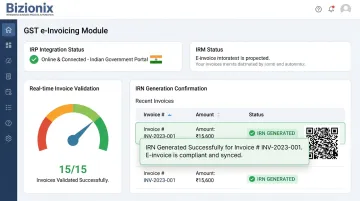
The GST e-invoicing module connects directly to the Invoice Registration Portal via API. Key capabilities include:
- Real-time validation of invoice data against GST rules
- Instant IRN (Invoice Reference Number) generation
- Elimination of manual JSON uploads and portal logins
For businesses managing multiple entities — subsidiaries, branches, GST-registered entities, franchise networks — the multi-company management capability allows a single secure login to access all entities with independent books of accounts per entity and consolidated dashboards at the group level.
| Attribute | Details |
|---|---|
| Best For | Indian MSMEs, multi-location enterprises, and growing businesses needing integrated sales + ERP with GST compliance |
| Key Features | Unified sales and operations management, GST-ready accounting, automated e-invoicing with instant IRN generation, multi-company management, real-time dashboards, 100% cloud-based |
| Pricing | NEO plan: ₹999/year (includes CRM, Sales, Accounts, Warehouse, HRMS, and Finance modules); Enterprise: contact Bizionix for custom pricing |
How We Chose the Best B2B Sales Management Software
The most common evaluation mistake is choosing based on brand recognition or feature volume. The result is low adoption, duplicate tools, and wasted spend on a platform the team works around rather than in.
Core Evaluation Criteria
Every tool on this list was assessed against:
- Pipeline and lead management depth — not just whether features exist, but how well they support actual B2B sales workflows
- Ease of adoption — HBR's research on CRM failure points directly at tools used for inspection rather than process improvement; adoption matters more than capability on paper
- Integration with financial and communication systems — sales data that doesn't connect to finance creates blind spots for leadership
- Scalability — the platform should grow with the business without requiring a costly migration every few years
- Total cost of ownership — subscription price is one line item; add implementation fees, onboarding costs, and admin overhead before comparing platforms
What Indian MSMEs Should Evaluate Specifically
These general criteria hold across markets — but Indian businesses face an additional layer of complexity that standard evaluation frameworks miss. The India SME Forum's 2025 META Report found that 52.6% of respondents reported difficulty finding appropriate digital tools, despite 71.8% of digitised MSMEs already using CRM software. High adoption doesn't mean good fit.
For Indian businesses, additional criteria apply:
- Does the platform support GST compliance and e-invoicing natively or require a third-party connector?
- Can it handle multi-entity management for businesses with multiple GST registrations?
- Is the pricing structured for MSME budgets, not enterprise contracts?
- Is there local implementation and support available?

A standalone CRM may check the sales management box while leaving accounting, inventory, and compliance in separate tools — rebuilding exactly the fragmentation it was meant to solve.
Conclusion
There's no single right answer across all business sizes and contexts. The fit depends on how your team sells and what your operations actually require:
- Salesforce suits enterprises with complex, multi-stakeholder sales processes and dedicated admin resources
- HubSpot works well for inbound-focused teams that need fast adoption
- Zoho offers strong value for Indian businesses wanting CRM-plus-ecosystem integration
- Pipedrive serves teams that want visual, activity-driven pipeline management without configuration overhead
For Indian MSMEs, the real question is whether a standalone CRM is actually sufficient — or whether the business needs sales management that stays connected to accounting, inventory, GST compliance, and multi-entity operations. Managing these functions across separate tools creates the exact fragmentation that software is supposed to solve.
Bizionix was built for businesses in that position. It's an integrated ERP platform that manages sales alongside finance, inventory, and GST compliance under one platform — covering the full operational scope that most Indian MSMEs actually run on.
If you're evaluating whether an all-in-one approach makes more sense than stitching together a CRM with separate accounting and billing tools, get in touch with the Bizionix team or request a demo to see the platform in action.
Frequently Asked Questions
What is B2B sales management software?
B2B sales management software is a platform that manages the full sales cycle — from lead capture and pipeline tracking through to deal closure and performance analytics. It's designed for business-to-business sales, where longer timelines, larger deal values, and multiple decision-makers make informal tracking impractical.
What is the difference between a CRM and B2B sales management software?
A CRM primarily manages contact data and customer relationships. B2B sales management software is broader — it encompasses active pipeline management, sales forecasting, team performance tracking, and workflow automation. Most modern platforms combine both, but the emphasis differs between tools.
Which B2B sales management tool is best for Indian MSMEs?
Indian MSMEs benefit most from platforms that combine sales management with GST-compliant billing, inventory control, and multi-entity management. Standalone CRMs handle leads and pipelines well but leave compliance and operations in separate tools — making integrated ERP solutions like Bizionix a stronger operational fit.
What features should I look for in a B2B sales management tool?
Prioritise these core capabilities:
- Pipeline visualisation and lead management
- Sales forecasting based on real pipeline data
- Automation for follow-ups and task reminders
- Performance dashboards for team tracking
- Integration with communication and financial systems
How does B2B sales management software help with deal tracking and forecasting?
These platforms show exactly where each deal sits in the pipeline, flag stalled or at-risk opportunities, and generate revenue forecasts from historical and current data. Sales leaders get the information they need to act early, not after a deal has gone cold.
Can B2B sales management software integrate with accounting and inventory systems?
Many platforms offer integrations, though depth varies. Zoho CRM, for example, connects to Zoho Books natively. For businesses that want no manual syncing between disconnected tools, all-in-one platforms that unify sales, accounting, and inventory on a single database — Bizionix being one — are a more complete fit.