Introduction
Growing businesses hit an inventory wall. What worked with one warehouse, one team, and a manageable SKU count becomes unmanageable the moment a second location opens or a new sales channel goes live. A single missed reorder stalls production. Stock discrepancies between branches trigger duplicate purchases. When a transfer goes unreconciled, an order gets confirmed against inventory that's already committed elsewhere.
Most businesses understand that inventory matters. The real problem is structural. Fragmented spreadsheets, location-specific trackers, and disconnected tools create data blind spots that compound quietly — then very visibly — as volume grows. For Indian MSMEs managing multiple branches or GST-compliant stock transfers, this fragmentation carries an additional compliance cost that's easy to underestimate.
This article covers what a centralized inventory management system actually delivers at the operational level, the specific benefits it creates, and the practices that make it work consistently — not just at launch, but as the business scales.
Key Takeaways
- A centralized inventory system gives every team and location one real-time view of all stock data
- Cuts carrying costs, reduces stockouts, and improves order fulfillment accuracy with real-time visibility
- Fragmented systems cause stockouts, excess inventory, reconciliation errors, and reactive decisions
- Set automated reorder points, enforce a single source of truth, run regular audits, and integrate across business modules
- It works as an ongoing operational discipline, not a one-time setup
What Is a Centralized Inventory Management System?
A centralized inventory management system is a single platform that tracks, controls, and updates all inventory data across departments, locations, and channels — so every team works from the same numbers, in real time.
ASCM defines inventory management as the ability to track stock as it moves in and out of warehouses. Centralized means that tracking happens in one system — not across separate local records that require manual reconciliation.
Where It Applies
The model fits any business that has moved beyond one team managing stock from one place:
- Manufacturing — tracking raw materials, WIP, and finished goods across production stages
- Distribution — managing stock across multiple warehouses or depots
- Retail and trade — synchronizing inventory across store locations and order channels
- Multi-entity MSMEs — managing inventory for subsidiaries, branches, or GST entities from a single platform
What It Actually Eliminates
The real value lies in what a centralized system eliminates:
- Data silos where different teams hold different stock numbers
- Manual reconciliation between disconnected tools or spreadsheets
- Delayed stock updates that cause decisions to be made on stale data
- Guesswork in purchasing, allocation, and fulfillment
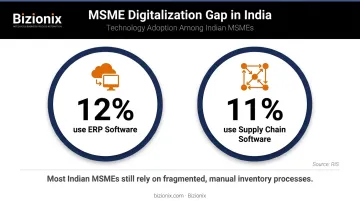
India's MSME sector still has significant ground to cover. RIS reported that only 12% of surveyed Indian MSMEs use ERP software and 11% use supply chain management software — which means fragmented, manual inventory processes remain the default for most businesses.
Key Benefits of Centralized Inventory Management
The benefits below are tied to outcomes businesses actively track: cost, accuracy, speed, and decision quality. They also compound — each one reduces friction in a specific area, and together they create an operation that is easier to manage, scale, and trust.
Real-Time Visibility Across All Stock and Locations
When all inventory data flows into a single system, every stakeholder — warehouse staff, procurement, finance, and management — sees the same live stock picture. Stock movements trigger automatic updates, so purchases, sales, returns, and transfers reflect immediately, without manual syncing between separate tools.
Key operational outcomes:
- Replenishment, allocation, and production decisions are made on current data, not yesterday's report
- Stockouts caused by teams operating on different numbers are eliminated
- Managers act on demand signals immediately rather than waiting for stock counts or cross-department confirmation
APQC benchmarks median inventory accuracy at 95.0% across 8,660 companies — and notes that higher accuracy directly improves order fill rates and reduces expedited orders. The gap between that benchmark and where a fragmented operation sits is where the stockouts and fulfillment errors live.
KPIs this affects: stock accuracy rate, stockout frequency, order fill rate, manual reconciliation hours
When it matters most: Any business managing multiple locations, branches, or channels — where the risk of each team running on different data is highest. Bizionix, built as a cloud ERP for Indian MSMEs, provides this real-time inventory visibility across entities through a single secure login, with consolidated and separate views available without switching between systems.
Real-time visibility sets the foundation — but it only pays off financially when it feeds directly into how you control stock levels and purchasing decisions.
Reduced Carrying Costs and Smarter Stock Control
A centralized system gives businesses a complete view of what they hold, where it sits, and how fast it moves. That visibility directly reduces overordering, dead stock buildup, and unnecessary storage spend.
How it reduces costs in practice:
- Reorder points are set on actual consumption patterns, not guesses
- Slow-moving items are identified before they become dead stock
- Consolidated purchase data enables better volume negotiations with suppliers
- "Buffer buying" — ordering extra because no one is sure what's already on hand — stops
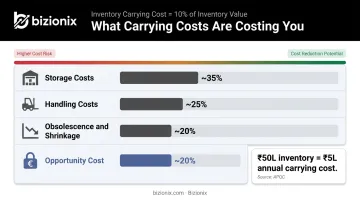
APQC's benchmark puts median inventory carrying cost at 10% of inventory value across 6,468 companies, covering storage, handling, obsolescence, shrinkage, and opportunity cost. For an MSME holding ₹50 lakh in inventory, that's ₹5 lakh annually in carrying costs. Tighter stock control eliminates most of it — freeing capital for production, marketing, or expansion instead of leaving it idle in a warehouse.
KPIs this affects: inventory turnover rate, carrying cost as a percentage of inventory value, dead stock volume, days inventory outstanding (DIO)
When it matters most: Businesses with high SKU counts, seasonal demand, or multi-warehouse operations — where misallocating stock across locations carries the highest financial cost.
Lower carrying costs improve working capital. That same centralized data also directly shapes how quickly and accurately orders get fulfilled.
Faster, More Accurate Order Fulfillment
When inventory data is centralized, order processing becomes faster and more reliable. The right stock is allocated to the right order at the right time, with fewer errors and less back-and-forth between teams.
Purchase orders, sales orders, and dispatch records all connect to the same inventory ledger. Any change in one function reflects immediately in the others — so sales, warehouse, and procurement work from a single source of truth instead of reconciling conflicting records.
Research from Sana Commerce found that roughly one-third of online B2B orders contain errors, and that order errors and returns reduce profitability and efficiency by 6% to 10%. Incorrect inventory data was the cause of 27% of reported order errors among B2B buyers.
Fulfillment errors — wrong items shipped, orders placed against already-committed stock, missed dispatch timelines — erode customer trust and create costly returns. When teams aren't resolving inventory discrepancies manually, they process more orders with the same resources.
KPIs this affects: order accuracy rate, order cycle time, return rate from fulfillment errors, customer satisfaction score
When it matters most: Peak demand periods, businesses with high product variety, or any operation fulfilling from multiple stock points — where the chance of a mismatch between committed and available stock is highest.
What Happens When Inventory Management Is Fragmented
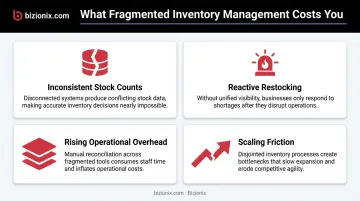
Businesses managing inventory through spreadsheets, department-level trackers, or disconnected software experience a predictable set of problems that worsen as volume and complexity grow.
The common consequences:
- Inconsistent stock counts — different teams hold different versions of inventory data, leading to duplicate orders, overselling, or stock allocated against orders already fulfilled elsewhere
- Reactive restocking — without centralized reorder triggers, teams order too early (creating excess) or too late (causing stockouts), driven by memory or manual spot-checks rather than live data
- Rising operational overhead — reconciling data across systems, resolving fulfillment disputes, and managing returns from picking errors add up to real costs that don't surface as a single line item
- Scaling friction — adding SKUs, warehouse locations, or order volume exposes every gap in the existing system, making growth harder rather than smoother
A Capterra analysis of small business software buyers found that operational inefficiency was the top trigger for switching to inventory software, cited by 50% of respondents — ahead of limited functionality at 33%. For MSMEs managing growth across multiple locations or channels, fragmented inventory is rarely a single identifiable failure. It's a slow drain on time, accuracy, and margin that compounds until the cost of inaction outweighs the cost of change.
Best Practices to Get the Most from Your Centralized Inventory System
A centralized inventory system delivers its full value only when used consistently, reviewed regularly, and integrated into the decisions it is meant to support. The platform alone does not fix operational habits.
Practice 1 — Maintain a Single Source of Truth
Every inventory transaction — receipts, transfers, adjustments, sales — must be recorded in the central system immediately. Parallel tracking in spreadsheets or local records breaks the integrity of the data and reintroduces the same fragmentation the system was implemented to eliminate.
Practice 2 — Define and Automate Reorder Points
Set minimum stock levels and reorder triggers for every SKU based on actual lead times and consumption rates. Automated alerts or purchase order triggers remove the human lag that causes stockouts during busy periods.
Practice 3 — Conduct Regular Stock Audits
Schedule periodic cycle counts to verify physical stock against system records. Address variances immediately — small discrepancies ignored over time compound into inaccuracies that undermine forecasting and purchasing decisions.
For Indian MSMEs, aligning stock audits with GST return cycles is practical. CBIC's CGST accounts and records rules require registered businesses to maintain stock accounts for each commodity — opening balance, receipts, supply, losses, and closing balance. Building audit rhythms around those compliance obligations keeps inventory data clean and keeps the business filing-ready simultaneously.
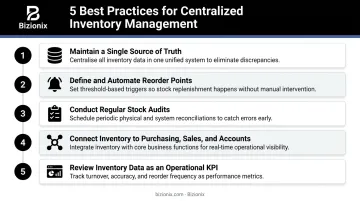
Practice 4 — Connect Inventory to Purchasing, Sales, and Accounts
A centralized system's value multiplies when it integrates with procurement workflows and sales order management. When a confirmed sales order automatically checks and commits inventory — and triggers a purchase order when stock falls below threshold — every function responds to the same real-time data without manual handoffs.
Bizionix is designed around this principle. Its inventory, purchase, warehouse, and sales modules share a single database, so stock movements, procurement actions, and sales transactions stay aligned automatically. For MSMEs managing multiple GST entities or branches, the multi-company management capability provides consolidated oversight without losing entity-level separation.
Practice 5 — Review Inventory Data as an Operational KPI
Treat inventory performance metrics — turnover, accuracy, dead stock ratio — as standard KPIs reviewed in regular management meetings. Teams that only check inventory data when something goes wrong use the system reactively — and miss the forward-looking value it's built to provide.
Conclusion
Every stock decision — replenishment, allocation, fulfillment, purchasing — is only as good as the data behind it. When inventory data is fragmented across spreadsheets, locations, or disconnected tools, those decisions compound into waste, delays, and lost margin.
The benefits compound. Better data leads to smarter purchasing. Smarter purchasing reduces carrying costs. Reduced waste recovers working capital. But only when the system is applied consistently and reviewed as part of regular operations.
Centralized inventory management is not a one-time implementation. It is an ongoing operational discipline — one that strengthens decision-making as the business scales. Left fragmented, it quietly erodes margins, delays fulfillment, and limits growth. Platforms like Bizionix are built specifically to give Indian MSMEs the unified inventory visibility needed to avoid that outcome.
Frequently Asked Questions
What is a centralized inventory system?
A centralized inventory system is a single platform through which all inventory data — across locations, departments, and channels — is recorded, tracked, and updated in real time. It ensures every team works from the same accurate stock information rather than separate local records.
What types of Warehouse Management Systems are there?
The commonly referenced types of Warehouse Management Systems are standalone WMS, ERP-integrated WMS, cloud-based WMS, and supply chain module WMS. Each differs in deployment model and how tightly it connects to other business functions like procurement and finance.
What is the difference between centralized and decentralized inventory management?
Centralized management uses a single system to oversee all inventory across all locations. Decentralized management has each location or department tracking stock independently, which creates data silos, inconsistent stock counts, and higher reconciliation overhead as the business grows.
What are the main benefits of a centralized inventory management system?
The key benefits are real-time stock visibility, lower carrying costs, more accurate order fulfillment, better demand forecasting, and the ability to make purchasing and operational decisions on current, verified data rather than estimates.
How does centralized inventory management reduce costs?
It reduces costs by preventing overordering through accurate stock visibility, minimizing dead stock, eliminating manual reconciliation work, and enabling better supplier negotiations through verified, consolidated purchase data.
Is centralized inventory management suitable for small businesses?
It suits any business managing more than one location, sales channel, or product line. Modern cloud-based systems built specifically for Indian MSMEs have made centralized inventory management accessible without enterprise-level cost or complexity.