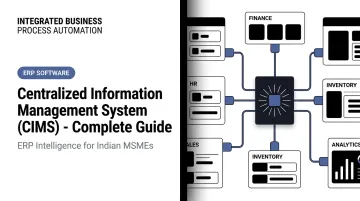
This guide covers what a Centralized Information Management System (CIMS) actually is, how the RBI's regulatory CIMS portal works for financial institutions, the key features and benefits of a business-level CIMS, and how Indian MSMEs can go about adopting one.
Key Takeaways
- A CIMS consolidates data from all departments into one system, eliminating fragmented tools in favor of a single source of truth
- The RBI's CIMS portal is a separate regulatory platform — banks, NBFCs, and other regulated entities use it to report Digital Lending App data
- Poor data quality costs organizations at least ₹100+ crore equivalent annually, per Gartner — a direct result of information silos
- Key CIMS features: centralized data, role-based access, real-time dashboards, cross-department integration, and automation
- Cloud-based ERP platforms like Bizionix act as practical CIMS implementations for Indian MSMEs, with GST compliance built in
What Is a Centralized Information Management System?
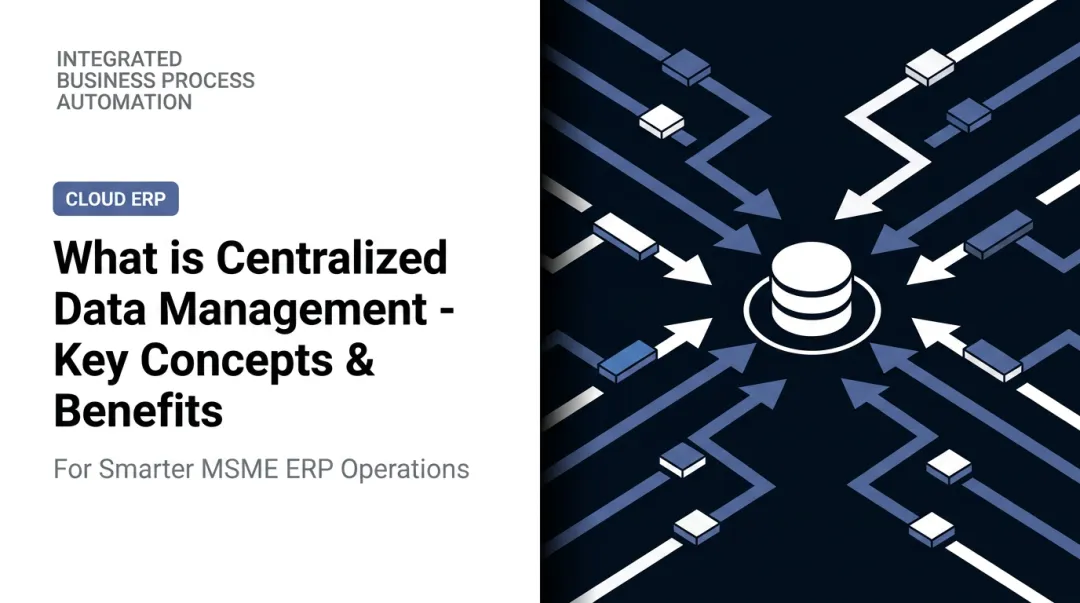
A Centralized Information Management System is a unified platform that consolidates data collection, storage, processing, and distribution across an organisation — replacing fragmented tools and siloed records with a single source of truth.
Instead of finance, sales, inventory, and HR each maintaining separate records in separate tools, a CIMS ensures all information flows into and out of one system. Authorised users access the same real-time data, regardless of their department or location.
What a CIMS Actually Does
Operationally, a CIMS:
- Collects data from multiple inputs across business functions
- Makes that data available for cross-functional analysis and reporting
- Supports real-time decision-making with accurate, consolidated information
- Links workflows between departments that were previously disconnected
What a CIMS Is Not
A CIMS is not simply a database, a file storage system, or a standalone accounting tool. Each of those handles one function in isolation:
- A document repository stores files but doesn't govern how information moves
- A CRM manages customer data but doesn't connect it to inventory or finance
- An accounting tool tracks transactions but doesn't link them to operations
As IBM defines enterprise data management, the goal is organising, governing, and optimising data throughout its lifecycle — not just storing it.
Two Contexts in India
For Indian businesses, it helps to know that the term CIMS refers to two different things depending on context:
- Enterprise CIMS: The general concept of integrated business information management, typically implemented as an ERP system for MSMEs and mid-sized enterprises
- RBI's CIMS portal: A specific regulatory reporting platform for banks, NBFCs, and other regulated entities supervised by the Reserve Bank of India
This guide covers both.
Types of CIMS: The RBI Regulatory Portal and Business Information Systems
RBI's Centralised Information Management System
The Reserve Bank of India operates its own CIMS as a regulatory reporting infrastructure. Under RBI Digital Lending Directions 2025 (RBI/2025-26/36), dated May 8, 2025, Regulated Entities (REs) are required to report all Digital Lending Apps (DLAs) through the CIMS portal.
Who must comply:
- All Commercial Banks
- Primary Urban Co-operative Banks
- State and Central Co-operative Banks
- All NBFCs, including Housing Finance Companies
- All-India Financial Institutions
The RBI directions define Digital Lending Apps as mobile and/or web-based applications, whether standalone or part of a suite, that facilitate digital lending services.
Key regulatory requirement: The RBI notification states that "RE shall ensure that the reporting in respect of all DLAs on the CIMS portal is completed by June 15, 2025."
The CIMS portal functions as the official submission channel for regulated entities, replacing email-based reporting with structured, system-based submissions. It also supports a public directory of legitimate digital lending apps, improving transparency and helping borrowers identify authorised platforms.
Business-Level CIMS for Enterprise Operations
The regulatory use case above is specific to lending compliance. At the enterprise level, CIMS takes a different form: an integrated business management platform, most commonly implemented as an ERP (Enterprise Resource Planning) system. SAP defines ERP as software that integrates core business processes across finance, manufacturing, supply chain, sales, procurement, and HR.
For Indian MSMEs, this means every transaction updates multiple records at once:
- A sale posts to accounts receivable, updates inventory, and triggers GST entries automatically
- A purchase adjusts stock levels, records the payable, and flags reorder thresholds
- A stock movement reflects instantly in finance and operations without manual reconciliation
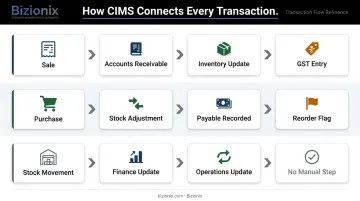
The result is a single source of truth across the entire business, eliminating the delays and errors that come with managing separate systems per department.
Key Features of an Effective Business CIMS
Not every integrated software qualifies as a true CIMS. These are the features that define a capable system:
Centralized Data with Controlled Access
- Single data repository — all departments read from and write to the same system
- Role-based access controls — users see only what their role permits (view, edit, or admin)
- Entity-level permissions — particularly important for multi-location or multi-company operations
Bizionix, for example, implements role-based access with department and branch restrictions, combined with full activity logs per entity — so every action is traceable back to a specific user.
Real-Time Dashboards and Reporting
A CIMS should provide live visibility, not end-of-month summaries. Management dashboards that pull from a unified database give leadership an accurate, continuously updated picture of business health — not a monthly snapshot.
Key metrics visible in real time typically include:
- Cash flow position and receivables aging
- Inventory levels across all locations
- Sales performance by team, region, or product
- Operational bottlenecks and pending approvals
Cross-Department Module Integration
The practical value of a CIMS comes from modules that share data automatically:
- Finance & Accounting — P&L, balance sheet, bank reconciliation
- Sales & CRM — orders, quotations, customer lifecycle
- Inventory — real-time stock levels across locations
- Purchase Management — vendor orders, GRN, consumption tracking
- HRMS & Payroll — attendance, salary, statutory compliance
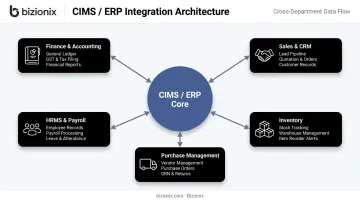
When a sales invoice is created in Bizionix, inventory levels update, financial records adjust, and GST compliance entries are generated — automatically.
Automation and Audit Trails
Two features that separate a genuine CIMS from basic software:
- Automation — validates data at entry, triggers downstream workflows, and handles GST returns and e-invoicing without manual steps
- Audit trails — logs every change, approval, and action with user identity, timestamp, and context, creating accountability that manual processes cannot match
Benefits of a Centralized Information Management System for Businesses
Eliminating Information Silos
When each department holds its own version of data, decisions get made on incomplete or conflicting information. McKinsey notes that data silos create inconsistencies and errors that increase the difficulty of business, data, and technology decisions. The downstream effects are real: duplicate work, miscommunication between teams, and strategies built on stale numbers.
A CIMS removes this by design. One system, one version of the truth, accessible to everyone with the appropriate permissions.
Better Decision-Making
When management can view real-time data across finance, sales, inventory, and operations from a single system, decisions are based on evidence — not approximations. That shift matters.
Moving from month-end report reviews to continuous operational visibility changes how quickly businesses can identify and respond to problems. Issues surface faster, and so do the opportunities.
Operational Efficiency
Staff in fragmented environments spend significant time:
- Hunting for information across multiple tools
- Reconciling conflicting data from different departments
- Manually re-entering the same data in multiple places
- Following up verbally on approvals and status updates
A CIMS eliminates most of this. Automated workflows replace manual follow-ups. Integrated modules mean data entered once is available everywhere. The time freed up goes toward higher-value work.
Transparency and Accountability
Clear audit trails, role-based visibility, and activity tracking mean that every action across the organisation is attributable. You can see exactly what's happening, where bottlenecks occur, and who is responsible.
For growing businesses managing multiple locations or teams, this level of structural accountability is difficult to achieve without a centralised system. It's the difference between guessing and knowing.
Compliance Support
For Indian businesses, compliance with GST filing, e-invoicing requirements, and statutory reporting is non-negotiable. A CIMS with built-in compliance tools automates much of this work.
Standardised data formats and automated return preparation reduce errors at filing time. Platforms like Bizionix go further — direct API integration with the IRP means IRN generation happens instantly, without manual intervention.
How to Implement a CIMS for Your Business
Step 1: Audit How Information Currently Flows
Before evaluating any software, map out how data actually moves through the business today. The audit should answer three questions:
- Where are the gaps in information flow?
- Which departments rely on manual handoffs?
- Where do errors and delays most commonly originate?
These answers define what the CIMS needs to solve and set the benchmark for measuring success after implementation.
Step 2: Select the Right Platform
Evaluation criteria for an Indian MSME adopting a CIMS or integrated ERP:
- Scalability: can it grow with the business without requiring a full system replacement?
- Module coverage: does it handle finance, GST compliance, inventory, billing, and HR?
- GST-readiness: is Indian compliance built in, or a costly add-on?
- Cloud accessibility: can multi-location teams access real-time data from anywhere?
- Implementation complexity: deployable without months of consultant work?
- Total cost of ownership — licences, implementation, training, and ongoing support combined
Platforms like Bizionix are built specifically for this context: a unified, GST-ready ERP starting at ₹999/year, with cloud access, multi-entity management, and none of the complexity or cost that comes with enterprise-tier systems.
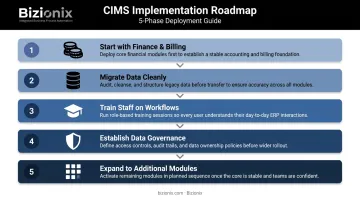
Step 3: Implement in Phases
Attempting a full rollout across every department simultaneously is one of the most common implementation mistakes. Deloitte identifies strategy, change management, and data migration as the critical factors in ERP implementation success.
A phased approach works better:
- Start with highest-priority modules — typically finance and billing, where impact is immediate and measurable
- Migrate data cleanly: incomplete or duplicate historical records undermine the system from day one
- Train staff on new workflows — the system only delivers value if people use it correctly
- Establish data governance: define who owns data quality, who can enter or modify records, and how exceptions are handled
- Expand to additional modules once the core is stable and adoption is solid
Frequently Asked Questions
What is a centralized information management system?
A CIMS is a unified platform that consolidates data collection, storage, and distribution across all of an organisation's departments into one accessible system. It replaces fragmented tools with a single source of truth, giving authorised users real-time access to accurate information for better decision-making.
What is the use of CIMS portal?
In the Indian regulatory context, the CIMS portal refers to the RBI's platform through which regulated entities — including banks and NBFCs — submit data on Digital Lending Apps and other regulatory returns. It improves transparency, standardises reporting, and replaces manual email-based submissions with structured, system-based data transfer.
What is the difference between a CIMS and an ERP system?
CIMS is the broader concept: centralised, governed information management across an organisation. ERP is the specific software category that delivers this for enterprise operations, integrating finance, sales, supply chain, and HR into one platform. In practice, most businesses encounter CIMS through an ERP implementation.
How does a centralized information management system benefit small and mid-sized businesses?
MSMEs benefit by eliminating data silos, reducing manual errors, speeding up billing and reporting cycles, and improving GST compliance. A cloud-based CIMS also gives owners real-time visibility across all business functions from one platform, without requiring large IT teams or infrastructure investment.
What are the key features to look for in a CIMS?
Look for: centralised data storage with role-based access, real-time dashboards, cross-department module integration, workflow automation, cloud accessibility with 24/7 availability, audit trails for accountability, and built-in compliance tools — particularly GST-ready reporting for Indian businesses.
Is a CIMS the same as a data warehouse?
No. A data warehouse aggregates historical data for analysis. A CIMS actively manages the flow, access, and use of information across live operations, including workflows, approvals, real-time transactions, and governance. A data warehouse can sit within a CIMS architecture, but it doesn't replace one.