Introduction
Picture a typical Tuesday morning at a growing Indian business. The owner needs a quick answer: can we fulfil this bulk order profitably? The accountant has last month's numbers in a spreadsheet. The warehouse team tracks stock in a separate tool. The salesperson who knows the customer's outstanding balance is travelling. Nobody has the full picture — and the decision waits.
This is a data fragmentation problem — and it is widespread among Indian MSMEs. According to a 2025 RIS report on MSME digitalisation, only **12% of Indian MSMEs use ERP systems**. Just 13% use CRM tools, and 11% use supply chain management software. Most growing businesses are running on disconnected information spread across departments.
Centralized data management solves this directly. What follows breaks down the core concepts and the practical benefits businesses see when they bring their data into one place.
Key Takeaways
- Centralized data management consolidates data from all business functions into one unified system, giving every team a single, reliable source of truth.
- Fragmented data across departments causes delayed decisions, compliance gaps, and wasted operational effort.
- Key concepts include data integration, data governance, master data management, access control, and data quality.
- Core benefits include faster decisions, stronger security, GST compliance readiness, and lower operational costs.
- For Indian MSMEs, a cloud ERP like Bizionix brings this together through integrated modules, built-in GST compliance, and real-time visibility across operations.
What Is Centralized Data Management?
Centralized data management is the process of consolidating data from multiple business functions — sales, finance, inventory, HR, procurement — into a single, unified repository, governed by consistent policies, access controls, and quality standards. A shared drive full of spreadsheets is storage. Centralized data management is an operational framework — covering how data is collected, structured, validated, secured, and made accessible across the organization.
The Single Source of Truth in Practice
The most tangible outcome of centralized data management is a single source of truth: every department references the same data. There are no competing versions of a report, no conflicting inventory counts, and no reconciliation headaches at month-end.
In practice, this means:
- The warehouse manager and the sales team see the same stock levels — in real time
- The finance team and the operations head work from identical receivables figures
- Auditors can trace any transaction back to its origin without chasing multiple systems
Bizionix describes this as the operating reality its platform creates: "sales, finance, and operations use the same real-time numbers." Every department acts on the same data simultaneously, eliminating the version conflicts that slow decisions and create errors.
What Changes for a Growing MSME
Most growing MSMEs already feel this gap. A business managing billing in Tally, inventory in Excel, payroll in a standalone HR tool, and sales tracking in WhatsApp threads is running on fragmented data — and making decisions accordingly. When these systems connect through a unified ERP, the business gains one consistent view of operations: accurate stock counts, real-time financials, and a payroll that reflects actual headcount — without manual reconciliation between tools.
The Hidden Cost of Fragmented Data
Data silos form naturally in growing businesses. Finance runs on accounting software, warehouses run on spreadsheets, and sales teams track deals in a CRM — or their phones. Each system makes sense in isolation. Together, they leave no one with a complete, reliable view of the business.
Real-World Consequences for MSMEs
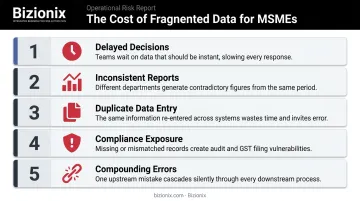
The operational cost of this fragmentation is significant:
- Delays decisions — owners wait on data from multiple sources, often acting on information that's already outdated
- Produces inconsistent reports — month-end figures differ across departments because each team captures a different snapshot
- Forces duplicate data entry — the same vendor, customer, or product gets entered into accounting, inventory, and CRM separately, creating conflicting records
- Creates compliance exposure — GST records, purchase histories, and vendor documentation scattered across systems make audits harder and filing errors more likely
- Compounds errors — manual re-entry between systems multiplies mistakes with every transfer
Gartner reports that poor data quality costs organizations at least USD 12.9 million per year on average — a figure driven precisely by the inconsistency, duplication, and gaps that data silos create. For Indian MSMEs operating on tighter margins, even a fraction of that cost adds up fast.
The problem compounds as the business grows. More departments mean more tools, and more tools mean more versions of the same data — each slightly different, none fully trusted. Centralized data management exists specifically to break that cycle.
Key Concepts in Centralized Data Management
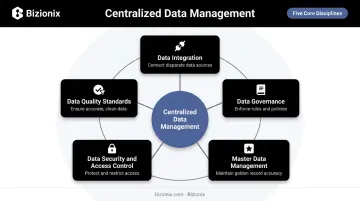
Understanding centralized data management means understanding the five disciplines that make it work.
Data Integration
Data integration is how information from multiple systems — accounting software, CRM, inventory tools, payroll — gets brought into one central platform. IBM defines it as combining and harmonizing data from multiple sources into a unified, consistent format.
Two mechanisms make this possible:
- ETL pipelines (Extract, Transform, Load) — pull data from source systems, reformat it, and load it into a central repository on a scheduled or continuous basis
- APIs — connect systems in real time, allowing data to flow between applications without manual export and import
Bizionix takes a different approach: a natively unified single database architecture. All modules — finance, inventory, sales, HR — operate on one shared database. There is no sync required because data is never separated to begin with. A sales invoice created by the sales team immediately updates inventory levels, accounting records, and financial reports.
Data Governance
Data governance defines the policies and rules that determine who can access which data, how it must be stored, who is responsible for it, and how long it should be retained. Gartner describes it as a framework of decision rights and accountability for how data is valued, created, consumed, and controlled.
Without governance, even a centralized system degrades over time. Data entered inconsistently or accessed by the wrong people loses reliability fast. Governance is what prevents the same silos from re-forming inside the new system.
Master Data Management (MDM)
Master Data Management is the discipline of creating a golden record : one authoritative, trusted version of critical business entities like customers, vendors, and products.
Consider a common MSME problem: the same vendor appears as "Sharma Traders," "Sharma Trading Co.," and "Sharma Trdrs" across accounting, purchasing, and inventory systems. Reconciling these into a single record eliminates duplication and ensures every department references the same supplier history, pricing, and documentation.
Data Security and Access Control
Centralization makes security far simpler to enforce. Instead of managing separate login systems, user permissions, and security configurations across a dozen tools, a centralized platform applies consistent policies across all data at once.
Role-based access control (RBAC) — a model defined by NIST — assigns permissions based on job function. In practice:
- The finance team accesses payroll and financial data
- The warehouse manager sees inventory and stock movements
- The sales team views customer records and pricing, not cost structures
Bizionix enforces this at the entity level: view, edit, and admin permissions are configured by department or branch, with full activity logs tracking who accessed or modified what, and when.
Data Quality Standards
Centralization enforces uniform formats, validation rules, and consistency checks across all data inputs. Data entered by the finance team meets the same structural standards as data entered by the warehouse team — because both are entering data into the same system with the same rules applied.
This prevents the format mismatches, missing fields, and entry errors that accumulate when departments run on separate tools with separate standards.
Together, these five disciplines — integration, governance, MDM, security, and data quality — form the operational backbone of any centralized data management system. Each one reinforces the others.
Key Benefits of Centralized Data Management
Faster and More Confident Decision-Making
With all business data in one system, owners and managers stop waiting for department reports to be compiled, cross-checked, and forwarded. Real-time dashboards covering sales, inventory, receivables, and expenses are available immediately — to anyone with appropriate access.
A typical MSME owner without centralized data chases staff for updates, waits for Excel files, and makes decisions on last week's numbers. With Bizionix, that same owner opens one platform and sees the current state of the business — cash flow, outstanding invoices, stock levels, team activity — without asking anyone.
Decisions made on accurate, current information carry less risk. That's the operational difference a single source of truth creates.
Enhanced Data Security
Centralized data management directly addresses this vulnerability. One system means one security perimeter: encryption, role-based access, login monitoring, and audit trails are configured once and applied universally. There's no question of whether a particular spreadsheet is password-protected or whether a particular tool has been updated.
For Indian MSMEs, where 88% of SMB breaches are ransomware-related according to Verizon's 2025 Data Breach Investigations Report, consistent security enforcement is not a luxury.
Improved Operational Efficiency
Centralization eliminates three categories of operational waste:
- Duplicate data entry — information entered once flows automatically to all relevant modules
- Manual reconciliation — no cross-checking between systems because there is only one system
- Time spent searching — no hunting through email threads, shared drives, or WhatsApp to find a purchase order or delivery challan
Bizionix replaces the "scattered Excel files, WhatsApp approvals, and manual follow-ups" that characterize pre-ERP MSME operations with digital workflows, automated tracking, and real-time visibility. Staff spend time on productive work rather than data housekeeping.
Reduced Costs
Managing one integrated system costs less than maintaining five or six separate software subscriptions with separate databases, separate user licenses, and the IT overhead of keeping them loosely synchronized.
A 2023 FICCI survey of over 600 Indian SMEs found that digitalization reduced annual operational costs by 11-20% for 35% of surveyed businesses, and by more than 20% for 30%. Bizionix positions its NEO plan at ₹999 per year — a direct replacement for multiple standalone tools that cost more and deliver less visibility.
Elimination of data duplication also reduces storage overhead over time, and the reduction in manual errors reduces the cost of corrections, rework, and compliance penalties.
Compliance and Audit-Readiness
Under the CGST Rules, 2017, GST compliance requires maintaining:
- True and correct accounts with complete audit trails
- Source documents — invoices, delivery challans, e-way bills, credit and debit notes
- Electronic change logs with inter-linkages available on demand
When records are centralized, meeting these requirements is a byproduct of normal operations. Every transaction is logged, every document is stored in one location, and every modification is traceable.
Bizionix connects directly with the GST e-Invoice system via API, auto-populates GSTR-1, maintains complete audit trails, and keeps all vendor and customer documentation within one platform. Compliance reviews become routine checks rather than last-minute recoveries.
Centralized vs. Decentralized Data Management
Decentralized data management distributes data across multiple systems, locations, or department-controlled databases with no unified governance or single access point. On the surface, this approach has its appeal: teams retain local autonomy and avoid dependency on a single system. But for most growing businesses, the tradeoffs outweigh the convenience.
| Dimension | Centralized | Decentralized |
|---|---|---|
| Storage location | Single unified repository | Multiple systems, locations, or tools |
| Governance model | Consistent policies, defined ownership | Varies by department or tool |
| Data consistency | One version of every record | Multiple versions, frequent conflicts |
| Security controls | Applied uniformly across all data | Varies; gaps are common |
| Cost over time | Lower — one system to maintain | Higher — multiple subscriptions and sync overhead |
| Best suited for | MSMEs, mid-sized enterprises, compliance-heavy businesses | Low-stakes local data; large enterprises with distinct regional units |
For most Indian MSMEs that need consistent reporting, GST compliance, and cross-department visibility, centralized data management delivers greater long-term value. The transition is more straightforward than most expect, particularly with cloud-based ERP platforms built specifically for MSME scale and Indian compliance requirements.

How to Get Started with Centralized Data Management
Step 1: Audit Your Current Data Landscape
Before choosing any platform, map where data currently lives. Which spreadsheets exist? Which standalone applications? Who owns them? Where do the biggest inconsistencies appear? This baseline prevents surprises during migration and helps prioritize what to consolidate first.
Step 2: Establish Governance Policies Upfront
Define who owns which categories of data, who can access or modify it, and what quality standards apply — before you build the new system. Governance decisions made upfront prevent the same silos from re-forming inside the new centralized platform.
Even basic decisions shape how clean the system stays over time:
- Who approves a new vendor record?
- Who can edit customer pricing?
- Who resolves duplicate entries across departments?
Step 3: Choose a Platform Built for Your Scale
Look for an integrated solution that covers your core business functions — finance, inventory, sales, procurement, HR, and compliance — in a single system rather than stitching together separate tools.
For Indian MSMEs, Bizionix is a cloud ERP designed around these requirements. Key capabilities include:
- GST-ready accounting with automated e-invoicing
- Real-time visibility across departments
- Role-based access control
- Multi-department data consolidation without enterprise-level cost
Plans start at ₹999/year with a 14-day free trial available before purchase.
Frequently Asked Questions
What is a centralized data management system?
A centralized data management system is a unified platform or repository where data from all departments and sources is stored, governed, and accessed. Every team in the organization works from the same accurate, up-to-date information rather than maintaining separate records in disconnected tools.
What are the 4 pillars of data management?
The four pillars are data quality, data governance, data security, and data integration. Together, they ensure data is accurate, protected, properly governed, and accessible across the organization.
What is the difference between centralized and decentralized data management?
Centralized management uses one unified repository with consistent governance and security, while decentralized management distributes data across multiple systems without unified control. For most growing businesses, centralized management delivers better consistency, stronger security, and lower long-term costs.
What are the biggest challenges of implementing centralized data management?
The most common hurdles are migrating data from legacy systems and spreadsheets, getting cross-department buy-in, and establishing governance policies. Most organizations manage these through phased implementation, clear ownership, and choosing a platform with solid onboarding support.
How does centralized data management improve decision-making?
Having all business data in one place gives leaders real-time, consistent information without waiting on reports compiled from disconnected sources. Owners see the current state of the business immediately, not after a chain of follow-up emails.
Is centralized data management suitable for small and mid-sized businesses?
MSMEs often see the strongest gains from centralization because it directly replaces inefficient manual processes and disconnected tools. Modern cloud-based ERP solutions have made this accessible and affordable — Bizionix, for example, starts at ₹999/year specifically for Indian MSMEs.