Data without structure is just noise. Data management is the practice that converts raw, scattered information into a reliable business asset — one that supports decisions, streamlines operations, and holds up under regulatory scrutiny.
This article covers:
- A plain-language definition of data management
- The key processes involved (collection, storage, quality, governance, MDM)
- Why it matters for growing businesses and MSMEs
- Common challenges and practical best practices
Key Takeaways
- Data management = the practices, processes, and tools that make business data trustworthy and usable across its entire lifecycle
- Poor data quality costs organizations millions annually, mostly through decisions made on inaccurate or incomplete information
- Key disciplines include data quality, governance, integration, and master data management
- For Indian MSMEs, GST e-invoicing and DPDPA compliance make structured data management non-negotiable
- Bizionix eliminates data silos by consolidating all business data into a single system
What Is Data Management?
DAMA International defines data management as the "development, execution, and supervision of plans, policies, programs, and practices that deliver, control, protect, and enhance the value of data and information assets throughout their lifecycles."
In practical business terms: it's how you collect, organise, store, protect, and use data so it actually works for you.
Data vs. Information
Raw data (a list of transactions, a customer's phone number, a purchase order number) means nothing on its own. Data management is what processes and structures it into information you can act on.
Consider the difference between:
- A spreadsheet of 10,000 sales line items (raw data)
- A dashboard showing monthly revenue trends by product category (actionable information)
The second exists only because someone managed the first. That's the core function of data management — turning noise into decisions.
The Data Lifecycle
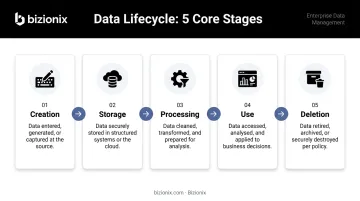
Data management isn't a one-time cleanup exercise. It's an ongoing discipline covering the full lifecycle:
- Creation — data enters the business through transactions, forms, integrations
- Storage — data is saved in databases, cloud systems, or files
- Processing — data is cleaned, transformed, and prepared for use
- Use — data supports decisions, reports, and operations
- Deletion — outdated or redundant data is retired appropriately
For growing MSMEs, managing this lifecycle consistently is what separates businesses that scale cleanly from those that hit operational bottlenecks as transaction volumes rise.
One Common Misconception
Data management is often treated as an IT problem. It isn't. Finance, sales, HR, and operations all generate and depend on managed data. Every department head who pulls a report or updates a customer record is participating in data management — the label doesn't change the responsibility.
Key Processes in Data Management
Data management comprises several interconnected disciplines. Each addresses a different point in the data lifecycle, and together they determine whether your data is reliable enough to act on.
Data Collection and Integration
Collection is straightforward — gathering data from transactions, customer interactions, supplier records, and operational systems. The harder problem is integration: combining data from multiple, disparate sources into a unified format.
This is where ETL (Extract, Transform, Load) pipelines come in. As IBM defines it, ETL is "a data integration process that combines, cleans, and organizes data from multiple sources into a single, consistent dataset."
Without integration, siloed data causes:
- Conflicting customer records across sales and billing systems
- Inventory figures that don't match accounting totals
- Reports built on different versions of the same data
Data Storage and Operations
Storage options have expanded significantly. The main categories:
| Storage Type | Best For |
|---|---|
| On-premises databases | Full control, predictable workloads |
| Cloud databases | Scalability, remote access, cost efficiency |
| Data warehouses | Analytics and reporting on structured data |
| Data lakes | Raw, unstructured, or high-volume data |
Cloud-based storage is the default choice for most growing businesses today. Across OECD countries, cloud computing is already used by an average of 49% of firms with ten or more employees — pay-per-use pricing and lower infrastructure overhead make it the practical option for MSMEs that can't justify large upfront capital costs.
Data Quality Management
Poor data quality has direct financial consequences. Duplicate customer records lead to billing errors. Outdated supplier contacts delay procurement. Incorrect invoice amounts create compliance risk.
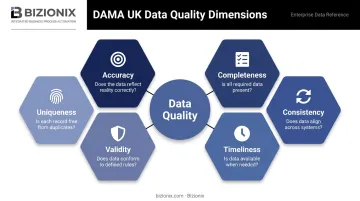
Data quality management is the process of profiling, cleaning, validating, and monitoring data to ensure it meets defined standards. DAMA UK identifies six core quality dimensions:
- Accuracy — does the data reflect reality?
- Completeness — are all required fields populated?
- Consistency — does data match across systems?
- Timeliness — is the data current enough to be useful?
- Validity — does the data conform to expected formats and rules?
- Uniqueness — are there duplicate records inflating or distorting data?
Data Governance and Security
Data governance is the framework of policies, roles, and responsibilities that determines who can access data, how it should be handled, and how it stays compliant with regulations.
Data security is the technical enforcement of that framework — encryption, role-based access controls, and audit trails that make governance real rather than theoretical.
For Indian MSMEs, two specific regulations make governance a practical operational requirement right now:
- Businesses with aggregate turnover exceeding ₹5 crore must comply with GST e-invoicing mandates (effective 1 August 2023 under GST Council Notification 10/2023)
- India's Digital Personal Data Protection Act, 2023 (received assent 11 August 2023) requires organisations handling personal data to implement appropriate safeguards and notify breaches
Master Data Management (MDM)
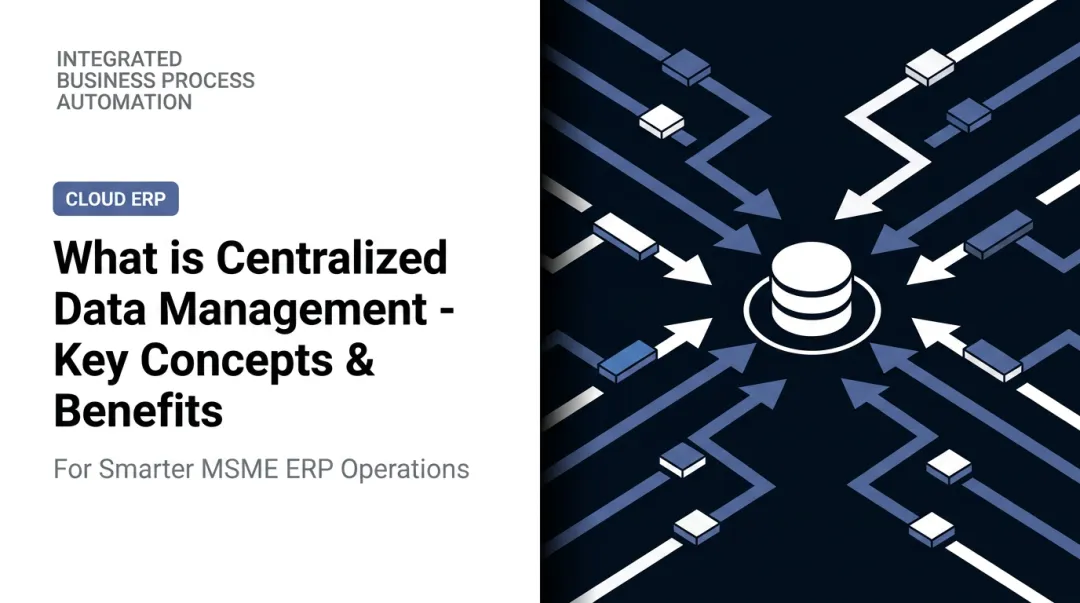
MDM creates a single, authoritative "master record" for key business entities — customers, products, suppliers, employees — so every department works from the same version of the truth.
As Gartner defines it, MDM is where "business and IT work together to ensure uniformity, accuracy, stewardship, semantic consistency, and accountability of shared master data assets."
Without MDM, a single customer might have five different records across sales, billing, and support systems — with different phone numbers, addresses, and outstanding balances. Each discrepancy creates a decision point where someone has to guess which record is correct — and that guess costs time, money, or both.
Why Data Management Matters for Your Business
Data management is ultimately about business outcomes, not infrastructure. Here's where the impact shows up directly.
Better Decision-Making
When data is clean, centralised, and accessible, decisions are based on facts rather than gut feel or month-old reports. Research by Brynjolfsson, Hitt, and Kim found that firms using data-driven decision-making showed 5–6% higher output and productivity compared to peers relying on other inputs.
The contrast is stark. Fragmented data produces decisions built on incomplete or conflicting information:
- Stock-outs because inventory figures were out of date
- Missed revenue because debtor reports were stale
- Mispriced quotes built on outdated cost data
Operational Efficiency
Manual data re-entry, reconciliation between systems, and chasing updated figures across spreadsheets are all symptoms of poor data management. McKinsey research found knowledge workers spend 19% of their working time searching for and gathering information — time that could be redirected to higher-value work.
Because Bizionix runs on a unified data architecture with a single centralised database, a sales invoice created in the CRM automatically updates inventory levels, accounting ledgers, and GST returns. No manual intervention, no version conflicts.
Regulatory Compliance
Organised, well-governed data makes GST filing, e-invoicing, TDS management, and audit preparation far more manageable. The inverse is equally true: unmanaged data means scrambling to locate records at filing time, higher error rates, and real penalty exposure. Under Section 122 of the CGST Act, invoice-related offences carry penalties of ₹10,000 or the tax evaded — whichever is higher.
Scalability
Spreadsheets hit a wall. As a business adds locations, product lines, or customers, the volume and complexity of data grows past what manual systems can reliably handle. A sound data management foundation — centralised, structured, and governed — means growth doesn't come with proportional administrative chaos.
Bizionix's multi-company management capability is built for exactly this stage of growth:
- Multiple entities, GST registrations, and branch locations under a single secure login
- Independent books of accounts per entity
- Group-level dashboards for consolidated visibility across the business
Common Data Management Challenges
Data Silos and Volume Growth
Most MSMEs don't set out to create data silos — they accumulate them. Each tool adoption solves a specific problem while adding another disconnected data store:
- Accounting managed in one system
- Customer records tracked in a separate CRM
- Inventory in a third tool
- HR and payroll in yet another platform
Reconciling across these silos is time-consuming and error-prone. Cohesity research found that 87% of senior IT decision-makers believed their organisation's data was fragmented — a challenge that compounds as data volumes grow.
Data Quality Issues
Many businesses carry years of poorly structured data: inconsistent name formats, duplicate vendor records, missing GST numbers, outdated contact details. Retroactive cleaning is resource-intensive, and without ongoing quality processes — validation rules, format standardisation, regular audits — the problems keep recurring.
IMA Strategic Finance research found that SMEs rely on Excel for 79% of data formatting tasks and 55% of data cleansing work. At that volume, manual processes are where errors accumulate fastest — and where they're hardest to catch.
Compliance Complexity
Staying current with GST rule changes, e-invoicing mandates, and evolving data privacy requirements alongside day-to-day operations is genuinely difficult for businesses without dedicated compliance or IT teams. Governance processes that feel excessive at small scale quickly become non-negotiable as regulatory obligations stack up.
Data Management Best Practices
Start with Business Goals, Not Technology
Before selecting tools or redesigning processes, identify what decisions you need data to support. Define specific objectives:
- Reduce debtor follow-up time by tracking receivables in real time
- Eliminate invoicing errors through pre-submission validation
- Get accurate stock levels across multiple locations
Technology should serve these goals — not become the goal itself.
Prioritise Data Quality from Day One
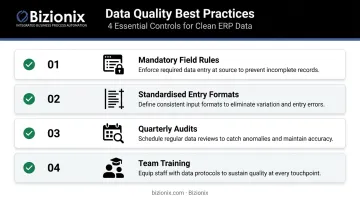
Prevention is cheaper than correction. Build quality in from the start:
- Set mandatory field rules for critical data (GST number, PAN, contact details)
- Standardise entry formats across teams (date formats, naming conventions)
- Conduct quarterly audits to catch drift before it compounds
- Train team members on correct entry practices — most data quality failures are process failures, not system failures
Govern Access and Ownership
Define clearly who owns which data, who can access it, and what they can do with it. Role-based access controls ensure sensitive financial or customer data is only visible to those who need it. Document your data policies — ambiguity about ownership is where gaps appear.
Bizionix is built around this principle. Its access governance features include:
- Entity-level permissions scoped to individual companies
- Role-based controls (view, edit, and admin) per user
- Department and branch restrictions for multi-location teams
- Full activity logs creating an audit trail for compliance and accountability
Frequently Asked Questions
What are the main types of Master Data Management (MDM)?
The three primary MDM implementation styles are: consolidation (aggregating data into a central hub), registry (linking records across systems without moving them), and coexistence (synchronizing a central master record with existing operational systems). A fourth pattern, centralised, keeps all master data exclusively in the hub. The right choice depends on how much data centralisation the business needs and how many source systems are involved.
What are the main types of Database Management Systems (DBMS)?
The four primary types are: relational DBMS (structured tables using SQL — MySQL, PostgreSQL), NoSQL DBMS (flexible, schema-free storage for unstructured data — MongoDB), in-memory DBMS (ultra-fast processing for real-time data requirements), and cloud DBMS (hosted, scalable storage managed by a cloud provider). Most growing businesses use a relational or cloud DBMS as their primary system.
What is the relationship between Master Data Management and ETL?
They're complementary, not competing. ETL is the process: extract data from source systems, transform and clean it, then load it into a target system. MDM governs the master records that ETL feeds into, ensuring transactional data is matched against and used to enrich those records.
What are CDM and CRM, and how do they differ?
CDM (Customer Data Management) is the broader practice of collecting, organising, and governing all customer-related data across an organisation. CRM (Customer Relationship Management) is a specific tool for managing customer interactions and sales pipelines — and a subset of CDM, typically the primary operational source feeding the wider customer data picture.
What is the difference between data management and data governance?
Data management is the overall practice of handling data throughout its lifecycle (collection, storage, quality, integration, and use). Data governance is specifically the framework of policies, roles, and standards that ensure data is used consistently, securely, and in compliance with applicable regulations. Governance is one discipline within the broader data management umbrella.
Why is data quality important in data management?
Poor data quality (inaccurate, incomplete, or duplicated records) leads directly to faulty decisions, compliance failures, and operational inefficiencies. Reports, forecasts, and processes are only as reliable as the data underneath them. Data quality management keeps that foundation accurate, so the decisions and processes built on it hold up under scrutiny.