Introduction
Choosing an ERP partner is genuinely difficult. There are hundreds of vendors globally — product companies, implementation giants, open-source platforms, custom development shops — and no universal definition of what an "ERP software development company" actually is.
For Indian businesses, the problem is sharper. Many global ERP platforms are priced for multinationals, built without GST compliance, and require six-figure implementation budgets before a single report runs. Yet picking the wrong vendor — one that's too complex, too expensive, or poorly supported — can set an operation back by years.
That decision deserves a clear-eyed comparison. Below you'll find 12 ERP companies spanning product vendors, implementation specialists, and India-focused platforms — plus a selection framework built around business size, industry, and compliance needs.
Key Takeaways
- ERP software development companies design, build, customize, or implement systems that unify business operations — finance, inventory, HR, compliance, and more
- Global platforms like SAP, Oracle, and Microsoft offer powerful tools, but their cost and complexity make them a poor fit for most growing businesses
- Indian MSMEs benefit most from purpose-built, GST-compliant cloud ERP with local support and transparent pricing
- Evaluate vendors on total cost of ownership, post-deployment support, and India compliance fit — not brand recognition alone
- Shortlist vendors who offer configurable modules, proven GST integration, and responsive support after go-live
What Is an ERP Software Development Company?
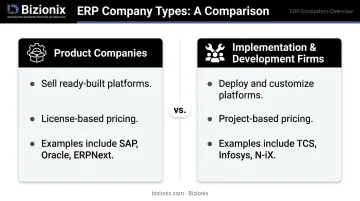
The term covers two distinct categories:
- Product companies — build and sell a ready ERP platform (SAP, Oracle, ERPNext)
- Implementation/development firms — deploy, customize, or build ERP systems for clients (TCS, Infosys, N-iX)
Some companies do both. Understanding which type you're dealing with matters, because it directly affects pricing, customization potential, and support structure.
The market behind these companies is substantial. According to Grand View Research, the global ERP software market stood at USD 77.08 billion in 2025 and is projected to reach USD 157.07 billion by 2033 at a 9.5% CAGR.
India's share is growing faster. The Indian ERP market was USD 1.79 billion in 2024 and is forecast to reach USD 2.73 billion by 2028 at an 11.07% CAGR, according to Statista.
For Indian businesses, this growth reflects a concrete need: over 5.77 crore registered MSMEs contribute roughly 30% of India's GDP (Ministry of MSME Annual Report 2024–25), and the majority still rely on fragmented tools or manual processes.
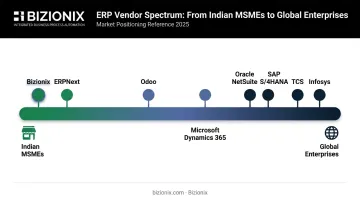
The 12 companies below were selected on market presence, feature depth, deployment flexibility, and relevance to businesses operating at different scales in India.
12 Best ERP Software Development Companies
1. Bizionix (IIS-LLP)
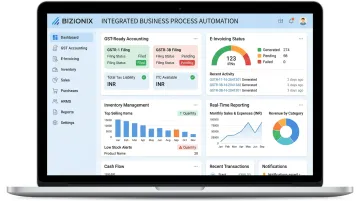
Bizionix is a cloud-native ERP platform built specifically for Indian MSMEs by IIS-LLP, a subsidiary of Protocol India Private Limited with over two decades of combined industry experience. It consolidates Finance & Accounting, Sales & CRM, Inventory, Warehouse Management, HRMS & Payroll, Production Planning, and Multi-Entity Management under a single secure login.
What separates Bizionix from most ERP options in this space is its direct API integration with the GST e-Invoice system. The IRN generation process is fully automated — create an invoice in the system, and IRN plus QR code are generated instantly via direct IRP connectivity. No third-party tools, no manual submission.
| Key Features | GST-ready accounting, instant e-invoicing with IRN generation, multi-company management, real-time dashboards, inventory and warehouse management, HRMS & payroll |
| Best For | Indian MSMEs, manufacturing companies, distribution businesses, CA firms, franchise networks, multi-location enterprises |
| Deployment / Pricing | 100% cloud-based SaaS; NEO plan from ₹999/year; Enterprise plan with custom pricing — contact info@bizionix.com for a demo |
2. SAP S/4HANA
SAP's flagship enterprise ERP platform, built for large organizations with complex, multi-country operations. Powered by the SAP HANA in-memory database, it delivers real-time processing across finance, supply chain, procurement, manufacturing, and HR. SAP's AI copilot Joule is available with S/4HANA Cloud Public Edition for informational, navigational, and transactional tasks.
Implementation complexity and cost are significant — SAP is better suited for organizations with dedicated IT teams and large transformation budgets.
| Key Features | AI/ML integration via Joule, real-time MRP, financial consolidation, multi-national compliance, extensive SAP ecosystem |
| Best For | Large enterprises and multinational corporations |
| Deployment / Pricing | Cloud and on-premise; enterprise-tier, quote-based pricing |
3. Oracle NetSuite ERP
Oracle's cloud-first ERP platform now serving 43,000+ customers across manufacturing, retail, services, and healthcare. Offers financial management, inventory, supply chain, and CRM in one unified system with strong multi-subsidiary and multi-currency support.
| Key Features | Financial management, inventory, CRM, real-time BI, multi-subsidiary support |
| Best For | Mid-market to large enterprises scaling globally |
| Deployment / Pricing | Cloud-only; quote-based pricing with one-time implementation fee |
4. Microsoft Dynamics 365
Microsoft's modular ERP and CRM platform deeply integrated with Office 365, Power BI, and Azure. Business Central targets SMBs; Dynamics 365 Finance serves larger enterprises. Microsoft Copilot is included with Business Central plans, enabling AI-driven automation across workflows.
| Key Features | Finance, supply chain, HR, CRM, Power BI integration, Copilot AI automation |
| Best For | SMBs to large enterprises already using Microsoft tools |
| Deployment / Pricing | Cloud and on-premise; Business Central Essentials at $80/user/month, Premium at $110/user/month (paid yearly) |
5. Odoo
Open-source ERP with 50 main applications and 50,000+ community apps covering CRM, inventory, accounting, HR, manufacturing, and eCommerce. Available in a free Community edition and a paid Enterprise version with support, upgrades, and mobile access.
Popular with Indian businesses for its modular pricing and an official India partner network — though backend customization typically requires a skilled IT team or certified Odoo partner.
| Key Features | Modular architecture, open-source, accounting, CRM, inventory, eCommerce, HR |
| Best For | SMBs and process-heavy businesses with in-house or partner IT support |
| Deployment / Pricing | Cloud and on-premise; free Community edition; Enterprise pricing per app, per user |
6. ERPNext (Frappe)
Developed by Frappe Technologies, an Indian company, ERPNext is a fully open-source ERP with strong India-specific compliance built in — GST filing, e-invoicing with IRN/QR workflow, TDS management, GSTR-1/2/3B reports, and multi-currency accounting. Zero license cost on self-hosted deployment; paid cloud hosting available via Frappe Cloud.
The trade-off: self-hosting requires infrastructure management and technical capability. Community support is strong, but it won't replace dedicated vendor support for most MSMEs.
| Key Features | GST compliance, accounting, inventory, manufacturing, HR, project management |
| Best For | Cost-conscious Indian SMEs with IT capability and tolerance for self-managed deployment |
| Deployment / Pricing | Cloud (Frappe Cloud) or self-hosted; free self-hosted; cloud hosting from low monthly fees |
7. Tata Consultancy Services (TCS)
India's largest IT services company and one of the world's leading ERP implementation partners. TCS has 21,200 SAP consultants, 550+ ongoing SAP engagements, and delivered 350+ Microsoft Dynamics 365 engagements for 300+ global customers — earning Microsoft Business Applications Inner Circle recognition.
Engagement size and cost make TCS more suited to large enterprises than MSMEs.
| Key Features | SAP S/4HANA, Oracle, MS Dynamics 365 implementation; ERP migration; managed services; AI-led transformation |
| Best For | Large enterprises and government organizations requiring end-to-end ERP transformation |
| Deployment / Pricing | Custom engagement model; pricing on request |
8. Infosys
One of India's top ERP implementation partners globally, Infosys brings 26,000+ SAP professionals, 650+ SAP clients, and 20+ years of ERP experience across SAP S/4HANA, Oracle Cloud, and Microsoft Dynamics. Serves manufacturing, utilities, life sciences, and financial services with proprietary tools for accelerated implementation.
| Key Features | SAP and Oracle implementation, ERP modernization, cloud migration, AI-powered process automation |
| Best For | Large enterprises undergoing multi-country ERP transformation |
| Deployment / Pricing | Project-based and managed services; pricing on request |
9. Wipro
Wipro's ERP practice spans SAP, Oracle ERP Cloud, and Microsoft Dynamics 365 — covering advisory, implementation, upgrade, and managed services across manufacturing, healthcare, energy, and retail. Its FullStride Cloud practice specifically targets cloud ERP transitions and cross-platform migrations.
| Key Features | ERP implementation, cloud migration, system integration, AI-led process automation |
| Best For | Enterprises seeking comprehensive ERP transformation with cloud migration |
| Deployment / Pricing | Engagement-based; pricing on request |
10. N-iX
European-headquartered software engineering firm with 2,400 tech experts and 80+ active enterprise clients. Offers custom ERP development, SAP consulting and application management, Microsoft Dynamics 365 work, and Oracle ERP services across manufacturing, telecom, and finance sectors.
| Key Features | Custom ERP development, SAP consulting, MS Dynamics 365, Oracle, ERP modernization |
| Best For | Mid-to-large global enterprises needing custom ERP builds or platform implementations |
| Deployment / Pricing | Project and team extension models; pricing varies by engagement |
11. Stridely Solutions
Indian ERP development and implementation company headquartered in Ahmedabad with delivery centers across India and offices in the US. Specializes in SAP, Microsoft Dynamics 365, Oracle ERP, RPA, and AI/ML-based ERP enhancements, with a focus on human capital management alongside core ERP modules.
| Key Features | SAP, MS Dynamics 365, Oracle ERP, RPA, AI/ML integration, HCM |
| Best For | Indian mid-sized companies needing SAP or Dynamics implementation with local delivery |
| Deployment / Pricing | Project and dedicated team models; pricing on request |
12. Accely
SAP-focused ERP implementation partner serving mid-market clients across manufacturing, retail, energy, and healthcare in India and the Asia-Pacific region. Differentiates through pre-built SAP solution templates for faster deployment and a specific focus on mid-market businesses — not just large enterprises.
| Key Features | SAP Business One, SAP S/4HANA, industry-specific templates, mid-market ERP |
| Best For | Mid-market manufacturing, retail, and services companies looking for SAP at accessible cost |
| Deployment / Pricing | Cloud and on-premise SAP deployments; pricing on request |
How We Chose the Best ERP Software Development Companies
The most common mistakes businesses make when selecting ERP vendors:
- Choosing by brand name without checking whether the platform actually fits their size and workflows
- Ignoring total cost of ownership: implementation, customization, training, and ongoing support often dwarf the license fee
- Overlooking local compliance — for Indian businesses, GST e-invoicing support (mandatory above ₹5 crore aggregate turnover) is non-negotiable
- Underweighting post-go-live support, which is where most ERP projects actually succeed or fail
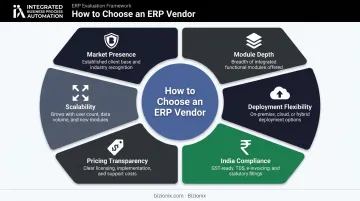
Key Factors Used to Build This List
- Verified market presence and client track record
- Depth of ERP capability across core modules
- Deployment flexibility (cloud, on-premise, hybrid)
- India-market relevance — especially GST and e-invoicing compliance
- Pricing transparency or clear engagement model
- Scalability for different business sizes
No vendor paid for inclusion. The list reflects genuine fit across business scales, from Indian MSMEs needing a practical, affordable cloud ERP to global enterprises running multi-country SAP rollouts.
Conclusion
The best ERP software development company for your business is not automatically the most recognizable global brand. For Indian MSMEs — the roughly 5.77 crore registered businesses accounting for a substantial portion of the country's economic output — an enterprise platform built for multinationals often creates more problems than it solves: bloated features, expensive implementations, and compliance gaps that require additional workarounds.
Those gaps make vendor evaluation critical. Before committing, weigh each option against your actual operational reality: business size, workflows, GST compliance needs, budget, and post-deployment support. A vendor with strong local knowledge and a platform built around Indian compliance requirements will consistently outperform a global brand that treats those as afterthoughts.
For Indian MSMEs seeking a unified, cloud-based ERP built specifically for their context, Bizionix by IIS-LLP offers a full-featured platform with GST-ready accounting, instant e-invoicing, multi-company management, and real-time dashboards — without SAP-level complexity or cost. Reach out at info@bizionix.com or call +91 91779 99277 to request a demo.
Frequently Asked Questions
What is the difference between an ERP software vendor and an ERP development company?
ERP vendors sell pre-built platforms — SAP, Oracle, and ERPNext are examples. ERP development companies build custom ERP systems from scratch or implement and customize existing platforms to match a client's specific processes. Many firms today do both.
How much does ERP software development or implementation cost in India?
Cloud ERP subscriptions for Indian SMEs can start at a few thousand rupees per year, with costs scaling based on modules, users, and customization depth. For context, Panorama Consulting reports mid-sized companies internationally spend USD 150,000–750,000 on enterprise implementations — India-specific costs are typically lower but vary widely by platform and scope.
How long does ERP implementation typically take?
Cloud-based SaaS ERP platforms can be live in 1–3 months. Large-scale custom or on-premise implementations typically run 6–18 months depending on module count, data migration complexity, and organizational readiness.
Should Indian MSMEs choose a custom ERP or a ready-made solution?
Most MSMEs benefit more from ready-made cloud ERP built for Indian compliance — faster deployment, lower upfront cost, and ongoing vendor support. Custom ERP makes sense only when your processes are genuinely non-standard and cannot be accommodated by configurable platforms.
What key features should an ERP for Indian businesses include?
Any ERP for Indian businesses should cover these baseline capabilities:
- GST-ready accounting with e-invoicing and IRN generation
- Inventory and warehouse management
- Multi-company support with role-based access control
- Real-time reporting and dashboards
- 100% cloud accessibility
How do I evaluate an ERP development company before signing a contract?
Focus your due diligence on four areas:
- Experience: Request verifiable client references in your industry
- Support terms: Clarify post-deployment SLAs before signing
- Total cost: Factor in customization, training, and annual fees — not just licensing
- Compliance knowledge: Confirm the vendor understands GST e-invoicing thresholds and workflows