The right asset management software eliminates these problems by centralising asset data, automating tracking, and giving teams real-time visibility from a single dashboard — without requiring an IT department to run it.
This guide covers what asset management software actually does, the top options for Indian small businesses, and a clear framework for choosing the right fit.
Key Takeaways
- Asset management software tracks physical and digital assets from purchase to disposal — replacing error-prone spreadsheets
- Look for lifecycle tracking, maintenance scheduling, depreciation management, mobile access, and GST/accounting integration
- For Indian MSMEs, GST compliance and affordable pricing matter as much as feature depth
- Top picks include Bizionix, Freshservice, Asset Panda, Fiix, and Limble CMMS
- The best choice depends on your asset types, team size, and whether you need a standalone tracker or a full ERP
What Is Asset Management Software and Why Do Small Businesses Need It?
Asset management software is a centralised digital platform for tracking, maintaining, and optimising both physical assets (equipment, vehicles, office hardware) and digital assets (software licences, subscriptions) across their full lifecycle. It replaces manual spreadsheets and disconnected records with automation and real-time visibility.
The cost of ignoring this is measurable. Capterra's research links poor asset tracking to network downtime, security vulnerabilities, redundant purchases, and lost productivity from delayed equipment refreshes — all avoidable with the right tool.
Key Features to Look For
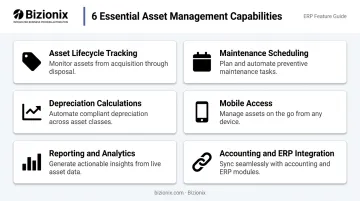
Small businesses don't need enterprise-level complexity. The right tool should be quick to set up, manageable without dedicated IT support, and priced on a per-user or per-asset basis. Look for these capabilities:
- Asset lifecycle tracking — from acquisition and tagging through to disposal
- Maintenance scheduling — automated reminders prevent missed servicing
- Depreciation calculations — essential for compliance with Indian Companies Act Schedule II and income tax rules
- Mobile access — field teams need to update records and run audits on the go
- Reporting and analytics — utilisation reports, audit trails, and cost summaries
- Accounting and ERP integration — GST-ready platforms matter most for businesses above the ₹5 crore e-invoicing threshold
Best Asset Management Software for Small Businesses in India
Choosing the right asset management software means matching the tool to how your business actually operates — not just picking the one with the longest feature list. The platforms below were evaluated on ease of use, SMB feature depth, pricing transparency, integration capabilities, and fit for India's regulatory environment.
Bizionix
Bizionix is a cloud-based, all-in-one ERP platform developed by IIS-LLP, specifically built for Indian MSMEs. Rather than offering asset management as a standalone module, it integrates it alongside accounting, GST compliance, inventory, billing, HRMS, and multi-company management — all from a single login.
For Indian small businesses, the standout capability is its direct API integration with the GST e-Invoice system, enabling instant IRN generation, real-time invoice validation, and automatic QR code creation. Businesses with aggregate turnover exceeding ₹5 crore are required to generate e-invoices under GST Council Notification 10/2023 — Bizionix handles IRN generation natively — no additional integrations required.
Its multi-company management feature allows businesses to track assets and financials across multiple branches, GST entities, or subsidiaries from one secure login — with both consolidated and entity-level views. The platform is designed to scale from a single-location MSME to a multi-site operation without switching systems.
Key Features: Asset management module, fixed asset tracking, GST-compliant accounting, automated e-invoicing with IRN generation, multi-company management, real-time dashboards, inventory control, HRMS
Pricing: NEO (Basic): ₹999/year (14-day free trial available); Enterprise: contact sales for custom pricing
Best For: Indian MSMEs, manufacturing businesses, multi-location enterprises, and growing businesses that want asset management within a unified ERP
Freshservice
Freshservice, by Freshworks, is a cloud-based IT service management platform with a strong IT Asset Management (ITAM) module. It's widely used by SMBs globally and has a significant India presence, with customers like Asian Paints adopting it for ITSM transformation.
Its differentiator is the combination of ITSM and ITAM in one platform. Key capabilities that reduce manual overhead for small IT teams include:
- Freddy AI — detects anomalies, flags trends, and automates asset categorisation
- Automated discovery — captures assets across on-premise, cloud, and hybrid environments without manual data entry
Key Features: IT asset lifecycle tracking, automated discovery, software licence management, AI-powered workflows (Freddy AI), contract and warranty management, reporting dashboards
Pricing (USD): Starter: $19/agent/month; Growth: $49; Pro: $99; Enterprise: contact sales (billed annually)
Best For: Small businesses with IT-heavy asset portfolios — laptops, servers, software licences, and SaaS subscriptions
Asset Panda
Asset Panda is a dedicated, flexible asset tracking platform that manages the full asset lifecycle with barcode scanning, mobile inspection capabilities, and highly customisable configurations across industries. Based on over 1,300 user reviews on Capterra, it consistently receives strong ratings for ease of use and flexibility.
Its mobile-first design lets field teams perform audits, manage check-in/check-out, and update records offline — then sync when connected. It supports REST API and over 18 integrations, though it lacks the native ERP depth that businesses needing accounting integration would require.
Key Features: Barcode and QR tracking, mobile asset inspections, check-in/check-out management, repair and maintenance tracking, lease record management, customisable asset fields
Pricing: Custom quote based on number of assets tracked (no public list price; contact for quote)
Best For: Small businesses needing a dedicated, flexible asset tracker for physical equipment spread across locations — without a full ERP
Fiix
Fiix, by Rockwell Automation, is a CMMS-based asset and maintenance management platform that centralises asset data, work orders, parts inventory, and maintenance schedules on one dashboard. It's built for operations where equipment reliability is business-critical.
Its AI-powered Asset Risk Predictor and Fiix Foresight module enable predictive maintenance — moving teams from reactive repairs to scheduled interventions. ERP integration is a genuine strength — Fiix connects natively with SAP, Oracle, NetSuite, Microsoft Dynamics, Sage, and QuickBooks via no-code options, custom integrations, and open API.
Key Features: Predictive and preventive maintenance, work order management, multi-location asset tracking, parts and inventory management, ERP integration, KPI dashboards
Pricing (USD): Free plan available; Basic: $45/user/month; Professional: $75/user/month; Enterprise: custom
Best For: Small manufacturing, industrial, or multi-site businesses that need strong maintenance management alongside asset tracking
Limble CMMS
Limble CMMS is a user-friendly asset and maintenance management platform built for rapid adoption by small teams. Its clean interface minimises training time, and automation handles preventive maintenance schedules and work order creation with minimal manual input.
Limble is rated 4.8 out of 5 on Gartner Peer Insights and praised by over 50,000 maintenance professionals for responsive customer support and guided implementation. For businesses transitioning from spreadsheets, it's one of the fastest platforms to get up and running.
Key Features: Preventive maintenance automation, asset register with custom fields, work order tracking, vendor and contractor management, mobile inspections, reporting
Pricing (USD): Standard: $28/user/month; Premium+: $69/user/month; Enterprise: $115/user/month (billed annually)
Best For: Small businesses and growing teams that want a simple, quick-to-implement CMMS without a steep learning curve
How to Choose the Right Asset Management Software
The most common mistake small businesses make is buying tools built for enterprises (resulting in underutilised features and overpaid licences) or choosing standalone trackers that create data silos with their accounting systems.
Capterra's 2024 Tech Trends Survey found that small businesses are least likely to attend product demos (just 28% do), while midsize businesses report 68% purchase regret. Attend a demo. Run a trial. Validate integrations before committing.
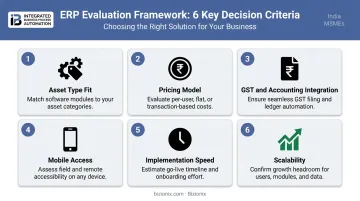
Evaluate each platform across these criteria:
- Asset type fit — physical equipment, IT assets, or a mix? CMMS tools suit machinery-heavy operations; ITAM suits IT portfolios; ERP platforms work well when you need both
- Pricing model — per-user (Fiix, Limble), per-agent (Freshservice), asset-volume (Asset Panda), or flat subscription (Bizionix)
- GST and accounting integration — critical for Indian businesses above the ₹5 crore e-invoicing threshold
- Mobile access — field-heavy teams need offline and mobile capabilities
- Implementation speed — simple CMMS tools like Limble deploy in days; full ERP platforms may take weeks, depending on data migration scope
- Scalability — confirm the platform handles new locations, asset categories, and team members without costly upgrades
Bring in stakeholders from finance and operations — not just IT — before finalising any purchase. Cross-functional buy-in is one of the most reliable predictors of successful adoption.
Conclusion
The best asset management software for a small business is the one that fits your specific asset types, team size, and operational goals — not necessarily the one with the longest feature list.
For Indian MSMEs, the core decision is straightforward: do you need a standalone tracker, or a platform that connects asset management to accounting, GST compliance, and broader business operations? Standalone tools like Asset Panda and Limble solve the tracking problem well.
But when assets feed into financial records, depreciation schedules, and GST reporting, managing those workflows across separate tools creates reconciliation gaps and compliance risk. A unified ERP like Bizionix keeps those processes in one place — reducing errors and cutting the time spent on month-end closings.
Before deciding, think about where the business will be in two years — will the software still fit when you add locations, employees, or new asset categories? If that question gives you pause, a 14-day free trial of Bizionix is a practical way to test how asset management, GST-compliant accounting, inventory, and HRMS run together in a single platform built for Indian MSMEs.
Frequently Asked Questions
What is asset management software for small businesses?
It's a centralised digital platform that helps businesses track, monitor, and manage both physical assets (equipment, vehicles, hardware) and digital assets (software licences, subscriptions) throughout their lifecycle. It replaces manual spreadsheets with automation and real-time visibility.
What features should small businesses prioritise in asset management software?
The most critical features are asset lifecycle tracking, automated maintenance scheduling, depreciation management, mobile access, and accounting or ERP integration. Complex enterprise features like CMDB or AI-powered discovery are secondary for most small teams.
How is asset management software different from an ERP system?
Standalone asset management software focuses solely on tracking and maintaining assets. An ERP like Bizionix integrates asset management with accounting, inventory, billing, and GST compliance into one platform — a stronger fit for businesses that want unified operational control without managing multiple tools.
How much does asset management software typically cost for small businesses?
International tools range from free basic tiers to USD $19–$99 per agent/month (Freshservice) or USD $28–$75 per user/month (Limble, Fiix). Indian MSME-focused ERP platforms like Bizionix offer integrated pricing that replaces several standalone tools. Always factor in implementation, training, and data migration when calculating total cost of ownership.
Can asset management software help with GST compliance in India?
Dedicated tracking tools don't include GST features. Integrated ERP platforms like Bizionix do — offering GST-ready accounting, automated e-invoicing with direct IRN generation, and asset records that feed directly into financial reporting.
How long does it take to implement asset management software in a small business?
Simple standalone tools like Limble or Asset Panda can be operational within days. ERP platforms with asset management modules may take a few weeks depending on data migration, configuration requirements, and team training.