Introduction
Running a service business in India has never been more operationally demanding. Client deliverables, billing cycles, GST compliance, and team coordination across simultaneous projects — managing all of this through spreadsheets, WhatsApp approvals, and separate accounting tools creates exactly the kind of fragmentation that costs money.
The result? Month-end financial surprises, delayed invoicing, IRN generation errors, and missed compliance deadlines.
According to the MSME Annual Report 2024-25, service-sector MSMEs now account for over 2 crore registered businesses in India, outnumbering manufacturing registrations. Yet most still rely on disconnected tools that create financial leakage at every handoff.
An ERP built for service organizations solves this by unifying every function — accounting, billing, CRM, HR, compliance — into one platform. This guide breaks down the top ERP solutions for Indian service businesses, what makes each one suitable, and how to choose the right fit for your team size and billing model.
Key Takeaways
- Service ERPs unify project management, billing, CRM, HR, and GST compliance into one system — eliminating disconnected tools
- Time tracking, client management, flexible billing, and GST-ready invoicing matter more to service businesses than inventory or manufacturing features
- The best ERPs for Indian MSMEs balance affordability, GST readiness, and ease of adoption
- Top solutions covered: Bizionix, Zoho One, ERPNext, Odoo, and SAP Business One
- Your choice depends on team size, billing model, compliance needs, and whether you need multi-company or multi-location support
Why Service Organizations Need a Specialised ERP
Service businesses generate revenue from time, expertise, and relationships, not physical goods. Standard ERP platforms are built around inventory movement, purchase orders, and production workflows — none of which apply to a consulting firm, CA practice, or hospitality group tracking billable hours and retainer agreements.
Gartner recognises cloud ERP for service-centric enterprises as a distinct market category — separate from product-based ERP — precisely because the operational requirements diverge so sharply.
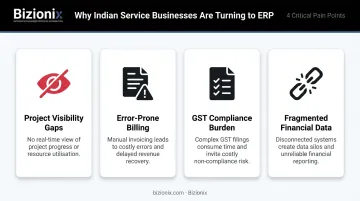
The Four Pain Points Driving ERP Adoption
Service firms consistently report the same pressure points before making the switch:
- Project visibility gaps: Multiple concurrent clients, no single view of status, billing, or resource allocation — decisions get made on stale data.
- Error-prone billing: Manual invoice creation and format mismatches delay collections. Unpaid MSME dues have reached nearly ₹50,000 crore, with 2.18 lakh delayed-payment applications filed as of early 2025.
- GST compliance burden: E-invoicing now applies to businesses with aggregate turnover between ₹5 crore and ₹10 crore (effective August 2023), and Indian MSMEs navigate over 500 micro-regulations annually.
- Fragmented financial data: Sales, HR, and finance running on separate systems with no consolidated view makes accurate forecasting nearly impossible.
Each platform reviewed below targets at least one of these gaps directly. For Indian MSMEs moving past spreadsheets and disconnected tools, that focus is what separates a workable fit from a frustrating mismatch.
Best ERP Solutions for Service Organisations in India
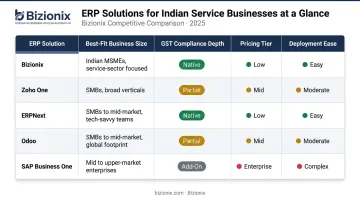
These solutions were evaluated on service-specific capabilities: project billing, client management, GST compliance, real-time reporting, and scalability for growing Indian enterprises.
Bizionix
Bizionix is a cloud ERP platform built specifically for Indian MSMEs by IIS-LLP — a subsidiary of Protocol India Private Limited, backed by over two decades of industry experience. The platform replaces fragmented software stacks with a single unified system covering accounting, billing, CRM, HR, and operations.
For service organisations, the GST e-invoicing integration is a practical differentiator. Bizionix connects directly to India's Invoice Registration Portal (IRP) via API — no manual JSON uploads, no third-party tools.
The workflow is direct: create a sales invoice, the system validates against GST rules, and the IRN and QR code generate instantly. GSTR-1 auto-populates from the same data, keeping accounts and compliance permanently in sync.
For CA firms, franchise networks, or multi-location service groups, the multi-company management module covers subsidiaries, GST-registered branches, and franchise units from a single secure login. Each entity maintains independent books of accounts with role-based access controls.
Pricing is structured as a flat annual subscription rather than per-user licensing. The Bizionix NEO plan starts at ₹999/year (including a 14-day free trial), covering CRM, Sales, Accounts, Finance, and HRMS. The Enterprise plan offers custom pricing with access to all 12+ modules.
| Feature | Details |
|---|---|
| Key Features | GST-ready accounting, automated e-invoicing with instant IRN generation, multi-company management, real-time dashboards, CRM, HRMS, and operations modules |
| Best For | Indian MSMEs in consulting, hospitality, CA firms, franchise networks, and service businesses seeking an affordable all-in-one ERP with built-in GST compliance |
| Pricing | NEO plan from ₹999/year; Enterprise plan with custom pricing — contact Bizionix for details |
Zoho One
Zoho One is a comprehensive suite from Zoho Corporation — widely adopted by Indian SMEs — covering CRM, accounting (Zoho Books), project management, HR, and helpdesk under a single subscription. The Standard edition includes more than 50 integrated apps.
Zoho Books handles GST accounting well: GST-compliant invoices, GSTIN/HSN/SAC workflows, multi-GSTIN support, e-way bill generation, B2B e-invoicing, and TDS management are all built in. For service businesses that want a broad toolset under one vendor, it addresses the most common operational needs without requiring multiple subscriptions.
The limitation shows up at scale. Service businesses managing complex multi-project billing or needing deep financial reporting across entities may find that configuring workflows across 50+ apps becomes time-consuming — and the platform is built as a suite of connected tools rather than a natively unified architecture.
| Feature | Details |
|---|---|
| Key Features | CRM, Zoho Books (GST accounting), Projects, People (HR), Desk (helpdesk), and 50+ apps with cross-app automation |
| Best For | Small-to-mid-sized Indian service businesses wanting a broad toolset under one vendor at an accessible price point |
| Pricing | Per-employee per-month subscription; visit Zoho's website for current India pricing |
ERPNext
ERPNext is a free and open-source ERP developed by Frappe Technologies in India, with modules for accounting, project management, HR, CRM, and more. Licensed under GNU GPL v3, the software costs nothing to self-host.
India-specific compliance is well-developed: GST accounting, e-invoicing, e-way bill, TDS, HSN/SAC codes, and GSTR reporting are all supported natively. Frappe Cloud offers managed hosting starting from USD 5 per month for a site plan, or USD 20 per month for a server plan — making it one of the most cost-transparent options on this list.
Implementation requires technical resources. Customising workflows, maintaining the system, and handling upgrades all demand developer involvement or a certified implementation partner. For teams without IT capacity, the low licensing cost can be offset by implementation spend.
| Feature | Details |
|---|---|
| Key Features | GST accounting, project management, HR and payroll, CRM, multi-currency and multi-company support, open-source with community modules |
| Best For | Tech-savvy service businesses or cost-conscious startups willing to invest in implementation and ongoing maintenance |
| Pricing | Open-source (free to self-host); Frappe Cloud from USD 5/month; implementation costs separate |
Odoo
Odoo is a modular, open-core ERP with a large global user base, offering project management, timesheets, CRM, invoicing, HR, and 80+ additional modules. The modular architecture lets service businesses start with what they need and add functionality as the organisation grows.
India localization in Odoo 19.0 covers Indian Accounting, GST e-invoicing, e-waybill, GSTR-1, GSTR-2B, and GSTR-3B workflows — with BVM IT Consulting Services India as the registered GSP. For service-specific needs, the Timesheets module links time directly to projects, tasks, or sales orders, enabling time-and-materials billing.
Odoo's Community edition is open-source, but full India GST compliance and advanced features like multi-company support are Enterprise-only. Enterprise pricing for India is listed at USD 31.10 per user per month (billed annually) for Standard, or USD 61.00 for Custom — and module costs can escalate with scale.
| Feature | Details |
|---|---|
| Key Features | Project management, timesheets, CRM, invoicing, HR, and 80+ modules with open-core architecture and API integrations |
| Best For | Mid-sized service organisations needing flexibility to customise workflows and comfortable with a modular setup |
| Pricing | Community edition free; Enterprise from USD 31.10/user/month (billed annually) for India |
SAP Business One
SAP Business One is an enterprise-grade ERP from SAP, positioned for small-to-mid-sized businesses. It covers financial management, project accounting, CRM, purchasing, and advanced analytics — with a partner network in India and a verified India localization guide (version 16.0, updated May 2024) covering GST and electronic billing.
For service firms that have outgrown MSME-tier solutions — those with complex multi-currency operations, deep financial controls, or aggressive growth plans — SAP Business One provides the infrastructure. The tradeoff is cost and complexity: implementation requires a certified SAP partner, licensing is quote-dependent, and total cost of ownership is significantly higher than any other option on this list.
| Feature | Details |
|---|---|
| Key Features | Financial management, project accounting, CRM, purchasing, advanced analytics, and a broad ecosystem of industry add-ons |
| Best For | Larger or rapidly scaling service organisations that need enterprise-level financial controls and can support the associated implementation investment |
| Pricing | Quote-dependent through SAP-certified partners; costs vary by users, modules, and deployment type |
How to Choose the Right ERP for Your Service Business
The Evaluation Framework
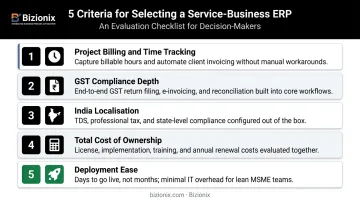
Solutions should be assessed on service-sector fit — not generic feature counts. The criteria that matter:
- Project billing and time tracking — can the system handle hourly, milestone, retainer, and fixed-fee billing models?
- GST compliance depth — does it include native e-invoicing with IRN generation, e-way bill, TDS, and GSTR auto-population?
- India localisation — is compliance built in, or bolted on through third-party modules?
- Total cost of ownership — licensing is only part of the equation; factor in implementation, training, and ongoing support
- Deployment ease — can non-technical teams adopt it without a 6-month rollout?
Common Selection Mistakes
According to Gartner research, 25% of ERP initiatives fail outright and 75% of ERP strategies are not strongly aligned with business goals — patterns that show up repeatedly in Indian service businesses making the same selection errors.
The most common ones in Indian service businesses:
- Defaulting to SAP because of brand recognition when a leaner platform delivers better operational fit
- Underestimating implementation complexity, especially for open-source platforms requiring developer resources
- Choosing a platform without native GST e-invoicing, then needing a costly switch within two years as the compliance threshold expands
For Indian MSMEs, the right ERP is the one that fits your billing model, team size, and compliance requirements — and starts delivering measurable gains within weeks, not after a year of configuration.
Conclusion
Service organisations in India need an ERP that reflects how they actually operate: managing client relationships, tracking billable activity, generating GST-compliant invoices, and maintaining financial visibility across projects or locations. A platform built around manufacturing workflows will always be a poor fit.
When evaluating options, go beyond feature lists. Ask how quickly non-technical staff can adopt the system, what implementation support looks like, and whether the platform can scale with your business without forcing a migration in two years.
For Indian service MSMEs that need GST-ready accounting, automated e-invoicing, CRM, HR, and multi-company management in a single affordable platform, Bizionix is designed around those requirements. Start with a 14-day free trial on the NEO plan, or reach the team directly:
- Email: info@bizionix.com
- Phone: +91 91779 99277
- WhatsApp: Request a demo
Frequently Asked Questions
What is an ERP system for service organisations?
An ERP for service organisations is a unified software platform that integrates project management, billing, client management, HR, and financial reporting into one system. Unlike product-based ERPs, it centres on how service businesses generate revenue : time, expertise, and client relationships rather than physical goods.
How is ERP for service businesses different from a standard ERP?
Service ERPs prioritise time tracking, retainer billing, resource allocation, and client management over inventory or manufacturing workflows. They must support flexible billing models — hourly, milestone, fixed-fee — rather than product-based order management, and handle compliance requirements like GST e-invoicing that apply to B2B service transactions.
What features should an Indian service business look for in an ERP?
Must-haves include GST-compliant accounting with native e-invoicing and IRN generation, project and client management, automated billing across multiple models, real-time financial dashboards, and multi-company or multi-location management for businesses operating across entities or branches.
Is a cloud ERP better than on-premise for service businesses?
For most Indian MSMEs, yes. Cloud ERPs offer lower upfront cost, remote access for distributed teams, and automatic compliance updates — critical as GST rules continue to evolve. They also implement faster and eliminate the need for on-premise infrastructure, making them practical for multi-location service operations.
Can an ERP help with GST compliance for Indian service businesses?
Modern ERPs built for the Indian market handle GST-ready accounting, automated IRN generation, GSTR auto-population, TDS management, and e-way bill support. This reduces manual effort and lowers the risk of rejection errors or penalties under GSTN-mandated formats.
How much does an ERP cost for a small service business in India?
Costs vary significantly: ERPNext is free to self-host (Frappe Cloud from approximately ₹420/month), Bizionix NEO starts at ₹999/year, and Odoo Enterprise from approximately ₹2,600 per user per month. MSMEs should calculate total cost of ownership — licensing, implementation, training, and support — not just the headline price.