Generic accounting software wasn't built for this. Tools designed for a retail shop or service business have no concept of marketplace settlement files, automated TCS reconciliation, or state-wise GST logic for inter-state shipments. The result is manual workarounds, compliance gaps, and hours lost every month to data entry that software should be handling.
India's ecommerce market reached ₹10,82,875 crore (US$125 billion) in 2024 and is projected to hit ₹29,88,735 crore (US$345 billion) by 2030, according to IBEF. At that scale, getting your accounting infrastructure right isn't optional — it's foundational.
This guide covers the best accounting software options for Indian ecommerce sellers, evaluated specifically for GST compliance, marketplace integrations, and MSME pricing.
Key Takeaways
- Indian ecommerce accounting goes beyond basic bookkeeping: GST compliance, TCS reconciliation, and multi-marketplace integration are all non-negotiable
- Top picks: Zoho Books, Tally Prime, Bizionix, Vyapar, and Busy Accounting — each suited to different business sizes
- Non-negotiable features: automated GSTR filing, e-invoicing with IRN, inventory tracking, and marketplace settlement reconciliation
- Bizionix NEO starts at ₹999/year with a 14-day free trial, making it one of the most affordable all-in-one options for growing MSMEs
Why Ecommerce Businesses in India Need Specialised Accounting Software
Standard accounting software handles invoices, expenses, and bank statements. Indian ecommerce sellers need all of that plus several layers of compliance that most tools simply aren't built for.
The Compliance Burden Is Unique
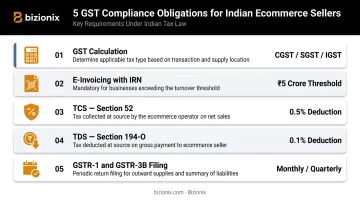
Every transaction on an Indian marketplace triggers multiple compliance requirements:
- GST calculation — CGST + SGST for intra-state sales, IGST for inter-state, based on the buyer's location
- E-invoicing — mandatory for businesses with aggregate turnover above ₹5 crore, requiring real-time IRN generation via the Invoice Registration Portal
- TCS under Section 52 of the CGST Act — ecommerce operators collect GST TCS at 0.5% (reduced from 1% via Notification No. 15/2024 dated 10 July 2024) before remitting payments to sellers
- TDS under Section 194-O — income tax deducted at 0.1% (effective 1 October 2024) by marketplace operators on payments to sellers
- GSTR-1 and GSTR-3B — monthly or quarterly return filings required for every tax period
Where Traditional Software Breaks Down
Most accounting tools fail Indian ecommerce sellers in predictable ways:
- Marketplace settlement reconciliation — generic tools can't match Amazon or Flipkart payout files against actual orders, returns, and fees
- TCS/TDS tracking — deductions taken by marketplace operators don't automatically flow into your books
- High-frequency transaction handling — a seller processing hundreds of daily orders across multiple channels quickly overwhelms manual import workflows
The gap shows up at filing time: hours of manual reconciliation, error-prone GST returns, and return rejections that could have been avoided with the right system from the start.
Best Accounting Software for Ecommerce Businesses in India
Each option below is evaluated on GST compliance depth, ecommerce-specific integrations, ease of use for Indian sellers, MSME pricing, and scalability. These criteria reflect what actually matters when you're managing orders, returns, and filings across multiple channels.
Zoho Books
Cloud-based accounting software built by Zoho Corporation, with strong India compliance features and a broad integration ecosystem covering major Indian marketplaces and payment gateways.
Zoho Books stands out for automated GST invoicing, connections with Amazon India, Shopify, and Etsy, auto-populated GSTR filings, and real-time financial dashboards. For online-first businesses that want minimal manual work, it's the most accessible cloud-native option.
| Details | |
|---|---|
| Key Features | GST-compliant invoicing, GSTR-1/3B auto-population, bank reconciliation, inventory management, multi-channel sales sync, mobile app |
| Pricing | Free plan (up to ₹25 lakh annual revenue, 1,000 invoices/year); Standard ₹749/month; Professional ₹1,499/month; Premium ₹2,999/month; Elite ₹4,999/month; Ultimate ₹7,999/month (billed annually) |
| Best For | Ecommerce startups and SMBs wanting a cloud-native, GST-ready platform with strong marketplace integrations |
Tally Prime
India's most widely deployed accounting software, built by Tally Solutions, trusted by over 2.5 million businesses and deeply embedded in the CA community across the country.
Tally Prime's compliance depth is hard to match — it handles e-invoicing with IRN and QR code generation, e-way bills, GSTR-1 direct upload, GSTR-3B filing, and 2A/2B reconciliation. Tally Solutions is also listed as a GSTN-empanelled GSP, which gives it direct portal connectivity. The limitation for ecommerce sellers is its desktop-first architecture; marketplace syncs typically require third-party connectors or manual import.
| Details | |
|---|---|
| Key Features | Comprehensive GSTR support, e-invoicing with IRN/QR codes, e-way bill generation, batch-wise inventory, multi-currency, Tally.NET remote access, financial reports |
| Pricing | Silver (single-user): ₹8,100/year or ₹22,500 lifetime; Gold (multi-user): ₹24,300/year or ₹67,500 lifetime — all prices exclusive of 18% GST |
| Best For | Established ecommerce businesses with strong offline operations and accountants already familiar with the Tally ecosystem |
Bizionix
Cloud ERP platform developed by IIS-LLP (a subsidiary of Protocol India Private Limited), designed for Indian MSMEs that need a unified system replacing fragmented accounting, inventory, and compliance tools.
Bizionix stands apart through its depth of GST integration. The platform connects directly with the GST e-Invoice system via API: sales invoices are validated in real-time, IRN is generated instantly through the Invoice Registration Portal, and the invoice is ready to share within seconds. No JSON uploads, no third-party tools. GSTR-1 is auto-populated from the same workflow.
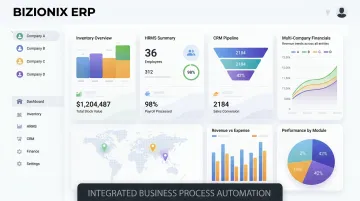
Beyond accounting, the platform covers the full operational picture under one login:
- Inventory control with multi-location stock tracking
- Purchase management and warehouse management
- HRMS and CRM modules
- Multi-company management with separate books, compliance, and financials per entity
- Consolidated dashboards and role-based access control
The NEO plan at ₹999/year (with a 14-day free trial) makes this accessible for early-stage MSMEs, while the Enterprise plan scales for larger, more complex operations.
| Details | |
|---|---|
| Key Features | GST-ready accounting, automated e-invoicing with instant IRN generation, GSTR-1 auto-population, multi-company management, real-time dashboards, inventory and warehouse management, configurable workflows, activity tracking |
| Pricing | NEO plan: ₹999/year (14-day free trial available); Enterprise: custom pricing — contact the team at info@bizionix.com or +91 91779 99277 for a demo |
| Best For | Growing ecommerce MSMEs and multi-entity businesses that want an affordable all-in-one ERP with strong GST compliance, without SAP-level complexity |
Vyapar
Mobile-first GST billing and accounting app built for small Indian businesses, with offline functionality and an interface that requires no accounting background.
Vyapar is the right fit for new or micro ecommerce sellers who need fast GST invoice generation and basic inventory tracking without committing to a full accounting suite. It supports desktop billing, barcode-based inventory, and offline invoice creation — useful in areas with unreliable internet. It's not built for high-volume marketplace reconciliation, but it handles the basics well for very small operations.
| Details | |
|---|---|
| Key Features | GST invoicing, inventory tracking with barcode support, offline mode, P&L and cash flow reports, real-time data backup |
| Pricing | Check current INR pricing directly on vyaparapp.in/pricing — a basic free tier is available, with paid plans for desktop and mobile |
| Best For | New or micro ecommerce sellers needing a low-cost, beginner-friendly mobile solution for GST billing and basic bookkeeping |
Busy Accounting
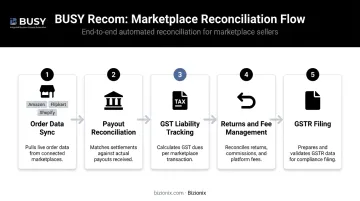
Indian accounting software from BUSY Infotech with a dedicated ecommerce reconciliation module — BUSY Recom — designed specifically to handle settlement data from Amazon, Flipkart, and Shopify.
BUSY Recom is the standout feature here: it syncs order data, reconciles marketplace payouts, tracks GST liability, manages returns, and handles marketplace expense tracking. GSTR-1/2A/2B/3B reconciliation and e-invoicing are built in. For sellers who run significant volumes on Amazon or Flipkart and need tight control over marketplace-specific financial data, this is one of the most specialized options available.
| Details | |
|---|---|
| Key Features | Ecommerce payout reconciliation (Amazon, Flipkart, Shopify), GST accounting, e-invoicing, inventory management, settlement matching, GSTR filing support, e-way bills |
| Pricing | BUSY Basic: ₹9,999/year; Standard: ₹14,999/year; Enterprise: ₹19,999/year. BUSY Recom: ₹36,000/year (up to 12,000 orders), ₹60,000/year (30,000 orders), ₹96,000/year (60,000 orders) |
| Best For | Indian ecommerce sellers on Amazon and Flipkart who need marketplace-specific reconciliation alongside complete GST accounting |
How We Chose the Best Ecommerce Accounting Software in India
The most common mistake Indian ecommerce sellers make is choosing software based on brand recognition or monthly price — without checking whether it actually handles India-specific requirements. A tool that can't reconcile TCS deductions or auto-populate GSTR returns creates compliance problems that cost far more than the software savings.
The evaluation criteria used for this list:
- Handles GSTR auto-filing, e-invoicing with direct IRP connection, TCS/TDS reconciliation, and state-wise GST logic
- Connects natively with Amazon India, Flipkart, Shopify, and Indian payment processors
- Offers affordable entry points without locking compliance features behind enterprise tiers
- Gets a seller without a dedicated finance team operational quickly
- Provides cloud access with real-time data and no single-machine dependency
- Scales with growing order volumes without requiring a platform switch
Each tool in this list was scored against all six criteria. Where a tool excels on compliance but falls short on integrations — or vice versa — that tradeoff is called out directly so you can match the right option to your specific setup.
Conclusion
Choosing accounting software for an Indian ecommerce business is a compliance decision as much as a financial one. The wrong choice means manual reconciliation, GST filing gaps, and financial reports you can't rely on when it matters.
Before deciding, map out your situation clearly:
- Which selling channels you operate (marketplace, D2C, or both)
- Your monthly order volume and peak season demands
- Your GST turnover — especially if you're nearing the ₹5 crore e-invoicing threshold
- Whether you're managing one seller account or multiple entities
Prioritise software that handles your current needs without requiring a replacement six months from now.
For growing MSMEs that want a unified, GST-compliant platform built specifically for India — one that handles accounting, e-invoicing, inventory, and multi-entity management without the cost or complexity of enterprise ERP — Bizionix by IIS-LLP is worth exploring. You can start with a 14-day free trial or request a demo to see the full platform firsthand.
Frequently Asked Questions
What is the best accounting software for ecommerce businesses in India?
There's no single universal answer — it depends on business size and complexity. Zoho Books works well for cloud-native startups, Tally Prime suits GST-heavy established businesses with existing CA relationships, and Bizionix is a strong fit for growing MSMEs that need a full ERP beyond just accounting.
Which accounting software is most commonly used in India?
Tally Prime is the most widely deployed accounting software in India overall, used by over 2.5 million businesses. Among online sellers specifically, Zoho Books and Busy Accounting have strong adoption due to their GST automation and ecommerce-specific features.
Can I integrate accounting software with Amazon India and Flipkart?
Yes. Zoho Books supports Amazon and Shopify integration from higher pricing tiers, and Busy Accounting's Recom module directly syncs order data and reconciles settlements from Amazon, Flipkart, and Shopify — including return handling and marketplace fee tracking.
What is TCS in ecommerce and how does accounting software handle it?
GST TCS (Section 52, CGST Act) is collected by marketplace operators at 0.5%; income tax TDS (Section 194-O) is deducted at 0.1%. These are separate obligations. Accounting software automates reconciliation of both against your books and GST filings, eliminating manual matching of payout statements.
How does accounting software handle GST for ecommerce businesses in India?
It auto-calculates CGST/SGST (intra-state) and IGST (inter-state) based on the buyer's location, generates IRN-linked e-invoices for businesses above the ₹5 crore threshold, and auto-populates GSTR-1 and GSTR-3B returns, minimising manual filing effort and errors.
Is there free accounting software for ecommerce sellers in India?
Zoho Books has a free plan for businesses under ₹25 lakh annual revenue (capped at 1,000 invoices/year), and Vyapar offers a basic free tier. Most multi-marketplace sellers will still need a paid plan for GST automation, marketplace integrations, and settlement reconciliation.