The good news: purpose-built accounting software eliminates most of this exposure. But with dozens of options available, choosing the wrong one — one built for global markets, or one that can't scale beyond basic billing — creates a different set of problems.
This guide covers the best accounting software for Indian small businesses, with honest comparisons across GST compliance depth, usability, pricing, and scalability.
Key Takeaways
- Indian MSMEs need software built for CGST/SGST/IGST splits, GSTR-1/3B filing, and e-invoicing — global tools rarely qualify
- Top options: TallyPrime (legacy desktop), Zoho Books (cloud-first), Vyapar (mobile billing), Busy Accounting (multi-branch GST), Bizionix (cloud ERP)
- E-invoicing is mandatory for businesses with aggregate turnover exceeding ₹5 crore — verify your software supports IRN generation before buying
- Micro-businesses need simple billing; growing MSMEs need platforms that connect accounting, inventory, and procurement
- Price alone is a poor selection criterion — GST e-invoicing compatibility and scalability matter more
Why Indian MSMEs Need Specialised Accounting Software
Standard accounting software automates bookkeeping, GST invoicing, ledger management, bank reconciliation, and financial reporting. For Indian businesses, that's the baseline expectation — the harder requirement is handling the specific structure of Indian tax law.
India's 5.77 crore registered MSMEs contribute roughly 30% of GDP and over 45% of exports. Yet according to the PayNearby MSME Digital Index 2024, only 29% of MSMEs used accounting software in a survey of 10,000+ retail businesses — meaning the majority still rely on manual registers or spreadsheets.
Relying on manual methods becomes increasingly risky as compliance obligations grow:
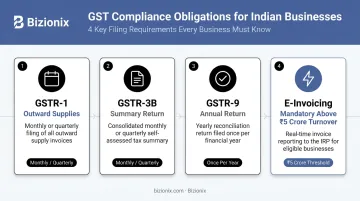
- GSTR-1 (outward supplies) due monthly or quarterly
- GSTR-3B (summary return) due monthly or quarterly
- GSTR-9 (annual return) filed once per financial year
- E-invoicing mandatory above ₹5 crore aggregate turnover since August 1, 2023
Generic or global tools — built for VAT or flat-rate tax systems — don't handle CGST/SGST/IGST splits, HSN codes, or IRP/IRN workflows natively. Without India-specific handling, businesses risk ITC mismatches, IRN rejections, and penalties that accumulate across every filing cycle.
Best Accounting Software for Small Businesses in India
Each tool below was evaluated on:
- GST compliance capability (e-invoicing, return filing, multi-GSTIN support)
- Ease of use for non-accountants
- Cloud accessibility and offline availability
- Pricing transparency
- Inventory integration
- Scalability across MSME types
TallyPrime
TallyPrime is the reference point for accounting software in India. With 2.5 million paid businesses reported by the Economic Times (September 2024), it remains the dominant platform for trading companies, manufacturers, and service businesses with in-house accountants.
Its depth of GST support — GSTR-1, GSTR-3B reconciliation, multi-GSTIN handling, and robust inventory with purchase management — is unmatched among traditional desktop tools. The offline-first architecture suits businesses with unreliable internet. A large ecosystem of Tally-trained accountants across India also reduces onboarding friction significantly.
Cloud access is available via TallyPrime Cloud Access (hosted on Oracle Cloud Infrastructure), but this is hosted access to the desktop product, not a native browser-first SaaS.
| Attribute | Details |
|---|---|
| Key Features | GST billing and return generation, multi-currency, inventory management, payroll, ledger management, bank reconciliation |
| Pricing | Silver: ₹600/month + GST (or ₹18,000 lifetime); Gold: ₹1,800/month + GST (or ₹54,000 lifetime) |
| Best For | Traditional businesses, trading companies, manufacturing units, businesses with Tally-trained accountants |
Zoho Books
Zoho Books is the cleanest cloud-native option for Indian SMEs. Its free plan — available for businesses with annual revenue below ₹25 lakh — makes it accessible for micro-businesses, while paid plans scale up to 25 users with advanced analytics.
GST support covers GSTR-1, GSTR-2, GSTR-2B, GSTR-3B, and GSTR-9 reports. E-invoicing connects directly with the Invoice Registration Portal for IRN generation and QR code embedding. Integration with Zoho CRM, Zoho Payroll, and Zoho Inventory means it grows naturally if your business already uses other Zoho products.
| Attribute | Details |
|---|---|
| Key Features | GST invoicing and e-invoicing (IRN/QR), automated bank reconciliation, inventory tracking, custom reports, vendor and client management, multi-currency |
| Pricing | Free (below ₹25L revenue); Standard ₹749/month (annual); Professional ₹1,499/month; Premium ₹2,999/month; Elite ₹4,999/month; Ultimate ₹7,999/month |
| Best For | Startups, service businesses, digital-first founders, and product companies needing integrated cloud accounting |
Vyapar
Vyapar is built for the smallest end of the market — kirana stores, retail shops, and single-location product businesses. Its claim of 1 crore+ small businesses using the app reflects its positioning: simple, offline-capable GST billing designed for owners who don't have accounting backgrounds.
The mobile app is free to use; desktop access and cloud sync across multiple devices require a paid plan. UPI payment support and payment reminders are useful additions for cash-flow management. It doesn't support multi-branch or multi-entity accounting, which keeps the interface focused and appropriate for its core users.
Note: Vyapar's official pricing pages showed some variation during research. Verify current pricing directly at vyaparapp.in before purchasing.
| Attribute | Details |
|---|---|
| Key Features | GST invoicing (HSN/CGST/SGST/IGST), inventory tracking, purchase management, payment reminders, UPI support, basic reports |
| Pricing | Mobile: from ₹699/year; Desktop from ₹1,999/year; Desktop + Mobile from ₹2,399/year (verify before purchase) |
| Best For | Single-location retail, kirana stores, and small product-based businesses needing offline-capable GST billing |
Busy Accounting Software
Busy sits in a useful middle ground: more capable than basic billing apps like Vyapar, without the complexity of a full ERP. It's well-suited for distributors, traders, and multi-branch retailers who need e-way bill generation, e-invoicing, and branch-level accounting under separate GSTINs.
The batch and serial tracking features in inventory management are particularly relevant for businesses in pharma distribution, FMCG trading, and manufacturing. Both desktop and cloud-hosted deployment options exist, giving businesses flexibility on how they run it.
Note: Busy's official pricing pages also showed some variation during research. Verify current pricing at busy.in before purchasing.
| Attribute | Details |
|---|---|
| Key Features | GST e-invoicing and e-way bill, multi-branch accounting, inventory with batch tracking, payroll, TDS/TCS compliance, business analytics |
| Pricing | Basic: ₹9,999/year; Standard: ₹14,999/year; Enterprise: ₹19,999/year (single-user; recheck before purchase) |
| Best For | Traders, distributors, multi-branch retailers, and businesses needing advanced GST and inventory beyond basic billing |
Bizionix
Bizionix, developed by IIS-LLP (a subsidiary of Protocol India Private Limited with over two decades of industry experience), is positioned differently from the others on this list. It's a 100% cloud-based ERP platform — not a standalone accounting tool — built specifically for Indian MSMEs that need more than bookkeeping.
Where Zoho Books and Vyapar focus on accounting and GST, Bizionix connects those functions with sales, procurement, inventory, warehouse management, production planning, HRMS, and payroll. All departments work from the same data, eliminating manual reconciliation between tools and end-of-month data chases.
Key differentiators:
- Automated IRN generation and QR code embedding via direct API integration with the GST e-Invoice system — processed within seconds of invoice creation
- Pre-submission validation against GST rules, preventing IRP rejections before they happen
- Multi-company management under a single login, with separate books, ledgers, and GST compliance per entity — suited for holding companies, franchise networks, and CA firms
- Real-time dashboards giving management live visibility across all departments, replacing month-end reporting cycles
The NEO plan starts at ₹999/year and covers core accounting, sales, warehouse, and HRMS modules — an accessible entry point for growing MSMEs. Enterprise pricing is custom, designed for organisations needing full module access and priority support.
| Attribute | Details |
|---|---|
| Key Features | GST-ready accounting, automated e-invoicing with IRN/QR generation, multi-company management, inventory and procurement, real-time dashboards, role-based access controls |
| Pricing | NEO: ₹999/year; Enterprise: contact for pricing |
| Best For | Growing MSMEs, multi-location businesses, manufacturing, distribution, CA firms managing multiple clients, businesses replacing fragmented multi-tool setups |
How to Choose the Right Accounting Software
What to evaluate first
Before comparing features, get clear on three things:
- Your GST registration status — if you're registered, GSTR filing support is non-negotiable
- Your turnover relative to ₹5 crore — if you're above (or approaching) this threshold, e-invoicing with IRN generation is mandatory
- Your operating model — single location or multiple? One entity or several?
Common mistakes Indian small business owners make
- Choosing a tool based on price alone without checking GST e-invoicing compatibility
- Selecting global platforms not built for Indian tax structures (CGST/SGST/IGST splits, HSN codes)
- Starting with a basic billing app that can't scale when operations expand
- Ignoring multi-user and multi-branch requirements until they become urgent problems
Quick selection guide
| Business Type | Recommended Option |
|---|---|
| Kirana / single-location retail | Vyapar |
| Service startup, cloud-first | Zoho Books |
| Trading company, Tally-trained staff | TallyPrime |
| Multi-branch distribution / GST-heavy | Busy Accounting |
| Multi-entity MSME, ERP-level needs | Bizionix |
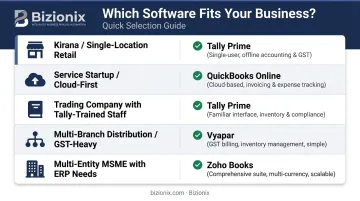
Use this guide as your starting point, then verify that your shortlisted option handles your specific compliance requirements — and can scale without forcing a platform switch mid-growth.
Conclusion
Every Indian small business has different needs. A kirana store owner needs straightforward GST billing with offline access and mobile payment support. A growing MSME managing multiple locations, entities, or warehouses needs a platform where accounting, compliance, and operations are connected — not scattered across separate tools.
When evaluating options, look beyond sticker price. Consider GST e-invoicing depth, vendor support quality, multi-user capability, and what the software looks like when your business doubles in size.
Those criteria matter most when a business outgrows basic accounting tools. Bizionix addresses them directly — combining accounting, GST compliance, inventory, and multi-entity management under a single login, without the complexity or cost of enterprise-grade systems built for larger organizations. Reach out for a demo or explore pricing tailored to your business size.
Frequently Asked Questions
What is the best accounting software for small businesses in India?
The right fit depends on how your business operates. TallyPrime suits traditional businesses with in-house accountants; Zoho Books works well for cloud-first startups; Bizionix fits growing MSMEs that need ERP-integrated accounting across multiple entities.
Is TallyPrime good for small businesses in India?
TallyPrime is one of the most trusted accounting platforms in India, with strong GST compliance, inventory support, and a large trained accountant ecosystem. It works best when you have staff already familiar with Tally; cloud access requires a separately purchased hosted solution.
Does accounting software in India handle GST filing automatically?
Most India-specific tools generate GSTR-1 and GSTR-3B ready reports, calculate CGST/SGST/IGST splits, and support e-invoicing for applicable businesses. Actual submission still happens through the GST portal or a CA — the software prepares and validates, not files on your behalf.
What is the difference between accounting software and ERP software for small businesses?
Standalone accounting tools focus on bookkeeping, invoicing, and GST. ERP platforms integrate those functions with inventory, procurement, sales, HR, and operations in one system. For growing MSMEs, that integration matters — disconnected departmental tools create data silos that slow decisions and inflate errors.
Can I switch accounting software without losing my financial data?
Most modern platforms support data import/export via Excel or CSV. Before switching:
- Confirm the new platform handles your historical transaction format
- Check whether dedicated migration support is available
- Back up all existing data before initiating any transfer
Which accounting software is best for GST e-invoicing in India?
E-invoicing is mandatory for businesses with aggregate turnover exceeding ₹5 crore (as of August 2023). Zoho Books, Busy Accounting, and Bizionix all offer direct API integration with the GST e-Invoice system for automated IRN generation and QR code embedding. These are the strongest options for businesses that need reliable e-invoicing compliance.