Introduction
Running finances across disconnected systems is a daily grind for most Indian MSMEs. Ledgers in one tool, GST filing in another, inventory tracked in spreadsheets — and then month-end arrives with reconciliation gaps, HSN mismatches, and missed e-invoice deadlines.
Fragmentation is the real problem, not effort.
India's accounting software market is valued at USD 698.87 million in 2025 and is forecast to reach USD 1,496.95 million by 2034 — a clear signal that businesses are actively moving away from manual, disconnected processes. Add to this the GSTN's record of nearly 1.43 billion returns filed since GST's inception, and the compliance burden becomes obvious.
Accounting ERP software tackles this by unifying financial operations, GST compliance, inventory, and business management into one platform. With mandates like GSTR-1, GSTR-3B, e-invoicing, and TDS growing more complex each year, the software you choose directly shapes your compliance risk and day-to-day efficiency.
This guide covers the top accounting ERP options for Indian businesses, what to look for, and how to evaluate them against your actual business needs.
Key Takeaways
- Accounting ERP combines core finance (AR, AP, GL, reporting) with operations like inventory and procurement — one platform, no duplicate entry or reconciliation gaps
- Indian businesses must treat GST compliance, e-invoicing (IRN generation), and multi-GSTIN support as non-negotiables
- Top options include Bizionix, TallyPrime, Zoho Books, ERPNext, and Busy — each suited to different sizes and needs
- Choosing the right fit comes down to company size, cloud vs. desktop preference, multi-branch complexity, and how much GST automation your team actually needs
What Is Accounting ERP Software and Why Does India Need It?
Standalone accounting software handles transactions — invoicing, bookkeeping, basic reporting. Accounting ERP goes further: it connects financial functions (general ledger, accounts payable, accounts receivable, financial reporting) with operational modules like inventory, procurement, and sales. Every department works from the same financial data, in real time, with no reconciliation required.
For Indian businesses, this integration is especially critical — GST compliance alone adds a layer of regulatory complexity that disconnected tools simply can't handle reliably.
GST compliance alone involves GSTR-1, GSTR-3B, HSN-wise reporting, e-way bills, and e-invoicing mandates. Businesses using separate tools for billing, accounting, and compliance filing constantly deal with:
- Duplicate data entry across systems
- Reconciliation gaps between sales and tax records
- Filing errors from manual HSN or GSTIN mismatches
- Missed e-invoice deadlines triggering late fees
The GSTN Annual Report 2023-24 shows 14.7 million active GST taxpayers as of August 2024 — each navigating this compliance layer, often with fragmented tools.
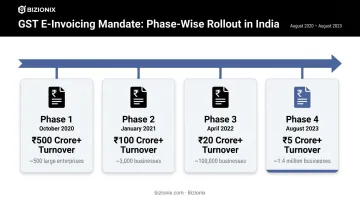
Since Notification No. 10/2023 extended e-invoicing to businesses with turnover above ₹5 crore from August 2023, the mandate now covers a much wider segment of Indian MSMEs. An accounting ERP automates these workflows inside the same system where transactions are recorded — so compliance isn't a separate task, it's a byproduct of normal operations.
Best Accounting ERP Software in India
Solutions below were evaluated across five criteria:
- Accounting module depth and GST compliance coverage
- E-invoicing and IRN generation capability
- Multi-company and multi-GSTIN management
- Deployment flexibility (cloud vs. desktop)
- Fit for Indian MSMEs and mid-sized businesses
Bizionix
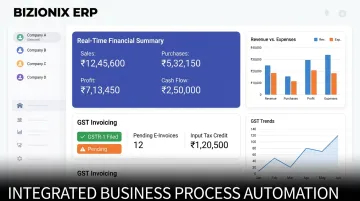
Bizionix is a 100% cloud-based ERP built specifically for Indian MSMEs by IIS-LLP (a subsidiary of Protocol India Private Limited), backed by over two decades of industry experience. It covers accounting, inventory, sales, procurement, HR, and GST compliance — all accessible via a single login across multiple companies.
For finance teams, the most operationally significant feature is direct API integration with the GST e-Invoice portal. When a sales invoice is created in Bizionix, the system validates it against GST rules and generates the IRN in real time — no manual steps, no third-party tool. The QR code is embedded automatically, and the invoice is ready to share within seconds. Setup requires only an API key and GST credentials.
For businesses managing multiple entities — holding companies, franchise networks, CA firms with client portfolios — Bizionix allows consolidated oversight across all GST-registered entities from one login, with independent books and role-based access per entity.
| Feature Area | Details |
|---|---|
| Key Accounting Features | GST-ready accounting, AR/AP management, general ledger, bank reconciliation, P&L, balance sheet, trial balance, real-time financial dashboards, pre-validated invoices |
| GST & Compliance | Direct API integration with GST e-Invoice portal for instant IRN generation, automated GSTR-1 preparation, multi-GSTIN management |
| Deployment & Pricing | 100% cloud-based; NEO plan from ₹999/year; Enterprise plan on request |
Best for: Indian MSMEs, CA firms managing multiple clients, manufacturing, distribution, and multi-location businesses.
TallyPrime
TallyPrime has three decades of history in Indian accounting and remains the default choice for accountants and SMBs running desktop-first workflows. Its familiarity and deep GST support make it hard to displace in firms where accountants already know the interface.
Core accounting features cover general ledger, AP/AR, bank reconciliation, payroll, inventory-linked accounting, and financial reporting. GST support includes GSTR-1, GSTR-3B, e-invoicing, e-way bills, and TDS.
The primary limitation: TallyPrime is desktop-first. Cloud access and remote collaboration require a Tally Software Services (TSS) subscription, and multi-company remote workflows often need additional setup or add-ons.
| Feature Area | Details |
|---|---|
| Key Accounting Features | General ledger, AP/AR, bank reconciliation, payroll, inventory-linked accounting, financial reporting |
| GST & Compliance | GST invoicing, GSTR-1/3B, e-invoicing, e-way bills, TDS; cloud access requires TSS |
| Deployment & Pricing | Desktop (hybrid); Silver lifetime ₹22,500 + GST (single PC); Gold lifetime ₹67,500 + GST (multi-user); annual TSS renewal applies |
Best for: SMBs and accountants comfortable with desktop-based workflows and the existing Tally ecosystem.
Zoho Books
Zoho Books is a cloud-native accounting platform with a clean interface, automated workflows, and a free plan for businesses with annual revenue under ₹25 lakh. For growing MSMEs that want clean invoicing, GST compliance, and bank reconciliation without implementation complexity, it's a practical starting point.
GST support covers e-invoicing with IRN generation via the Invoice Registration Portal, GSTR reports, TDS, and e-way bill generation. Bank feeds and auto-reconciliation reduce manual effort significantly.
Full ERP depth — manufacturing, multi-company consolidation — requires Zoho One or separate module purchases. Businesses that need full manufacturing or multi-company consolidation will need to add Zoho One or purchase separate modules.
| Feature Area | Details |
|---|---|
| Key Accounting Features | GST invoicing, expense tracking, bank reconciliation, AP/AR, financial reports, project billing |
| GST & Compliance | E-invoicing, GSTR reports, TDS, e-way bills; direct GST portal integration |
| Deployment & Pricing | Cloud-based; Free plan (revenue ≤ ₹25 lakh); Standard from ₹749/org/month; higher tiers up to ₹7,999/org/month |
Best for: Small businesses and micro-enterprises starting with cloud accounting; businesses already in the Zoho ecosystem.
ERPNext
ERPNext is an open-source ERP with a strong Indian user base, covering accounting, inventory, manufacturing, procurement, and HR in one system. The software itself is licensed under GPL-3.0 and costs nothing — but hosting, implementation, and ongoing support are separate costs that businesses must plan for.
The separate India Compliance app handles GST compliance, e-invoicing, and e-way bill features — it must be installed separately. Frappe Cloud managed hosting starts from ~USD 5/month (approx. ₹420/month) for small sites. The open-source model enables deep customization, but that flexibility typically requires developer resources or an implementation partner.
| Feature Area | Details |
|---|---|
| Key Accounting Features | General ledger, AP/AR, cost center accounting, multi-currency, financial statements, bank reconciliation |
| GST & Compliance | GST invoicing, e-invoicing, e-way bills, GSTR reports via India Compliance app |
| Deployment & Pricing | Self-hosted (free license) or Frappe Cloud from ~USD 5/month (approx. ₹420/month); implementation separate |
Best for: Tech-capable businesses or those with implementation partner support who want full ERP depth at low licensing cost.
Busy Accounting Software
Busy serves traders, wholesalers, and distributors across India — 360,000+ customers use it nationally. Where it stands apart is inventory depth: batch-level tracking, multi-godown management, and tight stock-to-finance linking make it particularly strong for FMCG, pharma, and distribution businesses.
GST compliance is built in, covering e-invoicing, e-way bills, and GSTR reports. The interface reflects its desktop origins and is older than cloud-native alternatives. Cloud access is available via BUSY Online but at an additional monthly cost.
| Feature Area | Details |
|---|---|
| Key Accounting Features | Accounting with inventory integration, multi-godown, batch management, financial reporting, GST billing |
| GST & Compliance | GST invoicing, e-invoicing, e-way bills, GSTR-1/3B/2A/2B auto-download and reconciliation |
| Deployment & Pricing | Desktop-first; Basic ₹9,999/year, Standard ₹14,999/year, Enterprise ₹19,999/year; BUSY Online from ₹1,000/month |
Best for: Traders, distributors, and FMCG businesses where inventory-accounting integration is the core requirement.
Key Features to Look for in Accounting ERP Software in India
GST Compliance and E-Invoicing Automation
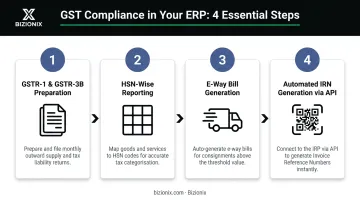
Any accounting ERP shortlisted for an Indian business must handle end-to-end GST workflows natively. The minimum bar:
- GSTR-1 and GSTR-3B preparation and filing support
- HSN-wise reporting
- E-way bill generation
- Automated IRN generation through direct API integration with the GST e-Invoice portal
Manual GST processes are the primary source of filing errors and late fees for Indian MSMEs. Software that only exports data for manual filing on the portal shifts the burden without solving it.
Core Accounting Modules: AR, AP, GL, and Reporting
Verify that these modules exist natively before shortlisting any platform:
- Accounts receivable and payable
- General ledger
- Bank reconciliation
- Financial reporting: P&L, balance sheet, cash flow statement
A fragmented setup — accounting in one tool, operations in another — creates reconciliation gaps every period. Native integration between sales, procurement, and accounting eliminates this entirely.
Multi-Company and Multi-Branch Management
Businesses managing multiple entities, GSTINs, or locations need consolidated accounting across all of them from a single login. Ask specifically:
- Can each entity maintain separate books, GST registration, and ledgers?
- Is consolidated reporting available across entities?
- Are role-based access controls enforced at the entity level?
Running separate software instances per entity multiplies licensing costs, data entry effort, and reconciliation risk — a structure that doesn't scale.
Cloud Accessibility and Real-Time Dashboards
Cloud-based accounting ERP gives finance teams and founders real-time visibility into cash flow, receivables, and financial position — without waiting for month-end reports. For CA firms or business owners who need to review financials remotely, desktop-only solutions create access gaps that slow decisions.
When evaluating platforms, check for:
- Native cloud architecture (not a desktop tool with a cloud add-on)
- Real-time dashboards accessible from any device
- Role-based access so finance teams and founders see what's relevant to them
Integration with Banking and Business Systems
Look for:
- Automated bank feed import for daily transaction matching and reconciliation
- Direct GST portal connectivity for live filing data validation
- Operational system links across CRM, inventory, and procurement to cut manual data entry between departments
How We Chose These Accounting ERP Solutions
Solutions were shortlisted based on four criteria: depth of native accounting functionality beyond basic billing, GST and e-invoicing compliance readiness for the Indian regulatory environment, suitability for MSMEs and growing enterprises, and cloud deployment availability.
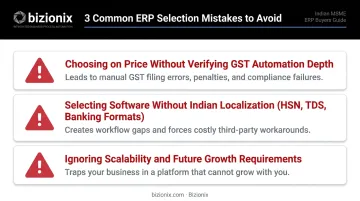
Common selection mistakes to avoid:
- Choosing based on price alone without verifying GST automation depth — a cheap tool that doesn't automate e-invoicing still requires manual compliance effort
- Selecting software built for international markets without Indian localization (HSN codes, TDS, Indian banking formats)
- Picking a tool for current transaction volumes without considering growth — platform migrations are expensive and disruptive
Beyond these mistakes, scalability was a deciding factor. Your accounting ERP should handle today's volumes and tomorrow's complexity — without forcing a platform migration. We ranked lower any tool requiring expensive add-ons or custom development for core compliance features.
Conclusion
The right accounting ERP for an Indian business isn't the most popular option or the cheapest — it's the one that fits the business's compliance requirements, operational complexity, and growth path.
Before deciding, evaluate:
- GST automation depth (not just feature claims — verify the workflow)
- Multi-company capability if you manage more than one entity or GSTIN
- Cloud vs. desktop architecture and what it means for remote access
- Total cost of ownership: licensing, implementation, training, and compliance maintenance
If your business checks most of those boxes — multiple entities, active GST compliance obligations, and a need for e-invoicing without manual workarounds — Bizionix by IIS-LLP is built specifically for that profile. It's a cloud-based accounting ERP designed for Indian MSMEs and growing enterprises, with automated e-invoicing, multi-company management, and GST compliance integrated from the ground up.
Reach out for a demo at info@bizionix.com, call +91 91779 99277, or connect via WhatsApp to see how the platform fits your business.
Frequently Asked Questions
What is the difference between accounting software and accounting ERP software?
Standalone accounting software handles financial transactions like invoicing and bookkeeping. Accounting ERP integrates those same functions with broader business operations — inventory, procurement, sales — into one platform, eliminating data silos and providing a unified financial view across the organisation.
Which accounting ERP software is best for Indian MSMEs?
The best fit depends on business size and complexity. Cloud-native platforms built specifically for Indian MSMEs, like Bizionix, offer GST compliance, multi-company management, and e-invoicing automation without enterprise-level cost or setup complexity — making them strong options for growing businesses.
Does accounting ERP software in India support GST filing and e-invoicing?
Most mid-to-advanced accounting ERP platforms in India support GST invoicing, GSTR preparation, e-way bills, and e-invoicing. Quality varies: some platforms require third-party add-ons, while others offer direct API integration with the GST portal for automated IRN generation at the point of invoice creation.
What are the must-have accounting modules in an ERP for Indian businesses?
General ledger, accounts payable and receivable, bank reconciliation, GST compliance (GSTR preparation and e-invoicing), and financial reporting are the core requirements. For multi-entity businesses, consolidated multi-company accounts under a single login is also non-negotiable.
Can a small business afford accounting ERP software in India?
Cloud-based accounting ERP has made enterprise-grade functionality accessible at subscription pricing. Indian MSMEs no longer need large upfront investments. Platforms like Bizionix NEO start at ₹999/year, and modular pricing means businesses only pay for what they actually use.
How long does it take to implement accounting ERP software?
Cloud-based platforms designed for SMEs typically go live in days to a few weeks. Complex on-premise deployments can take months. Data migration quality and user training are the most common factors that affect go-live timelines regardless of platform choice.