Most businesses in this segment sit in an awkward gap. They've outgrown Vyapar or a basic invoicing tool, but a full SAP or Oracle implementation — with its six-month rollout, dedicated IT team, and ₹50+ lakh price tag — is overkill. What they need is something in between.
This guide covers the best accounting software for medium-sized Indian businesses in 2026, evaluated specifically for GST readiness, e-invoicing compliance, multi-entity management, scalability, and real-world fit for the 50–500 employee range.
Note: QuickBooks Online India is not included in this list — Intuit discontinued the product for Indian users as of July 2023, with no current availability.
Key Takeaways
- Medium-sized Indian businesses need GST compliance, e-invoicing, multi-entity management, and real-time reporting built in
- Top options in 2026 include Bizionix, TallyPrime, Zoho Books, and Busy Accounting Software
- Evaluate on GST compliance, cloud access, multi-GSTIN support, integration depth, and total cost of ownership
- E-invoicing is mandatory above ₹5 crore aggregate turnover — your software must handle IRN generation natively
- Your best fit depends on industry, transaction volume, GSTIN count, and whether you need standalone accounting or full ERP
What's at Stake for Medium-Sized Indian Businesses
Who Counts as "Medium-Sized" in India?
As of April 1, 2025, the Ministry of MSME updated its classification thresholds: a medium enterprise now covers businesses with investment up to ₹125 crore and annual turnover up to ₹500 crore.
Practically speaking, you're in this segment if you have:
- Multiple departments with separate budget responsibility
- Operations across more than one location, state, or GSTIN
- A finance team that needs more than a spreadsheet but doesn't have a dedicated ERP team
- Annual turnover above ₹5 crore — the threshold at which e-invoicing becomes mandatory
The MSME Annual Report 2024-25 recorded approximately 24,000 registered medium enterprises out of 4.25 crore Udyam-registered MSMEs — a small count, but representing some of the most operationally complex businesses in the country.
Why Standard Accounting Tools Fall Short
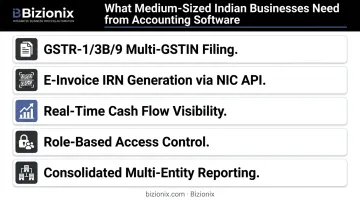
That operational complexity is exactly where basic billing tools break down. A medium-sized business operating across locations and GSTINs needs:
- GSTR-1, GSTR-3B, and GSTR-9 filing across multiple GSTINs
- E-invoicing with IRN generation via the NIC API (mandatory above ₹5 crore turnover)
- Real-time cash flow visibility — not month-end exports
- Role-based access for accountants, managers, and branch heads
- Consolidated reporting across entities or locations
The tools covered below were selected specifically for this profile: growing Indian businesses with multi-location operations, compliance obligations, and finance teams that need real capability without enterprise-level cost or complexity.
Best Accounting Software for Medium-Sized Businesses in India 2026
How we evaluated these tools:
- India-specific GST and e-invoicing compliance
- Scalability for mid-market operations (50–500 employees)
- Total cost of ownership across plans
- Suitability for multi-entity or multi-location setups
Bizionix
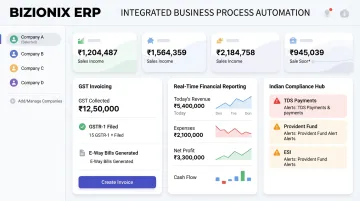
Bizionix is a 100% cloud-based ERP built specifically for Indian MSMEs by IIS-LLP — a subsidiary of Protocol India Private Limited with over two decades of industry experience. It covers accounting, billing, inventory, payroll, and GST compliance in one unified platform under a single secure login.
The standout differentiator is its direct API integration with the GST e-Invoice system. When a user creates a sales invoice, the system automatically validates it against GST rules, then generates the IRN and QR code via direct IRP connection in real time. No manual JSON uploads. No waiting.
Multi-company management works through a single login dashboard: separate books of accounts per entity, role-based permissions down to branch level, and group-level consolidated reporting. This makes it practical for holding companies, franchise networks, and businesses with multiple GSTINs.
| Feature Area | Details |
|---|---|
| Key Features | GST-ready accounting, automated e-invoicing with IRN generation, multi-company and multi-location management, real-time dashboards, role-based access, inventory and payroll modules |
| Pricing | NEO plan: ₹999/year; Enterprise plan: custom pricing (contact sales) |
| Best For | Mid-sized Indian enterprises managing multiple entities, branches, or GSTINs who want an all-in-one cloud ERP without SAP-level complexity |
If you need a solution with a larger partner ecosystem and an established on-premise option, the next two tools take a different approach.
TallyPrime
TallyPrime is India's most widely adopted accounting software, trusted by 2.5 million+ businesses across manufacturing, trading, and distribution. Its strength lies in deep compliance functionality and a large ecosystem of accountants and implementation partners who already know the product.
GST coverage is thorough: GSTR-1 direct upload, GSTR-3B reconciliation, GSTR-2A/2B reconciliation, e-invoice generation, and e-way bill management are all included. The system runs primarily on desktop, with cloud access available as a paid add-on.
For medium-sized businesses with established accounting teams and complex inventory needs, TallyPrime delivers proven depth. Remote access requires additional paid services — worth factoring into total cost before committing.
| Feature Area | Details |
|---|---|
| Key Features | GST filing (GSTR-1, GSTR-3B, e-way bill), inventory management, payroll, multi-company ledger, bank reconciliation, optional cloud sync |
| Pricing | Silver: ₹750/month or ₹22,500 lifetime; Gold: ₹2,250/month or ₹67,500 lifetime (all + 18% GST); TallyPrime Server: ₹2,70,000 + GST |
| Best For | Businesses with established accounting teams that prefer a locally installed or hybrid system with deep compliance and a familiar workflow |
Zoho Books
Zoho Books is a cloud-first accounting platform from Zoho Corporation, designed for businesses that want clean UX, strong GST compliance, and tight integration with the broader Zoho ecosystem — CRM, inventory, HR, and more.
The India-specific feature set includes GST invoicing, e-invoice submission to IRP, and support for up to 10 GSTINs per organisation depending on plan. Automated bank reconciliation, multi-currency, and workflow automation make it particularly suited for service businesses with international clients.
Growing businesses should note: transaction and user caps apply at each plan level. The Elite or Ultimate tier is typically needed for mid-market volume.
| Feature Area | Details |
|---|---|
| Key Features | GST invoicing and e-invoice support, automated bank reconciliation, multi-currency, workflow automation, client portal, 45+ integrations |
| Pricing | Standard: ₹749/month (annual); Professional: ₹1,499/month; Premium: ₹2,999/month; Elite: ₹4,999/month; Ultimate: ₹7,999/month (all annual billing) |
| Best For | Cloud-first mid-sized businesses — especially in services, consulting, or those already using Zoho CRM or other Zoho apps |
Busy Accounting Software
Busy is a well-established Indian accounting and business management software with a strong user base in wholesale, distribution, retail, and manufacturing. Where it stands out is inventory depth: multiple godowns, multiple price lists, and batch-wise management with expiry date and manufacturing tracking — capabilities most general-purpose accounting tools don't offer.
GST compliance is comprehensive: GSTR-1 direct upload, auto e-invoice and e-way bill generation, and GSTR-2A/2B auto-download and reconciliation are all available from the Standard edition upward. Desktop and cloud deployment options let businesses choose based on their existing IT setup.
| Feature Area | Details |
|---|---|
| Key Features | GST billing and e-invoicing, multi-godown inventory, batch-wise management, payroll, CRM, cloud and desktop deployment |
| Pricing | Basic: ₹9,999/year; Standard: ₹14,999/year; Enterprise: ₹19,999/year (single-user, + GST); Busy Online: ₹10,800/year + GST |
| Best For | Trading, distribution, and manufacturing businesses that need deep inventory management tightly integrated with accounting and GST compliance |
Key Features to Look for in Mid-Sized Indian Businesses' Accounting Software
Key Features to Look for in Accounting Software for Mid-Sized Indian Businesses
GST and E-Invoicing Compliance
This is non-negotiable. Any software shortlisted for a medium-sized Indian business must handle:
- Automated GSTR-1 and GSTR-3B preparation from transaction data
- HSN/SAC classification at the line-item level
- Direct e-invoice IRN generation via NIC's IRP API
Per CBIC Notification No. 10/2023, e-invoicing is mandatory for businesses with aggregate turnover above ₹5 crore, effective August 1, 2023. At medium-enterprise scale, virtually every business in scope needs a system that handles this natively — not through manual JSON uploads.
Multi-Entity and Multi-GSTIN Management
A medium-sized business with three branches across two states, a subsidiary, and separate GST registrations cannot manage this through a single-entity accounting tool without creating a reconciliation nightmare.
Look for:
- Separate books per entity with consolidated reporting
- Single login access across all companies
- Branch-level permissions and role-based controls
Real-Time Dashboards and Financial Reporting
The shift from month-end batch exports to real-time visibility changes how decisions get made. A finance manager should be able to see outstanding receivables, cash position, and department-wise expenses today — not after the accounts team runs a report next week.
Practically, this means:
- Spotting overdue receivables before they age past 60 days
- Catching department budget overruns in the same week they occur
- Making cash flow decisions based on current data, not last month's export
Scalability Without Complexity
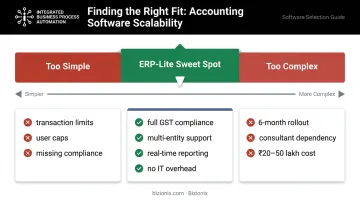
There are two failure modes here:
- Too simple: The tool breaks as the business grows — transaction limits, user caps, or missing compliance features
- Too complex: An enterprise ERP requiring a six-month implementation, a dedicated IT team, and ongoing consultant dependency
The right fit for most mid-sized Indian businesses is an ERP-lite solution: full GST compliance, multi-entity support, and real-time reporting — without the infrastructure overhead.
Integration With Existing Business Systems
Accounting doesn't operate in isolation. Disconnected systems create duplicate data entry and reconciliation errors across:
- Inventory and warehouse management
- CRM and sales pipelines
- Payroll and HR
- Banking and payment reconciliation
The best platforms offer this through native integrated modules — so inventory, payroll, and sales data feed directly into accounting without middleware or manual reconciliation. Where native modules aren't available, open API support for third-party tools is the next best option.
How We Chose These Accounting Software Options
Not every accounting tool on the market suits a mid-sized Indian business. The options below were shortlisted specifically for companies in the 50–500 employee range, operating under Indian tax law.
Evaluation Criteria
Each tool was assessed against:
- India-specific compliance: GST, e-invoicing, GSTR filing, and e-way bill support built in natively
- Mid-market operational fit: Suitable for 50–500 employee businesses with multi-location or multi-entity needs
- Deployment model: Cloud, desktop, or hybrid — and what that means for remote access and data control
- Pricing transparency: Total cost including licensing, cloud access add-ons, and implementation
- Real-world usability: Whether accounting teams without enterprise IT support can actually operate the software effectively
Knowing what to look for matters just as much as knowing what to avoid.
Common Mistakes to Avoid
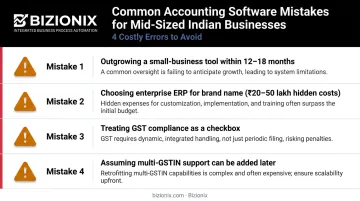
Medium-sized businesses frequently make these errors when selecting accounting software:
- Outgrowing a small-business tool within 12–18 months — transaction limits, user caps, and missing compliance features become blockers faster than expected
- Picking an enterprise ERP for the brand name — six-month implementations, consultant dependency, and hidden costs in the ₹20–50 lakh range are typical outcomes
- Treating GST compliance as a checkbox — tools that handle basic invoicing but need manual intervention for e-invoicing or GSTR filing create real compliance risk as volumes grow
- Assuming multi-GSTIN support can be added later — businesses with multiple registrations need this built in from day one, not retrofitted
Conclusion
The right accounting software for a medium-sized Indian business in 2026 does far more than record transactions. It manages GST filings, generates IRNs automatically, consolidates multi-entity books, and gives your finance team real-time visibility — without needing a dedicated IT department to keep it running.
Evaluate each option against your specific situation:
- How many GSTINs do you manage?
- Do you need standalone accounting or unified ERP across departments?
- Is your team desktop-first or cloud-ready?
- What's your transaction volume, and does each tool's pricing tier support it?
For mid-sized Indian enterprises that need GST compliance, automated e-invoicing, multi-company management, and real-time financial visibility without the complexity or cost of enterprise software, Bizionix by IIS-LLP is worth a closer look. Visit bizionix.com or reach the team at info@bizionix.com to request a demo or start a free trial.
Frequently Asked Questions
What qualifies as a medium-sized business in India for accounting software purposes?
As of April 1, 2025, medium enterprises are classified as those with investment up to ₹125 crore and turnover up to ₹500 crore. If your business has multiple departments, operates across more than one location, or has turnover above ₹5 crore (triggering e-invoicing obligations), you've likely outgrown basic billing software and need a more capable platform.
Is TallyPrime sufficient for a medium-sized business in India?
TallyPrime handles GST compliance, inventory, and multi-company ledgers well and works for many mid-sized businesses. However, remote access requires paid add-ons, and cloud dashboards or consolidated multi-entity reporting typically need the higher-cost TallyPrime Server licence.
What is the difference between accounting software and ERP for mid-sized businesses?
Accounting software manages financial transactions, GST compliance, and reporting. ERP integrates those functions with inventory, procurement, HR, and CRM into a single unified system. Most medium-sized Indian businesses benefit from an ERP-lite approach — full accounting and compliance capabilities combined with operational modules, without enterprise implementation complexity.
Is e-invoicing mandatory for medium-sized businesses in India?
Yes, for most. CBIC Notification No. 10/2023 made e-invoicing mandatory for registered taxpayers with aggregate turnover above ₹5 crore, effective August 1, 2023. At medium-enterprise scale, the vast majority of businesses fall within scope and need software with built-in IRN generation via the NIC IRP API.
Can one accounting software manage multiple companies or GSTINs?
Several platforms support this. Bizionix offers multi-company management under a single secure login with entity-level permissions and consolidated reporting. Zoho Books supports up to 10 GSTINs per organisation depending on plan. This capability is essential for business groups, franchise networks, or multi-state operations.
What should a medium-sized Indian business budget for accounting software?
Costs range from ₹999/year (Bizionix NEO) to ₹67,500+ for a TallyPrime Gold lifetime licence, with cloud subscriptions like Zoho Books running ₹749–₹7,999/month by tier. Budget separately for implementation, training, and support, which can add 20–40% to the base cost for complex deployments.