Introduction
Over 7.9 crore enterprises were registered as of March 2026, contributing more than 31% to India's GDP and employing nearly 32.8 crore people. Yet most of these businesses still run on a patchwork of disconnected tools: one app for accounting, another for customer management, a third for team communication, spreadsheets for inventory, and WhatsApp for approvals.
The result? Data silos, manual errors, mounting subscription costs, and compliance gaps that catch up fast.
This guide lists the best software tools for Indian small businesses in 2026, evaluated on GST compliance, ease of use, India-market relevance, scalability, and value for money. Whether you're a five-person service firm or a growing manufacturer with multiple locations, there's a right tool for your stage.
Key Takeaways
- Indian MSMEs need software that is cloud-based, GST-compliant, and scalable — not just affordable
- The best tools cover accounting, project management, communication, CRM, and operations
- Fragmented tool stacks create hidden costs and compliance blind spots
- Bizionix offers an all-in-one cloud ERP built for Indian MSMEs — with GST compliance and multi-entity management in one platform
- Choose based on your business size, industry, and growth stage — not just the free plan
Why Indian Small Businesses Need the Right Software in 2026
Business software, in the MSME context, means any tool that automates, organises, and manages core functions — from billing and inventory to team coordination and customer tracking. The purpose: free owners from repetitive manual work so they can focus on growth.
The urgency is real. According to NASSCOM's AI Enablement for MSMEs report, 65% of tech-enabled MSMEs cite lack of awareness about digital tools and deployment resources as their top adoption challenge. Many business owners simply don't know what's available — or they've tried tools that didn't fit India-specific requirements like GST compliance. The gap is informational, not technical.
A separate SaaS benchmark found small businesses with 1–100 employees use an average of 102 apps — many redundant, many unused, most creating security and integration risks.
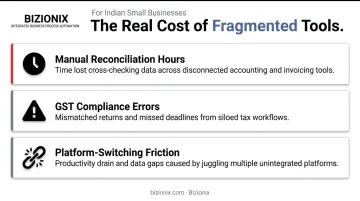
For Indian MSMEs, that fragmentation costs more than subscription fees. The real damage shows up as:
- Manual reconciliation hours when tools don't talk to each other
- Compliance errors when GST data doesn't sync across systems
- Constant friction from switching between unconnected platforms
The tools featured below were chosen specifically for Indian business conditions — GST compliance, INR pricing, cloud accessibility, and the ability to handle real operational workloads.
Best Software Tools for Small Businesses in 2026
Each tool below was evaluated for India-market fit, GST compliance where relevant, and practical value for small teams managing growth without large IT budgets.
Zoho Books
Zoho Books is India's most widely used cloud accounting platform for small businesses. It connects directly with the GST portal, supports automated e-invoicing, e-way bill generation, and covers GSTR-1, GSTR-3B, and GSTR-9 filing with GSTR-2A and GSTR-2B reconciliation — all from a single interface.
What makes it genuinely useful for MSMEs is the revenue-based free plan: businesses with annual turnover under ₹25 lakhs pay nothing. Paid plans scale with invoice volume and user count, not arbitrary feature gates.
| Key Features | GST-compliant invoicing, e-way bill generation, bank reconciliation, GSTR filing, expense tracking, multi-currency support |
| Pricing | Free (turnover under ₹25 lakhs, up to 1,000 invoices/year) → ₹749/month (Standard, billed annually) → up to ₹7,999/month (Ultimate, billed annually) |
| Best For | Small businesses and CA firms needing GST-ready accounting with solid reporting |
Trello
Trello is a visual task management tool built around Kanban-style boards. Teams use it to organise projects, assign tasks, track deadlines, and manage workflows — without needing a dedicated project manager or technical setup.
Its free plan supports up to 10 collaborators per workspace, which covers most early-stage small teams. The real strength is integrations: Trello connects with 200+ apps including Google Drive, Slack, and Zapier, allowing teams to build lightweight connected workflows without custom development.
| Key Features | Kanban boards, task cards with due dates, checklists, file attachments, Power-Ups (integrations with 200+ tools) |
| Pricing | Free (up to 10 collaborators) → US$5/user/month (Standard, billed annually) → US$10/user/month (Premium) |
| Best For | Small teams managing marketing, operations, or client delivery without dedicated project managers |
Slack
Slack replaces email for day-to-day team communication. Organised into channels by topic or department, it keeps conversations searchable, reduces inbox clutter, and integrates with over 2,600 business tools — from Google Drive and Trello to Zoom and accounting platforms.
For small businesses with remote or multi-department teams, Slack's value is consolidation: one place for all team communication instead of fragmented WhatsApp groups, email threads, and in-person conversations that leave no record. The free plan has one significant limitation — message history is searchable for only 90 days. Teams that need longer records should budget for the Pro plan.
| Key Features | Channels, direct messaging, file sharing, app integrations (2,600+ apps), searchable message history |
| Pricing | Free (90-day message history, up to 10 apps) → US$7.25/user/month (Pro, billed annually) → US$15/user/month (Business+) |
| Best For | Small businesses with remote or multi-department teams that need organised, centralised communication |
Zoho CRM
Zoho CRM is a sales and customer management platform with strong India-market adoption. For businesses already using Zoho Books, the integration is seamless — accounts, contacts, and transactions sync bidirectionally, eliminating duplicate data entry across sales and finance teams.
The free tier covers up to 3 users, which is sufficient for small sales teams or service businesses just starting to formalise their pipeline. Paid plans add Zia AI capabilities including lead scoring, sales predictions, and automated follow-ups — features that matter when a sales team scales beyond manual tracking.
| Key Features | Lead and contact management, pipeline tracking, email integration, Zia AI scoring, workflow automation, dashboards |
| Pricing | Free (3 users) → ₹800/user/month (Standard) → ₹1,400/user/month (Professional) → ₹2,400/user/month (Enterprise) → ₹2,600/user/month (Ultimate) |
| Best For | Service-based businesses, sales teams, and CA firms managing multiple clients or leads |
Bizionix
Bizionix (by IIS-LLP, a subsidiary of Protocol India Private Limited) takes a different approach from every other tool on this list. Where Zoho Books handles accounting, Zoho CRM handles sales, Trello handles tasks, and Slack handles communication, Bizionix handles all of it — in one platform, under one login.
Built over two decades of combined industry experience, it's a 100% cloud-based ERP designed specifically for Indian MSMEs. The e-invoicing module connects directly with the GST Invoice Registration Portal via API — no manual JSON uploads, no third-party tools. IRN generation and QR code embedding happen instantly, with GSTR-1 auto-populated from every sales transaction.
Beyond accounting, the platform covers inventory and warehouse management, HR and payroll, CRM, multi-company management, document workflows, and real-time dashboards — all from a single secure login. For businesses managing multiple GST entities, branches, or franchise locations, that unified visibility is difficult to replicate with separate tools.
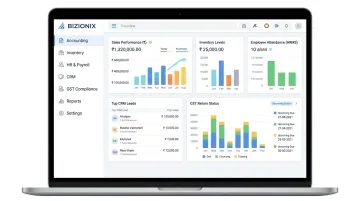
The NEO plan starts at ₹999/year (discounted from ₹2,999) with a 14-day free trial. The Enterprise plan is custom-priced for larger or more complex operations.
| Key Features | GST e-invoicing with direct IRN generation, multi-company management, inventory and warehouse tracking, accounts payable/receivable, HR and payroll, CRM, real-time dashboards, activity tracking, GSTR-1 auto-population |
| Pricing | NEO: ₹999/year (14-day free trial) → Enterprise: contact for pricing |
| Best For | Indian MSMEs, manufacturing businesses, distribution companies, franchise networks, CA firms, and multi-location enterprises replacing fragmented tools |
How We Chose These Tools
Not every tool built for global markets works for Indian businesses. Here's the framework used to evaluate each one.
Selection Criteria
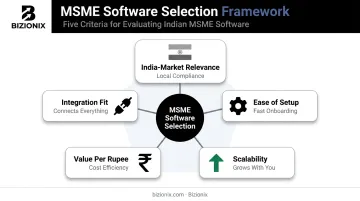
Each tool was evaluated on five factors:
- India-market relevance — GST compliance, INR pricing, local regulatory fit
- Ease of setup — accessible for non-technical business owners without IT teams
- Scalability — usable from early-stage through meaningful growth
- Value per rupee — free plan quality, paid tier fairness, total cost vs. functionality
- Integration fit — how well it connects with other tools in a typical MSME stack
Knowing what to look for is only half the equation. Understanding where most MSMEs go wrong helps narrow the choice faster.
Common Mistakes to Avoid
Indian small business owners run into the same selection pitfalls repeatedly:
- Choosing by brand recognition — a globally popular tool may not support GST workflows, e-way bills, or India-specific compliance requirements
- Ignoring tool sprawl — each new subscription adds cost, integration complexity, and data fragmentation. A 2020 Blissfully benchmark found businesses with 1–100 employees used 102 apps on average, with duplicate and orphaned subscriptions creating waste and security risk
- Skipping GST verification — accounting or invoicing tools without proper GST filing and reconciliation support create compliance gaps that surface at audit time
The Economic Times reported that 69% of Indian MSMEs support tax compliance automation and e-invoicing — a clear signal that GST capability should be a core selection criterion, not an afterthought.
Conclusion
Indian small businesses in 2026 have more software choices than ever. The question isn't whether to use software — it's whether to build a stack of single-function tools or invest in a unified platform that grows with the business.
Point solutions like Zoho Books, Trello, Slack, and Zoho CRM each do their job well. They suit businesses that need targeted functionality and have the bandwidth to manage multiple subscriptions, integrations, and data handoffs between platforms. That calculus shifts as operations grow. For MSMEs scaling across departments, managing multiple entities, or dealing with month-end reconciliation chaos, an integrated ERP typically makes more long-term sense. Consider what five separate tools actually cost:
- Subscription fees across each platform
- Staff time managing integrations and data handoffs
- Errors and delays that surface between disconnected systems
- Reconciliation overhead at month-end
In most cases, those hidden costs exceed what a unified platform runs.
Bizionix is designed for that transition — when an Indian MSME has outgrown its spreadsheet-and-app-stack phase and needs sales, finance, inventory, HR, and compliance working from one system. Visit bizionix.com or connect via WhatsApp to see how it fits your operations.
Frequently Asked Questions
What software is best for a small business?
The right choice depends on your biggest operational gap. Businesses focused on financial management should start with a GST-compliant accounting tool like Zoho Books; sales-driven businesses will benefit more from a CRM like Zoho CRM. If you need accounting, inventory, HR, and CRM without juggling separate subscriptions, an all-in-one ERP like Bizionix is the more efficient choice.
How much does AI-assisted accounting cost in India?
AI-assisted accounting features — automated GST filing, transaction categorisation, e-invoicing — are built into many existing platforms rather than sold separately. Zoho Books includes these capabilities from ₹749/month. Integrated ERP platforms like Bizionix bundle similar features alongside inventory, HR, and CRM, often at a lower total cost than multiple standalone subscriptions combined.
What is the difference between accounting software and ERP software for small businesses?
Accounting software manages financial records — invoices, ledgers, GST returns, and reports. ERP software connects those functions with inventory, HR, CRM, and procurement in a single system. For businesses running multiple operations, ERP eliminates the data silos and manual reconciliation that separate tools create.
Is cloud-based software safe for small business data in India?
Reputable cloud platforms use enterprise-grade encryption, role-based access controls, and activity logging to protect business data. Bizionix, for example, includes entity-level permissions, full audit trails, and monthly data backups. When evaluating any cloud tool, verify that it offers role-based access control, activity tracking, and a documented backup policy.
How do I choose the right software for my small business in India?
Start with your biggest operational pain point — accounting and GST compliance, or managing multiple functions in one place. For any financial tool, confirm GST readiness, check for a free trial, and compare the total cost of several standalone subscriptions against a single integrated platform before deciding.
Can a small business use free software tools to run operations?
Free plans from Zoho Books, Trello, and Slack work for very early-stage businesses with limited volumes and small teams. As compliance requirements and transaction counts grow, those limitations become bottlenecks — and the combined cost of paid tiers across multiple tools often exceeds what a single integrated platform charges.