Introduction
Most growing Indian businesses hit a familiar wall. Sales are increasing, teams are expanding, and the finance function — still running on spreadsheets and disconnected tools — can't keep up. Month-end becomes a scramble, GST filing feels like guesswork, and cash flow visibility is always one step behind reality.
This isn't a niche problem. According to ICRIER's 2025 Annual Survey of MSMEs, offline channels remain the primary mode for roughly 70% of Indian MSME transactions — a strong indicator of how many businesses are still managing financial operations without integrated digital systems.
Accounting and financial management software exists precisely to solve this. This article covers what these platforms are, which features matter most, the concrete benefits they deliver, and how to choose the right solution for your stage of growth.
Key Takeaways
- Accounting software covers bookkeeping and transactions; modern platforms extend this to budgeting, forecasting, and strategic planning
- Core features: general ledger, AP/AR automation, GST compliance, e-invoicing, and real-time reporting
- For Indian businesses, built-in GST compliance with direct IRP integration is non-negotiable
- Cloud-based platforms cost less, update automatically, and are accessible from anywhere — unlike on-premise systems
- Choose based on your transaction volume, compliance needs, number of entities, and growth trajectory
What Is Accounting and Financial Management Software?
Accounting and financial management software is a digital system that records, tracks, manages, and analyses an organisation's financial transactions — covering income, expenses, assets, liabilities, and compliance obligations.
The two terms are related but distinct:
- Accounting software focuses on bookkeeping and transactional records: journal entries, invoices, bank reconciliation, and financial statements
- Financial management software (FMS) is the broader category that extends to budgeting, forecasting, cash flow management, and strategic financial planning
As SAP defines it, FMS covers "the software and processes used to manage income, expenses, and assets in an organisation." In practice, modern platforms combine both functions into one integrated system.
The Progression from Basic Tools to Integrated Platforms
Small businesses often start with simple bookkeeping tools or spreadsheets. That works — until it doesn't. As transaction volumes grow, entities multiply, or GST obligations become more complex, those tools become a liability rather than an asset.
Growing enterprises, particularly in manufacturing, distribution, and multi-location setups, need systems that connect financial data across the entire organisation. This is where FMS transitions into ERP territory.
Most businesses follow a recognisable path as they scale:
- Start with spreadsheets or basic bookkeeping tools
- Adopt standalone accounting software as transaction volumes grow
- Migrate to integrated ERP platforms when operational complexity demands it
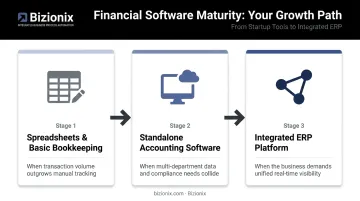
At step three, businesses need a solution that bridges the gap between simple accounting tools and expensive enterprise systems like SAP. Bizionix is built for this exact stage — an ERP platform centred on accounting and GST compliance, designed for Indian MSMEs without the cost or implementation overhead of large-scale enterprise software.
Regardless of where a business sits on that path, the core goal is the same: give finance teams a single, accurate, real-time view of the company's financial health.
Key Features of Accounting and Financial Management Software
General Ledger and Bookkeeping
The general ledger (GL) is the backbone of any accounting system. It records every financial transaction across the organisation and forms the basis for all financial reporting.
Modern software automates journal entries, maintains audit trails, and eliminates manual reconciliation. Multi-company configurations allow businesses to manage separate entities — each with independent books of accounts — from a single platform. Bizionix, for instance, supports multi-entity management where each company maintains its own GST compliance, ledgers, and financials with full isolation, while centralised dashboards provide group-level visibility.
Accounts Payable and Accounts Receivable (AP/AR)
AP/AR automation is where most businesses see immediate operational impact:
- Accounts Payable: Manages supplier invoices, approval workflows, and payment scheduling — reducing delays and late payment penalties
- Accounts Receivable: Tracks customer invoices, outstanding balances, and collections — shortening billing cycles and improving cash flow visibility
- Bank reconciliation: Matches transactions automatically rather than requiring manual line-by-line comparison
Budgeting, Forecasting, and Financial Planning
Strong financial management software moves finance teams from reactive bookkeeping to proactive planning. This includes:
- Setting annual and departmental budgets
- Comparing actuals versus forecasts in real time
- Running scenario analyses to model different business outcomes
- Generating financial projections to support investment decisions
That shift from recording history to shaping outcomes is where finance stops being a support function and starts driving decisions.
GST Compliance, Tax Automation, and E-Invoicing
For Indian businesses, this is the most critical feature category. GST regulations are updated frequently, and the consequences of non-compliance are real: central tax officers issued around 33,000 GST notices for return discrepancies in FY2017-18 and FY2018-19 alone.
GST-ready accounting software should handle:
- Automated tax calculations on every transaction
- GST-compliant invoice generation in approved formats
- GSTR-1 auto-population from sales data
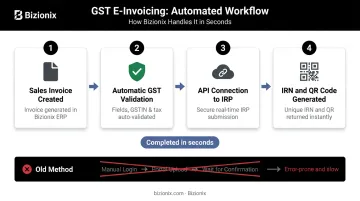
- Direct API integration with India's Invoice Registration Portal (IRP) for instant IRN and QR code generation
The e-invoicing threshold currently applies to businesses with aggregate annual turnover exceeding ₹5 crore, with the 2025 advisory adding a 30-day reporting limit for taxpayers with AATO of ₹10 crore and above.
Bizionix connects directly with the IRP via API, bypassing manual JSON uploads and third-party portals entirely. The workflow is fully automated: create a sales invoice, and IRN generation happens within seconds after automatic GST validation.
This eliminates manual portal submissions, prevents rejection from formatting errors, and keeps GSTR-1 aligned without any additional reconciliation step.
Financial Reporting and Analytics
Real-time reporting has replaced the monthly report cycle for businesses using modern platforms. Core reports include:
- Income statements (Profit & Loss)
- Balance sheets
- Cash flow statements
- Trial balances
Beyond standard statements, customisable dashboards allow decision-makers to track KPIs, identify financial leakage, and spot trends before they become problems. Bizionix provides real-time books where financial data updates continuously as transactions occur. The numbers you see at 10 AM on a Tuesday reflect what's actually happening in the business, not what happened last month.
Expense Management and Asset Tracking
Expense and asset tracking directly affect the accuracy of your balance sheet and P&L — yet most businesses underinvest in both:
- Expense management: Tracks employee and operational expenses with categorisation and approval controls, ensuring nothing slips through unrecorded
- Asset management: Records asset values, calculates depreciation, and monitors condition over time — supporting accurate balance sheets and compliance reporting
Core Benefits of Accounting and Financial Management Software
Improved Accuracy and Elimination of Manual Errors
Spreadsheet-based financial management creates a predictable set of problems:
- Duplicate entries that corrupt reconciliation
- Version conflicts when multiple people edit the same file
- Miscalculations that compound across months
- Missing audit trails that can't hold up under review
Automated validation checks and integrated workflows eliminate these failure points.
The result is cleaner financial records that hold up under scrutiny — whether that's an internal review, a CA audit, or a GST assessment.
Real-Time Visibility for Better Decisions
When financial data is always current, business leaders can make faster decisions about cash allocation, cost control, and growth investments. They're not waiting for month-end to find out whether the business is profitable or which product lines are draining margin.
This shift from historical reporting to live visibility changes how finance teams operate — and how seriously management takes financial data.
Reduced Operational Costs and Improved Efficiency
Automating invoice processing, reconciliation, and report generation frees finance staff from manual tasks. That time shifts toward analysis, forecasting, and decisions that need context — not just calculation.
Platforms like Bizionix are specifically designed to replace multiple disconnected tools — accounting software, GST filing utilities, spreadsheet trackers, separate payroll systems — with a single platform. For MSMEs paying for five or six separate subscriptions while still doing manual reconciliation between them, the cost and efficiency case is straightforward.
Stronger Compliance and Audit Readiness
Built-in compliance tools handle the moving parts of Indian tax regulation automatically. When GST rates change or new e-invoicing advisories are issued, a well-maintained platform updates accordingly — rather than requiring manual intervention across every invoice template and filing workflow.
Businesses that automate GST compliance maintain audit-ready records continuously, rather than scrambling before each filing deadline.
Scalability Without System Overhauls
As compliance obligations expand and transaction volumes grow, replacing your software shouldn't be the answer. The right platform scales alongside the business — handling new users, additional entities, and increased volume without disruption.
Bizionix handles this through its multi-entity architecture — businesses can manage subsidiaries, branches, franchise networks, and separate GST-registered entities from a single login, with independent books maintained for each while group-level dashboards provide consolidated visibility.
Who Benefits Most from This Software?
Three business profiles see the clearest return from accounting and financial management software:
- Growing MSMEs with multiple departments or locations that have outgrown spreadsheets — the tipping point is usually when finance staff spend more time reconciling data than analysing it.
- Manufacturing and distribution businesses that need to connect financial data directly to inventory, procurement, and supply chain operations.
- CA firms managing multi-company client portfolios, where a single login, instant cross-entity dashboards, and role-based access controls make all the difference. Bizionix is purpose-built for this use case.
Signals That It's Time to Upgrade
- Frequent data entry errors or version conflicts across financial files
- Difficulty producing timely financial reports for management or lenders
- GST filing requires significant manual reconciliation or external help
- No real-time view of cash position or receivables outstanding
- Finance team productivity is limited by manual processes rather than analysis
Cloud-Based vs. On-Premise: What's Right for Your Business?
The distinction is practical:
- On-premise software runs on local servers, requires internal IT management, and demands upfront hardware investment
- Cloud-based software is hosted by the vendor, accessible from any device with internet access, and maintained without internal IT overhead
For Indian MSMEs, cloud-based platforms offer a practical edge across three areas:
- Regulatory readiness: Automatic updates reflect changes — like revised GST thresholds or new e-invoicing advisories — without manual intervention
- Data protection: Built-in backups eliminate risk from local hardware failure
- Cost accessibility: Lower upfront investment makes enterprise-grade functionality available without enterprise-grade IT infrastructure
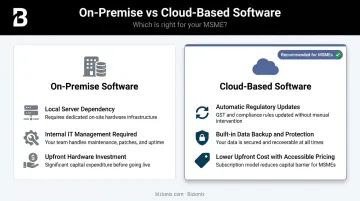
Bizionix is built as a 100% cloud-based platform — users access financial data 24/7 from any device, with real-time visibility across all entities.
Security is enforced through role-based access controls (view/edit/admin permissions at the entity level), end-to-end encryption, and complete activity logging. Every action is traceable, and accountability is built into the system by design.
How to Choose the Right Accounting and Financial Management Software
Define Requirements Before Evaluating Vendors
Map out your actual needs first:
- How many users will need access?
- Do you manage multiple entities or GST registrations?
- What's your approximate monthly transaction volume?
- Which compliance requirements apply (e-invoicing threshold, TDS, GST returns)?
- What existing tools need to integrate or be replaced?
The goal is to avoid two common mistakes: over-investing in features the business won't use for years, or under-investing in a tool it will outgrow within 18 months.
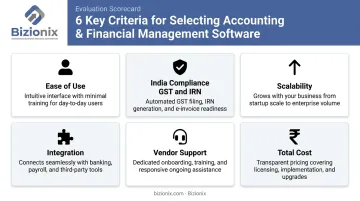
Key Selection Criteria
| Criterion | What to Look For |
|---|---|
| Ease of use | Can finance staff use it without extensive training? |
| India compliance | GST, e-invoicing (IRN generation), GSTR-1, TDS built in |
| Scalability | Can it handle more entities, users, and transactions? |
| Integration | Does it connect to inventory, payroll, CRM natively? |
| Vendor support | Implementation help, onboarding, and ongoing support quality |
| Total cost | Per-module pricing vs. all-in-one pricing across full lifecycle |
These criteria matter most when evaluating platforms against each other. For Indian MSMEs, the practical choice is usually a purpose-built solution like Bizionix that handles GST compliance, multi-entity management, and MSME workflows natively — rather than an enterprise platform like SAP that adds complexity and cost without addressing the specific needs of growing Indian businesses.
Recommended Evaluation Process
- Request product demos — see the actual workflows for GST compliance, invoicing, and reporting, not just feature lists
- Ask about data migration — how does the vendor support migrating historical data from existing systems or spreadsheets?
- Verify integration coverage — confirm that the platform connects with tools already in use (or replaces them natively)
- Check vendor track record — look for vendors with experience serving Indian MSMEs in your sector, particularly for India-specific compliance
Frequently Asked Questions
What is the difference between accounting software and financial management software?
Accounting software focuses on recording and managing financial transactions — bookkeeping, invoicing, and reconciliation. Financial management software is the broader category that includes strategic functions like budgeting, forecasting, and financial planning. Modern platforms typically combine both into a single integrated system.
Is FMS an ERP system?
Financial management software is not the same as an ERP, but it is often a core module within one. Standalone FMS solutions focus on financial operations, while ERP platforms integrate finance with other business functions like inventory, procurement, production, and HR.
Which software is used for financial accounting?
Options include cloud-based ERP platforms, dedicated accounting applications, and integrated business management solutions. For Indian MSMEs, built-in GST compliance and direct e-invoicing support are essential — many global tools lack India-specific regulatory coverage.
What are the top accounting and financial management software options?
Popular options include Oracle NetSuite, TallyPrime, Zoho Books, SAP Business One, and integrated MSME platforms like Bizionix. Note that QuickBooks exited the Indian market as of July 2023. The best choice depends on business size, industry, and compliance requirements — particularly GST obligations for Indian businesses.
How does accounting and financial management software help with GST compliance in India?
GST-ready software automates tax calculations, generates compliant invoices, and supports GSTR-1 auto-population — with direct IRP API integration for instant IRN generation. This reduces filing errors, compliance notices, and penalties, which matters given how often GST regulations and thresholds change.