Introduction
Growing businesses hit a familiar wall. Revenue is climbing, headcount is up, and new locations or product lines are being added — but the systems underneath are a patchwork of spreadsheets, disconnected tools, and missed follow-ups. Month-end reporting takes days. Billing errors slip through. Leadership is making decisions on last week's numbers.
Enterprise web applications are built to solve exactly this. The term gets attached to large corporations, but the real need sits with growing and mid-sized businesses trying to hold complex operations together without the systems to match.
This article explains what enterprise web applications are, what measurable advantages they deliver, and why they matter — with direct focus on Indian MSMEs moving beyond basic digital tools toward genuinely integrated operations.
Key Takeaways
- Enterprise web applications are browser-based software systems built to handle complex, multi-user business operations across departments and locations
- Unlike standalone tools, they are built for scalability, cross-system integration, and secure real-time data access
- Core advantages include eliminating manual inefficiency, centralizing decisions, and scaling without proportional cost increases
- Indian MSMEs are digitally active but operationally fragmented — only 12% use ERP software, despite 95% using at least one digital product
- Value compounds over time — provided adoption is consistent and tied to measurable business outcomes
What Is an Enterprise Web Application?
An enterprise web application is browser-accessible business software built to handle the complex, multi-user operational needs of a growing organization — covering finance, inventory, HR, compliance, and customer management within a single integrated platform.
Two definitions anchor this well. IBM describes enterprise applications as large-scale software solutions designed to streamline and automate organizational operations. TechTarget adds that web applications are stored on a remote server and delivered through a browser — meaning no local installation, no hardware dependency, and access from anywhere.
What Enterprise Web Applications Replace
In practice, these systems replace a combination of:
- Spreadsheets used for reporting, inventory, and payroll
- Disconnected standalone tools — accounting, inventory, billing, and HR running in separate silos
- Manual coordination through email, phone calls, and messaging apps
- Paper-based compliance processes for GST filing, e-invoicing, and audit trails
Common examples include ERP systems, CRM platforms, business intelligence dashboards, and compliance management tools. Bizionix, for example, consolidates accounting, inventory, billing, HRMS, and GST compliance into one unified system built specifically for Indian MSMEs.
What defines an enterprise web application is its intent: to give businesses control, clarity, and consistency across every function through one connected system.
Key Advantages of Enterprise Web Applications
For growing businesses, the case for enterprise web applications comes down to three outcomes that show up directly in the numbers: lower operating costs, faster decisions, and growth that doesn't require proportional overhead increases.
Advantage 1: Eliminating Operational Inefficiency Through Process Unification
Manual coordination is not just slow. It introduces compounding errors: a wrong figure entered in one system spreads across invoices, reports, and decisions before anyone catches it.
Enterprise web applications address this by replacing fragmented, manual processes with a single system where work flows automatically. Instead of emailing between departments, reconciling figures across spreadsheets, or chasing approvals manually, tasks trigger automatically based on defined workflows. Data updates in real time across all functions.
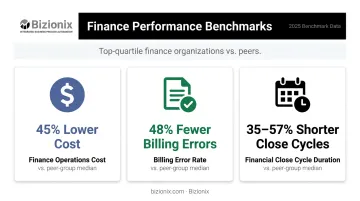
The financial impact of this shift is measurable. The Hackett Group's 2025 Digital World Class finance benchmark found that top-quartile finance organizations operate at 45% lower cost as a percentage of revenue, generate 48% fewer billing errors, and achieve 35–57% shorter close cycles than their peers.
What changes in practice:
- Sales orders update inventory automatically — no manual stock adjustment required
- Invoices are validated against GST rules before submission, catching errors before they become rejections
- Approvals follow defined digital workflows instead of WhatsApp messages and verbal sign-offs
- Financial reports pull from live data, not from manually consolidated spreadsheets
KPIs impacted: employee productivity (hours saved weekly), billing error rates, order and approval turnaround time, cost per transaction.
The impact is sharpest for businesses operating across multiple departments or locations where coordination still runs through calls, emails, or shared files — and where billing cycles and inventory updates remain manual.
Advantage 2: Centralized Data Access That Supports Faster, More Accurate Decisions
When different departments use different tools, decision-makers never see the full picture at the same time. Finance has one set of numbers. Sales has another. Inventory is tracked somewhere else entirely. By the time reports are consolidated, the data is already stale.
Enterprise web applications break this pattern. Because all functions — sales, inventory, finance, HR — feed into a single system, leadership can access live dashboards rather than waiting for department-level reports to be compiled and reconciled.
The cost of not having this is significant. Gartner's research on data quality estimates that poor data quality costs organizations at least USD 12.9 million per year on average — a global benchmark, but one that reflects a problem Indian MSMEs encounter at every scale.
Fragmented tools create exactly the conditions for data inconsistency: duplicate entries, version conflicts, and reconciliation gaps that surface as billing errors or compliance failures.
What centralized data enables:
- Leadership sees real-time P&L, cash position, and receivables without waiting for month-end
- Inventory positions are visible across locations without manual stock checks
- GST liability summaries are available on demand, not assembled the week before filing
- Decisions are made on current numbers, not last week's compiled report
KPIs impacted: report preparation time, decision cycle time, forecast accuracy, compliance error rate.
Rapid growth amplifies this problem. When a business is adding staff, locations, or product lines simultaneously, month-end reporting that takes days of manual consolidation becomes a recurring bottleneck — one that centralized data eliminates.
Advantage 3: Scalability Without Proportional Increases in Cost or Complexity
Traditional growth creates a predictable cost spiral: more locations mean more tools, more staff managing those tools, and more coordination overhead at every layer. Each new addition requires new software, new integrations, and new processes to hold it together.
Cloud-based enterprise web applications change this equation. Adding a new branch, a new user, or a new module does not require new hardware, new infrastructure, or a separate IT team. The system expands within the same platform.
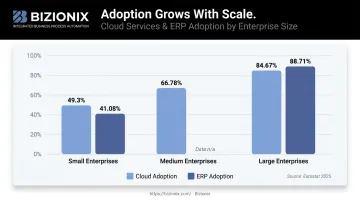
The adoption data reflects how growth-stage businesses eventually arrive at this need. Eurostat's 2025 data shows that 49.3% of EU small enterprises use paid cloud services, rising to 66.78% for medium enterprises and 84.67% for large enterprises. ERP adoption follows a similar pattern: 41.08% among EU small enterprises, climbing to 88.71% among large enterprises. These figures — drawn from EU markets but consistent with adoption patterns globally — confirm that integrated systems become near-universal at enterprise scale precisely because disconnected tools stop working at a certain growth threshold.
What scalability looks like in practice:
- A new branch is added through a single dashboard — no new hardware, no separate software license
- New users log in with defined role-based permissions from day one, without IT setup
- Multi-company management allows business groups to manage multiple GST-registered entities from one secure login
- Activity logs and audit trails maintain accountability as teams grow and delegation increases
KPIs impacted: cost per additional user or location, new staff onboarding time, number of tool subscriptions managed, audit trail completeness.
For businesses planning multi-location expansion, managing multiple GST-registered entities, or operating in regulated sectors like manufacturing or distribution, scalability stops being a feature and becomes a baseline requirement.
What Happens When Enterprise Web Applications Are Missing
The absence of integrated systems rarely shows up as a single obvious failure — it builds gradually, across teams and months, until the gaps become impossible to ignore.
Growing businesses that continue on disconnected tools and manual coordination typically experience:
- Departments work from different versions of data, creating report discrepancies that erode confidence in any single number
- Manual billing and compliance processes introduce mistakes that compound into financial leakage and regulatory risk over time
- Teams spend more time resolving coordination failures than doing productive work — problems surface after the fact rather than being caught early
- Duplicate data entry, reconciliation effort, missed payments, and subscription sprawl across multiple tools accumulate across a financial year
- As the business grows, manual workarounds become hard constraints; leadership becomes the single point of failure for decisions that should be delegated
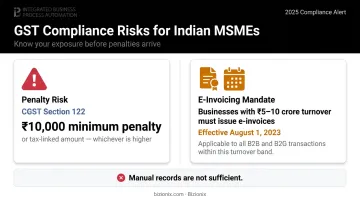
For Indian MSMEs specifically, GST compliance adds a concrete dimension to this risk. CBIC's CGST Section 122 ties GST offences to penalties of ₹10,000 or tax-linked amounts, whichever is higher. And since August 1, 2023, businesses with aggregate turnover between ₹5 crore and ₹10 crore are required to issue e-invoices — a mandate that requires accurate, system-generated invoice data, not manually assembled records.
How to Get the Most Value from Enterprise Web Applications
The businesses that extract the most value from enterprise web applications treat them as an ongoing operational discipline, not a one-time deployment.
The conditions that drive maximum value:
- The system is applied consistently across all relevant departments — not just adopted by one team while others continue on spreadsheets
- Outcomes are reviewed against baseline metrics at regular intervals (billing error rates, report preparation time, close cycle duration)
- The data generated is used actively to improve processes — not just stored
For Indian MSMEs, there's one additional condition that often determines whether the system delivers: local compliance needs to be built in, not bolted on. GST, e-invoicing, GSTR-1 auto-population, and multi-company management need to be part of the system from day one — not features to configure later.
Bizionix is built specifically for this context. The platform consolidates accounting, inventory, purchase management, HRMS, CRM, and GST compliance into a single system, with direct API integration to the IRP for instant IRN generation.
Setup requires only an API key and GST credentials, with no implementation complexity or the cost associated with large-scale ERP systems. For MSMEs that have outgrown their current tools but aren't ready for SAP-level investment, it closes that gap directly.
Conclusion
The long-term value of enterprise web applications isn't about any single feature. It's about what happens when operations, data, and workflows stop running in parallel silos and start reinforcing each other.
The return on these systems builds as they become embedded in how the business actually runs — not as a tool people log into occasionally, but as the operational backbone teams depend on daily.
For growing MSMEs dealing with fragmented systems and manual processes, an enterprise web application is not a luxury reserved for large enterprises. It's the foundation that makes structured, auditable, scalable growth achievable — without needing to rebuild from scratch every time the business expands.
Frequently Asked Questions
What are enterprise web applications?
Enterprise web applications are browser-based software systems built to handle complex, multi-user business operations across finance, inventory, HR, and compliance within a single integrated platform. They require no local installation, run on any device, and update in real time across all users.
What are examples of web-based enterprise applications?
Common examples include ERP systems, CRM platforms, business intelligence dashboards, HRMS tools, and compliance management systems. These range from broad operational platforms like Bizionix, which consolidates multiple functions, to industry-specific solutions for manufacturing, hospitality, or distribution.
How are enterprise web applications different from regular software?
Regular software handles a single function for a limited number of users. Enterprise web applications are built for multi-user, multi-department use, with scalability, cross-system integration, role-based access controls, and real-time data visibility built in from the ground up.
Are enterprise web applications only for large companies?
No. Modern cloud-based enterprise web applications are built to be accessible and affordable for growing and mid-sized businesses. For Indian MSMEs navigating GST compliance, multi-location growth, and manual coordination overhead, they are now a practical, cost-effective choice.
What makes an enterprise web application different from a website?
A website delivers information to visitors. An enterprise web application processes transactions, manages workflows, stores and analyses business data, and supports multiple users performing different functions simultaneously — all within a single, connected system.
How do I know if my business needs an enterprise web application?
If your business relies on spreadsheets for reporting, uses multiple disconnected tools, or struggles with manual follow-ups and approval chains, those are clear signals. Businesses crossing the ₹5 crore e-invoicing threshold also need a system that handles GST compliance automatically rather than through manual processes.