Introduction
Many small business owners discover their margins were far thinner than expected only after a job is complete — not because they didn't work hard enough, but because costs were never tracked against the specific job in real time. In manufacturing, construction, and professional services, this gap between actual and estimated costs erodes profitability across every job.
Job costing software solves this: it assigns every rupee of labor, materials, and overhead to individual jobs, so you know whether each project made or lost money — while there's still time to act.
Yet most Indian small businesses haven't made the switch. According to the Ministry of MSME Annual Report 2024-25, over 5.77 crore MSMEs are registered in India, contributing approximately 30% of GDP.
A FICCI survey of 600+ manufacturing SMEs found only 48% use digital tools for finance — meaning more than half are still making critical cost decisions on instinct or spreadsheets.
This guide covers the best job costing software options for Indian small businesses, what features to prioritise, and how to choose the right fit for your industry and team size.
Key Takeaways
- Job costing software tracks labor, materials, and overhead per job — so you know exactly which projects are profitable
- Indian MSMEs need tools that are affordable, cloud-based, and GST-compliant
- Top tools covered: Bizionix, Zoho Books + Projects, TallyPrime, and Procore — QuickBooks Online exited India in 2023
- Must-have features: real-time cost tracking, labor and material allocation, invoicing, and budget-vs-actual reporting — all in one place
- GST readiness and e-invoicing (including IRN generation) are mandatory for businesses crossing the e-invoice threshold
What Is Job Costing and Why Small Businesses Need It
Job costing tracks all costs — direct labor, raw materials, equipment, and overhead — against a specific job or project, separately from every other job. As defined by the ICAI, it is a form of specific order costing where cost is determined individually per job rather than accumulated across a production process.
A repair workshop tracking parts and technician hours per service order, or a consulting firm billing by client project, are both using job costing logic.
This is fundamentally different from tracking total business expenses. Knowing your monthly material spend is useful; knowing that Job A consumed ₹80,000 in materials against a ₹65,000 budget — while Job B came in under — is actionable.
Why Small Businesses Lose Money Without It
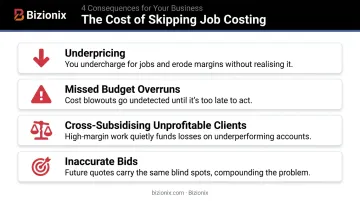
Without job costing, small businesses routinely:
- Underprice repeat work with no reliable cost baseline from past jobs
- Miss budget overruns until the invoice is already raised and the damage is done
- Cross-subsidise unprofitable clients without realising it — high-volume customers that look valuable can quietly erode margins
- Submit inaccurate bids on new projects, winning work they'd be better off declining
For Indian MSMEs in manufacturing, construction, and professional services, the problem runs deeper. GST compliance requirements, multi-site operations, and varied client billing cycles all add layers of complexity that manual tracking simply cannot handle at scale. Job costing software ties these threads together — giving you cost visibility per job alongside the compliance and reporting structure your business already needs.
Best Job Costing Software for Small Businesses
These tools were selected based on ease of use for small teams, real-time cost visibility, affordability, and direct relevance to the Indian MSME context.
Bizionix
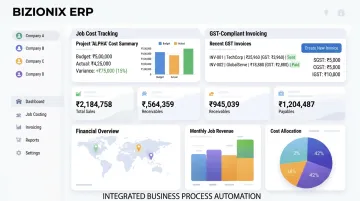
Bizionix is an all-in-one cloud ERP built specifically for Indian MSMEs by IIS-LLP, a Hyderabad-based technology firm backed by over two decades of industry experience. Rather than bolting a job costing module onto a basic accounting tool, Bizionix integrates project cost tracking, inventory, billing, HRMS, and GST-compliant accounting into a single unified platform, eliminating the fragmented systems — multiple spreadsheets, disconnected tools, separate GST software — that most MSMEs currently rely on.
Its GST compliance capabilities are particularly strong. Bizionix connects directly to the Invoice Registration Portal via API for instant IRN generation, automatic QR code creation, GSTR-1 auto-population, and pre-validated invoice formats in both PDF and JSON.
For businesses above the ₹5 crore turnover threshold where e-invoicing is mandatory under Notification No. 10/2023, this built-in compliance removes a significant operational burden.
The platform also supports multi-company management from a single secure login, which is particularly useful for business groups, franchise networks, or businesses managing multiple GST entities. Each entity maintains independent books, while group-level dashboards provide consolidated visibility.
| Feature | Detail |
|---|---|
| Key Features | Real-time visibility, GST-compliant invoicing, direct IRP API for IRN generation, multi-entity management, HRMS & payroll, inventory control, production planning |
| Best For | Indian MSMEs in manufacturing, distribution, and services needing end-to-end business management with embedded GST compliance |
| Pricing | NEO (Basic) plan at ₹999/year (₹2,999 standard); Enterprise plan on contact-for-quote basis |
| Free Trial | 14-day free trial available |
Zoho Books + Zoho Projects
For Indian small businesses already operating in the cloud, Zoho Books combined with Zoho Projects covers the full project-to-invoice cycle within a suite many Indian firms already use. It works particularly well for IT services, consulting, and professional services firms. Zoho Books includes GST-compliant invoicing, GSTR filing support, and e-invoice management. Zoho Projects adds project-level budgeting, time tracking, expense assignment, and earned value management from the Premium plan upward.
The combination gives businesses project profitability monitoring and client billing within an integrated suite many Indian firms are already using. The price point is notably more accessible than Western alternatives.
| Feature | Detail |
|---|---|
| Key Features | GST-compliant invoicing, project budgeting, time and expense tracking, client billing, Zoho ecosystem integrations |
| Best For | Small Indian businesses in consulting, IT services, or professional services wanting cloud-based project tracking with GST readiness |
| Zoho Books Pricing | Free plan (under ₹25L revenue); Standard from ₹749/month (annual); Professional from ₹1,499/month; Premium from ₹2,999/month |
| Zoho Projects | Free up to 5 users and 3 projects; paid plans with 15%+ savings on annual billing — verify current INR pricing here |
Note: Pricing changes frequently — confirm current plans directly on the Zoho website before purchasing.
TallyPrime
TallyPrime is the most deeply embedded accounting and ERP solution in the Indian SME market, used by over 2.5 million businesses globally. Its job costing module allows cost allocation per job through cost centres, tracks project expenses and revenues, monitors raw material movement across godowns and sites, and generates Job Work Analysis reports showing net profit or loss by project.
For manufacturers, traders, and job shops where the accountant already knows Tally, adoption is fast and the compliance depth is hard to match. The interface is more traditional than modern SaaS tools, and cloud access is more limited, but for businesses with desktop-first workflows, that may not be a drawback.
| Feature | Detail |
|---|---|
| Key Features | Job costing via cost centres, project expense and revenue allocation, stock consumption tracking, material movement, GST compliance, payroll |
| Best For | Indian manufacturers, traders, and job shops needing robust compliance and job-level costing with accountant-familiar interfaces |
| Pricing | Silver (single-user): ₹8,100/year or ₹22,500 lifetime + 18% GST; Gold (multi-user): ₹24,300/year or ₹67,500 lifetime + 18% GST |
Verify current pricing at tallysolutions.com/buy-tally.
Procore
Procore is a construction-specific cloud platform built for contractors who manage multiple concurrent projects with complex financial workflows: budget vs. actual tracking, change order management, subcontractor billing, and document control across project teams. According to Procore's own data, 80% of expert-level users report reduced unforeseen project costs after adoption.
That depth comes with trade-offs. Procore is priced on a custom annual basis by construction volume, with no official INR pricing available. It targets growing construction businesses with larger teams, not very small contractors just starting to formalise cost tracking.
| Feature | Detail |
|---|---|
| Key Features | Real-time budget tracking, change order management, subcontractor billing, document control, accounting integrations |
| Best For | Construction-focused SMBs managing multiple projects needing construction-specific financial reporting and compliance |
| Pricing | Custom annual quote based on Annual Construction Volume; contact Procore directly |
Note: No INR pricing or India-specific pricing page was verified. Confirm India availability and pricing directly with Procore.
A Note on QuickBooks Online
QuickBooks Online is not recommended for Indian MSMEs at this time. Intuit officially discontinued QuickBooks products and services in India from January 31, 2023, and no current India pricing page or local availability has been re-established.
Key Features to Look for in Small Business Job Costing Software
Real-Time Cost Tracking
Real-time cost tracking is the feature most often missing in basic accounting tools. You need to see labor, material, and overhead costs assigned to each job as they are incurred — not consolidated after project close. By the time a post-mortem report surfaces a ₹40,000 overrun, the job is already invoiced and the margin is already lost.
GST Compliance and E-Invoicing
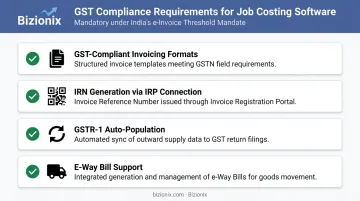
Under Notification No. 10/2023, businesses with aggregate turnover between ₹5 crore and ₹10 crore must generate e-invoices from August 1, 2023. Higher turnover bands have been covered since earlier phases. Your job costing software must support:
- GST-compliant invoicing formats
- IRN generation via IRP connection
- GSTR-1 auto-population
- E-way bill support where applicable
Software that doesn't handle this forces parallel compliance workflows, which doubles your admin burden and increases the risk of filing errors.
Ease of Use Across Non-Finance Teams
Small business owners and site supervisors should be able to log costs and review job status without requiring finance training. If your team needs a consultant to run basic reports, the software is creating friction, not solving it — look for role-based dashboards and guided cost-entry screens as indicators of practical usability.
Integration with Accounting and Payroll
Job costing data must flow into your accounting system without manual re-entry. Whether through native integration or API connections, cost data should automatically update your books, P&L, and GST filings — eliminating the double-entry errors that erode trust in your numbers.
Profitability Reporting
Profitability reporting is where job costing data converts into better decisions. Prioritize software that provides:
- Job-level profit and loss views
- Budget vs. actual comparisons
- Cost-to-completion forecasts
- Filterable dashboards by job type, client, or time period
Without these views, you're tracking costs without learning from them — which means your pricing on the next job will carry the same blind spots as the last.
How to Choose the Right Tool
Each tool below was evaluated on four criteria relevant to Indian MSMEs: real-time cost visibility, ease of use for non-finance teams, pricing transparency, and GST compliance. Use that lens when comparing your options.
The most common selection mistakes:
- Choosing a tool sized for large enterprises — you'll pay for features you'll never use and spend months on implementation
- Expecting a general accounting tool to perform deep job costing — basic invoicing platforms track totals, not per-job profitability
- Adopting a global platform without verifying GST compliance — this creates parallel manual work that erodes the efficiency gain
A practical framework for selection:
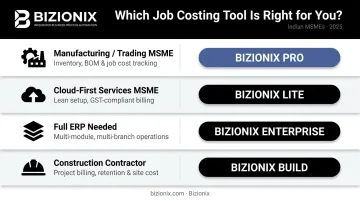
| Your Situation | Recommended Starting Point |
|---|---|
| Manufacturing or trading MSME, accountant already uses Tally | TallyPrime with job costing module |
| Cloud-first, service or consulting business | Zoho Books + Zoho Projects |
| Need full ERP with GST, inventory, and HRMS in one | Bizionix |
| Construction contractor with complex multi-project workflows | Procore — confirm India availability before committing |
Pick the tool your team will open every day — one that matches where your business is now and won't need replacing the moment you add ten more clients or a second location.
Conclusion
For Indian MSMEs — whether in manufacturing, construction, or services — job costing isn't a nice-to-have capability. It's the difference between pricing confidently and guessing, between catching overruns early and absorbing them silently.
Choose based on real-world fit: ease of adoption for your team, quality of vendor support, how well the tool integrates with your existing workflows, and whether it handles Indian compliance without additional workarounds.
If those criteria matter to you, Bizionix is built to meet them. It's a GST-compliant ERP platform designed specifically for Indian MSMEs, combining:
- Job cost tracking with invoicing and financial management
- Inventory, HRMS, and payroll in a single system
- Direct GST e-invoicing with automated IRN generation
Priced well below enterprise ERP alternatives, Bizionix includes a 14-day free trial on the NEO plan.
Request a demo or contact the team: info@bizionix.com | +91 91779 99277 | Start your free trial
Frequently Asked Questions
What is job costing for small business?
Job costing is a method where a small business tracks all costs — labor, materials, and overhead — separately for each job or project. This lets you determine the actual profitability of each engagement and use that data to price future work more accurately.
What is the difference between job costing and process costing?
Job costing tracks costs per individual job or project — used in construction, custom manufacturing, and consulting. Process costing tracks costs across a continuous production process, used in mass manufacturing like chemicals or food production where output is homogeneous.
Can I use Excel or basic accounting software for job costing?
Excel and basic accounting tools can handle simple tracking but lack real-time cost updates, automated allocation, and job-level reporting. As project volume grows, these gaps lead to errors and missed cost variances that hurt margins.
What features should I look for in job costing software for a small business?
Prioritise real-time cost tracking per job, labor and material cost allocation, budget vs. actual reporting, invoicing integration, and — for Indian businesses — GST compliance with e-invoicing and IRN generation support.
Is job costing software only for construction businesses?
No. Job costing applies equally to manufacturing, IT services, professional services, consulting, and any business taking on discrete projects or custom orders. Construction gets the most attention, but project-based service firms and custom manufacturers rely on it just as heavily.
How does GST compliance affect job costing software selection for Indian MSMEs?
Indian businesses must ensure their software supports GST-compliant invoicing, e-invoice generation with IRN, and GSTR-1 reconciliation. Without this, billing and tax filing require separate manual processes — adding operational risk and undermining the value of going digital.