Unlike a retail business that needs one GSTIN managed cleanly, CA firms need software built for professional complexity: multi-client management, direct IRP API integration, reconciliation tools, and audit-ready documentation — all in one place.
This guide evaluates the best GST invoice software options specifically for CA business workflows, with feature breakdowns, verified pricing, and clear use-case guidance for 2025.
Key Takeaways
- CA-grade GST software must handle multi-GSTIN management, IRN generation, and GSTR reconciliation — billing is just the starting point
- Compliance deadlines are live: the ₹5 crore e-invoicing threshold applies now; the 30-day IRP upload rule kicks in for ₹10 crore+ AATO businesses from April 2025
- Top options: Bizionix, ClearTax, Tally Prime, Zoho Books, and Refrens — each suited to different practice sizes
- Evaluate on: multi-client management, IRP API integration, reconciliation accuracy, pricing transparency, and support responsiveness
- Free tiers: available across most tools, but none cover the professional-grade features CA firms actually require
What Makes GST Invoice Software Different for CA Firms
A CA firm manages dozens of client entities simultaneously, each with its own GSTIN, return schedule, and potentially its own e-invoicing obligation.
Generic billing software is built for a single business owner: one GSTIN, one set of books, one return cycle. That works for a kirana store. For a CA managing 30+ clients, it creates compounding inefficiencies at every step of the workflow.
The Pain Points Generic Tools Can't Solve
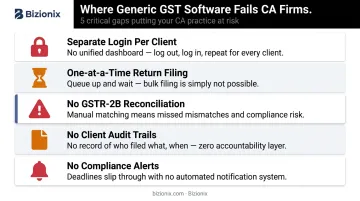
- Requires a separate login per client, turning every client interaction into a logout-login cycle
- Forces return filing one client at a time with no bulk processing
- Skips automated GSTR-2B vs. purchase data comparison, leaving ITC mismatches undetected until they become penalties
- Provides no client-wise audit trails to fall back on when a scrutiny notice arrives
- Misses upcoming deadlines and regulatory changes with no built-in compliance alerts
The 2025 Compliance Context
Each of those gaps becomes harder to manage under two regulatory changes that took effect in 2025:
E-invoicing is mandatory for businesses above ₹5 crore AATO (per GST Council Notification No. 10/2023, effective August 2023 and continuing in 2025). CA firms managing such clients need software with direct IRP API integration — not manual JSON uploads.
The 30-day IRP upload rule took effect on 1 April 2025 for businesses with ₹10 crore+ AATO. Per the IRP advisory dated 27 March 2025, e-invoices older than 30 days cannot be reported on IRP portals. Manual workflows simply can't keep pace with this requirement.
Best GST Invoice Software for CA Businesses
These five platforms were evaluated on: multi-GSTIN support, e-invoicing with IRN generation, GSTR filing accuracy, client management ease, and pricing structure.
Bizionix
Bizionix is a cloud ERP built by IIS-LLP (a subsidiary of Protocol India Private Limited), with over two decades of industry experience behind it. It's designed specifically for Indian MSMEs and CA firms managing multiple client entities — and the multi-company architecture reflects that focus.
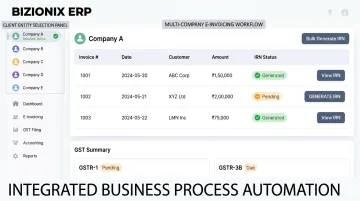
A CA firm gets a single secure login that covers the entire client portfolio. Switching between client entities requires no logout — the company selection dashboard shows all entities at a glance, and switching is instant.
Each entity maintains fully independent books, separate GST data, and isolated ledgers. Entity-level permissions and role-based access controls mean staff only see what they're authorised to see, with full activity logs per company.
On e-invoicing: Bizionix connects directly to the GST e-Invoice system via API. When a sales invoice is created in the ERP, data is automatically validated against GST rules, and the IRN and QR code are generated instantly — no manual JSON uploads, no third-party tools, no portal logins. The final invoice is ready to share with the QR code already embedded.
| Feature | Detail |
|---|---|
| Multi-company management | Single login, instant entity switching, independent books per GSTIN |
| E-invoicing | Direct IRP API integration, instant IRN and QR code generation |
| GST accounting | GSTR-1 auto-population, real-time financial reporting |
| Audit trail | Entity-level activity logs, role-based access controls |
| Architecture | 100% cloud-based, real-time visibility across all client accounts |
Pricing: Bizionix NEO at ₹999/year (includes a 14-day free trial); Enterprise plan on request. Verify current pricing at bizionix.com.
Best for: CA firms managing multiple client entities requiring unified GST compliance, automated e-invoicing, and accounting under one platform — especially practices looking to move away from fragmented, multi-login workflows.
ClearTax
ClearTax focuses on high-volume GST compliance for CA practices across India. The core use case: processing dozens of client returns simultaneously from a single interface, without switching accounts or juggling portals.
The platform handles GSTR-1 through GSTR-9C workflows, NIL filing, and auto-filing of GSTR-3B and GSTR-9. Its e-invoicing API supports IRN generation, cancellation, and retrieval. Error detection before filing reduces rejection rates, and bulk processing makes it practical for large portfolios.
| Feature | Detail |
|---|---|
| Multi-GSTIN management | Bulk GSTR filing across multiple client GSTINs |
| E-invoicing | API-based IRN generation and cancellation |
| Reconciliation | Automated reconciliation, error detection before filing |
| Audit trail | Comprehensive filing history and documentation |
| Filing support | GSTR-1, 3B, 9, 9C; NIL filing; GSTIN history pull |
Pricing: Expert Pack at approximately ₹40,000/year (up to 300 GSTINs, 3,000 invoices/year/GSTIN, 5 users) — confirm current pricing directly with ClearTax before purchase. Enterprise pricing available on request.
Best for: Large CA firms handling high-volume, multi-client GST compliance portfolios where bulk filing and reconciliation at scale are the primary requirements.
Tally Prime
Tally Prime has been part of Indian CA workflows long enough that most practitioners have used it at some point. Its GST feature set is mature — multi-GSTIN management, ITC utilisation tracking, detailed ledger reporting, and a broad ecosystem of third-party add-ons built over decades.
The trade-off is its desktop-first design. TallyPrime Cloud Access exists (starting at ₹600/user/month, separate from the license cost), but it's not a native cloud experience. The learning curve is steeper than modern alternatives, and mobile access is limited.
| Feature | Detail |
|---|---|
| Multi-GSTIN management | GST return preparation, ITC tracking |
| E-invoicing | Supported with GST compliance |
| Reporting | In-depth GST liability and ledger reports |
| Customisation | Extensive, with third-party add-on ecosystem |
| Architecture | Desktop-first; Cloud Access available separately |
Pricing: Silver Rental at ₹750 + 18% GST/month (single user); Gold Rental at ₹2,250 + 18% GST/month (multi-user). Perpetual license options also available.
Best for: Established CA firms with dedicated accounting staff who prefer deep feature depth and are comfortable with a traditional desktop-centric workflow.
Zoho Books
Zoho Books is a cloud-native accounting platform built for CA firms managing growing MSME clients. GST compliance features cover return filing, e-invoicing via its registered GST Suvidha Provider status, automated bank reconciliation, and workflow automation rules.
The Zoho ecosystem integration pays off if clients already use Zoho CRM, Inventory, or Projects. Multi-currency support and project billing add utility for service-based clients. One caveat: pricing scales with users, so larger teams will see costs rise quickly.
| Feature | Detail |
|---|---|
| GST compliance | Return filing, e-invoicing via GST Suvidha Provider status |
| Automation | Bank reconciliation, workflow rules |
| Multi-currency | Supported |
| Ecosystem | Integrates with Zoho CRM, Inventory, Projects |
| Architecture | Cloud-based, strong mobile app |
Pricing: Standard at ₹749/month (3 users, 5,000 invoices/year); Professional at ₹1,499/month (5 users, 10,000 invoices/year); Premium at ₹2,999/month (10 users, 25,000 invoices/year) — all billed annually.
Best for: CA firms managing growing MSME clients that need cloud accounting with strong automation and Zoho ecosystem integration.
Refrens
For smaller practices managing multiple client businesses, Refrens offers a practical entry point. The platform handles e-invoicing, e-way bill generation, GSTR-2B reconciliation, and automated journal entries — all from a single account — at a price point that larger platforms rarely match.
The platform generates balance sheets and P&L statements automatically, maintains a transparent audit trail, and provides instant access to financial reports across all managed entities.
| Feature | Detail |
|---|---|
| Multi-business management | Single account, multiple entities |
| E-invoicing and e-way bills | Integrated within billing workflow |
| GSTR-2B reconciliation | Automated reconciliation supported |
| Financial reporting | Balance sheet, P&L, automated journal entries |
| Audit trail | Transparent transaction history |
Pricing: Accounts GST plan at approximately ₹12,000/year; Accounts plan at approximately ₹14,000/year (includes full accounting suite, 5 team members). A free/basic plan is also available for basic invoicing. Verify current pricing on Refrens.com before purchase.
Best for: Small-to-mid-sized CA practices managing multiple client businesses that need full accounting and compliance features at a cost-effective price.
Key Features to Look for in GST Invoice Software for CA Businesses
Multi-GSTIN and Multi-Client Management
This is the foundational requirement for any CA practice. The software must allow switching between client GSTINs within a single session — no repeated logins, no separate accounts per client. Each entity should maintain fully separate books, ledgers, and compliance records, while a consolidated view remains accessible for oversight.
Software that forces separate logins per client doesn't scale — it creates friction on every interaction and raises the risk of filing mistakes when working across multiple sessions at once.
Automated E-Invoicing with IRN Generation
For CA clients with AATO above ₹5 crore, e-invoicing isn't optional. The software must connect directly to the Invoice Registration Portal (IRP) via API. Per GSTN's e-invoicing process, the IRP returns a digitally signed e-invoice with a unique IRN and QR code upon submission.
For clients with AATO above ₹10 crore, the 30-day upload rule adds urgency — invoices older than 30 days cannot be reported on the IRP from April 2025. Manual workflows create unacceptable compliance risk at this scale.
GSTR Filing and Reconciliation Accuracy
Automated GSTR-1, GSTR-3B, and GSTR-2B reconciliation is essential. The software should flag mismatches between purchase data and GSTR-2A/2B before filing — because under Section 16 of the CGST Act, ITC eligibility requires supplier-furnished details to be communicated to the recipient. Unreconciled mismatches create ITC disallowance risk.
From July 2025, auto-populated GSTR-3B liability becomes non-editable (changes must go through GSTR-1A before filing). Software that auto-populates accurately from invoice data reduces manual correction work.
Audit Trail and Documentation
CA firms need timestamped records of every transaction and filing action — accessible per client entity, without ambiguity. When a GST scrutiny notice arrives, the quality of documentation determines how quickly it can be resolved. Cloud-based platforms with entity-level activity logs provide stronger, more accessible audit trails than desktop-based tools with local storage.
Pricing Transparency and Scalability
Pricing structures vary across platforms. Before committing, map each model against your current client base and projected growth:
- Per-GSTIN (e.g., ClearTax) — costs compound quickly; affordable at 20 clients, expensive at 100
- Per-user (e.g., Zoho Books, Tally Prime) — predictable for small teams, less so as headcount grows
- Per-plan (e.g., Bizionix, Refrens) — flat-rate access works well for practices managing diverse client volumes
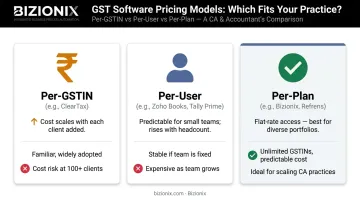
Per-GSTIN pricing in particular can erode margins fast. Run the numbers across realistic growth scenarios before locking into a platform.
How to Choose the Right GST Invoice Software for Your CA Practice
Common Selection Mistakes
- Defaulting to brand recognition — choosing Tally because it's familiar, without evaluating whether cloud-native alternatives better fit a growing, distributed practice
- Ignoring per-GSTIN cost escalation, which compounds quickly as your client base grows
- Selecting consumer-grade software — platforms without bulk filing, GSTR-2B reconciliation, or multi-GSTIN management create more work, not less
The Right Evaluation Framework
- Count your managed GSTINs, monthly invoice volumes, and the number of clients above the ₹5 crore AATO threshold who require e-invoicing
- Calculate total annual cost per platform at your current portfolio size — then project it two years out to catch per-GSTIN pricing traps
- Request a free trial and test actual workflows: client-switching, e-invoice generation, and GSTR-2B reconciliation with real data — not just a feature checklist
- Check vendor update frequency; confirm the platform incorporated the 2025 e-invoicing and GSTR-3B changes on time, since delayed updates expose your firm to compliance risk
One final check: support responsiveness during filing season. A platform that goes dark during GSTR-3B week is a liability, regardless of how strong its feature list looks during the demo.
Conclusion
Choosing GST invoice software for a CA practice comes down to one practical test: does it handle multi-client compliance, e-invoicing, and reconciliation without adding more complexity to an already demanding workflow?
With 2025 compliance requirements tightening — e-invoicing mandatory at ₹5 crore, the 30-day IRP upload rule in force, and auto-populated GSTR-3B liability becoming non-editable — CA firms still relying on manual processes or inadequate software are accumulating risk for themselves and their clients.
That's where Bizionix stands out for CA firms specifically. Multi-company management lets you switch between client entities from a single login, direct IRP API integration handles IRN generation instantly, and real-time visibility across the entire client portfolio is built into the platform by default. A 14-day free trial is available on the NEO plan, and the team can walk you through a demo tailored to your practice setup.
Contact Bizionix at info@bizionix.com, call +91 91779 99277, or visit bizionix.com to explore whether it fits your CA practice.
Frequently Asked Questions
What is the cost of GST invoice software?
Pricing ranges from free basic plans up to ₹40,000/year for professional-grade platforms like ClearTax. Mid-range cloud tools like Zoho Books run ₹749–₹2,999/month, while Bizionix NEO starts at ₹999/year. CA firms should factor in per-GSTIN or per-client costs when comparing options — what's affordable at 20 clients can become expensive at 80.
Are there free GST invoice software options?
Free plans exist — Refrens offers unlimited invoices on its basic tier, and ProfitBooks has a Startup plan (1 user, 10 invoices/month). However, free tiers consistently lack the features CA practices depend on — e-invoicing with IRN generation, GSTR-2B reconciliation, and multi-GSTIN management — making paid plans necessary for professional use.
What features should a CA firm prioritise in GST invoice software?
The core requirements for CA firms are:
- Multi-GSTIN client management from a single login
- Automated e-invoicing with direct IRP API integration
- GSTR-1/3B/2B filing and reconciliation
- Entity-level audit trails and predictable per-client pricing
Can GST invoice software manage multiple client GSTINs from one account?
Not all software supports this natively. Platforms like Bizionix, ClearTax, Refrens, and Tally Prime offer multi-GSTIN or multi-entity management. Basic billing tools typically require separate logins per client — a workable approach for one or two clients, impractical for a CA practice with dozens.
Is cloud-based GST invoice software reliable for CA firm use?
Cloud platforms are reliable for CA practices: they offer real-time access from any device, automatic compliance updates, and strong data backup. Reputable vendors maintain enterprise-grade security appropriate for handling sensitive client financial data. The key is selecting a vendor with a track record of timely regulatory updates.
How does e-invoicing work within GST invoice software?
Compliant software integrates directly with the Invoice Registration Portal (IRP) via API, submitting invoice data and receiving back a unique IRN with a digitally signed QR code. For businesses above ₹10 crore AATO, this must occur within 30 days of the invoice date under current 2025 rules.