Introduction
As Indian businesses grow beyond their founding chaos — multiple locations, expanding teams, GST obligations — the pressure to implement an ERP system becomes unavoidable. But the first major decision isn't which ERP to pick. It's what kind to get: custom-built from scratch, or an off-the-shelf platform ready to deploy?
This choice carries real weight. It affects your upfront investment, how quickly you go live, your long-term maintenance burden, and whether the system stays aligned with GST compliance requirements.
Only 12% of surveyed Indian MSMEs currently use ERP software, according to an RIS survey of 2,882 MSMEs. That means most businesses are making this decision for the first time, without a roadmap.
Get it wrong and you're looking at years of workarounds, runaway costs, or a system that nobody actually uses.
Key Takeaways
- Custom ERP is built from scratch for your exact workflows: maximum control, but with high upfront costs, long build timelines, and full maintenance on your team
- Off-the-shelf ERP is pre-built and ready to deploy — faster, more affordable, and backed by vendor support and compliance updates
- The real decision hinges on how unique your workflows are versus how quickly you need results
- For most Indian MSMEs, a configurable off-the-shelf ERP covering GST, billing, and inventory is the faster, more cost-effective choice
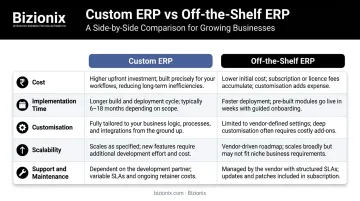
Custom ERP vs. Off-the-Shelf ERP: Quick Comparison
| Factor | Custom ERP | Off-the-Shelf ERP |
|---|---|---|
| Cost | High upfront development cost; full maintenance borne by the business | Lower entry cost; subscription or one-time licensing with predictable fees |
| Implementation Time | Months to years depending on scope | Weeks to a few months, including data migration and training |
| Customisation | Fully tailored; no feature compromises | Pre-defined features, but extensive configuration without code changes |
| Scalability | Scalable by design, but upgrades need fresh development | Scales via vendor updates and module additions |
| Support & Maintenance | Entirely self-managed; requires retained development capacity | Vendor handles updates, patches, compliance changes, and first-line support |
What is Custom ERP Development?
Custom ERP is software built from the ground up for a single company's specific processes, workflows, and industry requirements — no standardized module constraints, no licensing dependency on a third-party vendor.
To be clear: custom ERP is not the same as configuring or customizing an existing platform. It means commissioning original software development, typically over many months or years.
Core Advantages
- Complete feature control — you include exactly what you need, nothing else
- Deeper integration with legacy systems and niche tools that standard APIs don't support
- No vendor dependency — your roadmap isn't held hostage to another company's product decisions
- Data sovereignty — sensitive financials, inventory records, and customer data stay in your own controlled environment, not on a third-party vendor's servers
For businesses in regulated sectors, that last point is often the deciding factor.
Core Limitations
The risks, though, are substantial. Panorama Consulting's 2015 ERP Report found that 55% of ERP projects experienced budget overruns and 75% ran over timeline — and those figures covered packaged ERP implementations, not fully custom builds where risk is amplified further.
Other limitations:
- Long time-to-value; the business runs on old systems while development continues
- Finding and retaining skilled developers is an ongoing risk
- Every process change or business evolution requires fresh development effort
- Annual support and maintenance fees hover around 18–25% of original licensing cost — and custom code makes that burden heavier, not lighter
Where Custom ERP Makes Sense
Custom development is genuinely justified in specific situations:
- Businesses in niche or heavily regulated industries — defence, specialised pharma, proprietary financial compliance workflows — where no standard platform comes close
- Large enterprises with multi-year development budgets and in-house technical teams
- Companies where data sovereignty is a non-negotiable regulatory requirement
- Healthcare organisations requiring deeply integrated EHR-ERP systems with proprietary clinical workflows
For these use cases, the cost and complexity are justified. For most MSMEs, they aren't.
What is an Off-the-Shelf ERP System?
Off-the-shelf ERP is pre-built enterprise software developed for a broad range of businesses in a given category — wholesale distribution, manufacturing, services, hospitality. It ships with standardised modules covering finance, HR, inventory, compliance, and more, ready to deploy without custom development.
One distinction matters here: configuration is not the same as customisation. Configuration means adjusting settings, workflows, and parameters within the existing system — no code changes required. Customisation means modifying the underlying source code. Modern off-the-shelf ERPs handle the vast majority of business needs through configuration alone.
Core Advantages
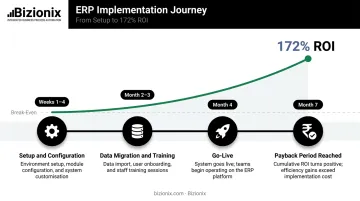
- Faster go-live — a Forrester TEI study of Microsoft Dynamics 365 Business Central found a composite SMB with 150 employees implemented in an average of 4 months, with 172% ROI and a 7-month payback period
- Predictable subscription pricing with lower upfront cost than custom builds
- GST rule changes, e-invoicing updates, and bug fixes handled automatically by the vendor
- Built-in Indian compliance features for platforms designed for the local market — GST accounting, IRN generation, e-Way Bill, GSTR filings
Core Limitations
- May not accommodate highly non-standard processes out of the box
- Businesses become dependent on the vendor's product roadmap for new features
- Per-user subscription costs can compound significantly as teams grow — Forrester's model applies a 15% upward risk adjustment to subscription fees to account for this scaling effect
- Some platforms resist deep configuration, creating gaps for edge-case workflows
The Configurability Advantage
Today's cloud-based off-the-shelf ERPs are far more adaptable than legacy packaged software. Module-level selection, role-based permissions, workflow flags, and user-defined templates allow businesses to shape the system to their processes — without writing a single line of new code.
Bizionix uses role-based access control with entity-level permissions, department or branch restrictions, and full activity logs — letting each organisation define exactly who sees what. The Enterprise plan includes custom workflow configurations matched to organisational SOPs, all within the existing unified architecture.
Where Off-the-Shelf ERP Thrives
That configurability translates directly into real-world fit for a wide range of businesses:
- Growing MSMEs digitising core operations quickly
- Multi-location businesses needing unified visibility across branches and warehouses
- Companies managing GST compliance, billing, and inventory across departments
- Businesses scaling from manual or fragmented systems to a single platform
For Indian MSMEs specifically, Bizionix covers GST compliance, direct IRP API integration for instant IRN generation, multi-company management, and real-time visibility — without SAP-level complexity or cost. The NEO plan starts at ₹999/year, making the entry point accessible.
This model works particularly well for wholesale distribution, hospitality, professional services, manufacturing SMEs, CA firms managing client portfolios, and franchise networks — wherever processes are largely standard and the value lies in execution speed and compliance accuracy.
Custom ERP vs. Off-the-Shelf ERP: Which Is Better for Your Business?
The right choice depends on your business processes, growth stage, budget, and how genuinely unique your operations are. A practical starting point: if an off-the-shelf ERP covers your needs through configuration, full custom development is unnecessary for most MSMEs. The remaining gaps are almost always addressable through workflow adjustments or minor add-ons.
Choose Custom ERP If:
- Your business operates in a niche or heavily regulated sector with workflows that genuinely cannot be replicated in standard software
- You are a large enterprise with the budget, timeline tolerance, and technical team to own a multi-year development project
- Data sovereignty is a non-negotiable requirement — your data must live exclusively on your own infrastructure
- Long-term total cost of ownership calculations clearly favour building over buying
Choose Off-the-Shelf ERP If:
- You are an MSME or mid-sized company that needs to go live quickly and predictably
- Your core processes — finance, inventory, billing, GST compliance, and e-invoicing — are reasonably standard
- You want vendor-managed updates, built-in GST compliance, and predictable costs without maintaining a development team
- You don't have in-house technical capacity to own and evolve a custom system over years
Key Questions to Ask Before Deciding
Before committing to either path, work through these:
- Can the off-the-shelf ERP handle at least 75–80% of current requirements through configuration — not customisation?
- What is the 3–5 year total cost of ownership for each path, including implementation, maintenance, support, and scaling costs?
- Do you have internal technical capacity to maintain a custom system through business changes, team turnover, and compliance updates?
- How rapidly will your processes change over the next few years — and which ERP type adapts more gracefully?
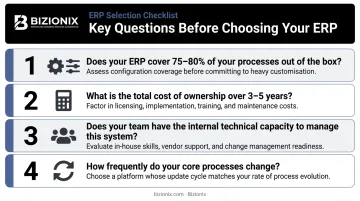
For most Indian MSMEs — where GST mandates, e-invoicing requirements, and lean IT teams are everyday realities — these four questions consistently point toward a well-configured off-the-shelf ERP over a costly custom build.
Conclusion
The right ERP choice comes down to one thing: fit. Does it match where your business is today, and can it keep up as you grow?
Large enterprises with unique, complex processes — and the budgets and teams to match — may find that custom development pays off over a long horizon. But for most Indian MSMEs, an intelligent, configurable off-the-shelf ERP that covers core operations, adapts to business workflows, and handles GST compliance requirements is the faster, safer, and more cost-efficient path forward.
When evaluating your options, focus on three practical questions:
- Does it handle Indian compliance requirements (GST, e-invoicing) out of the box?
- Can it be configured to your workflows without months of development?
- Will the vendor support you as your business scales?
A well-chosen ERP doesn't just replace spreadsheets — it gives your entire team a single source of truth to run the business from.
Frequently Asked Questions
What is a custom ERP?
Custom ERP is software built from scratch to match a specific company's unique workflows, processes, and industry requirements. Unlike off-the-shelf solutions, it is developed exclusively for one business and includes only the features that organisation needs, with no standardised module constraints imposed by a vendor.
Can AI replace an ERP?
No. AI is a capability layer that enhances ERP functions (forecasting, anomaly detection, automation) but it does not manage the structured data flows, compliance requirements, and cross-departmental coordination that ERP systems handle. Gartner projects AI-enabled cloud ERP tools will drive a 30% faster financial close by 2028, but as an enhancement, not a replacement.
What is the difference between ERP customisation and ERP configuration?
Configuration means adjusting settings, workflows, and parameters within an existing ERP without touching source code: faster, cheaper, and easier to maintain through upgrades. Customisation involves modifying or adding to the underlying code to create new features, which carries higher cost and significant upgrade complexity.
Which ERP type is better for small and medium businesses in India?
For most Indian SMEs, a cloud-based off-the-shelf ERP with built-in GST compliance, configurable modules, and affordable subscription pricing delivers better value than a full custom build. The key is choosing a platform designed specifically for Indian business requirements and capable of adapting as the business grows.
What are the hidden costs of off-the-shelf ERP systems?
Common costs buyers underestimate include:
- Per-user pricing that compounds as teams grow
- Charges for premium modules beyond the base plan
- Data migration and implementation fees
- Configuration costs for anything outside standard setup
Confirm each before signing a contract.
How long does it take to implement a custom ERP vs. an off-the-shelf ERP?
Off-the-shelf ERP systems typically take weeks to a few months to implement, including data migration and training. Custom ERP development can span 6 months to several years depending on complexity, scope, and team availability. Panorama's 2025 ERP Report cites a 9-month median project timeline even for established implementations.