Introduction
If your business trades with retailers, distributors, or suppliers, you've likely run into this problem: a purchase order arrives from a partner via EDI, and someone on your team manually types that data into your ERP. Then they do it again for the invoice. And again for the shipment notice.
This process breaks down fast. Data entry errors compound, orders get delayed, and trading partners levy chargebacks for non-compliance. For Indian MSMEs managing GST obligations on top of all this, the operational burden is even steeper.
This guide covers the full picture of EDI-ERP integration — what these systems do, how integration actually works, the benefits you can expect, the challenges you'll face, and the practices that separate successful implementations from ones that fail under real-world conditions.
If you're a business owner, operations manager, or IT lead looking to eliminate manual re-entry between systems — this is where to start.
Key Takeaways
- EDI handles standardised document exchange with external trading partners; ERP manages internal operations
- Integration automates data flow between them, eliminating manual re-keying
- Benefits include faster order-to-cash cycles, fewer errors, real-time supply chain visibility, and lower costs
- Main integration methods: native connectors, API-based, middleware/iPaaS, and file-based exchange
- Success depends on clean master data, robust error handling, and an ERP built for connectivity
What Are EDI and ERP Systems?
EDI: The Language of Inter-Company Transactions
Electronic Data Interchange (EDI), as defined by GS1, provides global standards for electronic business messaging that automate transactions across the supply chain. Rather than exchanging paper documents or PDFs by email, trading partners exchange structured electronic files that computer systems can read and act on directly.
The four EDI transaction types that matter most in B2B operations:
| EDI Code | Document Type | ERP Process |
|---|---|---|
| EDI 850 | Purchase Order | Sales order creation |
| EDI 810 | Invoice | Accounts receivable/payable |
| EDI 856 | Advance Ship Notice (ASN) | Shipment confirmation, receiving |
| EDI 820 | Payment/Remittance Advice | Payment posting to AR |
Two major standards govern these documents: ANSI X12 (dominant in North America) and UN/EDIFACT (used internationally and defined by the UN as rules for structured data exchange between independent computerised systems). Nearly 126,000 companies globally have adopted GS1 EANCOM standards, which are built on EDIFACT.
EDI operates between companies, not within them. It covers how your business communicates with suppliers, buyers, and logistics partners.
ERP: The Internal System of Record
An ERP (Enterprise Resource Planning) system manages everything that happens inside your business — inventory levels, purchase orders, sales orders, financial accounts, manufacturing schedules, and payroll. It's a centralised platform where all departments work from the same operational data.
EDI handles the exchange; ERP handles the execution. A purchase order received via EDI means nothing until it becomes a sales order inside your ERP — one that triggers picking, packing, and invoicing.
Major ERP systems with EDI integration support include:
- SAP S/4HANA — uses IDoc format and ALE/EDI processes
- Oracle NetSuite — EDI partner configuration for ASNs
- Microsoft Dynamics 365 Business Central — Data Exchange Framework plus marketplace EDI modules
- Acumatica — via marketplace solutions such as TrueCommerce and SPS Commerce
For Indian MSMEs, ERP integration has a compliance requirement that adds urgency: GST e-invoicing. From 1 August 2023, businesses with aggregate turnover above ₹5 crore must generate invoices in the GST INV-01/JSON format and submit them to the Invoice Registration Portal (IRP) for IRN validation.
How EDI and ERP Integration Works
The Data Flow: From Trading Partner to ERP Record
Here's how a typical inbound transaction moves through an integrated system:
- Partner sends EDI 850 — a retail buyer transmits a purchase order in ANSI X12 format
- EDI system receives and parses — the document is validated against the agreed transaction set
- Data mapping and translation — EDI fields are converted into the ERP's internal format (XML, IDoc, JSON)
- ERP record is created — the translated data creates a sales order automatically via API or middleware
- Fulfilment triggers outbound EDI — once the ERP processes shipment, an EDI 856 ASN goes back to the partner automatically
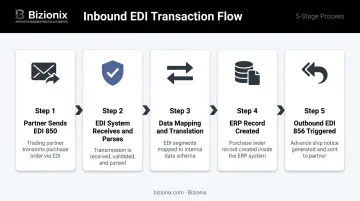
When configured properly, this entire flow runs without human intervention at any step.
The Mapping Layer: Where Most Complexity Lives
SAP's documentation illustrates the challenge clearly: SAP systems use IDocs internally, while external EDI subsystems must convert between IDocs and standards like EDIFACT or ANSI X12. Every field — product codes, dates, quantities, addresses, unit-of-measure conventions — must be accurately mapped between the two formats.
The complexity is real: trading partners apply the same standard differently, optional fields get used in non-standard ways, and custom product identifiers rarely match ERP item codes. Each partner effectively requires its own mapping configuration.
Four Integration Methods
| Method | Best For | Trade-off |
|---|---|---|
| Direct/Native Connectors | Single ERP-EDI pair, fast deployment | Can create vendor lock-in |
| API-Based (REST/SOAP) | Real-time, highly tailored connections | Requires internal development resources |
| Middleware/iPaaS | Multiple integrations, centralised management | Higher upfront setup complexity |
| File-Based (SFTP/MFT) | Lower volumes, simpler environments | No real-time visibility |
Gartner's iPaaS category explicitly covers API management, event-driven messaging, B2B/EDI, and managed file transfer, positioning middleware as the practical choice for organisations managing several integration points simultaneously.
What Happens Without Integration
Manual re-entry is the alternative — and it's costly. APQC's benchmarking data from 2,342 companies shows a median first-time error-free invoice processing rate of 92%, meaning roughly 1 in 12 invoices carries an error requiring rework. At scale, that rework compounds quickly into:
- Delayed payments and stalled receivables cycles
- Supplier disputes from mismatched order or shipment data
- Penalty deductions from trading partners for non-compliance
Key Benefits of EDI-ERP Integration
End-to-End Automation and Error Reduction
When EDI data flows directly into the ERP, human re-entry disappears from the process. Purchase orders become sales orders automatically. Invoices generated by the ERP are translated into EDI format and transmitted without manual intervention. Each manual step eliminated also removes a point where errors can compound — so the gain is both speed and accuracy.
Faster Order-to-Cash and Procure-to-Pay Cycles
Automation compresses transaction timelines significantly. According to Ardent Partners' 2024 AP research, Best-in-Class AP teams globally achieve 82% faster invoice processing and 78% lower per-invoice costs than their peers — with 77% of those leading organisations using e-invoicing as a standard practice. For Indian MSMEs moving toward GST e-invoicing mandates, these numbers reflect what integrated systems already make possible.
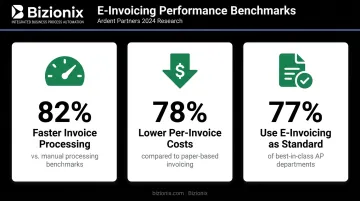
Orders that took days to process manually can move through the system in minutes. Earlier invoicing means earlier payment collection, which directly improves cash flow.
Improved Inventory and Supply Chain Visibility
When EDI documents flow into the ERP in real time, inventory records update automatically. Teams see stock levels, order statuses, and shipment progress without chasing information across disconnected systems.
This visibility matters for:
- Avoiding stockouts during demand spikes
- Preventing over-ordering based on stale data
- Improving forecasting accuracy with live transaction data
- Faster exception identification when shipments are delayed
Lower Operating Costs and Chargeback Reduction
Two cost drivers shrink with integration:
- Chargebacks — trading partners penalise suppliers for late, incorrect, or non-compliant EDI transactions. GS1 US cites ASN-based shipment alerts as a way to avoid compliance failures and chargebacks. Automated, accurate EDI transmission reduces these events.
- Revenue leakage — billing errors, missed invoices, and mismatched records that go undetected in manual processes get caught when systems are connected and data is consistent.
Scalability Without Proportional Headcount Growth
A well-configured EDI-ERP integration absorbs growing transaction volumes without adding headcount. New trading partners, seasonal spikes, and additional product lines all run through the same automated pipeline. Manual processes, by contrast, scale linearly — more orders simply mean more staff hours. That difference is what makes integration a capacity decision, not just an efficiency one.
Common Challenges in EDI-ERP Integration
Understanding where integrations fail is as important as understanding why they succeed.
Data Mapping Complexity
Even within a standard like ANSI X12, each trading partner applies it differently. Optional fields get used inconsistently. Custom product codes don't map cleanly to ERP item masters. Each partner requires its own mapping configuration — and those configurations need ongoing maintenance as partners update their systems.
Master Data Synchronisation
EDI relies on master data accuracy. When product codes in your ERP don't match what your partner's system expects, transactions fail or arrive corrupted. APQC links master data management directly to order-to-cash performance across multiple business functions — the implication being that poor master data quality isn't just an IT problem, it's an operational one.
Ongoing Maintenance
Integration is not a one-time project. ERP upgrades, EDI standard updates, new partner onboarding, and changes to business rules all require re-testing and re-configuration. Managed EDI involves continuous maintenance of trading partner connectors, mailboxes, and message configurations. Organisations that don't plan for this find their integrations degrade quietly over time.
Compliance Requirements: GST E-Invoicing for Indian Businesses
For Indian businesses, EDI-ERP integration carries a regulatory dimension that goes beyond data exchange. Taxpayers with annual turnover above ₹5 crore must generate B2B invoices in JSON format (Form GST INV-01). Each invoice must be submitted to the IRP for IRN generation and digital signing before it's legally valid.
This means the ERP must be capable of:
- Generating compliant invoice JSON
- Connecting to the IRP via API (directly or via a GST Suvidha Provider)
- Handling bulk upload for high-volume scenarios
- Keeping GST returns aligned with invoice data
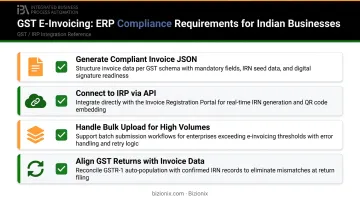
ERPs with native IRP connectivity — including direct API integration for instant IRN generation — reduce the compliance burden compared to workflows that depend on manual JSON export and separate portal submissions. For MSMEs scaling transaction volumes, this distinction affects both speed and audit readiness.
Best Practices for Successful EDI-ERP Integration
Clean Up Master Data Before Building the Integration
Audit ERP records before any integration work starts. Check for inconsistencies in:
- Product codes and item descriptions
- Pricing tables and unit-of-measure conventions
- Partner identifiers and ship-to addresses
- Tax classifications
Poor master data is the most common reason integrations fail post-launch. Errors that appear minor in isolation — a mismatched unit-of-measure, an outdated partner GLN — become systemic failures when processed at volume.
Build Error Handling and Observability From Day One
Effective monitoring requires more than knowing that an integration exists. It requires:
- Automated retry logic for transient connection failures
- Transaction logs capturing every inbound and outbound document
- Real-time dashboards visible to operations teams, not just IT
- Defined escalation paths for documents that need manual review
Without this infrastructure, failed transactions go undetected until they become chargebacks or missed deliveries. By then, the cost of resolution is far higher than the cost of prevention.
Choose the Right Integration Method for Your Business Size
Match your approach to your actual operational profile:
- Smaller businesses with fewer partners and lower volumes: file-based or native connectors are sufficient
- Mid-sized businesses managing multiple trading partners: middleware or API-based integration provides the flexibility and visibility needed
- Complex multi-entity groups: iPaaS platforms that centralize integration management across entities reduce long-term maintenance overhead
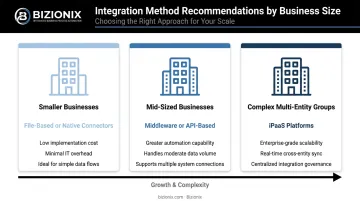
Avoid over-engineering for your current scale. But design for growth — adding trading partners to a poorly architected integration is far more expensive than building it right initially.
Standardise Partner Onboarding With Documented Templates
Each new trading partner adds complexity. Reduce that friction by creating:
- Mapping templates for common document types (850, 810, 856) that can be reused across partners
- Communication protocol documentation per partner (VANs, AS2, SFTP)
- SLAs covering response times, error resolution procedures, and compliance benchmarks
Structured onboarding cuts the time required to activate new partners and reduces the risk of errors during that activation window.
Choose an ERP Built for Integration
From an integration-readiness standpoint, look for:
- Open APIs (REST or SOAP) with documented endpoints
- Support for standard data formats (XML, JSON)
- Real-time data visibility across modules
- Modular architecture that doesn't require full customisation for each new connection
- Built-in automation capabilities that reduce reliance on external orchestration
For Indian MSMEs, add GST compliance to that list — specifically, direct IRP API integration for e-invoicing. Bizionix addresses this directly: its e-invoicing module connects with the IRP via API for instant IRN generation, while its unified architecture gives finance, inventory, sales, and procurement teams shared real-time visibility. That foundation means EDI integration and GST compliance don't have to be solved as separate problems.
Frequently Asked Questions
What are EDI and ERP systems?
EDI (Electronic Data Interchange) is a standardised method for computer-to-computer exchange of business documents between trading partners. ERP (Enterprise Resource Planning) is an integrated software suite managing internal business operations including finance, inventory, and procurement.
What are the top ERP systems globally?
SAP S/4HANA, Oracle NetSuite, and Microsoft Dynamics 365 are among the most widely deployed enterprise ERP systems globally. For Indian MSMEs, locally designed ERP solutions with built-in GST compliance often suit operational and regulatory needs better than enterprise-grade systems built for large multinationals.
What is EDI and ERP integration?
It's the process of connecting an EDI platform with an ERP system so that business documents received from trading partners automatically flow into the ERP without manual data entry — and outbound documents from the ERP are automatically translated and transmitted to partners.
What are the main methods for integrating EDI with an ERP system?
Four primary methods exist for EDI-ERP integration:
- Direct/native connectors — built-in links between specific EDI and ERP platforms
- API-based integration — real-time data exchange via application programming interfaces
- Middleware/iPaaS platforms — third-party tools that broker communication between systems
- File-based exchange — scheduled batch transfers using flat files (CSV, XML)
The right choice depends on transaction volume, number of trading partners, and available technical resources.
What are the biggest challenges in EDI-ERP integration?
Data mapping complexity, master data inconsistency, ongoing maintenance as systems and partners change, and compliance requirements (including GST e-invoicing for Indian businesses) are the most common obstacles. Addressing data mapping and master data governance before go-live prevents the majority of errors that surface after launch.
Can small and mid-sized businesses benefit from EDI-ERP integration?
MSMEs gain clear advantages from EDI-ERP integration: less manual data entry, faster order processing, and the ability to meet trading partner compliance requirements without building large IT teams. Cloud-based ERP platforms have brought integration within reach for businesses that previously lacked the budget or infrastructure to attempt it.