For medium-sized Indian businesses — typically in the 50–500 employee range — this is a genuine inflection point. The MSME sector now counts over 5.77 crore registered businesses as of December 2024, and a growing share are formalising operations, which means statutory obligations around PF, ESI, and TDS cannot be managed informally. Missing an ESI deposit, for instance, attracts 12% per annum interest plus damages of up to 25% — not a minor inconvenience.
This article covers the top HR software options for Indian medium-sized businesses in 2025, what to look for when evaluating them, and how to make a decision that holds up as the business scales.
Key Takeaways
- HR software centralizes employee data, automates payroll, and manages statutory compliance — critical once you cross 50 employees
- Indian mid-sized businesses must prioritise platforms with built-in PF, ESI, TDS, and professional tax compliance — not treated as optional add-ons
- Strong options balance ease of use, scalability, and value — without the complexity of full enterprise suites
- Evaluate on: payroll automation, compliance depth, self-service portals, integrations, and support quality
What Is HR Software and Why Do Medium-Sized Businesses Need It?
HR software falls into three categories. According to ADP, HRIS handles employee data and core HR processes, HRMS adds time tracking, payroll, and compliance tools, and HCM covers the full talent lifecycle including performance and learning. Most mid-sized businesses need HRMS-level functionality — enough to automate the operational layer without buying an enterprise suite they'll never fully use.
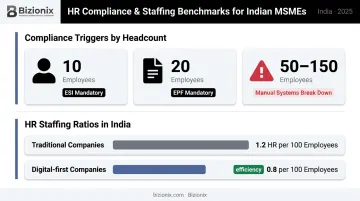
The pain point is predictable. Processes that worked at 30 employees — WhatsApp approvals, manual salary sheets, Excel leave trackers — break down somewhere between 80 and 150 people. Compliance requirements also multiply with headcount:
- EPF becomes mandatory once you cross 20 employees
- ESI applies from 10 employees onward
- Statutory filings, payroll calculations, and audit trails grow in parallel
HR teams don't scale proportionally with headcount. People Matters reports the average HR-to-employee ratio in India is 1.2 HR staff per 100 employees, while digital-first companies operate at 0.8 per 100 — a gap that widens fast without the right tools.
The platforms covered below are evaluated specifically for this scale: companies past the spreadsheet stage, not yet ready for enterprise-level complexity.
Top HR Software Solutions for Medium-Sized Businesses in 2025
These solutions were shortlisted based on fit with Indian medium-sized businesses — covering payroll automation, statutory compliance, ease of implementation, scalability, and value for money.
Bizionix (by IIS-LLP)
Bizionix is a cloud-based, all-in-one ERP platform built specifically for Indian MSMEs by IIS-LLP, a subsidiary of Protocol India Private Limited with over two decades of industry experience. Unlike standalone HR tools, the HR module sits inside a unified platform covering finance, payroll, inventory, and operations.
That integration means employee costs, attendance data, and salary expenses flow directly into financial reporting — without manual reconciliation between systems.
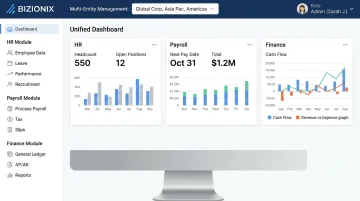
What sets Bizionix apart for multi-entity businesses is its single secure login architecture: HR administrators can manage employees across multiple companies, branches, or GST-registered entities from one dashboard, switch between entities without logging out, and configure role-based access so each team member sees only what they need.
The platform also carries proven direct API integration with government systems for GST compliance — applying that same integration philosophy to statutory compliance across modules.
Bizionix's core proposition is straightforward: HR, finance, and operations share a single source of truth — no disconnected systems, no manual reconciliation across tools.
| Attribute | Details |
|---|---|
| Key HR Features | Payroll management, employee records, attendance tracking, leave management, statutory compliance, multi-company HR visibility, employee self-service portal, role-based access control |
| Best For | Indian MSMEs in manufacturing, distribution, services, hospitality, and multi-location businesses seeking a unified ERP with embedded HR capabilities |
| Deployment & Pricing | 100% cloud-based; NEO plan starts at ₹999/year; Enterprise plan (full HRMS + payroll) requires a custom quote — verify current pricing at bizionix.com or contact info@bizionix.com |
Keka HR
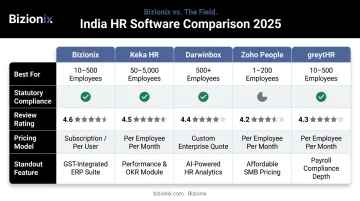
Keka has built strong traction among Indian mid-sized companies for a good reason: it combines a clean, modern interface with a genuinely capable payroll engine. The compliance engine and HR experience were clearly built as one system, not assembled from separate parts.
Key differentiators include robust statutory compliance automation covering PF, ESI, PT, TDS, and LWF, a highly rated mobile app, and performance management tools that go well beyond basic HR administration. With over 10,000 organisations on the platform and a US$57 million Series A from WestBridge Capital, it has the backing and user base to demonstrate staying power.
On review platforms, Keka scores 4.7/5 on SoftwareSuggest (173 reviews) and 4.5/5 on G2 (1,976 reviews).
| Attribute | Details |
|---|---|
| Key HR Features | Payroll automation, leave and attendance, performance reviews, recruitment (ATS), expense management, employee self-service, compliance reports |
| Best For | Mid-sized Indian companies (100–500 employees) looking for a dedicated HR platform with strong compliance and employee experience features |
| Deployment & Pricing | Cloud-based SaaS; per-employee per-month pricing — verify current tiers at Keka's official website |
Darwinbox
Darwinbox is enterprise-grade HCM built in India, now used by over 1,000 enterprises across 130+ countries with more than 4 million employees on the platform. It covers the full employee lifecycle from recruitment to exit and earned Challenger status in the 2025 Gartner Magic Quadrant for Cloud HCM Suites.
For Indian payroll, it generates 75 reports covering TDS, PF, NPS, Form 16, and Form 24Q, along with 100+ connectors for integrations. The trade-off: Darwinbox is more suited to larger or faster-scaling businesses. Its depth and configurability are assets when you need them, but they add implementation complexity that a 100-person team may not need yet.
Gartner Peer Insights shows a 4.8/5 rating from 141 reviews as of early 2024.
| Attribute | Details |
|---|---|
| Key HR Features | Core HR, recruitment, onboarding, payroll, performance, learning, surveys, workforce analytics |
| Best For | Mid-to-large Indian businesses (200+ employees) or those with regional and global expansion plans needing a scalable HCM platform |
| Deployment & Pricing | Cloud-based; quote-led pricing — contact Darwinbox directly for current rates |
Zoho People
Zoho People works best when a business is already inside the Zoho ecosystem. It integrates natively with Zoho Payroll and Zoho Books, meaning HR data, payroll transactions, and accounting entries stay in sync without third-party connectors. For businesses using Zoho for CRM, accounting, or project management, adding Zoho People is a natural extension rather than a new system to manage.
The platform has been in the HR space for 15 years, offers multiple public pricing tiers (including a free plan for very small teams), and scores well on ease of use. Payroll depth is strongest when paired with Zoho Payroll rather than used in isolation.
Review ratings: 4.6/5 on SoftwareSuggest, 4.4/5 on G2 (412 reviews), 4.4/5 on Capterra (331 reviews).
| Attribute | Details |
|---|---|
| Key HR Features | Employee database, leave management, time tracking, performance appraisals, onboarding workflows, self-service portal, HR analytics |
| Best For | Small to mid-sized Indian businesses (50–300 employees) already using Zoho products or prioritising ease of use and affordability |
| Deployment & Pricing | Cloud-based; multiple tiers available including a free plan — verify current per-employee rates on Zoho's official pricing page |
greytHR
greytHR is one of India's most established HR and payroll platforms, with over 23,000 organisations and 2.3 million users across 25+ countries. It has built its reputation on one thing: payroll accuracy and statutory compliance. If PF, ESI, PT, and TDS automation is the primary requirement, greytHR delivers this out of the box with a large library of pre-built statutory reports.
The trade-off versus platforms like Keka or Darwinbox is that greytHR's interface and feature set can feel more utilitarian — it prioritises getting payroll right over delivering a rich employee experience. For businesses where compliance and payroll accuracy are the top priorities, that's a feature, not a limitation.
Review ratings: 4.6/5 on SoftwareSuggest, 4.4/5 on G2 (1,262 reviews), 4.3/5 on Capterra (296 reviews).
| Attribute | Details |
|---|---|
| Key HR Features | Payroll processing, statutory compliance (PF/ESI/PT/TDS), leave and attendance, employee self-service, letters and documents, basic performance tracking |
| Best For | Indian SMBs and mid-sized companies (50–500 employees) where payroll accuracy and regulatory compliance are the primary requirements |
| Deployment & Pricing | Cloud-based SaaS; per-employee per-month pricing — verify current plan details on greytHR's official website |
Key Features to Look for in HR Software
Payroll Automation and Statutory Compliance
For Indian businesses, this is non-negotiable. TDS defaults attract interest of 1% per month for failure to deduct and 1.5% per month for failure to deposit after deduction, plus Section 234E fees of ₹200 per day. At 100+ employees, manual payroll creates compounding exposure: one missed ESI filing can cascade into penalties, interest, and strained relationships with inspectors.
Look for platforms that:
- Automate PF, ESI, PT, and TDS calculations end-to-end
- Generate ready-to-file compliance reports (Form 16, Form 24Q, PF challan)
- Update automatically when statutory thresholds or slabs change
Employee Self-Service and Mobile Access
A self-service portal reduces routine HR admin by letting employees handle their own requests: applying for leave, downloading payslips, updating personal details, and checking attendance. Each task they complete independently is one fewer interruption for your HR team.
India's average HR ratio of 1.2 staff per 100 employees leaves little capacity for administrative overhead. Digital-first companies that have moved to 0.8 per 100 have done so partly through effective self-service implementation.
Scalable Architecture and Integration Capability
The software must handle headcount growth, additional locations, and org restructuring without requiring replacement. Specific questions to ask:
- Can it handle multi-location or multi-entity payroll from a single instance?
- Does it integrate with accounting systems, ERP platforms, or biometric attendance hardware?
- What happens to your data if you outgrow the current plan?
Reporting, Dashboards, and Analytics
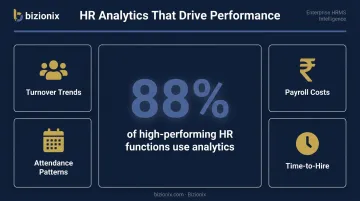
People Matters reports that 88% of high-performing HR functions rely on analytics to guide talent strategy. At 200 employees, visibility into turnover trends, attendance patterns, payroll costs, and time-to-hire is what separates a HR function that responds to problems from one that prevents them. Evaluate whether dashboards are real-time, customisable, and accessible to business leaders without requiring IT involvement.
Implementation Support and Vendor Reliability
A feature-rich platform with poor implementation support costs more in the long run than a simpler, well-supported tool. Evaluate:
- How long does implementation take for your headcount range?
- Is there a dedicated implementation team or just documentation?
- What does post-go-live support look like — tickets only, or a named contact you can call?
How We Chose the Best HR Software Solutions
Solutions were assessed based on their relevance to Indian mid-sized businesses across five dimensions: statutory compliance depth, payroll accuracy, ease of use, scalability, and integration capability.
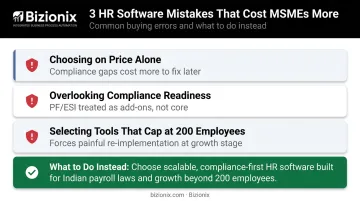
Three patterns consistently separate smart purchases from costly mistakes:
- Choosing on price alone often leads to compliance gaps that cost far more to fix later
- Overlooking compliance readiness is the most common mistake — some platforms treat PF/ESI as add-on modules, not core features
- Selecting tools that cap at 200 employees forces a painful re-implementation precisely when the business has the least capacity to manage it
Vendor reliability and support quality were weighted alongside features. A platform that handles 50 employees cleanly but breaks at 200 is not a solution — it's a delayed problem.
Conclusion
Choosing HR software is a long-term operational commitment, not a one-time product decision. The right platform should fit how the business actually runs today — and be capable of growing with it over the next three to five years.
Before committing, run a structured evaluation:
- Shortlist two or three solutions based on your core requirements
- Request demos with real use cases, not just feature walkthroughs
- Involve both HR and a finance or operations stakeholder — HR prioritizes ease of use and compliance accuracy; finance needs clean payroll reconciliation and reporting
- Confirm that implementation timelines and support commitments are in writing
A platform that works for both teams from day one will cause far fewer problems down the line.
Businesses looking for an all-in-one solution that combines HR, payroll, finance, and operations in a single unified platform built for Indian MSMEs can explore Bizionix at bizionix.com or reach the team directly at info@bizionix.com.
Frequently Asked Questions
What is the difference between HRIS, HRMS, and HCM software?
HRIS focuses on employee data and core HR record-keeping. HRMS adds time tracking, attendance, and payroll compliance tools. HCM is the broadest category, covering the full talent lifecycle including performance management and learning. For most mid-sized Indian businesses, HRMS-level functionality is the right starting point.
How much does HR software typically cost for a medium-sized business in India?
Indian HR platforms typically charge on a per-employee per-month basis, with costs varying by the number of modules, headcount, and support tier. Request vendor quotes that include implementation and training costs, not just the base subscription, as these add up quickly for complex deployments.
What features should medium-sized businesses prioritise when choosing HR software?
Payroll automation, statutory compliance (PF, ESI, TDS, professional tax), employee self-service, leave and attendance management, and reporting dashboards are the core must-haves. Advanced features like AI-driven analytics or full performance modules can be added as the business scales.
How long does it take to implement HR software for a medium-sized company?
Simpler platforms can go live in 2–4 weeks, while comprehensive systems with data migration, payroll setup, and integrations typically take 1–3 months. Vendor support quality and the cleanliness of your historical data both affect the timeline significantly.
Can HR software handle Indian statutory compliance like PF, ESI, and TDS?
India-built platforms like Keka, greytHR, and Bizionix include statutory compliance automation as a core feature. Verify that the platform supports your specific state's professional tax slabs and generates ready-to-file compliance reports before committing.
Is cloud-based HR software secure for storing sensitive employee data?
Reputable cloud-based HR platforms use encryption, role-based access controls, and regular security audits to protect employee data. Look for vendors who document their security practices clearly and provide audit trails for sensitive data access, especially across payroll and compliance records.