Introduction
For most Indian trading MSMEs in 2025, the operational load looks something like this: stock spread across three locations, orders arriving from four channels, a GST filing due Friday, and the finance team working from yesterday's numbers. None of that is unusual — it's Tuesday.
ERP software addresses this by connecting procurement, inventory, sales, finance, and compliance into a single operating system. When every department pulls from the same data, late-night reconciliation calls and billing disputes drop significantly.
The challenge is choosing the right platform. The market includes global enterprise tools, open-source frameworks, and purpose-built Indian MSME solutions — all claiming to handle trading operations. With over 2.58 crore trading enterprises registered across India and e-invoicing now mandatory for businesses above ₹5 crore turnover, getting the ERP decision wrong carries real compliance risk.
This guide evaluates five ERP systems against trading-specific requirements, India compliance readiness, and real-world value for MSMEs.
Key Takeaways
- ERP for trading businesses connects procurement, inventory, order management, finance, and compliance under one platform
- GST compliance, e-invoicing with IRN generation, and multi-location stock management are non-negotiable for Indian trading businesses
- The right ERP depends on your company size, budget, compliance needs, and preferred deployment model
- Five ERP systems are evaluated here on trading functionality, India localisation, and MSME scalability
What Is ERP Software for Trading Businesses?
ERP — Enterprise Resource Planning — connects the full buy-sell cycle under a single platform. Purchase orders, inventory tracking, order processing, sales invoicing, and financial management all operate from one database rather than separate tools that don't speak to each other.
Trading businesses have specific ERP requirements that differ from manufacturing or services:
- High transaction volumes with rapid stock movement across locations
- Vendor and customer networks that require structured relationship management
- Multi-location inventory that needs real-time visibility, not end-of-day snapshots
- India-specific compliance — GST filing, e-invoicing, IRN generation, and e-way bills for goods movements above ₹50,000
CBIC Notification No. 10/2023-Central Tax made e-invoicing mandatory from 1 August 2023 for all taxpayers with aggregate turnover above ₹5 crore. Generic accounting tools stop at the books. A proper ERP covers the full operation: procurement, inventory, invoicing, and built-in compliance — all from one place.
Best ERP Software Systems for Trading Businesses in 2025–2026
These five platforms were shortlisted based on trading-specific functionality (purchase-to-sale cycle, inventory, order management), India compliance readiness (GST, e-invoicing, IRN), cloud capability, MSME scalability, and overall cost-to-value ratio.
Bizionix by IIS-LLP
Bizionix is a 100% cloud-based ERP developed by IIS-LLP — a subsidiary of Protocol India Private Limited with over two decades of industry experience. It was built specifically for Indian MSMEs to replace fragmented tools with a single unified platform covering inventory, sales, purchase, finance, and multi-company management.
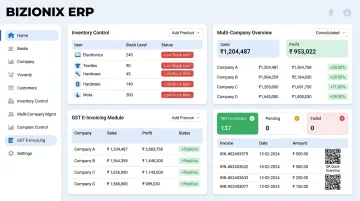
Bizionix connects directly to the GST e-Invoice system via API — no third-party tools in between. Invoices are validated against GST rules in real-time, IRNs and QR codes are generated instantly via direct IRP connection, and the invoice is ready to share within seconds.
For a trading business processing dozens of B2B invoices daily, this removes a significant compliance burden without any manual steps.
The multi-company management feature is equally relevant for trading groups. Multiple GST-registered entities, regional branches, or warehouse locations operate from a single secure login, with independent books per entity and consolidated group-level reporting available simultaneously.
| Feature | Details |
|---|---|
| Key Modules | Purchase management, sales & CRM, inventory control, warehouse management, multi-company management, GST-ready accounting, e-invoicing with instant IRN, financial reporting |
| Best For | Indian MSMEs in trading, distribution, and wholesale — particularly multi-location businesses or groups managing multiple entities |
| Pricing | Starts at ₹999/year (NEO plan); Enterprise plan with custom pricing for larger operations; 14-day free trial available — verify current plans at bizionix.com |
| Deployment | 100% cloud-based; no on-premise overhead |
SAP Business One
SAP Business One is an ERP used across 170+ countries, designed for small to mid-sized enterprises. In India, it covers GST, TDS, and statutory reporting through its India localisation, and is widely deployed by trading and distribution companies managing complex supply chains or multi-currency operations.
The platform offers full-featured inventory and warehouse management, integrated CRM, and supply chain visibility. Its GST guide (document version 16.0, updated May 2024) covers e-billing, e-way bill handling, GSTR workflows, and an e-billing connector path using ClearTax for IRP authentication.
That said, meaningful India compliance configuration requires certified SAP partners. Licensing, implementation, and support costs are significant — SAP Business One is a stronger fit for mid-sized trading companies with dedicated IT resources than for early-stage MSMEs working with lean teams.
| Feature | Details |
|---|---|
| Key Modules | Inventory and warehouse management, integrated CRM, purchase and sales order management, financial reporting, India GST localisation, multi-currency support |
| Best For | Mid-sized trading businesses in India with IT budgets and access to certified SAP implementation partners |
| Pricing | Pricing on request — no official fixed India per-user price published; contact SAP or a certified partner for current quotes |
| Deployment | Available as cloud and on-premise |
Odoo ERP
Odoo is an open-source ERP with a modular architecture — trading businesses can activate sales, purchase, inventory, accounting, and CRM modules without paying for functionality they don't need. Its India localisation (version 19.0) includes dedicated modules for GST accounting, e-invoicing via the NIC portal, e-way bill management, and GSTR-1 submission with GSTR-2B retrieval.
One configuration detail buyers should factor in before go-live: Odoo requires BVM IT Consulting Services India Private Limited to be configured as the GSP for e-invoicing, e-way bill, and GST return filing. That dependency adds a layer of setup that buyers should factor in before go-live. Odoo suits trading businesses with technical teams or implementation partner relationships looking for a configurable, mid-range platform.
| Feature | Details |
|---|---|
| Key Modules | Modular sales, purchase, inventory, accounting, CRM; India GST localisation with e-invoicing, e-way bill, GSTR filing; multi-currency; eCommerce and POS integration |
| Best For | Trading businesses with technical capacity or an implementation partner, seeking a customisable mid-range ERP |
| Pricing | Community edition: open-source/free; Enterprise edition: approximately USD $31–39/user/month (verify current India pricing at odoo.com/pricing) |
| Deployment | Cloud and self-hosted |
ERPNext (Frappe)
ERPNext is a fully open-source ERP under the GPL-3.0 licence, with strong community support in India and native GST compliance built into its India Compliance app. It covers trading essentials — inventory, purchase, sales, accounts, CRM, and multi-currency — and for businesses on Frappe Cloud, e-invoicing is fully integrated with IRN generation and QR code output.
ERPNext delivers enterprise-grade trading functionality at the lowest cost point on this list. The trade-off is implementation effort. Deploying and maintaining ERPNext requires technical resources, and the out-of-the-box experience requires more configuration than commercial alternatives. For a trading MSME with an in-house IT person or a willing implementation partner, it's a serious contender.
Frappe reports over 30,000 customers and 200+ partners globally — enough ecosystem depth to find implementation support across most Indian cities.
| Feature | Details |
|---|---|
| Key Modules | Native GST compliance (e-invoicing, e-way bills, GSTR filing), inventory management, purchase and sales cycle, multi-currency accounting, open-source with active Indian community |
| Best For | Small trading businesses with technical resources looking for a cost-effective, compliance-ready ERP |
| Pricing | Self-hosted: free; Frappe Cloud Site plans from ₹410/month, Server plans from ₹1,800/month; 14-day free trial available — verify at frappe.io/cloud/pricing |
| Deployment | Self-hosted (free) or Frappe Cloud |
Oracle NetSuite ERP
Oracle NetSuite is one of the most widely deployed cloud ERP platforms globally, with modules covering financial management, inventory, order management, CRM, and supply chain. For trading businesses with multi-entity or cross-border operations, its depth is hard to match.
The India Localization SuiteTax Engine SuiteApp provides GST functionality for purchase and sales transactions, and e-way bill generation is supported via IRN.
The honest assessment for Indian MSMEs: NetSuite's functionality and scalability are genuine, but the pricing and implementation complexity make it better suited to larger trading companies or those with significant international operations. India-specific GST configurations require setup work, and implementation typically requires an authorised NetSuite partner. It grows well — but starts expensive.
| Feature | Details |
|---|---|
| Key Modules | Multi-entity and multi-currency management, real-time financial reporting, inventory and supply chain management, CRM, advanced analytics, India GST via SuiteTax Engine SuiteApp |
| Best For | Larger trading businesses or those with international operations needing a globally scalable cloud ERP |
| Pricing | Pricing on request — no official fixed India price published; contact Oracle/NetSuite or an authorised partner |
| Deployment | Cloud-only |
How We Chose the Best ERP for Trading Businesses
ERP selection goes wrong when buyers focus on brand recognition or price and miss the operational fit. Gartner notes that by 2027, more than 70% of recently implemented ERP initiatives will fail to fully meet original business-case goals — most failures trace back to choosing a platform that doesn't match how the business actually runs.
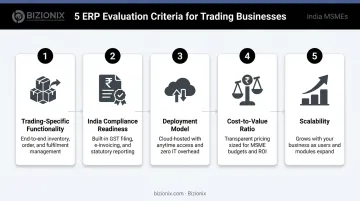
To avoid that outcome, we evaluated each system against five criteria specific to trading operations:
- Trading-specific functionality — depth of purchase, inventory, order, and sales management, not just accounting
- India compliance readiness — native GST, e-invoicing, and IRN generation versus add-ons or workarounds
- Deployment model — cloud availability and ease of access for distributed or multi-location teams
- Cost-to-value ratio — total cost of ownership including implementation, licensing, and ongoing support
- Scalability — ability to grow with the trading business from MSME scale upward
Many trading businesses choose an ERP that handles accounting well but lacks robust inventory and order management. That gap only surfaces after go-live — when sales can't see live stock levels, or purchase orders exist in isolation from the warehouse. Evaluate against your actual workflows, not just a feature checklist.
Conclusion
The right ERP for a trading business isn't the most feature-rich or the most expensive — it's the one that fits how your business operates, handles India's GST compliance without workarounds, and grows without forcing a costly platform change in two years.
Start your shortlist from current operational complexity:
- Small trading MSME with technical resources → ERPNext is worth evaluating
- Mid-range business needing customisation → Odoo with a partner
- Mid-sized company with IT budget → SAP Business One
- Large or international operations → Oracle NetSuite
- Indian MSME wanting purpose-built cloud ERP without enterprise complexity → Bizionix
Once you've narrowed the field, the next step is seeing the software handle your actual workflows — not a generic demo. For Indian trading MSMEs, Bizionix is built specifically for this: GST-ready accounting with automated e-invoicing, multi-company management under a single login, and pricing that doesn't assume an enterprise IT budget. Explore Bizionix or request a demo to see how it fits your operation.
Frequently Asked Questions
What is ERP software for trading businesses?
ERP for trading businesses is an integrated platform that connects procurement, inventory, order management, sales, finance, and GST compliance into a single system. It replaces fragmented department tools with a single source of real-time data everyone can act on.
What features should ERP software for trading companies have?
Core requirements include inventory and warehouse management, purchase and sales order processing, integrated GST compliance with e-invoicing and IRN generation, CRM, multi-location stock visibility, and real-time financial reporting. For Indian businesses, native e-way bill support is also essential.
Is ERP software useful for small trading businesses in India?
Cloud-based ERP platforms designed for MSMEs deliver enterprise-grade functionality without large IT teams or infrastructure investment. With plans starting under ₹1,000/year and quick deployment, even small Indian trading firms can go live without the complexity of traditional enterprise systems.
How does ERP software help with GST compliance in a trading business?
ERP systems with native GST modules automate invoice generation, IRN creation via the Invoice Registration Portal, e-way bill management for goods movements above ₹50,000, and GSTR filing. This reduces manual errors and the risk of compliance penalties significantly.
How long does it take to implement an ERP system for a trading company?
Implementation ranges from a few weeks for cloud-based MSME-focused solutions to several months for large, heavily customised platforms. ERPs with dedicated onboarding support — not just a software licence — cut go-live time and make team adoption considerably easier.
What is the typical cost of ERP software for a trading business in India?
Costs range from free (ERPNext self-hosted) to entry-level cloud subscriptions (Bizionix from ₹999/year, ERPNext from ₹410/month) to enterprise licensing that requires direct negotiation (SAP Business One, Oracle NetSuite). Always factor implementation, training, and ongoing support into the total cost — not just the licence fee.