With over 4 crore enterprises now registered on the Udyam Portal and GST compliance demands tightening — e-invoicing is now mandatory for businesses with turnover above ₹5 crore — the cost of fragmented accounting is rising fast.
The right multi-entity accounting software eliminates this fragmentation. It gives you separate books per entity, consolidated reporting across all of them, and real-time visibility from a single platform — without the manual effort or compliance risk.
This guide covers what multi-entity accounting software actually is, which features matter most for Indian businesses, and which platforms are worth evaluating in 2025.
Key Takeaways
- Multi-entity accounting software maintains separate books per entity while enabling consolidated reporting across all businesses from one platform
- For Indian businesses, GST compliance and e-invoicing with IRN generation are non-negotiable — not nice-to-have features
- India-built tools like Bizionix, Zoho Books, and Tally Prime handle local compliance natively — global tools typically require workarounds
- Top 2025 picks: Bizionix for Indian MSMEs, Zoho Books for SMEs, Tally Prime for traditional businesses, NetSuite for large enterprises
- The right fit depends on entity count, transaction volume, compliance needs, and budget
What Is Multi-Entity Accounting Software (and Why Indian Businesses Need It)
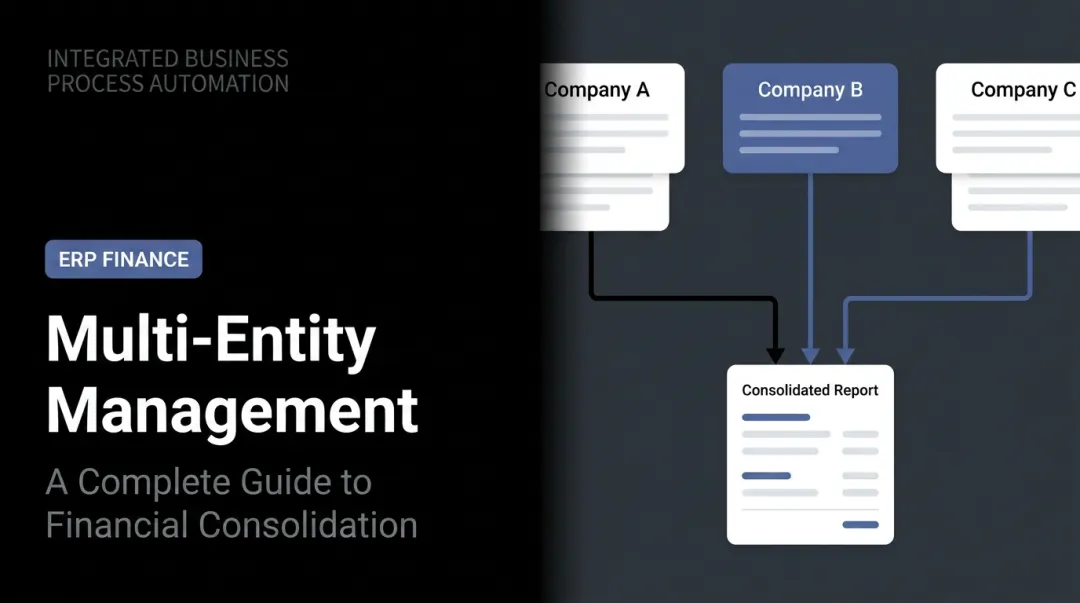
When you're running two or more registered entities, keeping the books straight across all of them is a different problem than managing a single company. Multi-entity accounting software is a unified platform that maintains separate books of accounts for each legal entity, subsidiary, or branch — while enabling consolidated financial reporting and intercompany management from a single interface.
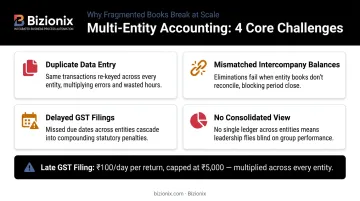
Without it, businesses managing two or more registered entities typically face the same set of problems:
- Duplicate data entry across disconnected systems for each entity
- Mismatched intercompany balances that take hours to reconcile manually
- Delayed GST filings because return data is scattered across spreadsheets and separate tools
- No consolidated view of overall financial health without building custom reports in Excel
These aren't just operational inconveniences. Late GST filings attract penalties under Section 47 of the CGST Act — ₹100 per day per return, capped at ₹5,000 — and for businesses with multiple GST registrations, that exposure multiplies across every entity.
India's MSME sector is growing steadily, and regulatory demands are only increasing. The GSTN Annual Report 2023-24 reports over 1.47 crore active taxpayers in the GST system, with more than 21 crore IRNs generated in August 2024 alone. At that scale, managing compliance across multiple entities with spreadsheets and disconnected tools isn't just inefficient — it's a genuine risk to the business.
Key Features to Look for in Multi-Entity Accounting Software
Consolidated Financial Reporting
The platform should generate P&L statements, balance sheets, and cash flow reports at the individual entity level — and roll them up into a consolidated group view without manual intervention. If your finance team still exports data to spreadsheets to compare entities, the software isn't doing its job.
GST Compliance and E-Invoicing Support
For Indian businesses, this is the feature set that separates workable from unworkable. Look for:
- GSTR-1, GSTR-3B, and GSTR-9 return support with direct filing capability
- Automated e-invoicing with IRN generation via direct API integration with the GSTN's Invoice Registration Portal (IRP)
- TDS/TCS management across all entities under a single platform
- Multi-GSTIN compliance — each entity's separate registration files independently without cross-contamination
Intercompany Transaction Automation and Role-Based Access
Strong platforms handle both of these in tandem:
- Intercompany automation — billing and journal entries post automatically, eliminating the balance mismatches that plague manually managed multi-entity books
- Role-based access controls — configure exactly which users see which entity's data, protecting sensitive financial information while maintaining a complete audit trail
Best Multi-Entity Accounting Software for Multiple Businesses in 2025
The platforms below were shortlisted based on multi-company management depth, India-specific compliance features, scalability for growing MSMEs, ease of use, and value for money.
Bizionix
Bizionix is a 100% cloud-based ERP built specifically for Indian MSMEs by IIS-LLP, a subsidiary of Protocol India Private Limited. It offers unified multi-company management with a single secure login across all entities, covering accounting, inventory, GST compliance, and operations in one platform.
What sets it apart for multi-entity businesses is the combination of depth and simplicity. Each entity maintains fully independent books (separate ledgers, GST filings, and compliance records), while a centralized group dashboard provides real-time visibility across the entire organization.
Users switch between entities without logging out. Role-based access controls can be configured per entity, per department, or per branch, with three permission levels: view, edit, and admin.
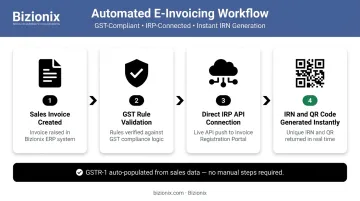
For GST compliance, Bizionix connects directly with the GST e-Invoice system via API. When a sales invoice is created, the system validates it against GST rules and generates the IRN and QR code instantly through direct IRP connection. No manual steps or third-party tools are required. GSTR-1 is auto-populated from sales data, keeping accounting and compliance in sync.
Bizionix is priced to be accessible for Indian MSMEs:
| Attribute | Details |
|---|---|
| Key Features | Multi-company management with single login, GST-ready accounting, automated e-invoicing with IRN, real-time consolidated dashboards, role-based access, inventory and operations modules, auto-populated GSTR-1 |
| Best For | Indian MSMEs, holding companies, franchise networks, CA firms managing multiple clients, and multi-location businesses |
| Pricing | Bizionix NEO: ₹999/year (14-day free trial included); Enterprise plan: custom pricing. Contact Bizionix for Enterprise rates |
Zoho Books
Zoho Books is a cloud-based accounting solution developed by Zoho Corporation, with strong GST compliance features and tight integration across the Zoho ecosystem. It supports multiple organisations under a single Zoho account, making it a practical choice for businesses already using Zoho CRM, Zoho Inventory, or other Zoho products.
It supports GSTR-1, GSTR-3B, GSTR-4, GSTR-9, and GSTR-9C, and is a GSTN-approved GSP for e-invoicing with direct IRN generation. TDS tracking is built in.
| Attribute | Details |
|---|---|
| Key Features | Multi-organisation management, GST return filing (GSTR-1, 3B, 4, 9, 9C), e-invoicing with IRN, TDS tracking, automated bank reconciliation, Zoho ecosystem integration |
| Best For | Small to mid-sized Indian businesses already using or considering the Zoho ecosystem |
| Pricing | Free plan available for businesses under ₹25 lakh annual revenue (1 user + 1 accountant). Paid plans: Standard ₹749/month (billed annually), Professional ₹1,499/month, Premium ₹2,999/month — all per organisation |
Tally Prime
Tally Prime is one of the most widely used accounting solutions among Indian SMEs, developed by Tally Solutions (Bengaluru-based). Claimed usage exceeds 2.5 million businesses, with reported market share above 80% in India.
That familiarity matters in practice: most accountants and finance staff already know Tally, which significantly reduces training time.
It supports multi-company management within a single instance, with robust GST compliance and e-invoicing capabilities including bulk IRN generation. The main trade-off: Tally Prime is primarily on-premises software. Cloud access is available via TallyPrime Cloud Access, but it's an add-on rather than native, which may limit real-time remote access compared to cloud-first platforms.
| Attribute | Details |
|---|---|
| Key Features | Multi-company support, GSTR-1 and GSTR-3B filing, e-invoicing with IRN and QR code, payroll, inventory management, report customisation, audit trail |
| Best For | Traditional Indian businesses, manufacturing and trading companies, and organisations where accountants are already trained on Tally |
| Pricing | Silver (single-user): ₹750/month or ₹8,100/year + 18% GST; Lifetime ₹22,500 + GST. Gold (multi-user): ₹2,250/month or ₹24,300/year + GST; Lifetime ₹67,500 + GST |
NetSuite
NetSuite is a comprehensive cloud ERP by Oracle, designed for mid-to-large enterprises. Its OneWorld module handles global multi-entity and multi-currency financial management: automated intercompany eliminations, real-time consolidated dashboards, and full ERP functionality across finance, inventory, and supply chain.
NetSuite's SuiteSuccess methodology promises deployment in 100 days. However, implementation costs are significant, and the platform's complexity makes it better suited for larger Indian enterprises or companies with substantial international operations, not early-stage or mid-market MSMEs.
| Attribute | Details |
|---|---|
| Key Features | OneWorld multi-entity and multi-currency management, consolidated reporting, automated intercompany eliminations, real-time dashboards, full ERP integration |
| Best For | Mid-to-large Indian enterprises, high-growth companies, and businesses with complex global operations requiring full-suite ERP |
| Pricing | Custom/quote-based. Implementation costs are significant; contact NetSuite directly for India-specific pricing |
How to Choose the Right Multi-Entity Accounting Software
Common Mistakes to Avoid
- Picking by brand recognition without checking whether the platform handles your specific entity structure and Indian compliance requirements
- Underestimating GST complexity: each GST registration files separately, and a platform without native GSTR handling creates more work, not less
- Selecting for today's entity count without asking whether the platform scales as you add more businesses
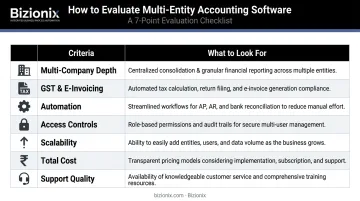
Evaluation Criteria That Actually Matter
| Criteria | What to Look For |
|---|---|
| Multi-company depth | Separate books per entity + consolidated group reporting |
| GST & e-invoicing | Native GSTR filing + direct IRP integration for IRN |
| Automation | Intercompany entries, bank reconciliation, invoice validation |
| Access controls | Role-based, entity-level, department-level permissions |
| Scalability | Can you add entities without migrating platforms? |
| Total cost | Per-entity pricing adds up fast — calculate for 3-5 year horizon |
| Support quality | India-based support with working hours that match your timezone |
The right platform fits your entity structure, existing team skills, and compliance requirements — not just the one with the longest feature list. Shortlist two or three options, run them against real scenarios like a multi-GSTIN reconciliation or an intercompany transfer, and check how each handles Indian compliance natively before committing.
Conclusion
Managing finances across multiple businesses is a real operational challenge — the right software turns that complexity into a manageable, largely automated process.
For Indian businesses, prioritise GST compliance and e-invoicing capabilities above everything else. A platform that handles your IRN generation, auto-populates your GSTR-1, and gives you consolidated financial visibility across all entities will pay for itself quickly in time saved and penalties avoided.
For Indian MSMEs that need multi-company management without enterprise-level costs, Bizionix provides a unified cloud platform covering accounting, GST compliance, operations, and entity consolidation — built specifically for the way Indian businesses operate. Explore a 14-day free trial or request a demo at info@bizionix.com or +91 91779 99277.
Frequently Asked Questions
Which accounting software is best for large businesses?
Large enterprises typically need full-suite ERP platforms like NetSuite, SAP S/4HANA, or Oracle Cloud ERP for complex global multi-entity requirements. For large Indian MSMEs and business groups that don't need that level of complexity or cost, platforms like Bizionix or Sage Intacct offer enterprise-grade capabilities at a more practical scale.
What are the top 3 accounting software options?
For Indian SMEs, Zoho Books, Tally Prime, and Bizionix are widely used options with strong local compliance features. For multi-entity businesses specifically, NetSuite, Bizionix, and Zoho Books cover the range from enterprise to mid-market.
What is multi-entity accounting software?
It's a unified platform that maintains separate books of accounts for each legal entity, subsidiary, or branch while generating consolidated financial reports across all of them. This eliminates the need for manual reconciliation across multiple disconnected systems.
Can one accounting software manage multiple companies in India?
Yes — Bizionix, Zoho Books, and Tally Prime all support multi-company management under a single login. Indian businesses should confirm that the chosen platform also handles GST compliance and e-invoicing independently across each entity's GSTIN.
Does multi-entity accounting software support GST compliance in India?
India-built platforms like Bizionix, Zoho Books, and Tally Prime offer native GST compliance including return filing and e-invoicing with IRN generation. Global tools like QuickBooks required additional configuration for GST and have since been discontinued in India, making them a non-option for Indian businesses today.
What is the difference between single-entity and multi-entity accounting software?
Single-entity software manages the books of one business only. Multi-entity platforms maintain separate ledgers for multiple legal entities and generate both individual and consolidated financial statements — essential for holding companies, franchise networks, and business groups managing more than one registered entity.