Introduction
Manual attendance registers, buddy-punching, and payroll mismatches are expensive habits. For Indian MSMEs managing anywhere from 20 to 500+ employees across multiple sites, these aren't minor inconveniences — they compound into payroll errors, compliance gaps, and hours of reconciliation work every month.
The scale of the problem is real. According to UKG and KPMG, nearly 40% of employers globally suffer millions of dollars in preventable losses annually due to payroll errors — many of which trace back to inaccurate attendance data.
That's exactly the gap attendance management software is designed to close. Modern platforms replace paper registers, biometric silos, and disconnected spreadsheets with a single digital record — one that connects directly to payroll, flags compliance issues, and gives managers live workforce visibility across locations.
This guide covers what attendance management software actually does, how to evaluate the right fit, and which platforms make the most sense for Indian MSMEs in 2025.
Key Takeaways
- Attendance management software automates clock-ins, leave tracking, and shift scheduling — with accurate data fed directly into payroll
- The best systems support multiple check-in methods: biometric, mobile GPS, QR, selfie, and web-based
- Must-have features: real-time dashboards, payroll integration, leave management, compliance reporting, and mobile access
- Indian MSMEs need cloud-based, GST-compliant tools that scale without excessive cost
- Bizionix, Keka, GreytHR, Zoho People, and Darwinbox are the strongest options for Indian businesses in 2025
What Is an Attendance Management System?
An attendance management system is a digital platform that records when employees arrive and leave, tracks absences and paid leave, manages shift schedules, and generates reports — replacing paper registers and manual spreadsheets.
Modern systems go well beyond basic time-stamping. According to Gartner's time and attendance software category, these platforms "automate the process of tracking employee work hours, attendance, leave, and overtime" while helping manage labour costs, efficiency, and compliance. That translates into three steps most businesses still handle manually.
How It Works in Three Steps
- Configure policies — Set attendance rules, shift types, leave entitlements, and compliance parameters for your organisation
- Onboard employees — Register staff via biometric device, mobile app, QR code, or card — depending on the system and workplace type
- Generate reports — Attendance data flows into dashboards, compliance reports, and payroll calculations without manual re-entry
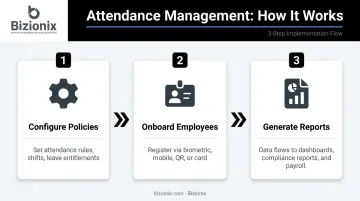
That third step separates a full attendance management system from basic time-tracking tools. Time-tracking measures task duration and supports billing. Attendance management confirms workforce presence, tracks leave balances, and feeds payroll directly, so salary calculations run on actual attendance records without manual input.
Best Attendance Management System Software in 2025
These five platforms were selected based on their suitability for Indian businesses, feature depth, payroll integration quality, ease of deployment, and value for MSMEs.
Bizionix
Bizionix is an all-in-one cloud ERP platform built specifically for Indian MSMEs. Its HR and attendance module sits within a unified system that also manages payroll, invoicing, GST compliance, and multi-location operations — eliminating the need for separate standalone tools.
What sets Bizionix apart from attendance-only tools is its architecture. Attendance data connects directly to payroll processing, leave management, and financial reporting within a single platform.
For businesses that currently juggle a biometric device, a spreadsheet, and a separate payroll tool, Bizionix consolidates all three into one system — no manual reconciliation, no data gaps.
The platform is 100% cloud-based with 24/7 access, supports multi-company management from a single login, and is designed from the ground up for Indian MSME workflows — including statutory compliance and GST-ready reporting. A 14-day free trial is available on the NEO plan.
| Category | Details |
|---|---|
| Key Features | Cloud-based attendance tracking, payroll integration, multi-location support, leave and absence management, GST-ready reporting, multi-company management, real-time dashboards |
| Best For | Indian MSMEs, multi-location businesses, CA firms, hotels, manufacturing and service companies seeking an integrated ERP with attendance capability |
| Pricing | NEO plan at ₹999/year (includes HRMS with employee management); Enterprise plan with complete HRMS & Payroll with Attendance Tracking — contact Bizionix at bizionix.com for Enterprise pricing |
Keka
Keka is an Indian HR and payroll platform designed for employee-experience-focused organisations. Its attendance module supports a wide range of capture modes: biometric, mobile, geo-tracking, continuous tracking, IP restrictions, facial recognition, selfie attendance, and IoT/WiFi/RFID devices.
Keka combines an intuitive mobile experience with strong payroll automation. Shift scheduling, overtime tracking, and leave calculations tie directly into payroll runs — making it popular among SMEs that want compliance accuracy without sacrificing usability. Its IoT-enabled tracking and flexible hybrid workforce policies give it an edge for businesses managing office and remote staff simultaneously.
| Category | Details |
|---|---|
| Key Features | Biometric, mobile, facial recognition, selfie, IoT/WiFi/RFID attendance; shift scheduling and rotation; overtime calculation; payroll integration; employee self-service portal |
| Best For | SMEs prioritising employee experience, hybrid workforce management, and payroll automation |
| Pricing | Visit keka.com/pricing for current India pricing — exact plan amounts were not confirmed from the official page at time of research (accessed May 2025; subject to change) |
GreytHR
GreytHR is an Indian HR and payroll platform built around compliance requirements. Its attendance module handles biometric, web, and mobile tracking across multiple locations, with IP-based access control and GPS-enabled geo-fencing for remote and field teams.
Where GreytHR stands out is statutory compliance coverage. Its payroll module directly handles PF with ECR generation, ESI computations, Professional Tax, TDS calculations, eTDS returns, Form 16, and Form 12BA — all tied to attendance records. For MSMEs navigating Indian labour law, having all of this built into the same attendance-linked payroll system removes a significant manual compliance burden.
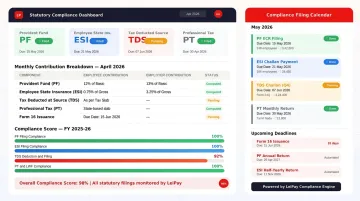
GreytHR also offers the most transparent India pricing of any platform on this list, making it a strong benchmark for MSME buyers.
| Category | Details |
|---|---|
| Key Features | Biometric, web, mobile, and selfie attendance; geo-fencing and geo-tagging; IP-based access control; auto-shift detection; PF, ESI, TDS compliance; shift and leave management |
| Best For | Indian SMEs across multiple locations needing compliance-ready centralised attendance and payroll |
| Pricing | Essential: ₹2,495/month for 50 employees + ₹45/additional employee. Growth: ₹4,495/month for 50 employees + ₹85/additional employee. GPS Live Tracking add-on: ₹140/user/month. (Source: greythr.com/pricing, accessed May 2025; subject to change) |
Zoho People
Zoho People is a cloud HR platform from Zoho — a homegrown Indian software brand — offering flexible attendance tracking across biometric, web, and mobile, with native integration across the Zoho product ecosystem.
The core advantage for Zoho People is ecosystem connectivity. Businesses already using Zoho Books, Zoho Payroll, or Zoho CRM get seamless data flow between HR and finance — no manual reconciliation between systems. The platform includes geo-fencing, automated attendance notifications, and AI support through Zia. A free edition for up to five users is available, though advanced features sit behind paid plans.
| Category | Details |
|---|---|
| Key Features | Biometric, web, and mobile check-ins; geo-fencing; real-time attendance monitoring; automated notifications; Zoho ecosystem integration; AI-assisted HR via Zia |
| Best For | Businesses already running Zoho products seeking cloud-based attendance with native ERP connectivity |
| Pricing | Free edition available for up to 5 users. For current INR plan pricing, visit zoho.com/people/zohopeople-pricing.html — exact amounts were not confirmed from the official page at time of research (accessed May 2025; subject to change) |
Darwinbox
Darwinbox is a full-scale HRMS used by large Indian organisations. Its attendance module includes geo-fencing and geo-tagging for contactless attendance, alongside a full employee lifecycle management platform.
Darwinbox is built for distributed, large workforces managing compliance across geographies. The platform's geo-fencing capabilities allow organisations to define geographic boundaries for valid check-ins, and its HRMS covers the full employee journey from onboarding through exit. Worth noting: the platform is better suited to mid-sized and large businesses than very small teams, and all pricing is handled through a sales conversation with no published plan amounts.
| Category | Details |
|---|---|
| Key Features | Geo-fencing and geo-tagging attendance; real-time attendance monitoring; customisable policies; full HRMS integration; enterprise-scale workforce management |
| Best For | Large enterprises and fast-scaling businesses needing multi-geography compliance and comprehensive HRMS |
| Pricing | Demo/sales-led model — no public pricing available. Request a demo at darwinbox.com |
How We Chose the Best Attendance Management Systems
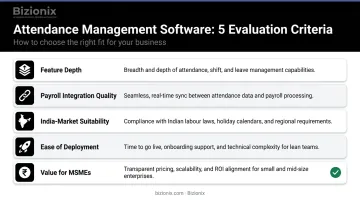
Every platform on this list was assessed against five criteria:
- Feature depth — clock-in methods, leave management, shift scheduling, overtime handling
- Payroll integration quality — does attendance data flow directly into payroll, or require manual steps?
- India-market suitability — PF, ESI, TDS, GST compliance, and local labour law support
- Ease of deployment — can a non-technical HR team set it up and run it?
- Value for MSMEs — transparent, proportionate pricing without enterprise-scale complexity
Where Most Buying Decisions Go Wrong
Of these five criteria, payroll integration trips up the most businesses. A company adopts a standalone attendance tool, then manually re-enters data into a separate payroll system. That manual step reintroduces the exact errors the software was supposed to prevent.
Attendance records should push directly into payroll calculations, leave deductions, and compliance reporting — no CSV exports, no copy-paste, no reconciliation overhead.
Before You Sign Anything
Run a 14–30 day pilot with real employee data before committing to any platform. The pilot should cover:
- At least one full location with mixed shift types
- Several leave scenarios (sick leave, earned leave, unpaid absence)
- One complete payroll cycle end-to-end
If the system handles all three without manual intervention, it's ready. If it struggles, negotiate implementation support or walk away — problems visible in a pilot only get harder to fix post-deployment.
Conclusion
The right attendance management system does more than log clock-ins — it drives accurate payroll, labour compliance, and real-time workforce visibility. For Indian MSMEs, choosing a platform that integrates attendance with payroll and broader operations is the difference between eliminating manual work and digitising the same inefficiencies.
Before making a final decision, assess three long-term factors:
- Scalability — can the platform grow from 30 to 300 employees without requiring a system change?
- Integration depth — does attendance data flow directly into payroll without manual exports?
- India compliance readiness — does the platform support PF, ESI, and relevant labour law requirements natively?
A platform that checks all three boxes is rare — but it exists. Bizionix is a GST-ready cloud ERP built specifically for Indian MSMEs, covering HR, attendance, payroll, and core operations in a single system. Visit bizionix.com or contact the team at +91 91779 99277 to learn more or request a demo.
Frequently Asked Questions
What is the difference between time tracking and attendance management software?
Time tracking measures how long tasks take and typically supports project billing or client reporting. Attendance management confirms employee presence, tracks leave and absences, and feeds directly into payroll. The best systems combine both functions so data flows without duplication.
What features should I look for in attendance management software for an MSME?
Prioritise multiple check-in methods (biometric, mobile, GPS), leave and shift management, direct payroll integration, and real-time dashboards. For Indian MSMEs specifically, also verify that the platform supports PF, ESI, and local labour law compliance — not all tools include this natively.
Is cloud-based attendance software better than on-premise for Indian businesses?
Cloud-based systems offer lower upfront cost, automatic updates, remote access, and easier multi-location management, making them the better fit for most Indian MSMEs. On-premise suits organisations with strict data residency requirements, though that need is uncommon at the MSME scale.
How does attendance management software integrate with payroll?
Integrated systems automatically push attendance data (work hours, overtime, leave deductions) into payroll calculations without manual re-entry. Integration quality varies significantly between products, which is why you should test a full payroll cycle during your evaluation period.
Can attendance management software track remote and field employees?
Yes. Modern systems support GPS-based mobile check-ins, geo-fencing, and offline sync for field workers. Managers can verify that employees are clocking in from authorised locations, which matters most for businesses with distributed or site-based teams.
What is an ERP attendance system and how is it different from a standalone tool?
An ERP attendance module is part of a larger business management platform: attendance data connects directly with payroll, HR, and finance without separate imports or reconciliation. Standalone tools require manual data transfers between systems, bringing back the same errors the software was supposed to prevent.