Introduction
Picture a hotel sales manager on a Tuesday morning: one browser tab open with Gmail, another with an OTA portal, a spreadsheet tracking corporate inquiries from last week, and a generic CRM that doesn't know what an RFP is. A wedding inquiry from Friday sits unread. A corporate block request from a regular client got buried under OTA notifications.
This is how most mid-sized hotels manage leads — not through a system, but through controlled chaos.
The cost is real. According to Cvent's 2025 planner survey, 24% of event planners cite slow responses as a direct frustration when sourcing venues, and most expect an RFP answer within four business days. Groups360 reports the average hotel RFP response rate sits around 45% — meaning 55 out of every 100 inquiries go unanswered.
At that response rate, lost bookings aren't an edge case — they're a predictable pattern.
This guide breaks down what hotel lead management software is, which features deliver the most impact, and how Indian hotel MSMEs can evaluate platforms built for their actual workflows — not enterprise chains with dedicated IT teams.
Key Takeaways
- Hotel lead management software centralises all inquiries, tracks leads through the sales funnel, and automates follow-ups to prevent lost revenue
- Teams without a structured system rely on inboxes and spreadsheets — causing slow responses, missed leads, and no pipeline visibility
- Features to prioritise: centralised lead capture, lead scoring, pipeline tracking, automated follow-ups, and actionable reporting
- Respond within two business hours, qualify leads early, and log every touchpoint — not just outcomes
- Indian hotel MSMEs need affordable platforms that combine lead management with billing and GST compliance
What Is Hotel Lead Management Software?
Hotel lead management software is a purpose-built system that captures, organises, tracks, and nurtures every incoming inquiry through a single digital workspace — covering everything from corporate RFPs and OTA bookings to wedding and event enquiries.
The key phrase is purpose-built. A generic CRM like Salesforce or Zoho can store contact records, but it doesn't understand group room blocks, event dates, proposal stages, or room pickup pacing. Getting a generic CRM to mirror how hotels actually sell takes months of custom development — and still produces a clunky workaround.
Hotel Tech Report defines hotel sales software as technology that centralises the full sales workflow from inquiry capture through proposals, contracts, and account management — with capabilities that reflect hospitality-specific complexity like group business, event coordination, and room inventory management. Generic tools can't replicate that out of the box.
What the Software Actually Does
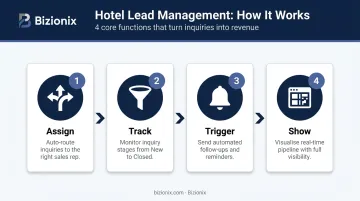
From the moment a lead arrives through any channel, a hotel lead management system:
- Assigns the lead to the right sales rep automatically, based on lead type or source
- Tracks the enquiry through defined stages — New → Qualified → Proposal Sent → Negotiation → Closed
- Triggers follow-up tasks, reminders, or automated communications based on lead activity
- Shows managers a real-time pipeline view — what needs attention, what's stalled, and what's close to converting
The result is a sales team working from a structured, visible pipeline — not scrambling through a cluttered inbox hoping nothing slips through.
Why Hotels Lose Revenue Without Proper Lead Management
The Reactive Lead Problem
Most hotel sales teams work from their email inbox. Leads get handled in the order they arrive, not in order of priority or probability. During high-demand periods, strong corporate enquiries get buried under OTA noise. During slow periods, there's no clear pipeline to work from — just a growing gap between available inventory and confirmed bookings.
The result: planners and corporate bookers move on to whoever responds first. Cvent's planner survey of 1,200+ respondents — foundational research still widely cited across the events industry — found that meeting response deadlines was a win factor for 19% of planners, while answering all RFP questions (40%) and providing accurate pricing (24%) were even more decisive. Speed and accuracy together win business.
The Multi-Source Chaos Problem
Leads arrive through multiple channels simultaneously:
- Brand portals and GDS platforms
- OTA enquiry forms (MakeMyTrip, Booking.com, Goibibo)
- Direct website enquiry forms
- Phone calls and walk-ins
- Email from event planners and corporate travel managers
Without a centralised system, sales teams spend time triaging rather than selling. Duplicate leads create conflicting follow-ups. Phone enquiries never make it into any system. A lead that came in through two channels simultaneously gets two separate — and often contradictory — responses.
The Visibility Gap
With no structured pipeline, hotel managers have no way to see:
- Which sales rep owns which lead
- How many active opportunities are in the funnel
- Where leads are stalling and why
- What the team's actual conversion rate is
Coaching becomes guesswork. Forecasting becomes impossible. And when a sales rep leaves, their leads often leave with them.
The Downstream Revenue Impact
Group and event leads aren't just about room revenue. A missed corporate block or wedding booking also means lost F&B spend, missed event space utilisation, and uncaptured ancillary revenue. CoStar and STR data through 2024 showed group demand rising 3.5% year-on-year with banquet and catering among the strongest F&B growth categories. Every missed group lead leaves the full revenue stack on the table — not just the room nights.
Key Features to Look for in Hotel Lead Management Software
Centralised Lead Capture
Every lead from every channel — email, OTA platforms, web forms, phone logs, RFP tools — should land in one dashboard. This "single source of truth" eliminates the triage problem. Sales reps stop managing inboxes and start managing opportunities. Cvent's 2025 survey found that 96% of planners use online RFP tools, making multi-channel capture essential for any modern property.
Lead Scoring and Prioritisation
Not every inquiry deserves equal urgency. A corporate block request arriving four days before the event date and a wedding inquiry for 14 months out require entirely different response speeds and effort levels.
Lead scoring lets teams automatically prioritise based on:
- Estimated lead value (room nights × rate + F&B)
- Event date proximity
- Lead source (direct vs. OTA vs. referral)
- Decision-maker access and booking probability
High-scoring leads get immediate attention; lower-priority inquiries enter a structured nurture sequence.
Pipeline Tracking and Stage Management
Every lead should map to a defined stage with a clear next action. A well-designed pipeline looks like:
- New — Inquiry received, not yet qualified
- Qualified — Event details, budget, and decision-maker confirmed
- Proposal Sent — Formal offer delivered
- Negotiation — Active discussion on pricing or terms
- Closed/Won or Lost — Deal resolved with outcome recorded
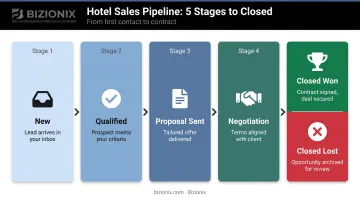
Managers should be able to see this pipeline in real time — not in a Monday morning status report.
Automated Follow-Up Tools
The "just checking in" email is the lowest-value follow-up in hospitality sales. Automation replaces it with stage-triggered sequences: an updated floor plan when a lead reaches the Proposal stage, or an availability confirmation when a prospect goes quiet for 72 hours.
The numbers from Radisson Hotel Group's AI-powered RFP rollout show what's possible at scale. According to Skift Meetings' 2023 report on the Radisson/Hivr.ai implementation, the group saw an 80% increase in lead-to-quote conversions, a 125% improvement in customer response rate, and a 59% reduction in proposal dispatch time.
These are company-reported figures from one implementation, not industry-wide benchmarks — but they reflect the practical scale of impact that well-configured automation can deliver.
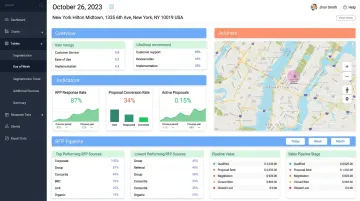
Reporting and Analytics
Month-end reports are too late for daily sales decisions. The metrics that actually drive behaviour are visible in real time:
- Lead source performance (which channels generate qualified leads)
- Team response time (who's meeting the two-hour standard)
- Conversion rate by lead segment (corporate vs. event vs. wedding)
- Pipeline value at each stage
Integration With Hotel Operations
Real-time reporting only delivers value when the data behind it is complete. A lead management system that creates a new data silo solves one problem and introduces another. The best implementations connect lead management with billing, invoicing, and operations — so when a lead converts to a confirmed booking, the workflow continues in the same system rather than jumping to a separate tool.
For Indian hotel MSMEs, Bizionix's HotelEase platform is built around this integration principle. The system's modules — Reservations, Front Office, Billing & POS, Guest CRM, and Accounts — operate from a single database, meaning a confirmed group booking flows through to GST-compliant invoicing without manual re-entry. For properties managing F&B, event space, and room charges across the same event, that connected workflow prevents the billing gaps and missed charges that erode revenue.
Hotel Lead Management Best Practices for 2025
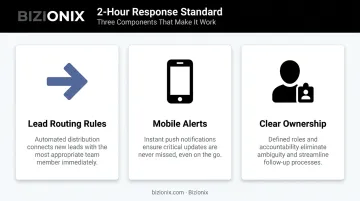
Set a Two-Hour Response Standard
Planners expect responses within four business days, but properties that respond within two hours — especially for high-value corporate and group inquiries — gain a measurable competitive edge. Put this into practice through:
- Lead routing rules that assign inquiries to the correct rep immediately on arrival
- Mobile alerts so reps aren't waiting to check a desktop inbox
- Clear ownership — every lead has one owner, not a shared inbox
Qualify Before You Invest
Not every inquiry will become a booking. A practical qualification checklist before committing significant proposal time:
- Confirmed event date and flexibility window
- Group size and room block requirement
- Budget signals (specific or ballpark)
- Decision-maker identified and reachable
- Competing venues already under consideration
Early qualification keeps strong leads moving fast and stops weak leads from consuming disproportionate follow-up effort.
Log Activity, Not Just Outcomes
Most CRMs get used only when a deal closes — which means the pipeline data is a graveyard of results with no explanation for what happened in between. Every touchpoint matters:
- Who called, when, and what was discussed
- What was sent and when
- What the prospect said about competing offers
Activity logs enable smoother handoffs when reps are unavailable, support better coaching conversations, and make pipeline reporting accurate rather than aspirational.
Follow Up With Value
The difference between professional follow-up and pestering is what you bring to each interaction. Instead of "just checking in," send:
- A revised proposal reflecting new information from the last conversation
- A local events calendar showing why their preferred dates will be high-demand
- An updated availability confirmation if space is limited
Guide the prospect toward a decision. Don't chase them.
Track Lead Sources Consistently
Which channels actually generate bookings — not just inquiries? Each source has a different cost profile:
- OTA leads generate volume but carry commission costs
- Direct web inquiries convert at higher margins
- Referrals often close faster with less nurturing
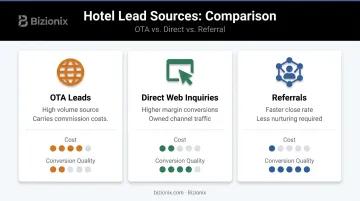
Analysing source performance monthly lets hotels shift spend toward what actually works — and over six to twelve months, that shift drives compounding revenue gains.
How to Choose the Right Hotel Lead Management Software
Match the Tool to Your Property's Reality
The right software for a 30-room boutique property in Hyderabad is different from what a 200-room business hotel managing multi-property portfolios needs. Before evaluating options, answer:
- How many leads do we receive per month across all channels?
- Do we manage multiple properties from one team?
- Do we need PMS integration, and with which system?
- Which reports do we actually review — and how often?
A platform with enterprise-grade complexity that your sales team won't log into is worse than a simple spreadsheet. Cost is the next filter.
Evaluate Total Cost of Ownership
Licensing fees are the visible cost. Hidden costs add up quickly: setup, training, ongoing maintenance, and the overhead of running separate tools for CRM, billing, invoicing, and GST compliance.
For Indian hotel MSMEs, consolidation matters. Bizionix's NEO package starts at ₹999/year and bundles CRM and lead management with accounting, invoicing, and GST compliance in a single platform. Properties paying separately for a booking tool, a billing system, and a compliance solution can cut both monthly spend and the friction of managing disconnected data by consolidating into one platform.
Prioritise Ease of Use
A system that requires three clicks to log a call or five screens to update a lead stage won't get used consistently. Before committing:
- Request a demo using real leads from your actual sales process
- Have the rep who will use it daily evaluate the mobile experience
- Assess how long it takes to onboard a new team member
Bizionix offers a 14-day free trial on its NEO package and a free-to-try evaluation path for HotelEase, which allows hotels to test the platform against real operational scenarios before purchasing.
Frequently Asked Questions
What are the 7 pillars of CRM?
The 7 pillars of CRM are generally defined as: strategy, people, process, technology, information, channel management, and customer experience. In hotel lead management, all seven apply. A CRM delivers results only when the team, the process, and the underlying data are aligned behind it.
What is hotel lead management software and how is it different from a hotel CRM?
Hotel lead management software focuses specifically on capturing, tracking, and converting inquiries through the sales funnel. A hotel CRM has broader scope — guest profiling, loyalty management, and post-stay communication. Many platforms, including Bizionix's HotelEase, combine both functions within a single system.
How does lead management software help hotels increase direct bookings?
By centralising leads from all sources and automating timely follow-ups, lead management software helps sales teams convert web and RFP enquiries into direct bookings faster — reducing dependence on commission-heavy OTA channels and improving margins on each confirmed reservation.
Can small and mid-sized hotels in India benefit from lead management software?
Yes — particularly Indian MSMEs, which often rely on manual processes and fragmented tools. Faster follow-ups and real-time pipeline visibility can improve conversion rates without requiring a large sales team. The Hotel Association of India notes that over 80% of Indian hotels are medium, small, or standalone properties — exactly the segment that gains most from structured lead management.
How does hotel lead management software integrate with a Property Management System (PMS)?
Integration between a lead management tool and a PMS allows confirmed bookings to automatically update the reservation calendar, eliminates double data entry, and keeps sales and operations teams working from the same information. Bizionix's HotelEase includes real-time PMS integration that syncs guest records and room assignments instantly upon booking confirmation.
What should I look for when choosing between a standalone lead management tool and an all-in-one ERP?
Standalone tools offer deep specialisation but create data silos across billing, compliance, and operations. Choose an all-in-one ERP if you also need GST invoicing, multi-department coordination, or multi-property management — consolidating systems reduces both cost and complexity without sacrificing the functionality you rely on.