Introduction
"Web-based enterprise management" means different things depending on who's using the term. For IT infrastructure teams, it refers to WBEM — a formal technical standard governed by the Distributed Management Task Force (DMTF) for managing distributed computing environments. For business operators, it describes the broader shift to running company operations through cloud-based platforms.
This article covers both. It traces the WBEM protocol standard from its 1996 origins through its layered architecture and implementation realities, then examines how the same underlying principle — unified, standardised management of disparate resources — has shaped modern cloud ERP platforms for growing businesses.
What you'll learn:
- The formal definition and founding purpose of WBEM
- How the architecture works, layer by layer
- Key components: CIM, CIMOM, providers, and protocols
- How WBEM compares to SNMP and WMI
- How the concept maps to modern web-based business management platforms
Key Takeaways
- WBEM is a DMTF-governed standard initiated in 1996 to unify IT infrastructure management across heterogeneous platforms
- Its architecture flows from operator interface → WBEM client → HTTP/HTTPS transport → WBEM server → providers → managed hardware/software
- The Common Information Model (CIM) is the platform-neutral data model at the centre of every WBEM deployment
- WBEM differs from SNMP (network-focused, simpler scope) and WMI (Windows-only implementation by Microsoft)
- The same unified-management model underpins modern cloud ERP systems — letting businesses replace fragmented tools with a single, real-time operational platform
What Is Web-Based Enterprise Management (WBEM)?
The Founding Problem
Before 1996, enterprise IT environments had no standardised way to manage hardware, software, and networks across different vendors. Each platform spoke its own language, and management tools were siloed, incompatible, and vendor-specific — a problem that multiplied as enterprises scaled across heterogeneous environments.
Announced in 1996 by BMC Software, Cisco Systems, Compaq, Intel, and Microsoft, WBEM established a common framework for managing distributed computing environments using internet-standard communication protocols. Today, it is governed and published by the DMTF as a set of specifications for discovering, accessing, and manipulating CIM-modelled resources.
What "Web-Based" Actually Means
The name is misleading. WBEM is not tied to a browser interface or any specific user interface at all. The "web" refers to its use of HTTP/HTTPS as the transport layer — the same protocols that underpin internet communication.
Operators can interact with a WBEM deployment through:
- A graphical user interface (GUI)
- A browser-based interface (BUI)
- A command-line interface (CLI)
None of these are required. WBEM operates entirely below the interface layer.
What WBEM Manages
WBEM's scope covers the full enterprise infrastructure stack:
- Server hardware — processors, memory, storage
- Network infrastructure — switches, routers, interfaces
- Desktop environments — workstation configuration and status
- Storage systems — arrays, volumes, file systems
- Virtualised environments — virtual machines and containers
The foundational data model enabling all of this is the Common Information Model (CIM) — detailed in the next section.
The Architecture of WBEM: How It Works
WBEM uses a layered broker-and-provider model. Understanding it requires following a management request from the operator down to the actual hardware.
Layer 1: The Interface (No Direct Device Access)
The operator works at the interface layer — a GUI, browser UI, or CLI. This layer has no direct connection to managed devices. It simply sends requests to the WBEM client through a set of APIs.
Layer 2: The WBEM Client
The client receives the operator's request, identifies the correct WBEM server for the target device, and constructs an XML-encoded CIM operation. Supported operations include:
GetClass,GetInstance,EnumerateInstancesSetProperty,CreateInstance,ModifyInstance,DeleteInstanceAssociators,References,ExecQuery
Layer 3: Transport (HTTP/HTTPS + CIM-XML)
The WBEM client sends the encoded request to the WBEM server over HTTP or HTTPS, with the payload in CIM-XML format (DSP0201). This transport layer is the communication backbone of the architecture — built on open standards, secured via HTTPS, and independent of any single vendor's implementation.
Layer 4: The WBEM Server (CIMOM)
The WBEM server — more precisely, the CIM Object Manager (CIMOM) — is where the real work happens. It:
- Decodes the incoming CIM-XML request
- Performs authentication and authorisation
- Checks syntax and semantics
- Consults the CIM model of the managed device
- Routes the request to the appropriate provider
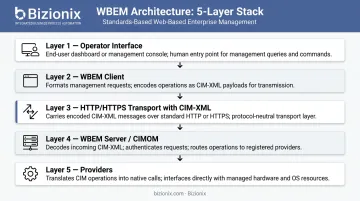
Without a valid CIM model for the target device, the CIMOM has no basis for routing — step 4 is what drives step 5.
Layer 5: Providers
Providers are small pieces of code sitting between the CIMOM and actual hardware or software. They handle device-specific interactions using a standardised interface — CMPI (Common Manageability Programming Interface) — a C-based extension interface that keeps provider development independent of both the operator's interface and the WBEM server's internals.
Each provider type handles a distinct category of interaction:
- Instance providers — retrieve and manipulate resource instances
- Method providers — execute operations on managed resources
- Association providers — handle relationships between managed objects
- Indication providers — generate event notifications
This design means new hardware or software can be brought under WBEM management simply by writing a new provider — without modifying the CIMOM or the operator's interface.
Core Components and Specifications of WBEM
The Common Information Model (CIM)
CIM is the platform-neutral data model that makes WBEM vendor-agnostic. It describes managed objects — hardware, software, networks, applications — using a consistent class-based structure regardless of platform.
CIM has two distinct parts:
| Part | What It Contains |
|---|---|
| CIM Specification (DSP0004) | Language, naming conventions, meta-schema defining Classes, Properties, Methods, and Associations |
| CIM Schema | Pre-built class libraries for common managed environments (core, common, and extension layers) |
The CIMOM (CIM Object Manager) is the application that manages these objects at runtime — receiving client requests, consulting the CIM model to identify the right providers, and routing operations accordingly.
WBEM Protocols and Discovery
WBEM is not a single protocol. The DMTF publishes several distinct specifications:
- CIM-XML (DSP0201) — encodes CIM data in XML for HTTP transport; the base encoding format
- CIM Operations over HTTP (DSP0200) — maps CIM operations onto HTTP request/response
- WS-Management (DSP0226) — web services-based management communication; widely implemented across enterprise infrastructure
- CIM-RS (DSP0210) — RESTful access to CIM/WBEM resources, enabling modern API-based environments to work with existing WBEM infrastructure
Beyond transport protocols, the DMTF also defines how clients discover and query WBEM resources:
- SLP (DSP0205) — Service Location Protocol allows WBEM clients to locate available WBEM servers on a network without manual configuration
- CQL (DSP0202) — CIM Query Language for querying managed object data
- FQL (DSP0212) — Filter Query Language for filtering managed object results
Implementing WBEM: What It Takes
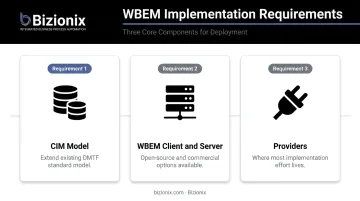
Three Core Requirements
Any WBEM implementation needs:
- A CIM model — typically created by extending an existing DMTF-published standard model for the device or service being managed; rarely built from scratch
- A WBEM client and server — open-source and commercial implementations are widely available
- Providers — custom code that interfaces between the WBEM server and the actual device or service; this is where most implementation effort lives
Available Implementations
| Implementation | Language | Notes |
|---|---|---|
| OpenPegasus | C++ | Implements significant DMTF CIM/WBEM components; v2.14.4 released Aug 2023 |
| OMI | C | Microsoft's open-source DMTF CIM/WBEM implementation; maintenance status varies by release |
| SBLIM/SFCB | C | Lightweight CIM daemon/CIMOM; available in Ubuntu packages |
| pywbem | Python | WBEM client and indication listener in pure Python |
| OpenWSMAN | C | Open-source WS-Management implementation for Linux, Unix, and Windows |
Operating systems with documented WBEM support:
- Microsoft Windows — via WMI (Windows Management Instrumentation)
- Oracle Solaris — Solaris WBEM Services with CIM Operations over HTTP
- IBM z/OS and AIX — CIM server with RACF-based security
- HP-UX — HP WBEM Services (
/opt/wbem) - Red Hat Enterprise Linux —
tog-pegasuspackages provide OpenPegasus services - Ubuntu — SFCB lightweight CIMOM
Practical Considerations
With the right implementation in place, the focus shifts to deployment decisions. Key steps before going live:
- Define which managed objects require instrumentation
- Select or build compatible providers for each device or software type
- Configure authentication and authorization correctly at the WBEM server layer
- Choose the appropriate protocol variant — CIM-XML, WS-Man, or CIM-RS — based on your environment
WBEM vs. Other Management Standards
WBEM vs. Other Management Standards
WBEM vs. SNMP
SNMPv1 was standardised in RFC 1157 in 1990 — six years before WBEM emerged. The two standards take fundamentally different approaches:
| Dimension | SNMP | WBEM/CIM |
|---|---|---|
| Model | Flat MIB-based data model | Object-oriented, class-based CIM model |
| Operations | Poll/trap (GetRequest, SetRequest, Trap) | Full CRUD plus method invocation and event indication |
| Scope | Primarily network device monitoring | Full enterprise: servers, storage, apps, networks |
| Complexity | Simpler to implement | More complex, more capable |
| Extensibility | Limited | Vendor extensions built into the model |
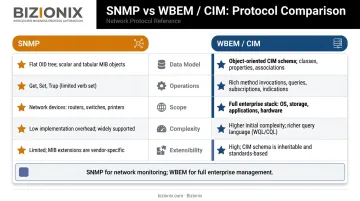
SNMP remains dominant for network device monitoring. WBEM is stronger for enterprise server and system management where enterprise management demands richer object models.
WBEM vs. WMI
WMI (Windows Management Instrumentation) is Microsoft's proprietary implementation of the WBEM standard, scoped exclusively to Windows. It includes a CIM repository, a management infrastructure layer, and providers — all following WBEM architecture. The relationship is direct:
- WBEM = the open, platform-neutral standard any vendor can implement
- WMI = Microsoft's Windows-specific implementation of that standard
Other Approaches
Remote shells, NETCONF/YANG, and proprietary vendor management APIs each cover specific niches — but none offers a unified model across heterogeneous environments. That's where WBEM's advantage becomes clear:
- Platform-neutral: one framework spanning Windows, Linux, Unix, and specialised hardware
- No vendor lock-in: eliminates the need for separate tooling per system type
- Standardised model: consistent object definitions regardless of underlying infrastructure
DMTF's Redfish standard handles modern secure hardware management for converged and software-defined data centres, complementing WBEM rather than replacing it.
Web-Based Enterprise Management Beyond IT: Modern Business Platforms
The phrase "web-based enterprise management" has taken on a second meaning that has little to do with CIM schemas or HTTP-encoded management requests.
For millions of businesses, it describes something more immediate: managing the entire operation — finance, inventory, billing, GST compliance, HR, multi-location stock — through a single web-accessible platform. No IT infrastructure expertise required.
The Same Principle, Applied to Business Operations
The core logic mirrors WBEM exactly. Instead of unified management of heterogeneous IT devices, cloud ERP platforms unify all business functions — replacing siloed, incompatible department tools with a single standardised framework.
India's public cloud services market is projected to reach US$30.4 billion by 2029, growing at a 22.6% CAGR for 2024–2029, according to IDC. With 5.70 crore MSMEs registered on India's Udyam Registration Portal as of December 2024, the demand for accessible, affordable business management platforms is growing faster than most traditional software vendors can serve.
What This Looks Like in Practice
For a mid-sized Indian business, web-based enterprise management means replacing:
- Excel files for accounting and stock tracking
- Separate tools for GST returns and e-invoicing
- Manual processes for HR and payroll
- Disconnected billing and CRM systems
...with a unified cloud platform accessible from any browser, with real-time visibility across departments.
Bizionix, developed by IIS-LLP (a subsidiary of Protocol India Private Limited) and backed by over two decades of industry experience, is built specifically for this purpose. The platform serves Indian MSMEs with integrated modules covering Finance & Accounting, Sales & CRM, Inventory Control, Warehouse Management, HRMS & Payroll, Purchase Management, and GST compliance — all under a single secure login.
Key capabilities include:
- Direct IRP API integration generates IRNs and QR codes automatically; the entire e-invoicing process completes in seconds
- Switch between entities, subsidiaries, or GST-registered branches under a single login with multi-company management
- Real-time dashboards pull sales, inventory, finance, and HR data from one continuously updated source
- Entity-level permissions and full activity logs keep access accountable with role-based access controls
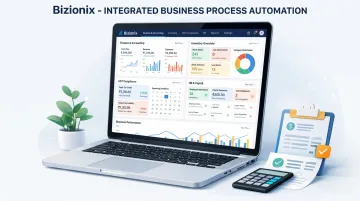
The starting plan (Bizionix NEO) is priced at ₹999/year — a fraction of what enterprise ERP systems cost — with no IT expertise required for setup.
The Convergence
WBEM the protocol manages IT infrastructure uniformly through a standardised framework. Cloud ERP platforms apply the same principle — unified, standardised management of all business resources — to the operational side of enterprises. The domain changes; the architecture does not.
Frequently Asked Questions
What is web-based enterprise management?
WBEM is a set of DMTF-published specifications for managing distributed IT environments using internet standards and the CIM data model. More broadly, the term also describes managing business operations — accounting, inventory, HR, compliance — through unified web-based platforms accessible from any browser.
What is WBEM used for?
WBEM is used to manage IT infrastructure — servers, networks, storage, desktops, and virtualised environments — across mixed or multi-vendor platforms in a standardised way. It underpins tools like Windows WMI and has been adopted across storage management, grid computing, and web services environments.
What is the difference between SNMP and WBEM?
SNMP is a simpler, older protocol using a poll/trap model focused primarily on network device monitoring. WBEM uses an object-oriented CIM data model capable of managing the full enterprise stack — servers, applications, storage, and networks — making it more powerful but considerably more complex to implement.
What are the core components of WBEM?
The five core components are CIM (data model), CIMOM (request manager), providers (hardware/software interface code), CIM-XML and WS-Management (transport protocols), and SLP (service discovery). Together, they form a complete, vendor-neutral management stack.
How does WBEM differ from WMI?
WMI is Microsoft's Windows-specific implementation of the WBEM standard. It follows WBEM architecture — CIM model, CIMOM, providers — but is scoped exclusively to Windows. WBEM is the open, platform-neutral standard that any vendor can implement across any operating system.
Is WBEM still relevant today?
Yes. WMI remains deeply embedded in Windows environments, and OpenPegasus and pywbem are actively maintained. DMTF's Redfish standard extends the core CIM concepts into modern REST-based APIs, keeping WBEM's foundational model relevant in enterprise IT today.