Introduction
A WhatsApp group and a shared spreadsheet can run a 10-person business just fine. Scale to 50, and those same tools start creating the problems they once solved.
Growing Indian businesses frequently operate on a patchwork of disconnected apps — manual approval chains, duplicate data entry across departments, and month-end reconciliations that surface problems nobody caught in real time.
Processes that once felt manageable suddenly create bottlenecks, financial leakage, and zero visibility into what's actually happening across the organisation.
This is the gap that Intelligent Business Process Management Software (iBPMS) is designed to close. As a category, iBPMS goes beyond mapping processes on paper — it actively automates decisions, flags exceptions in real time, and connects departments through shared workflows.
This guide explains what iBPMS is, how it differs from traditional BPM and ERP, what capabilities to evaluate, and what Indian MSMEs need to look for when selecting a platform.
Key Takeaways
- iBPMS adds AI-driven rules, real-time analytics, and cross-department integration to traditional process management
- Traditional BPM maps and monitors — iBPMS automates decisions, flags exceptions, and surfaces insights autonomously
- Key capabilities span process modelling, rule management, real-time analytics, third-party integration, and team collaboration
- Indian MSMEs should prioritise cloud-first deployment, GST e-invoicing readiness, and scalability without SAP-level complexity
What Is iBPMS and How Is It Different from Traditional BPM?
Business Process Management (BPM) is the practice of designing, monitoring, and continuously improving the workflows that run a business — from purchase approvals to employee onboarding to invoice generation. As defined by the Object Management Group, BPM is a continuous, iterative discipline aimed at reducing errors, lowering costs, and increasing productivity.
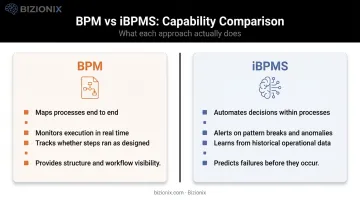
Traditional BPM gives you visibility and structure. It tells you how a process should work and lets you track whether it does.
Around 2012, Gartner introduced the "iBPMS" label to distinguish platforms that had evolved beyond static workflow tools. The 2019 Gartner Magic Quadrant for Intelligent Business Process Management Suites defines iBPMS as an integrated set of technologies that coordinate people, machines, and things — covering process discovery, analysis, design, implementation, execution, monitoring, and optimization. In short, iBPMS adds intelligence to the BPM foundation.
The practical difference:
- BPM tells you a process exists and whether it ran
- iBPMS automates decisions within that process, alerts you when something breaks pattern, and learns from historical data to predict where failures are likely next
That distinction matters when evaluating software categories. iBPMS is not a standalone CRM, a project management tool, or a simple workflow builder — it's the orchestration layer that ties multiple business functions together under a single process logic.
How iBPMS Relates to ERP
ERP manages data — financial records, inventory levels, headcount, purchase orders. iBPMS manages the processes that connect those data points across departments.
The confusion between the two is common — and costly. Businesses adopt an ERP expecting automation, then discover they still have manual approval handoffs, visibility gaps, and no real way to track where workflows are stalling.
Gartner warns that by 2027, more than 70% of recently implemented ERP initiatives will fail to fully meet their original business-case goals, with as many as 25% failing catastrophically. The root cause is rarely the ERP itself — it's the absence of process intelligence around it.
The strongest modern platforms combine both:
- ERP as the system of record — storing financial, operational, and transactional data
- iBPMS as the intelligent orchestration layer — automating decisions, routing approvals, and flagging exceptions in real time
Core Features of Intelligent Business Management Software
The difference between a genuine iBPMS platform and a basic workflow app shows up quickly — in whether the system can execute, monitor, and learn from your processes, or just document them. These are the capabilities that matter.
Process Modelling and Graphical Design
Visual, drag-and-drop process design lets business users — not developers — map workflows, assign ownership, and define conditional logic without writing a single line of code.
Processes that exist only in people's heads or static SOPs cannot be automated or optimised. Once a workflow is visually modelled, the system can execute it, track it, and flag where it breaks down.
Rule Management and Decision Automation
iBPMS platforms allow businesses to codify recurring decisions into automated rules:
- Approval thresholds (invoices above ₹1 lakh require finance director sign-off)
- Escalation triggers (purchase requests pending for 48+ hours automatically escalate)
- Deadline alerts (contract renewal reminders 30 days before expiry)
When these rules live in the system rather than in someone's inbox, the system catches exceptions before they become problems.
Real-Time Analytics and Ad Hoc Reporting
Reporting alone doesn't improve processes — visibility into live execution does. A capable iBPMS platform shows you:
- How long each workflow step takes on average
- Where delays recur most frequently
- Which exceptions are systemic vs. one-off
The distinction worth noting: retrospective reports tell you what happened. iBPMS analytics tell you what's happening now — and which steps need intervention before a bottleneck compounds.
Third-Party Integration and Unified Data
A platform that can't connect to your existing accounting software, CRM, or inventory tools creates new silos rather than eliminating old ones. Look for:
- Open APIs or pre-built connectors
- A unified data model where changes in one module reflect across the system instantly
- Native integration with India-specific compliance systems (GST e-Invoice portal, e-Way Bill)
Bizionix, for example, connects directly with the GST e-Invoice system via API — generating IRNs instantly without manual portal uploads or third-party tools.
Collaboration and Self-Service Portals
Cross-functional work breaks down when approvals happen over WhatsApp and sign-offs are verbal. A well-built iBPMS replaces that with structured, traceable collaboration:
- In-app task assignment with role-based access
- Digital approval chains replacing WhatsApp approvals and verbal sign-offs
- Employee self-service portals reducing administrative follow-up
- Audit trails showing who acted on what, and when
How iBPMS Tools Drive Process Optimisation
Process optimisation is a measurable outcome, not a vague goal. iBPMS tools reduce cycle times, eliminate redundant steps, prevent financial leakage, and give leaders real-time visibility into where operations are actually running versus where they should be.
From Reactive Management to Predictive Operations
Without intelligent process tools, businesses manage by exception — problems get discovered after they've caused damage. A missed approval or rejected invoice surfaces at month-end, when the cost of fixing it is highest.
With iBPMS, rule-based alerts and real-time analytics surface exceptions before they escalate. A deadline breach triggers an automated escalation. An anomalous transaction flags for review before it posts. Teams shift from firefighting to prevention.
Eliminating Departmental Silos with Unified Workflows
Sales, finance, procurement, and operations working in separate systems create predictable failures: handoff delays, duplicate data entry, and accountability gaps where no one owns the gap between departments.
iBPMS tools connect these departments through shared workflows and a single source of truth. When a sale closes, inventory updates automatically. A raised purchase order appears in finance immediately, and the resulting invoice populates GST accounting entries without manual reconciliation.
Platforms like Bizionix are designed specifically around this problem for Indian businesses — unifying CRM, sales, inventory, procurement, HRMS, and finance in one architecture so that cross-departmental handoffs happen in the system, not on WhatsApp.
Faster Billing Cycles and Financial Accuracy
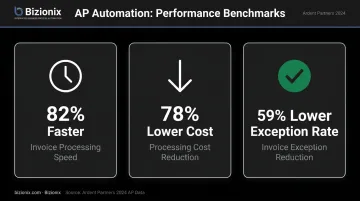
The performance gap between automated and manual billing is well-documented. According to Ardent Partners' 2024 AP benchmarking data, best-in-class accounts payable teams process invoices 82% faster and at 78% lower cost than their peers — with an invoice exception rate 59% lower than the rest of the market.
Pre-validated invoices eliminate the back-and-forth of rejection and resubmission. Automated e-invoicing workflows generate IRNs within seconds. Real-time financial tracking means billing doesn't wait for month-end reconciliation.
For Indian MSMEs operating under GST, this has direct compliance implications. Since Notification No. 10/2023, e-invoicing has been mandatory for businesses with aggregate turnover between ₹5 crore and ₹10 crore. Any platform that requires manual IRN generation is creating compliance risk on every transaction.
What to Look for When Evaluating iBPMS Tools for MSMEs
Most iBPMS platforms are designed for large enterprises — multi-year implementations, dedicated IT teams, and pricing that reflects both. MSMEs need enterprise-grade process intelligence without the overhead. Here's what to prioritise:
Cloud-First Deployment
A 100% cloud-based platform eliminates infrastructure costs, on-premise maintenance, and location constraints in one move. Multi-location Indian businesses managing distributed teams get real-time visibility across every site without setting up a single server. Bizionix is built entirely on cloud architecture with 24/7 access and real-time visibility across all modules.
GST Compliance Readiness
For any Indian MSME above the ₹5 crore turnover threshold, GST e-invoicing compliance is non-negotiable. Evaluate whether:
- The platform connects directly to India's Invoice Registration Portal (IRP)
- IRN generation is automated, not manual
- GSTR-1 auto-populates from sales data
- Pre-validation prevents rejections before submission
Configurability Without Developer Dependency
The platform should adapt to how your business works today and scale as it grows. Look for modular design, role-based access controls, multi-company management, and workflow configuration that operations teams can manage without involving IT.
Pricing That Fits MSME Scale
A platform that clears all three criteria above should still fit an MSME budget. Bizionix's NEO plan starts at ₹999 per year — a flat subscription, not per-user pricing — so enterprise-grade process management doesn't come with SAP-level cost.
Common Mistakes Businesses Make Before Adopting iBPMS
Automating Broken Processes First
The most common implementation mistake: digitising a flawed workflow before identifying what's wrong with it. Automation of a broken process produces faster, more consistent errors.
Process mapping and gap analysis should precede tool selection. Document each workflow, identify where delays, errors, and ownership gaps occur, then select a platform that addresses those specific failures.
Choosing Based on Feature Lists, Not Operational Fit
Panorama Consulting Group's 2024 ERP Report puts the median ERP implementation timeline at 15.5 months globally, with resource constraints cited as the most common cause of overruns — a pattern that holds across markets including India. Selecting software based on demos rather than real workflow testing directly causes overruns.
Before committing to a platform, test it against your actual workflows — not hypothetical use cases. The gap between what a system looks like in a demo and what it does under real operational load is where implementations fail.
Watch for these selection traps:
- Choosing the most feature-rich option when your team will only use 30% of it
- Prioritising UI aesthetics over integration capability with your existing tools
- Skipping a structured pilot with real data before sign-off
Underestimating Adoption
Even a well-configured platform fails if teams work around it. Panorama's data shows that less than half of organisations maintained an intense focus on change management during implementation — and smaller organisations fared worse.
Practical adoption steps:
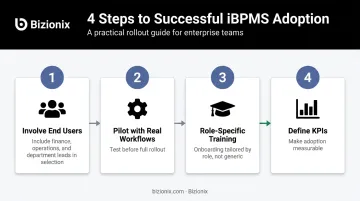
- Involve end users (finance teams, operations managers, department leads) in selection, not just IT or leadership
- Pilot with real workflows before full rollout
- Ensure onboarding includes role-specific training, not generic onboarding sessions
- Define clear KPIs so adoption is measurable, not assumed
Frequently Asked Questions
What is the difference between BPM and iBPMS?
BPM covers the design, monitoring, and continuous improvement of business processes. iBPMS adds AI-driven automation, predictive analytics, real-time monitoring, and intelligent rule management — making the platform proactive rather than just descriptive. BPM tells you how a process should run; iBPMS actively manages it while it runs.
How does iBPMS software improve business process efficiency?
iBPMS eliminates manual handoffs, automates recurring decisions, and surfaces bottlenecks in real time rather than after month-end. By connecting departments through shared workflows, it removes duplicate data entry, reduces approval delays, and gives management live visibility into operational performance.
What is the difference between iBPMS and ERP software?
ERP manages business data across functions — finance, inventory, HR. iBPMS manages the processes that connect those functions and make that data actionable. Many modern platforms combine both, embedding process intelligence directly into the operational backbone.
Is iBPMS suitable for small and mid-sized businesses?
MSMEs benefit significantly from iBPMS, particularly cloud-based platforms built for their scale and budget. Traditional enterprise iBPMS tools are overkill — but platforms like Bizionix deliver the same process intelligence in a configurable, affordable format that doesn't require a dedicated IT team.
What features should I prioritise when evaluating intelligent business management software?
Prioritise graphical process modelling, rule-based automation, real-time analytics, third-party integration, and — for Indian businesses — native GST e-invoicing capability with direct IRP connectivity. These five areas separate genuine iBPMS tools from basic workflow apps.
How long does it take to implement an iBPMS platform?
Enterprise ERP implementations average 15.5 months according to Panorama Consulting. Cloud-based platforms built for MSMEs move much faster — Bizionix's e-invoicing module, for example, goes live within minutes of entering API credentials. Choosing the right platform fit before you begin is the biggest single factor in keeping implementation on track.