Introduction
When the central government notified all four Labour Codes on 21 November 2025, it consolidated 29 existing central labour laws into a single reformed framework. Yet state-level adoption remains uneven, leaving employers caught between old obligations and new requirements at the same time.
That complexity has a measurable cost. According to the People Matters Future of Pay in India 2025 survey, 65% of organisations rate avoiding compliance risk as very challenging, and 53% struggle to keep pace with regulatory changes. For MSMEs without dedicated legal teams, these numbers reflect daily operational risk — not abstract concern.
This guide gives you the grounding to navigate that risk: what HR regulatory compliance actually means in 2026, which Indian laws demand your attention, where MSMEs most commonly stumble, and a practical four-stage framework for building a compliant workplace.
Key Takeaways
- HR regulatory compliance covers the full employee lifecycle — hiring, pay, workplace conduct, and exit — across statutory, regulatory, and contractual obligations
- India's framework spans central labour laws and state-specific acts, each carrying different headcount thresholds and filing deadlines
- Non-compliance risks financial penalties, criminal liability for directors, and lasting recruitment damage
- The four compliance stages: Identify → Implement → Monitor → Review
- Technology is no longer optional for MSMEs managing multi-layered obligations without legal teams
What Is HR Regulatory Compliance?
HR regulatory compliance is the process of aligning employment practices, policies, and documentation with all laws governing the workplace — from the moment someone is hired to their final settlement on exit. Unlike general business compliance, it spans the entire employee relationship: hiring, payroll, conduct, grievances, and exit.
Three Types of HR Compliance
| Type | What It Covers | Examples |
|---|---|---|
| Statutory | Government-legislated employment laws | EPF Act, Minimum Wages Act, POSH Act |
| Regulatory | Rules from enforcement agencies | EPFO filing requirements, ESIC challan procedures |
| Contractual | Obligations from employment agreements | Offer letters, NDAs, collective bargaining agreements |
Who Owns Compliance?
HR designs the policies and processes. But compliance is a shared responsibility — line managers approve leaves and handle conduct issues, finance processes statutory deductions, and leadership sets the culture. When any link breaks, the legal exposure falls on the employer.
That shared responsibility also dispels a common assumption: that HR compliance is just administrative box-ticking. The consequences of getting it wrong are concrete. A lapsed POSH committee can trigger criminal liability. A PF default invites penalties and back contributions. A misclassified contractor risks loss of business licences.
For MSMEs, the upside matters just as much. Strong compliance builds employee trust and supports retention — areas where smaller employers compete directly with large corporates.
Key HR Compliance Laws Every Indian Employer Must Know in 2026
The Four Labour Codes
India has consolidated 29 central labour laws into four codes: the Code on Wages, Industrial Relations Code, Code on Social Security, and Occupational Safety, Health and Working Conditions Code. The central government notified all four in November 2025. State-level rules, however, are still being finalised — with states like Gujarat, Karnataka, Uttar Pradesh, and Mizoram ahead of others.
For employers, 2026 is a compliance-readiness year. Existing statutory obligations under the pre-Code acts remain enforceable until states fully transition.
Wages and Minimum Wage Compliance
The Code on Wages covers minimum wages, payment of wages, bonus, and equal remuneration. A critical payroll provision: Section 2(y) defines wages as basic pay, dearness allowance, and retaining allowance. If excluded components (HRA, conveyance, other allowances) exceed 50% of total remuneration, they get added back into the wage base — directly affecting PF and bonus calculations.
Minimum wages vary by state, industry, and skill category, and are revised periodically. Underpayment penalties:
- First offence: Fine up to ₹50,000
- Repeat violation within 5 years: Imprisonment up to 3 months, fine up to ₹1 lakh, or both
Provident Fund and ESI Compliance
Two mandatory contribution schemes apply at different headcount thresholds:
| EPF | ESI | |
|---|---|---|
| Trigger | 20+ employees | 10+ employees (notified areas) |
| Wage ceiling | No ceiling | ₹21,000/month (₹25,000 for PwD) |
| Employer contribution | 12% of basic wages + DA | 3.25% |
| Employee contribution | 12% of basic wages + DA | 0.75% |
| Late payment interest | Section 7Q rate | 12% per annum |
| Damage escalation | Section 14B (increases with delay) | 5% (under 2 months) to 25% (beyond 6 months) |
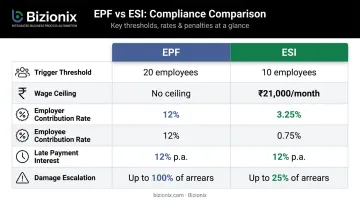
Defaults in either scheme carry compounding costs — the longer they persist, the steeper the recovery.
POSH and Workplace Safety
The POSH Act, 2013 requires any establishment with 10 or more workers to constitute an Internal Complaints Committee (ICC). Requirements include:
- Documented ICC with an external member
- Regular awareness programmes and orientation for ICC members
- Annual report submitted to the District Officer
- Annual information included in the employer's own report
Non-compliance under Section 26 carries a fine up to ₹50,000, and repeat offences can trigger cancellation or non-renewal of business licences — a consequence that goes well beyond the financial penalty.
State-specific Shops & Establishments Acts govern working hours, weekly offs, and leave for non-factory workplaces. These vary by state and must be tracked separately from central law obligations.
Maternity, Gratuity, and Bonus Obligations
These three obligations often activate together as MSME headcount crosses the 10–20 employee mark — making them easy to overlook until a compliance gap becomes a liability.
Maternity Benefit Act (10+ employees):
- 26 weeks paid maternity leave for women with fewer than two surviving children
- Crèche facility mandatory at 50+ employees
Payment of Gratuity Act (10+ employees):
- Eligibility triggers at 5 years of continuous service (except in cases of death or disablement)
- Formula: 15 days' wages per completed year of service
- Current ceiling: ₹20 lakh
Payment of Bonus Act (20+ employees, workers earning up to ₹21,000/month):
- Minimum bonus: 8.33%; maximum: 20%
- Calculated on ₹7,000 or the applicable minimum wage, whichever is higher
Gratuity is particularly prone to miscalculation when salary components have been restructured — verify that your wage definition aligns with the Act before headcount milestones trigger eligibility.
Common HR Compliance Challenges for Indian MSMEs
Common HR Compliance Challenges for Indian MSMEs
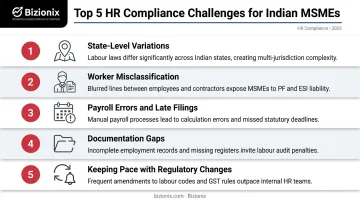
Indian MSMEs face compliance pressure from multiple directions — central laws, state-level rules, and an ever-shifting regulatory calendar. These five challenges show up most often.
Managing State-Level Variations
India's labour framework operates at both central and state levels. Each state has its own Shops & Establishments Act, minimum wage schedules, professional tax slabs, and leave rules. For MSMEs operating across states or hiring remote workers in multiple geographies, manually tracking these variations is both time-consuming and error-prone.
Worker Misclassification
Labelling full-time employees as contractors or daily-wage workers to avoid EPF and ESI obligations is one of the most common — and costly — errors. Labour inspectors and courts look at the nature of work and degree of control, not just what the contract says. Misclassification can result in back contributions, interest, damages, and criminal liability. Principal employers can also be held liable when their contractors fail to comply.
Payroll Errors and Late Filings
Common payroll mistakes include:
- Wrong wage base for PF calculation (especially after salary restructuring)
- Missed or delayed TDS deductions
- Incorrect professional tax deductions across states
- Late challan payments triggering interest and damages
These errors build up undetected and surface during audits or inspection notices — often with compound interest attached.
Documentation and Record Retention Gaps
Government inspectors can demand a wide range of records during audits, including:
- Employment contracts and statutory nomination forms
- Salary registers, muster rolls, and leave records
- Form 16s and PF/ESI contribution statements
Many MSMEs maintain these across disconnected spreadsheets, email threads, or physical files. Missing or inconsistent documentation is treated as evidence of non-compliance — even when the underlying obligations were met.
Keeping Pace with Regulatory Changes
Minimum wage revisions, ESI coverage changes, POSH reporting amendments, and Labour Code implementation updates are published through government gazettes that most MSMEs don't systematically monitor. The People Matters survey found 53% of organisations find keeping up with regulatory changes very challenging — and this applies acutely to MSMEs without dedicated compliance teams.
The 4 Stages of HR Compliance
Stage 1 — Identify Obligations
Map all applicable laws based on your location(s), industry, headcount, and employee categories. Key thresholds to track:
- 10 employees: ESI, POSH ICC, Maternity Benefit Act, Gratuity Act
- 20 employees: EPF, Payment of Bonus Act
- 50 employees: Crèche facility obligation
Stage 2 — Implement Policies and Processes
Translate legal obligations into written, documented outputs:
- Employee handbook covering leave, conduct, and grievance procedures
- POSH policy with ICC constitution records
- Payroll workflows with statutory calculation checklists
- Compliance calendar with all monthly, quarterly, and annual deadlines
Stage 3 — Monitor, Audit, and Train
Ongoing oversight keeps compliance from becoming reactive:
- Run periodic internal audits to catch gaps before inspectors do
- Train managers on POSH obligations, leave approval procedures, and incident reporting
- Track key metrics: filing timeliness, training completion rates, and policy violation incidents
Stage 4 — Review and Update
Schedule a minimum annual review, and trigger additional reviews when:
- Headcount crosses a statutory threshold
- The business expands into a new state
- A new wage notification or Labour Code implementation occurs
Assign clear ownership across finance, HR, and management so each update has a named accountable person.
How to Build an HR Compliance Strategy in 2026
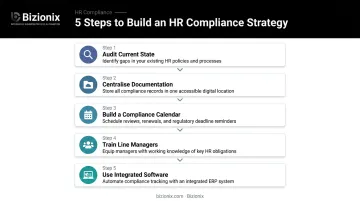
Building a defensible HR compliance posture comes down to five practical steps:
Audit your current state. Take stock of what filings are current, which policies exist in writing, and where documentation gaps exist. Prioritise high-risk areas: PF/ESI status, POSH ICC constitution, and minimum wage alignment.
Centralise documentation. Keep a single, secure repository — digital or cloud-based — for employment contracts, payroll registers, statutory returns, ICC records, and leave data. This reduces audit risk and speeds up responses to inspection notices.
Build a compliance calendar. Map every deadline to a named owner across three filing horizons:
- Monthly: PF and ESI challans
- Quarterly: Advance tax, TDS returns
- Annual: POSH annual report, shop licence renewals, professional tax renewals
Train line managers. Compliance breaks down at the manager level — in leave approvals, conduct handling, and incident escalation. Regular training keeps day-to-day decisions aligned with policy.
Use integrated software. Unified HR and payroll platforms automate statutory calculations, maintain digital employee records, and flag upcoming deadlines. Manual tracking across spreadsheets creates the exact documentation gaps and calculation errors that trigger penalties. Bizionix integrates HRMS, payroll, and compliance tracking into a single platform designed for Indian MSMEs — replacing fragmented processes with structured, auditable workflows.
Frequently Asked Questions
What is regulatory compliance in HRM?
Regulatory compliance in HRM means an organisation follows all applicable employment laws, government regulations, and statutory obligations — from hiring and pay to workplace conduct and exit. HR teams are responsible for creating and enforcing the policies that keep the business aligned with these requirements.
What are the compliances for HR in India?
Major HR compliance categories include:
- Statutory filings (EPF, ESI, TDS)
- Minimum wage adherence and POSH obligations
- Shops & Establishments registration
- Maternity and gratuity compliance
- Labour law returns and documentation requirements
Applicable laws depend on company size, state, and industry.
What are the 4 stages of compliance?
The four stages are:
- Identify — map applicable laws by headcount and location
- Implement — create policies and processes
- Monitor — audit, train, and track metrics
- Review — update regularly as laws change and the business grows
What happens if a company fails to comply with HR regulations in India?
Non-compliance carries serious consequences:
- Financial penalties and interest (PF defaults attract Section 7Q interest and Section 14B damages)
- Criminal liability for directors under certain acts
- Labour court disputes and difficulty renewing business licences
- Reputational damage affecting hiring and retention
How often should employers review their HR compliance programme?
At minimum annually — but also whenever headcount crosses a statutory threshold (10, 20, or 50 employees), when expanding into a new state, after any minimum wage revision, or following new Labour Code implementation at the state level.
Can HR compliance software help Indian MSMEs stay compliant?
Integrated HR and payroll software automates statutory calculations, generates compliant payslips, maintains digital records, and sends filing deadline reminders. For MSMEs without dedicated compliance teams, this reduces manual errors and missed obligations as the business scales.