Introduction
Running a hotel in India today means managing reservations, housekeeping, billing, and GST compliance — often across a tangle of Excel sheets, WhatsApp groups, and disconnected software. The operational overhead is real, and it compounds daily.
At the centre of this challenge is one decision: which Property Management System (PMS) to use, and in what form. Most hotels are choosing between a cloud-based PMS and an on-premise PMS — and the difference isn't cosmetic. It shapes how your staff works, how your revenue gets tracked, and whether your system scales as your property grows.
This guide helps independent and mid-sized hotel operators in India understand which PMS model fits their operational reality — with honest comparisons, India-specific context, and a clear framework for making the call.
Key Takeaways
- A hotel PMS manages reservations, check-in/check-out, billing, housekeeping, and reporting from one platform
- Cloud PMS runs on remote servers with subscription pricing, automatic updates, strong OTA integration, and mobile access
- On-premise PMS is installed on hotel servers — higher upfront cost, full data control, but limited remote access
- For most Indian hotels with 20–150 rooms, cloud PMS delivers better operational ROI with lower setup complexity
- The right choice depends on your room count, IT capacity, OTA dependency, and GST compliance needs
Cloud PMS vs On-Premise PMS: Quick Comparison
Before choosing a PMS, it helps to see how these two deployment models stack up side by side — especially on cost, control, and day-to-day practicality for hotel operations in India.
| Feature | Cloud PMS | On-Premise PMS |
|---|---|---|
| Hosting | Vendor's remote servers | Hotel's own servers |
| Access | Any device, anywhere | On-property network only |
| Upfront Cost | Low (subscription-based) | High (licensing + hardware) |
| Updates | Automatic, vendor-managed | Manual, often costly |
| OTA Integration | Native, real-time sync | Limited, needs third-party tools |
| Scalability | Scales without hardware | Requires new infrastructure |
| Data Control | Vendor-managed security | Full in-house control |
| IT Requirements | Minimal | Dedicated IT team needed |
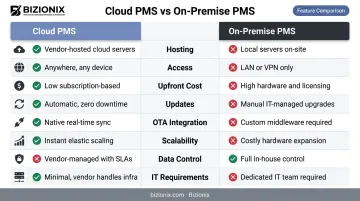
For most Indian hotels and resorts — particularly mid-sized properties and growing MSME operators — the lower upfront investment and automatic GST-compliant updates of a cloud PMS offer a clear practical advantage over maintaining on-premise infrastructure.
What Is a Cloud-Based Hotel PMS?
A cloud-based hotel PMS is software hosted on remote servers and accessed via the internet. There's no on-site hardware to manage — the vendor handles servers, security, and updates, while your team accesses everything through a browser or mobile app.
How It Works Day-to-Day
Every operational update — a room status change, a booking confirmation, a payment processed — is instantly visible across all departments and devices. Front desk, housekeeping, and management see the same live data simultaneously. That real-time synchronisation cuts the internal communication delays that fragment manual systems.
For Indian hotels specifically, OTA connectivity is a core operational requirement. The 2025 Cloudbeds State of Independent Hotels report, which analysed 90 million bookings globally, found that OTA share for independent hotels reached 63.4%, up from 61.3% the previous year.
Indian hotels depend on platforms like MakeMyTrip, Goibibo, Booking.com, Agoda, and Yatra — which means automated inventory and rate syncing across channels is a baseline operational requirement, not optional.
GST Compliance Advantage
This is where cloud PMS becomes especially relevant for Indian operators. With hotel GST rates structured at 12% for accommodation below ₹7,500 and 18% from ₹7,501 upward, per 2024 GST Council guidance, billing errors carry real compliance risk. Cloud platforms that integrate billing and accounting modules can automate GST invoicing, keep records audit-ready, and reduce manual reconciliation work.
Bizionix's HotelEase HMS, for example, is built on a cloud-based architecture with integrated billing, real-time financial reporting, and GST-ready accounting — covering not just room billing but F&B and ancillary charges too. For Indian MSMEs in hospitality, that kind of unified platform reduces the risk of GST filing errors caused by data scattered across multiple tools.
Best Fit: Cloud PMS Use Cases
- Independent hotels and resorts with lean IT setups
- Boutique properties that need OTA connectivity without dedicated IT staff
- Multi-location hotel groups requiring centralised reporting
- Mid-sized properties (20–150 rooms) where operational agility matters more than local data control
The operational gains at this scale are measurable. Mint Hotels & Suites expanded from 7 to 30 properties in under a year using Hotelogix's cloud PMS — managing 1,000+ rooms and saving over 1,500 man-hours per month (vendor-reported figures). Fragmented tools don't support that kind of growth.

What Is an On-Premise Hotel PMS?
An on-premise hotel PMS is installed directly on servers that the hotel owns and operates. The software runs within the property's local network, and all data stays on-site. The hotel manages its own hardware, handles software updates, and maintains IT security.
Cost and Infrastructure Reality
On-premise PMS implementations typically involve substantial upfront licensing fees — international industry benchmarks show costs reaching five-figure licence fees before hardware, installation, and IT support are factored in. Ongoing costs include server maintenance, cybersecurity, update management (which often requires planned downtime), and dedicated IT staffing.
For a 30-room independent hotel without an IT team, this model is rarely financially viable. Total cost of ownership over three to five years typically exceeds what a cloud subscription costs for the same period — with less operational flexibility in return.
Data Control vs. Operational Flexibility
The primary argument for on-premise PMS is control. All guest data, financial records, and operational history stay within the property's walls. For operators with strict data sovereignty requirements or those in areas with genuinely unreliable internet, this is a meaningful consideration.
The practical downsides, however, are real: restricted remote access, limited OTA integration capability, manual update cycles that fall behind current booking platform requirements, and the ongoing overhead of managing your own security infrastructure. Cloud security standards have advanced considerably over the past few years, which has narrowed the gap that once made on-premise the default choice for data-sensitive operators.
Best Fit: On-Premise PMS Use Cases
- Large luxury hotel chains with dedicated IT departments
- Properties in locations where internet connectivity is consistently unreliable
- Hotels with strict data sovereignty requirements or complex legacy system dependencies
Adoption trend: Hospitality Technology's 2024 Lodging Technology Study found that 33% of hoteliers planned to switch to a new PMS supplier and 69% identified integration of new technology with legacy systems as a major challenge — a clear signal that on-premise PMS limitations are pushing the industry toward cloud or hybrid alternatives.
Cloud PMS vs On-Premise PMS: Which Is Right for Your Hotel?
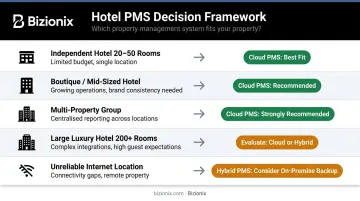
The decision comes down to five factors: property size, IT budget and staffing, OTA dependency, need for remote access, and GST/compliance requirements.
Decision Framework
| Your situation | Better fit |
|---|---|
| Independent hotel, 20–50 rooms, no IT team | Cloud PMS |
| Boutique or mid-sized hotel, 50–150 rooms | Cloud PMS with strong integrations |
| Multi-property Indian group | Cloud PMS with central dashboard |
| Large luxury hotel, 200+ rooms, dedicated IT | Enterprise cloud or hybrid PMS |
| Unreliable internet location | Evaluate cloud readiness first |
For Independent and Mid-Sized Indian Hotels
For most properties in the 20–150 room range operating without a dedicated IT team, cloud PMS is the practical choice. Lower setup cost, automatic updates, mobile access, real-time OTA sync, and GST billing integration consistently outweigh the data control advantages of on-premise.
Consider Rosakue Hospitality, which grew from 2 properties in 2019 to 13+ by 2023, reporting 2X occupancy and revenue growth in 2023 versus 2022 after adopting a cloud multi-property PMS (vendor-reported figures). That growth was driven by centralised rate and inventory management — a capability fragmented or on-premise tools could not have delivered at that pace.
For Large Hotel Chains
On-premise or hybrid PMS solutions remain relevant for enterprise-scale properties with:
- Complex multi-system integrations requiring deep customisation
- Strict data residency policies or regulatory requirements
- Substantial legacy infrastructure already in place
That said, the capital and ongoing maintenance requirements are significant. Oracle OPERA Cloud — now web-based and mobile-enabled — reflects where even enterprise hotel IT is heading.
The Hybrid Option
Some vendors now offer hybrid PMS models — local data storage combined with cloud-based access and updates. This suits hotels that need data control and remote flexibility simultaneously. It's a growing middle ground, though implementation complexity and cost are higher than pure cloud.
Conclusion
For the majority of independent and mid-sized Indian hotel operators, cloud PMS is the operationally and financially sound choice. Lower upfront cost, automatic updates, mobile access, and built-in OTA integration address the most common pain points without requiring dedicated IT infrastructure.
On-premise PMS still has a place, but only where capital resources, IT staffing, and specific data control requirements genuinely justify the cost and operational constraints. For most properties in India, that combination of factors is uncommon.
Beyond the cloud-vs-on-premise question, it's worth asking whether a standalone PMS is sufficient — or whether a more integrated platform would reduce operational overhead further. For properties managing billing, GST compliance, accounting, and multi-department coordination, a unified system eliminates the friction of connecting separate tools.
Bizionix's HotelEase HMS is built for exactly this scenario. Designed for Indian MSMEs, it covers:
- Reservations and front office management
- Housekeeping coordination
- Billing and guest CRM
- GST-ready accounting with real-time financial visibility
- Analytics across all operational areas
Everything operates within a single cloud-based platform, so compliance and reporting are part of the workflow rather than a separate exercise.
Frequently Asked Questions
What are the best hotel property management systems?
The best PMS depends on your property size and needs. For independent and mid-sized hotels, Hotelogix, Cloudbeds, and Mews are well-regarded cloud options. Indian operators should prioritise GST compliance and OTA integration with MakeMyTrip, Goibibo, and Booking.com — Oracle OPERA Cloud suits large enterprise properties.
How many types of hotel property management systems are there?
There are two primary types: cloud-based and on-premise, with an emerging hybrid model that combines elements of both. Beyond deployment type, PMS solutions also vary by scale suitability — from entry-level tools for micro-properties to enterprise-grade systems for large chains and multi-property groups.
Which property management system is best for luxury hotels?
Oracle OPERA Cloud and Mews are widely used by luxury properties for their guest profile depth, multi-property capabilities, and advanced reporting. The best choice depends on your operational complexity and existing IT setup.
What is the difference between a cloud PMS and an on-premise PMS?
Cloud PMS is hosted remotely, accessed via the internet, priced on a subscription model, and updated automatically by the vendor. On-premise PMS is installed on the hotel's own servers, involves higher upfront licensing and hardware costs, keeps full data on-site, but limits remote access and requires manual updates.
How much does a hotel property management system cost?
Cloud PMS entry-level pricing typically starts around ₹400–₹500 per room per month (USD $5 equivalent), with mid-range platforms ranging from ₹50,000–₹75,000/month for larger implementations. On-premise systems carry significantly higher upfront licence and hardware costs. Always factor in implementation, training, and integration fees beyond the base subscription.
What features should I look for in a hotel PMS?
Key features to prioritise:
- Reservation and front desk management
- Channel manager with OTA integration (MakeMyTrip, Booking.com, Goibibo)
- Billing and invoicing with GST compliance
- Housekeeping coordination and real-time reporting
- Mobile accessibility and audit trail capabilities
- Multi-property management for growing hotel groups