A Guest Room Management System (GRMS) addresses energy waste, guest friction, and operational fragmentation at the same time. It is not a luxury reserved for five-star chains. Mid-scale and boutique properties across India are finding real, measurable value in it.
This guide covers what a GRMS actually is, its core features, the operational benefits it delivers, and — critically — how to go beyond installation to genuinely optimise hotel operations with it.
Key Takeaways
- A GRMS automates lighting, climate, access, and service requests inside each guest room from a single interface
- It complements your PMS — the two serve different layers and work best when integrated
- Occupancy-based controls can reduce guest-room HVAC energy by 10–30% and cut lighting energy by up to 20% in unoccupied rooms
- GRMS delivers full ROI only when integrated with your hotel management and billing systems
- Software-layer platforms make GRMS accessible to smaller properties without hardware overhauls or full rewiring
What Is a Hotel Guest Room Management System?
A Guest Room Management System is a centralised platform that automates and controls in-room functions — lighting, climate, access, service requests, and room status — from a single interface accessible to both guests and hotel staff.
GRMS vs. PMS: Two Different Layers
These two systems are frequently confused, and the distinction matters for anyone evaluating hotel technology:
| System | What It Manages |
|---|---|
| PMS (Property Management System) | Reservations, billing, front-desk operations, back-office |
| GRMS (Guest Room Management System) | Physical and experiential layer inside each guest room |
A PMS handles the administrative skeleton of the hotel. A GRMS controls what the guest actually experiences: temperature, lighting, door access, and entertainment. The two systems are complementary. They deliver the most value when integrated — a checkout event in the PMS, for instance, can automatically trigger an occupancy reset in the GRMS.
Hardware-Based vs. Software-Layer Approaches
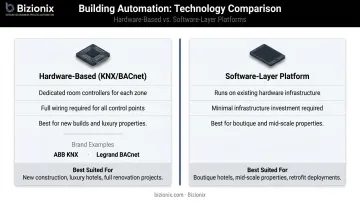
Two implementation paths exist, each suited to different property types:
| Approach | How It Works | Best Suited For |
|---|---|---|
| Hardware-based (KNX/BACnet) | Dedicated room controllers wired into each room; ABB's KNX scales from 5–10 rooms to 300+, Legrand's BACnet/IP offers similar range | New builds, full-scale refurbishments, luxury properties |
| Software-layer platforms | Runs on existing in-room hardware — TVs, tablets, or guest devices — minimising infrastructure investment | Boutique and mid-scale properties that cannot justify full rewiring |
Why It Matters for Indian Hotels Now
Both implementation paths point toward the same business case — and for Indian properties, the timing is particularly relevant.
The JLL Hotel Operators' Sentiment Survey 2024–2025, covering 1,075 operators across 20 countries, found technology and MEP upgrades were the leading capital expenditure priorities. 83% of respondents in outperforming markets expected staff costs to rise. For Indian hotel managers already watching energy overheads closely, GRMS addresses both pressures directly.
For guests, it means personalised comfort and responsive in-room control. For hotel managers, it delivers real-time visibility, automated workflows, and measurable cost savings.
Core Features of a Hotel Guest Room Management System
Smart Lighting and Climate Control
GRMS automates lighting and HVAC based on real-time occupancy detection. The logic is precise: when a door opens and closes, presence detectors activate for a configurable window (typically 10 minutes). If no motion is detected, the room enters unoccupied mode and HVAC shifts from Comfort to ECO or Standby.
Guests are not locked out of their own room environment. Local controls (touch panels, bedside switches, tablet interfaces) allow manual overrides without calling the front desk. Lighting capabilities typically include:
- Scene control (welcome, living, sleeping presets)
- Dimming and RGB colour settings
- DALI integration for commercial-grade control
Access Control and Occupancy Detection
Modern GRMS handles room entry through RFID cards, QR codes, PIN codes, or mobile keys. The Oracle/Skift 2022 global survey of over 5,000 consumers found 34.4% of travellers called own-device hotel access a must-have, and 47.7% of hotel executives were already replacing physical key cards with mobile access.
Beyond convenience, occupancy detection feeds live room status data directly to the hotel dashboard. This enables two downstream benefits: automatic energy management when rooms are empty, and accurate housekeeping triggers when guests check out.
Do Not Disturb, Make-Up Room, and Emergency Alerts
The DND/MUR system replaces verbal coordination for routine status updates:
- Guests activate DND or Make-Up Room via in-room panels or mobile
- Corridor displays communicate status visually to housekeeping staff without a phone call
- MUR notifications are sent directly to the hotel system architecture
- Emergency SOS alerts route immediately to reception
The operational value is reduced back-and-forth between floors and front desk — housekeeping knows room status before walking down the corridor.
In-Room Entertainment and Guest Communication
Beyond room controls, GRMS platforms connect to in-room entertainment: TV controls, content casting, and streaming access. More practically for hotel operations, the dashboard lets staff push communications directly to in-room screens.
This covers:
- Personalised welcome messages and local recommendations
- Wake-up call scheduling without front-desk calls
- Promotions and service offers replacing printed collateral
The result is lower front-desk call volume and a direct communication channel with the guest throughout their stay.
Centralised Dashboard and PMS Integration
The hotel management dashboard provides a live view across all rooms simultaneously — occupancy status, temperature settings, and DND/MUR/SOS alerts updated as they happen. Two-way PMS integration enables:
- Automated check-in/check-out triggers
- Real-time room status sync across departments
- Guest preference data carried forward across stays
With PMS integration in place, room-level data stops living in isolation — it feeds directly into front-desk workflows, housekeeping schedules, and guest history records.
How a GRMS Transforms Hotel Operations: Key Benefits
Guest Experience
Guests can personalise their room environment — lighting scenes, temperature, entertainment — without instruction or friction. The Oracle/Skift survey found 43.2% of travellers wanted voice-activated controls for lights and curtains, and 25.4% wanted temperature and lighting to auto-adjust based on pre-shared preferences. Meeting these expectations no longer requires a luxury-tier budget.
Energy Savings
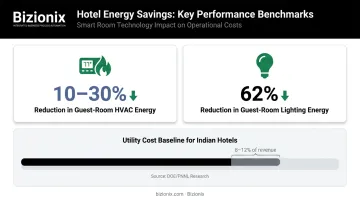
This is where the numbers are clearest. Research published through DOE/PNNL on occupancy-based hotel controls documented:
- 10–30% reduction in guest-room HVAC energy
- 62% reduction in guest-room lighting energy
For a hotel where utilities already consume 8–12% of revenue, these are not marginal gains. Vendor-reported figures (such as 20–45% per guestroom from Telkonet) suggest even higher potential, though independent estimates are the more conservative benchmark to plan against.
Operational Efficiency
GRMS shifts hotel operations from fixed schedules to event-driven workflows. Key efficiency gains include:
- Housekeeping triggers based on actual occupancy, not timetables
- Maintenance requests logged automatically, creating accountability trails
- Real-time room status visible from a central dashboard — no floor-by-floor checks needed
PwC's hospitality technology research found more than 70% of hotel executives rely on automation tools to reduce operational overhead. GRMS delivers that directly at the room level.
Security and Visibility
Integrated access control and real-time occupancy monitoring give managers a centralised security view across the property. The system tracks entry and exit, flags anomalies automatically, and maintains guest safety without manual rounds.
Data and Personalisation
Guest preferences — temperature settings, entertainment habits, service orders — build profiles that carry value beyond the current stay. According to PwC, 76% of hospitality executives prioritise personalising the guest experience to boost loyalty, compared to 61% in other industries. GRMS provides the room-level data that turns those personalisation goals into repeatable, scalable practice.
How to Optimise Hotel Operations with a GRMS
A GRMS manages the in-room layer. For full operational optimisation, it needs to connect to the back-office systems that handle billing, staffing, reporting, and compliance.
This is where hotel ERP platforms like Bizionix HotelEase become relevant. HotelEase consolidates GRMS-generated triggers — service orders, checkout events, room status changes — into a unified platform covering GST-compliant billing, revenue tracking, housekeeping task management, and real-time business visibility.
When a guest checks out, that event should flow automatically into:
- Billing reconciliation and GST invoice generation
- Room status updates across the property
- Housekeeping scheduling for the vacated room
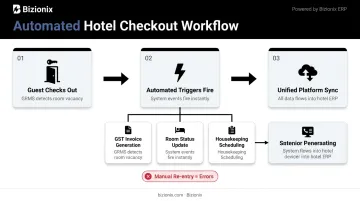
Manual re-entry across disconnected tools breaks that chain and creates errors.
Use Occupancy Data to Drive Smarter Staffing
Live checkout patterns from the GRMS tell you when rooms are actually vacating, not when they were scheduled to vacate. Scheduling housekeeping based on real departure data rather than fixed shift blocks reduces idle time and avoids the bottleneck of multiple rooms turning over simultaneously without adequate staff.
HotelEase's real-time hotel pulse — updated every second across occupancy, arrivals, departures, and room status — gives managers the same real-time occupancy and status data on mobile that the GRMS captures at the room level.
Use Guest Preference Data for Personalisation and Upselling
Return guests whose preferences are on file allow the hotel to pre-set room conditions before arrival. Stay-behaviour data also enables targeted offers at the right moment:
- An F&B promotion when a guest orders room service
- A spa offer after a long check-in
- An upgrade prompt during a quiet mid-week period
Guest CRM capability within HotelEase stores profiles, preferences, and stay history — so the preferences a GRMS captures at the room level directly inform upsell timing, pre-arrival setups, and repeat-stay incentives.
What to Look for When Choosing a Hotel Guest Room Management System
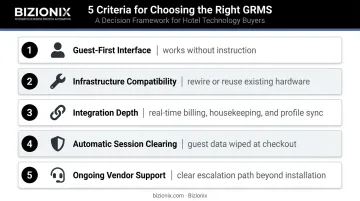
Not every GRMS delivers on its promises. Before committing to a system, evaluate these five criteria — each one separates a reliable long-term investment from a costly replacement cycle.
- Guest-first interface: If a guest needs instructions to dim the lights, the system has failed. Core functions — lighting, temperature, do-not-disturb — should work without explanation for first-time users.
- Infrastructure compatibility: Confirm whether the solution requires rewiring or runs on existing hardware. For mid-scale and boutique properties in India, this single question often determines feasibility before anything else.
- Integration depth: Many vendors claim PMS integration. The real question is how reliably data syncs in real time — and whether it covers billing, housekeeping triggers, and guest profiles, or only occupancy status.
- Automatic session clearing: Guest casting history, preferences, and service orders should be wiped automatically at checkout, not manually. Verify the vendor's compliance approach with applicable data privacy standards.
- Ongoing vendor support: A GRMS is core infrastructure. Confirm the vendor provides a clear escalation path and regular updates — well beyond the initial installation phase.
Common Implementation Challenges and How to Overcome Them
ROI and Staff Adoption
Staff resistance and unclear return on investment are the most common reasons GRMS implementations stall. Two practical approaches:
- Start with one floor or room category. Generating measurable results — energy savings, guest feedback, housekeeping efficiency — before full-property commitment builds internal confidence and refines the rollout.
- Build department-specific training, not a single session. Front desk, housekeeping, and maintenance each interact with GRMS differently. A single training session covering all three groups rarely sticks.
On payback: vendor data from Telkonet suggests occupancy-based energy management systems typically pay back in 2–3 years. Older or smaller properties without existing building automation may face longer timelines, making the phased rollout a lower-risk path forward.
Integration Complexity
Trying to connect GRMS to all existing systems simultaneously is the most common cause of delayed go-lives. One proven approach:
- Phase 1: PMS integration and billing sync (essential from day one)
- Phase 2: Loyalty systems, third-party e-commerce, advanced analytics (once Phase 1 is stable)
Prioritizing core integrations first keeps the go-live on track — one unstable connection won't stall the entire rollout.
Frequently Asked Questions
What is a guest room management system for hotels?
A GRMS is a centralised platform that automates and controls in-room functions including lighting, climate, access control, and service requests. It improves both the guest experience and staff efficiency by replacing manual coordination with real-time automation.
What is the difference between a GRMS and a hotel PMS?
A PMS handles back-end operations: reservations, billing, and front-desk management. A GRMS manages the physical and experiential layer inside each guest room. The two systems work best when integrated — with the PMS triggering room-level changes through the GRMS at check-in and checkout, eliminating manual handoffs between front desk and housekeeping.
What are the key features of a hotel guest room management system?
Core features include:
- Smart lighting and climate control
- Occupancy detection and DND/MUR status displays
- RFID and mobile access control
- Emergency SOS alerts
- In-room entertainment management
- Service request handling and a centralised dashboard with PMS integration
How does a GRMS help hotels reduce energy costs?
GRMS automatically adjusts lighting and HVAC based on real-time occupancy — dimming lights and moderating temperature when rooms are empty. Independent research documents 10–30% HVAC energy savings and up to 62% lighting energy savings from occupancy-based controls.
Can small and mid-sized hotels implement a guest room management system?
Yes. Software-layer platforms operate on existing in-room hardware without rewiring, making them accessible to boutique and mid-sized properties. A phased room-by-room rollout reduces initial investment and allows the property to validate ROI before full deployment.
How does a GRMS integrate with other hotel management systems?
A GRMS typically integrates with the hotel PMS for real-time room status sync and check-in/check-out triggers. It can also connect with back-office ERP systems for GST-compliant billing, housekeeping task management, and consolidated reporting. Platforms like Bizionix HotelEase are built specifically for this integration, combining hotel operations with GST compliance in a single system.