India's franchise sector has grown from roughly ₹4,500 crore in 2018 to ₹12,500 crore by end-2024, a 25% CAGR according to Franchise India. With nearly 4,600 franchisors and 200,000 outlets active across the country, the coordination challenge is no longer theoretical — it's an operational reality that manual spreadsheets and WhatsApp approvals simply cannot solve.
This article breaks down what a franchise management system actually is, the structural elements it must include, the software features that matter most, and what to evaluate when choosing one for an Indian franchise network.
Key Takeaways
- A franchise management system (FMS) is a centralised digital platform that lets franchisors manage operations, compliance, performance, and communication across all locations from one interface.
- Core structural elements include centralised data, standardised process controls, performance monitoring, communication tools, and financial management.
- Key software features to prioritise: analytics dashboards, CRM, HR/LMS tools, inventory tracking, and compliance management.
- Choose the right FMS and you eliminate silos, cut manual overhead, and gain real-time visibility across every location.
What Is a Franchise Management System?
A franchise management system is a unified digital platform that helps franchisors manage, monitor, and support their network of franchise locations — covering everything from operations and compliance to communication and performance reporting.
Unlike standalone tools — spreadsheets, separate CRMs, or disconnected accounting packages — an FMS integrates multiple business functions into a single ecosystem. It serves both the franchisor (head office) and franchisees (individual owners) simultaneously, rather than forcing each side to work with different systems.
Who Actually Needs One?
Any business with two or more franchise locations operating under a shared brand. That includes:
- Food and beverage chains managing multiple kitchen and service standards
- Retail networks with location-specific inventory and pricing
- Service franchises tracking technician performance and SOP compliance
- Multi-location MSMEs operating as a group with shared branding but separate GST registrations
The need intensifies as the network scales. At five locations, informal coordination becomes painful. At twenty, gaps in oversight create real exposure: brand standards slip, financial reporting loses accuracy, and underperforming locations go unnoticed for too long.
Key Elements of a Franchise Management System
Before evaluating software features, understand the structural elements an FMS must be built on. These foundational pillars determine whether the platform can actually run a distributed franchise network — or merely store data in one place.
Centralised Data and Real-Time Visibility
The backbone of any FMS is a centralised data repository. All location-level data — sales, inventory, compliance status, performance metrics — must flow into a single source accessible to the franchisor at any time.
Fragmented reporting is a familiar problem for anyone running more than a handful of locations. Head office ends up manually consolidating data from multiple stores, reconciling numbers that don't match, and making decisions based on week-old information. Real-time access shifts management from reactive to proactive.
Standardised Process Controls
An FMS must enforce standardised workflows, SOPs, and checklists across all franchise locations so that service quality, pricing, and brand presentation stay consistent regardless of which franchisee is running a unit.
The goal is non-negotiable standards enforced centrally, paired with enough operational flexibility for franchisees to handle day-to-day decisions without escalating every minor choice to head office.
Performance Monitoring and Reporting
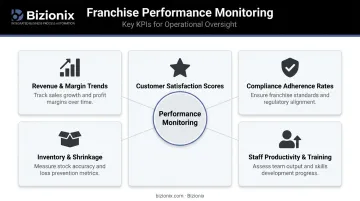
Location-level KPI dashboards give franchisors the visibility to act before small problems become expensive ones. Key metrics to track include:
- Revenue per unit and margin trends
- Customer satisfaction scores
- Compliance adherence rates
- Inventory performance and shrinkage
- Staff productivity and training completion
Franchisor-Franchisee Communication Infrastructure
An FMS replaces the ad hoc mix of emails, phone calls, and printed manuals with built-in communication tools. Franchisors can push policy updates, training materials, and operational announcements to all franchisees instantly — with confirmation tracking, not just a sent receipt.
Financial Management and Royalty Tracking
Royalty calculations, inter-entity invoicing, fee collection, and expense tracking all need clear audit trails to prevent financial discrepancies. For Indian franchise networks, this also means multi-GSTIN management and e-invoicing compliance — GST e-invoicing is now mandatory for taxpayers with aggregate turnover exceeding ₹5 crore.
Must-Have Features of a Franchise Management System
These are the software capabilities that bring the five structural elements to life. An FMS without all of these is an incomplete tool.
Business Intelligence and Analytics Dashboards
The system should surface key metrics across all locations through customisable dashboards and automated reporting — without manual weekly report compilation.
McKinsey research on customer analytics found that intensive analytics users were 2.6x more likely to achieve significantly higher ROI than organisations relying on manual reporting. For franchisors tracking performance across dozens of units, the difference between real-time dashboards and monthly spreadsheets is that significant.
Predictive analytics — flagging an underperforming unit before it becomes a crisis — is where stronger FMS platforms are separating themselves from basic reporting tools.
Key analytics capabilities to look for:
- Customisable dashboards per role (franchisor, regional manager, franchisee)
- Automated performance reports across all units
- Predictive alerts for underperforming locations
- Comparative benchmarking across the network
HR, Training, and Onboarding (LMS)
Every franchisee and their staff should reach operational readiness through the same structured process. An integrated Learning Management System (LMS) ensures training is standardised, tracked, and updated from head office rather than left to each franchisee's discretion.
SHRM research cites that employees with structured onboarding are 58% more likely to stay for three years and 50% more productive. For franchise networks that rely on consistent staff performance across locations, structured onboarding directly protects brand consistency across every location.
Core LMS capabilities include:
- Digital onboarding workflows for new franchisees and their staff
- SOP training modules with completion tracking
- Payroll and attendance management per location
- Performance review workflows accessible centrally
CRM and Marketing Automation
A built-in CRM tracks customer interactions, loyalty programmes, and service history across locations. Marketing automation enables brand-consistent promotions and campaigns to be executed from head office without requiring each franchisee to manage their own outreach independently.
Salesforce's State of the Connected Customer research found that 88% of customers say experience is as important as the products or services themselves. When franchise locations deliver inconsistent customer experiences, the brand — not the individual franchisee — takes the reputation hit.
Key CRM and marketing features to look for:
- Centralised customer database with interaction history across locations
- Loyalty programme management at network and unit level
- Campaign templates deployed from head office
- Location-level performance tracking for marketing spend
Inventory and Supply Chain Management
Real-time inventory tracking across locations, automated purchase order management, and supplier integration are critical for retail and food franchise networks. The ability to redistribute stock between units — rather than letting one location run out while another holds excess — directly affects both customer experience and carrying costs.
Key capabilities:
- Live stock level visibility per location
- Automated reorder triggers and purchase order generation
- Vendor management and goods receipt verification
- Consolidated supply chain view across all units
Compliance and Document Management
The FMS must centralise storage and version control for franchise agreements, SOPs, GST documents, audit logs, and regulatory records — with role-based access controls ensuring the right people see the right documents.
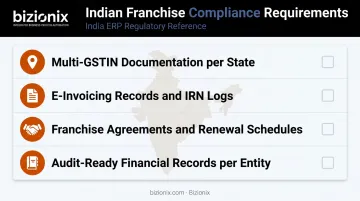
For Indian franchise networks, this means managing:
- Multi-GSTIN documentation per state registration
- E-invoicing records and IRN logs
- Franchise agreements and renewal schedules
- Audit-ready financial records per entity
Benefits of Implementing a Franchise Management System
A well-implemented FMS delivers measurable improvements across three areas that matter most to growing franchise networks: operational efficiency, brand consistency, and controlled scalability.
Operational Efficiency Across the Network
Automating scheduling, invoicing, reporting, and communication eliminates manual follow-ups that consume disproportionate time for both head office and individual franchisees. Deloitte's intelligent automation research found organisations that moved beyond pilots achieved an average cost reduction of 32% in repetitive administrative workflows. In franchise networks, that overhead doesn't disappear on its own. It falls on operations staff who could otherwise be onboarding new franchisees or resolving escalations that actually need human attention.
Brand Consistency and Customer Experience
Centralised process controls, standardised training, and unified marketing tools ensure customers receive a consistent brand experience at every location. Brand dilution rarely happens in one dramatic failure. It happens gradually, when individual franchisees start improvising on pricing, service steps, or promotional messaging — and head office has no visibility until a customer complaint surfaces.
A centralised FMS closes that gap before it widens.
Scalability Without Loss of Control
The right FMS allows franchisors to add new locations, onboard new franchisees, and expand into new regions without scaling up management overhead at the same rate. The system scales with the network. Without it, every new location adds coordination complexity: separate email threads, manual reconciliation across spreadsheets, and reporting gaps that compound as the network grows.
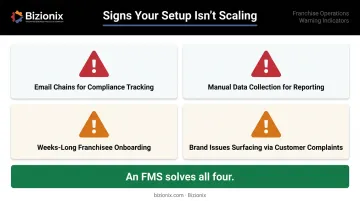
Key signs your current setup isn't scaling well:
- Head office relies on email chains to track franchisee compliance
- Reporting requires manual data collection from multiple locations
- Onboarding a new franchisee takes weeks instead of days
- Brand issues surface through customer complaints rather than internal audits
How to Choose the Right Franchise Management System
Three criteria should drive the evaluation:
1. Scalability: A system that works well at five locations but requires significant reconfiguration at twenty is a growth constraint, not a growth tool. Verify the platform can add entities, locations, and users without slowing down.
2. Integration capability — accounting, HR, CRM, inventory, and compliance should live in one platform. Every disconnected tool in the stack is a data silo waiting to create reconciliation problems.
3. Indian regulatory readiness : multi-GSTIN management, GST e-invoicing (mandatory above ₹5 crore aggregate turnover), state-wise reporting, and audit trail requirements under India's Companies (Accounts) Rules are non-negotiable for any franchise operating across states.
These three criteria narrow the field significantly. From there, practical factors — ease of use for franchisees (not just head office), mobile accessibility, support quality, and total cost of ownership — determine which shortlisted platform actually fits your network.
Bizionix, built for growing Indian MSMEs and multi-entity enterprises, addresses all three criteria in a unified ERP architecture. Its multi-company management module gives franchisors a single secure login across all entities, with:
- Independent books of accounts per franchise location
- Centralised dashboards with real-time financial visibility
- Role-based access controls for head office and franchisee staff
- Direct GST e-invoicing with automated IRN generation
Starting at ₹999 per year for the NEO plan, it's priced to fit growing networks without enterprise-level cost or complexity.
Frequently Asked Questions
What is a franchise management system?
A franchise management system is a centralised software platform that enables franchisors to manage, monitor, and support all franchise locations from a single interface. It consolidates operations, compliance, performance tracking, and communication for both head office and individual franchisees.
What are the 4 Ps of franchising?
The 4 Ps refer to the standard marketing mix: Product, Price, Place, and Promotion. In franchising, these define what's sold, at what price, through which locations, and how it's marketed — with an FMS enforcing consistency across each dimension.
What is the difference between a franchise management system and an ERP?
An FMS is designed specifically for managing franchise networks — franchisee relationships, royalties, brand compliance, and location performance. An ERP is a broader business management platform covering finance, HR, and operations. Some modern ERPs built for multi-entity businesses, like Bizionix, effectively serve as franchise management systems when they include the right modules and multi-company architecture.
How does a franchise management system support compliance across locations?
An FMS enforces compliance by centralising SOPs, storing legal and disclosure documents with version control, automating audit trails, and giving franchisors real-time visibility into whether each location is meeting brand and regulatory standards — including GST compliance requirements for Indian networks.
What are the most important features to look for in a franchise management system?
The core features to prioritise:
- Analytics and reporting dashboards
- CRM and marketing automation
- HR and LMS training tools
- Financial and royalty management
- Inventory tracking
- Compliance and document management
Look for a single platform that handles Indian GST requirements across multiple entities, so you're not stitching together separate tools.