Introduction
Picture this: your finance team is reconciling accounts on three different Excel files — each updated by a different person, each showing a slightly different number. Sales logs orders in a CRM that never talks to inventory. Procurement runs on email threads and WhatsApp approvals.
HR tracks attendance on paper registers. And at month-end, someone spends three days manually compiling a report for leadership.
This isn't an edge case. For many growing Indian MSMEs, it's Tuesday.
According to FSN's 2020 global finance survey, 46% of finance professionals cited location-based manual processes as a significant operational challenge, and 72% identified reconciliation as ripe for automation — work that a connected system should handle automatically.
These aren't just inefficiencies — they're symptoms of disconnected systems. An Enterprise Business Suite is designed to replace that fragmentation with a single, unified platform. This article covers what it is, which modules matter, how to recognize when your business needs one, and what to look for when choosing a platform built for the Indian MSME context.
Key Takeaways
- An Enterprise Business Suite integrates finance, HR, procurement, inventory, and CRM into a single unified platform
- The real value is automatic data flow between modules, not just individual features working in isolation
- GST e-invoicing is mandatory for businesses with turnover above ₹5 crore, making compliance-native software a necessity
- Spreadsheet chaos, data silos, and zero real-time visibility are clear signs you've outgrown your current tools
- Cloud-based suites built for Indian MSMEs deliver enterprise-grade capabilities without SAP-level cost or complexity
What Is an Enterprise Business Suite?
An Enterprise Business Suite is an integrated collection of software applications designed to manage, automate, and connect an organisation's core business functions — finance, HR, procurement, supply chain, sales — through a single unified system.
The key word is unified. A standalone accounting tool solves one problem in isolation. A separate HR app solves another. But when those systems don't communicate, data must travel by email, phone call, or copy-paste. Every handoff creates delay, duplication, and error.
How It Differs from Standalone Tools
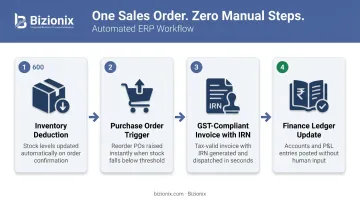
In a unified suite, a confirmed sales order can automatically:
- Deduct inventory in the warehouse module
- Trigger a purchase order if stock falls below threshold
- Generate a GST-compliant invoice with IRN
- Update receivables in the finance ledger
No manual intervention. No re-entry. That's the operational difference integration delivers.
The ERP Connection
ERP (Enterprise Resource Planning) forms the backbone of most Enterprise Business Suites. Gartner defines ERP as an integrated suite of business applications sharing a common process and data model. A full business suite typically extends that foundation to include CRM, supply chain management, BI/analytics, and compliance modules within the same platform.
A Shift That Changed Access
Traditional suites — Oracle EBS, SAP — were built for large enterprises with dedicated IT departments and significant capital budgets. Modern cloud-based platforms have made enterprise-grade software accessible to organisations without large IT teams or capital budgets. IDC reports India's public cloud services market reached USD 5.2 billion in the first half of 2024, projected to reach USD 25.5 billion by 2028 at a 24.3% CAGR. Cloud infrastructure is now mainstream — and that includes smaller organisations.
What an Enterprise Business Suite is NOT:
- A point solution that solves one department's problem
- A bundle of unconnected apps that require manual data transfers
- Software exclusively for Fortune 500 companies
Core Modules That Make Up an Enterprise Business Suite
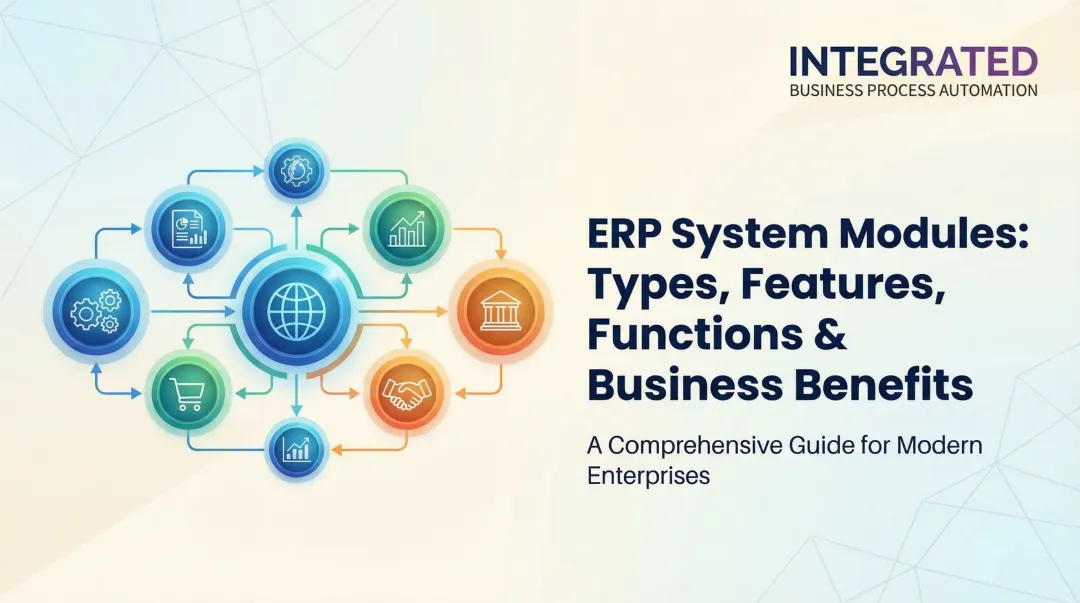
Most enterprise suites share a common module structure. Here's what each area manages:
| Module | What It Handles |
|---|---|
| Financial Management | Accounting, invoicing, GST returns, bank reconciliation |
| Human Resources | Attendance, leave, payroll, statutory compliance |
| Procurement | Purchase orders, vendor management, GRN |
| Inventory & Warehouse | Stock tracking, material issue, multi-location management |
| Sales & CRM | Lead tracking, quotations, customer orders, delivery |
| Production Planning | Manufacturing schedules, work orders |
| Reports & Analytics | Real-time dashboards, consolidated cross-department data |
Why Integration Beats Individual Features
A module's features matter less than how it connects to other modules. Consider what happens when a sales invoice is generated in a truly integrated system like Bizionix: the invoice data is automatically validated against GST rules, an IRN and QR code are generated via direct API integration with the government IRP, and the transaction updates accounts, receivables, and GSTR-1 — all within seconds. The result is fewer manual touchpoints, fewer compliance errors, and a faster close cycle.
GST and E-Invoicing Compliance in India
For Indian businesses, compliance isn't optional. GST Council Notification 10/2023 made e-invoicing mandatory for taxpayers with aggregate turnover exceeding ₹5 crore from 1 August 2023. The GSTN Annual Report 2023-24 recorded 21.45 crore IRNs generated in a single month across 8.62 lakh enabled taxpayers — numbers that reflect how deeply digital compliance is now embedded in daily business operations.
A business suite that handles GST natively — not through exports, workarounds, or third-party connectors — removes compliance risk from the operational equation. Platforms like Bizionix include direct IRP API integration, meaning IRN generation happens from within the invoicing workflow with zero separate portal interaction.
Built-In Analytics Replace Manual Reporting
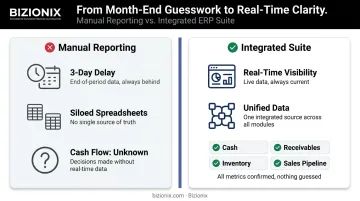
Modern suites include BI and dashboard capabilities that give management real-time visibility across departments. Instead of waiting three days for a month-end compilation, leadership sees cash position, receivables, inventory status, and sales pipeline updated live. That visibility is only accurate when all modules write to the same underlying database — a single source of truth rather than reconciled exports from separate tools.
Warning Signs Your Business Has Outgrown Its Current Tools
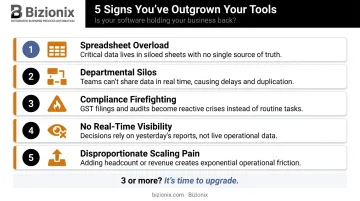
Most growing businesses don't realize their tools have stopped keeping up — until the cracks become too costly to ignore. Here are five signs it's already happening:
Spreadsheet overload: Critical business data lives across multiple Excel files, updated by different people, with version conflicts surfacing at the worst possible moments. When you can't trust the numbers in front of you, the system has already failed.
Departmental silos: Finance, operations, and sales each maintain separate records. Updates travel by email or WhatsApp. The same data gets entered multiple times, in different formats. Errors compound quietly.
Compliance firefighting: GST returns, e-invoices, and audit reports require manually pulling data from multiple sources each month — then reconciling and hoping nothing was missed. For businesses above the ₹5 crore turnover threshold, those misses carry regulatory consequences.
No real-time visibility: Leadership decisions are based on a report compiled last week. Inventory numbers are from yesterday's count. Cash flow is estimated, not known. Reactive management follows inevitably.
Disproportionate scaling pain: Adding a product line, opening a second location, or onboarding more customers creates administrative burden that grows faster than the revenue does. The business scales; the operational infrastructure doesn't.
If three or more of these describe your current situation, the cost isn't just operational friction — it's compounding daily in missed decisions, wasted hours, and compliance exposure. That's the problem an enterprise business suite is built to solve.
Key Business Benefits of Implementing an Enterprise Business Suite
Operational Efficiency
Automating workflows — purchase approvals, invoice generation, payroll processing — eliminates repetitive manual work. FSN's 2020 research found that **95% of finance leaders cited improving process efficiency** as a primary automation objective, and 90% wanted to eliminate mundane work. Yet only 9% had fully transformed finance through automation, leaving a wide gap between intent and action.
Bizionix customers who replace five or six disconnected tools with one integrated system save on software costs and recover hours previously lost to manual re-entry, reconciliation, and cross-department data chasing.
Faster, Better-Informed Decisions
A unified platform creates a single source of truth. Every department works from the same numbers, updated in real time. IDC found that 50% of small businesses with 1–99 employees listed financial management and ERP as a top technology priority specifically to gain actionable insights and unified data.
When leadership can see accurate inventory levels, outstanding receivables, and cash position without waiting for someone to compile a report, decision cycles compress and reactive firefighting decreases.
Financial Control and Reduced Leakage
Integrated financial tracking prevents the revenue leakage that commonly occurs in businesses with disconnected systems — missed charges, duplicate entries, unbilled services, and delayed invoicing.
Bizionix's finance module addresses this through:
- Real-time cash and receivables visibility
- Automated invoicing with pre-validation
- Complete transaction traceability across every entry
For MSMEs where cash flow directly determines growth capacity, knowing exactly where money is going isn't a reporting luxury — it's what separates controlled growth from constant crisis management.
Who Benefits Most from an Enterprise Business Suite?
Business Types
- Growing MSMEs that have operationally outpaced their current tools
- Multi-location businesses needing consolidated visibility without managing separate systems per branch
- Manufacturing and distribution companies with complex inventory, procurement, and production workflows
- Service businesses tracking projects, billing, and client accounts across departments
Internal Stakeholders
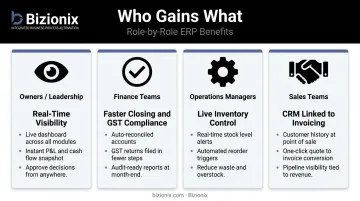
| Role | Primary Gain |
|---|---|
| Owners / Leadership | Real-time business visibility, no month-end surprises |
| Finance Teams | Faster closing, automated GST compliance, audit-ready data |
| Operations Managers | Streamlined workflows, live inventory control |
| Sales Teams | Integrated order management, CRM linked to invoicing |
Clearing Up the Cost Misconception
Enterprise Business Suites are not exclusively for large corporations. Bizionix, for example, offers a subscription-based model starting at ₹999 per year — a fraction of what legacy systems require in licensing, implementation, and IT infrastructure.
Modern cloud ERP platforms are built to fit businesses with 20 to 500 employees — configurable enough to match your workflows, without the cost or complexity that once made these tools impractical for smaller organizations.
How to Choose the Right Enterprise Business Suite
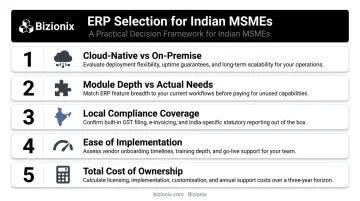
Key Evaluation Criteria
- Cloud-native vs. on-premise — Cloud-native systems eliminate server maintenance, reduce IT dependency, and allow 24/7 access from anywhere
- Module depth vs. your actual needs : A long feature list isn't a sign of fit. Evaluate whether the modules actually cover your finance, inventory, HR, and compliance workflows
- Local compliance coverage — For Indian businesses, GST filing, e-invoicing with direct IRN generation, and statutory payroll compliance are non-negotiable; verify these work natively
- Ease of implementation — Gartner recommends defining use cases and building an evaluation team before selecting; IDC warns that heavy customisation adds complexity and bugs
- Total cost of ownership — Factor subscription, implementation, training, and data migration into the comparison, not just the monthly fee
Common Selection Mistakes
- Choosing SAP-level complexity for a 50-person team — the system sits underused because the team can't operate it without IT support
- Selecting on price alone, without evaluating whether the platform handles India-specific compliance requirements
- Buying a generic global product and then discovering it requires workarounds for GST, e-invoicing, or Indian payroll formats
These mistakes are more costly than they appear. FSN's research found that more than 60% of automation projects failed or only partially met expectations — usually because process redesign and adoption planning were skipped before go-live.
Purpose-Built for Indian MSMEs
Indian MSMEs need a platform built around their actual compliance and operational context — not a global product retrofitted with workarounds. Bizionix, developed by IIS-LLP, covers GST-ready accounting, direct IRP API integration for instant IRN generation, multi-company management with a single login, and real-time dashboards across departments. It's built to scale with growing businesses without the overhead of legacy ERP systems.
Frequently Asked Questions
What is an enterprise business suite?
An enterprise business suite is an integrated software platform that combines multiple business management functions — finance, HR, procurement, inventory, and CRM — into one unified system. It enables seamless data flow between departments, eliminating the need for separate disconnected tools and manual data transfers.
What is Oracle E-Business Suite (EBS) used for?
Oracle EBS is one of the earliest and most established enterprise application suites, used by large organisations to manage ERP, CRM, and supply chain processes. It represents one specific implementation of the broader enterprise business suite concept, typically suited for large enterprises with substantial IT resources and budgets.
Is an enterprise business suite the same as an ERP?
ERP is the core component of most enterprise business suites, but a full suite typically extends beyond ERP to include CRM, business intelligence, compliance modules, and industry-specific tools. ERP handles transactional operations; the surrounding suite adds analytics, compliance, and customer-facing functions on top.
What modules are typically included in an enterprise business suite?
The most common modules are financial management, human resources, procurement, inventory management, sales and CRM, and reporting and analytics. Industry-specific platforms may also include manufacturing, production planning, warehouse management, or project management modules based on the industry.
How do I know if my business needs an enterprise business suite?
Your business likely needs one if you recognise several of these signs:
- Heavy reliance on spreadsheets for critical financial or operational data
- Significant manual effort in GST filing or compliance reporting
- No real-time visibility into finances or inventory across locations
- Frequent miscommunication caused by data silos between departments
- Headcount growing just to keep up with administrative work
Can small and mid-sized businesses afford an enterprise business suite?
Yes. Modern cloud-based suites use subscription pricing that eliminates large upfront investments, and purpose-built platforms for Indian MSMEs — like Bizionix — offer enterprise-grade capabilities at a fraction of the cost of legacy systems like SAP or Oracle, making them viable and ROI-positive for businesses well below the enterprise scale.